


Ergonomic design changes how you play golf because it directly reduces forearm muscle activity, delays physical fatigue, and shortens the seconds you spend fumbling for gear between shots. Ergonomics for recreational golfers comes down to comfort, consistency, and on-course efficiency, backed by research on grip mechanics and load carriage. The clearest evidence points in the same direction:
- Ergonomic grips lowered mean forearm muscle activity in key muscles during swing testing, with the largest gains among amateurs.
- Carrying a loaded bag over distance measurably degrades static balance, which explains why swings fall apart on the back nine.
- Faster, better-organized gear access cuts club-selection time and keeps pace of play from stalling your group.
If you make one change this season, start with your grip or your towel system. Those two touchpoints affect nearly every shot you hit.
Key Takeaways
Ergonomic golf accessories reduce forearm muscle activity, delay fatigue-driven balance loss, and cut the retrieval time that slows pace of play across 18 holes.
| Point | Details |
|---|---|
| Grip changes reduce muscle load | Ergonomic grips lowered ECRB, FCU, and PT activity most in amateurs and lower-volume players. |
| Fatigue erodes balance late in rounds | Static balance dropped after six miles of carrying, regardless of carry style used. |
| Grip size trades speed for control | Undersize grips increased clubhead speed but showed no muscle-activity advantage over standard sizes. |
| Organization saves real time | Consistent pocket layouts cut club-selection time from 15 to 20 seconds down to under five. |
| Aimingfluidgolf targets access and weight | Magnetic towel systems and lightweight divot tools reduce retrieval time and added bag load. |
Table of Contents
- Comfort, Fatigue and Balance Over 18 Holes: Why Ergonomics Matter
- Grip Design and Swing Consistency: What EMG Research Shows
- Ergonomic Organization That Speeds Play: Access and Simple Mechanics
- Injury Prevention: How Ergonomic Grips and Tools Reduce Overuse Risk
- How to Choose Ergonomic Golf Accessories: A Compact Buyer Checklist
- Quick Way to Test Ergonomic Claims: What to Do on the Range and the First Three Holes
- Common Trade-Offs and Myths (Short, Evidence-Based)
- Why Aiming Fluid Golf’s Ergonomic Approach Helps
- A Designer’s Take on the Most Overlooked Fix
- Try Ergonomic Accessories Risk-Free Before Your Next Round
- Frequently Asked Questions
- Sources
Comfort, Fatigue and Balance Over 18 Holes: Why Ergonomics Matter
A round of golf is a five-hour test of postural endurance, not just swing mechanics. Research on load carriage found that static balance declines after extended walking and carrying, regardless of whether a golfer used a single strap, double strap, or push cart, according to a study on golf bag load carriage. Fatigue accumulates quietly, and it shows up as a tighter grip, a slouched setup, and less precise clubhead control right when you need it most, on holes 15 through 18.
Statistic Callout: Balance measures dropped across multiple metrics after extended walking and carrying, independent of carry style.
Weight distribution matters as much as total weight. A bag loaded unevenly, or accessories buried at the bottom of a pocket, forces small compensating movements all day that add up to real fatigue.
Pro Tip: Before your next round, empty your bag and repack it with your five most-used items in top-mounted or side pockets. You’ll notice less bending and twisting by the 12th hole.
Grip Design and Swing Consistency: What EMG Research Shows
Electromyography, or EMG, measures electrical activity in muscles during movement, and it’s the most direct way to see what a grip actually does to your forearms mid-swing. A prospective case series found that an ergonomic golf grip reduced forearm muscle activity in the extensor carpi radialis brevis (ECRB), flexor carpi ulnaris (FCU), and pronator teres (PT) across multiple swing phases, according to research published in BMC Musculoskeletal Disorders. Reductions were most pronounced in amateurs, golfers playing 20 hours a week or less, and players without preexisting elbow pain.
Statistic Callout: The ergonomic grip reduced activity in a notable proportion of lead-arm and trail-arm measurements across swing phases tested.
Grip size tells a different, more nuanced story. Laboratory testing of undersize, standard, and jumbo grips found no significant difference in forearm muscle activity between sizes, but the undersize grip produced a notably higher clubhead speed, according to a laboratory study on hand grip sizes:
- Undersize grips produced a greater average clubhead speed compared to standard grips.
- Faster clubhead speed didn’t come with lower muscle load, meaning smaller isn’t automatically better for your arms.
- Fit to your hand size matters more than chasing extra distance from an undersize grip.
What this means practically: don’t assume a smaller grip protects your elbow just because it feels more responsive. Check your grip training and hand positioning against actual fit, not just feel.
Ergonomic Organization That Speeds Play: Access and Simple Mechanics
Well-organized bags let golfers find clubs and accessories faster, and that speed compounds over 18 holes. One bag-organization guide found that consistent pocket layouts can cut club-selection time from 15 to 20 seconds down to under five, according to guidance on organizing golf bags. Multiply that savings across 60 to 70 shots and you’ve reclaimed real minutes, and real patience, by the turn.
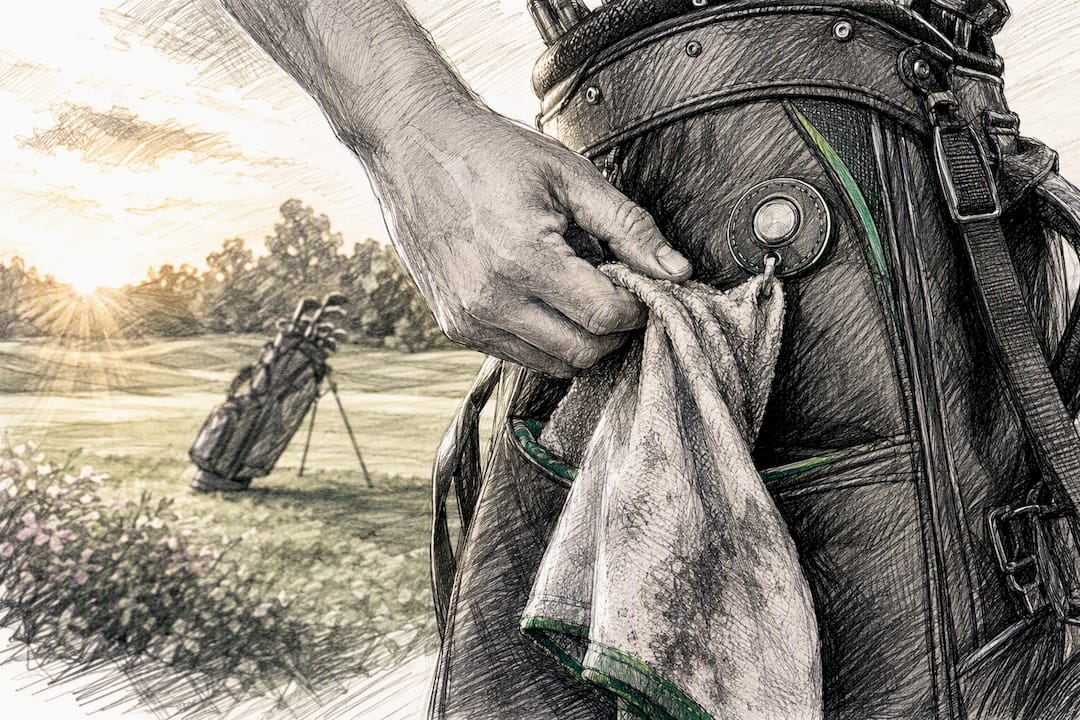
Design features that actually move the needle include top-mounted pockets for frequently used items, magnetic towel systems that eliminate searching through zippers, and external quick-access pockets for tees and markers. A towel and landing pad system that mounts where your hand naturally falls removes a small but repeated frustration from every shot.
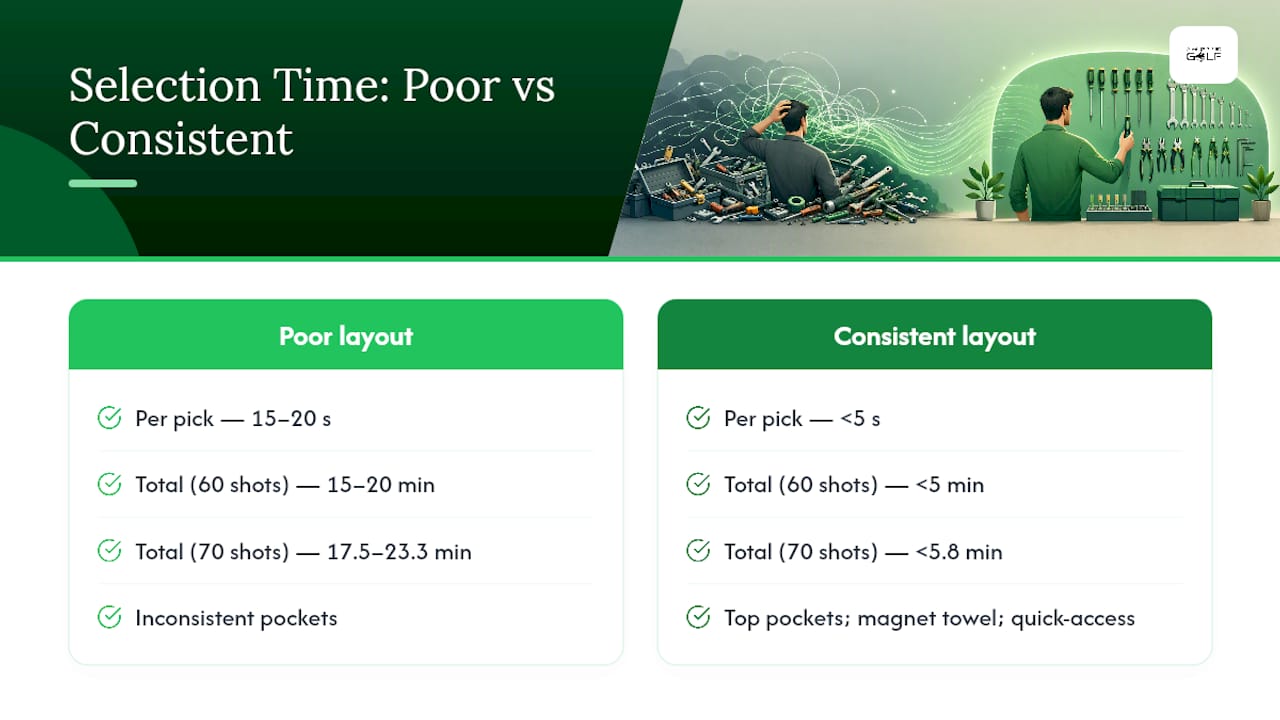
Pro Tip: Assign a permanent pocket to your top five carried items and never deviate. Muscle memory for where things live saves more time than any single gadget.
Injury Prevention: How Ergonomic Grips and Tools Reduce Overuse Risk
Medial and lateral epicondylitis, commonly known as golfer’s elbow and tennis elbow, both stem from repetitive strain on forearm tendons attached near the elbow. The muscles most implicated, ECRB on the lateral side and FCU on the medial side, are the same ones shown to carry less load with an ergonomic grip in the case series cited earlier. Lower activity in those muscles during repeated swings suggests a meaningful role in reducing overuse risk over a season of play.
Statistic Callout: Reductions in muscle activity were most consistent among amateurs and golfers playing 20 hours per week or less, the exact profile of most recreational players.
A separate clinical study of a curved handle design found decreased ulnar deviation, the side-to-side bending of the wrist, along with subjective comfort gains and less shock transmission for users with existing upper-extremity issues, per research on ergonomic handle design. That said, an ergonomic grip works best as prevention, not treatment. If you already have elbow pain, pair any grip change with rest and a physical therapy conversation rather than expecting the grip alone to fix it.
- Amateurs and lower-volume players see the largest muscle-activity reductions from ergonomic grips.
- Preexisting elbow pain reduces how much benefit a grip swap alone will deliver.
- Combine grip changes with proper club and grip maintenance so surface wear doesn’t quietly undo the ergonomic benefit.
How to Choose Ergonomic Golf Accessories: A Compact Buyer Checklist
Evaluating ergonomic claims in a pro shop or online listing gets easier with a short, repeatable framework. Work through these in order:
- Fit and sizing. Check grip circumference against your hand size rather than assuming standard fits everyone.
- Weight and balance. Compare an accessory’s added weight against your total bag load, especially if you walk.
- Material and tack. Look at grip surface texture and glove compatibility, since a slick grip forces extra squeeze pressure.
- Accessibility. Test magnet strength on towels, pocket placement for one-hand access, and whether items sit where your hand naturally reaches.
- Durability. Inspect stitching and materials, particularly on leather pouches and divot tools that see daily wear.
Beyond the checklist, prioritize by playing style. Walking golfers should weigh carry-system comfort heavily, since double-strap carriage reduces metabolic cost compared to single-strap bags. Cart golfers can prioritize grip and towel access instead, since carry weight matters less.
- Walkers: prioritize carry system and total weight first.
- Cart riders: prioritize grip fit and towel or pouch access first.
- Everyone: check what belongs in your bag before adding more accessories on top of an already heavy setup.
Quick Way to Test Ergonomic Claims: What to Do on the Range and the First Three Holes
Don’t take a grip or towel system’s marketing at face value. Run this two-part test before you commit:
- Range test. Hit 10 warm-up swings with your current setup, then five measured swings noting grip tension and ball-flight consistency. Switch to the ergonomic change and repeat five swings, comparing tension and dispersion.
- On-course micro-test. Use the new accessory for your first three holes only. Track perceived comfort, how quickly you access it, and whether your swing routine changes.
- Record specifics. Note grip pressure, wrist or elbow comfort, club retrieval time, and any shift in ball speed or feel.
Pro Tip: Keep notes on your phone between holes. Memory fades fast, and “it felt better” isn’t as useful as “less grip tension on approach shots.”
Common Trade-Offs and Myths (Short, Evidence-Based)
Not every ergonomic claim holds up under testing, and some trade-offs are unavoidable.
- Myth: Bigger grips always reduce injury risk. Lab testing found no significant difference in forearm muscle activity across undersize, standard, and jumbo grips, so size alone isn’t the deciding factor.
- Trade-off: Heavier, more durable accessories add fatigue over a walked round. If you walk regularly, lightweight construction usually wins over maximum durability.
- Myth: More pockets always slow you down. Poorly planned pockets do. Consistent assignment and magnetic quick-attach systems typically speed up play instead.
Why Aiming Fluid Golf’s Ergonomic Approach Helps
Aimingfluidgolf built its product line around the same principles the research above supports: faster access, lower handling time, and durable materials that don’t add unnecessary weight. The magnetic towel and landing pad system eliminates the search-and-fumble moment that costs seconds on every shot, while precision tees and foldable divot tools keep small, frequently used items exactly where your hand expects them.
- Magnetic towel systems reduce retrieval time compared to zippered pockets or hooks.
- Premium leather utility pouches keep valuables accessible without digging through a main compartment.
- Lightweight divot tools and precision tees minimize added bag weight for walking golfers.
The design goal throughout is simple: less searching, less strain, more consistent shots late in the round.
A Designer’s Take on the Most Overlooked Fix
The single most overlooked ergonomic fix isn’t the grip; it is pocket assignment. Golfers spend years chasing swing tips while ignoring that they lose focus every time they dig through a bag mid-round. One player reported regaining late-round consistency simply by moving to a magnetic towel setup and swapping to a properly fitted grip, removing two small frictions that had been quietly draining attention for years.
Try Ergonomic Accessories Risk-Free Before Your Next Round
You don’t need to overhaul your entire bag to feel the difference ergonomics make. Aimingfluidgolf designs its magnetic towels and organizational accessories specifically to cut the retrieval time and cognitive clutter this article covers, without asking you to change your swing or your budget philosophy overnight.

Start with one high-impact swap. Browse the best golf accessories guide to compare magnetic towel systems, precision tees, and utility pouches side by side, then test your pick using the range and three-hole protocol above before deciding it’s a permanent part of your bag. If you want a broader swing tune-up alongside your gear upgrade, these swing fundamentals pair well with any ergonomic change you make.
Frequently Asked Questions
Why does tool ergonomics affect play so directly? Ergonomic design changes how much muscle effort a swing requires and how quickly you access gear, both of which shape consistency and pace across a full round.
Does a bigger grip always prevent golfer’s elbow? Not necessarily. Lab testing found no significant difference in forearm muscle activity across undersize, standard, and jumbo grips, so fit and swing mechanics matter more than size alone.
How much time can better bag organization actually save? Guides on bag organization report club-selection time dropping from 15 to 20 seconds down to under five with consistent pocket layouts, adding up to real minutes over 18 holes.
Should I prioritize grip changes or carry-system changes first? If you walk regularly, prioritize your carry system and total weight first. If you ride a cart, prioritize grip fit and quick-access towel or pouch systems instead.
Can ergonomic accessories prevent elbow injuries by themselves? Ergonomic grips show a preventive association with lower muscle activity, particularly in amateurs, but they work best alongside proper rest and training rather than as a standalone fix for existing pain.
Sources
- An ergonomic golf grip leads to lower forearm muscle activity - A prospective case series
- The Effect of Golf Bag Load Carriage on Human Postural Control
- Do hand grip sizes influence forearm muscle activity and golf performance? (laboratory-based study summary)
Recommended
- Ergonomic golf accessories: 5 key performance upgrades – Aiming Fluid Golf
- Golf gear ergonomics: boost performance with smarter design – Aiming Fluid Golf
- Why high-quality golf tools make a real difference – Aiming Fluid Golf
- Why robust golf tools matter: improve your game’s efficiency – Aiming Fluid Golf


