


TL;DR:
- Tee height is the most controllable setup variable that influences launch, spin, and accuracy off the tee. Setting the ball at 50% above the crown aligns the center of the ball with the clubface, maximizing distance and consistency. Proper tee height, tailored to club and conditions, can significantly improve your driving performance without altering your swing.
Tee height is defined as the vertical distance between the ground and the bottom of the golf ball at address, and it directly controls where the clubface strikes the ball on every drive. This single setup variable governs launch angle, spin rate, and impact location before your swing even begins. Understanding why tee height affects shots means recognizing that poor tee height creates bad impact conditions that most golfers misread as swing flaws. You can gain distance and improve accuracy without changing your mechanics. The fix starts at ground level.
Why tee height affects shots at the point of impact
Tee height determines the vertical strike point on the clubface, and that single factor changes everything about how the ball launches. Modern drivers have a face height of roughly 2 to 2.5 inches. A golf ball measures 1.68 inches in diameter. When you tee the ball at 50% above the crown, the center of the ball aligns with the center of the clubface, producing maximum ball speed and minimum spin.
Deviate from that center contact and the physics work against you. A tee set too low places the ball near the top edge of the face, producing a steep downward attack angle, higher spin, and reduced carry distance. A tee set too high risks contact near the crown, generating weak, inconsistent shots with unpredictable ball flight. 68% of golfers use incorrect tee height, losing up to 20 yards per drive as a result. That is not a swing problem. That is a setup problem with a straightforward solution.
Attack angle compounds the effect. A higher tee encourages a shallower, upward attack angle because your body subconsciously adjusts posture and swing plane to match the ball position. A lower tee promotes a steeper, more downward strike. Golfers with naturally steep swings often compound their spin problem by teeing the ball too low, while those with shallow swings may tee too high and produce pop-ups.
Key impact outcomes by tee position:
- Too low (25% above crown): Launch angle of 8.2°, spin rate of 3,800 RPM, reduced carry distance
- Optimal (50% above crown): Launch angle of 12.3°, spin rate of 2,600 RPM, maximum ball speed
- Too high (75% above crown): Launch angle of 17°, spin rate of 1,900 RPM, increased dispersion and pop-up risk
Pro Tip: Before your next range session, bring three tees set at different heights and hit five balls with each. You will feel the difference in contact quality immediately, without changing a single thing about your swing.
What the data shows about tee height and shot performance
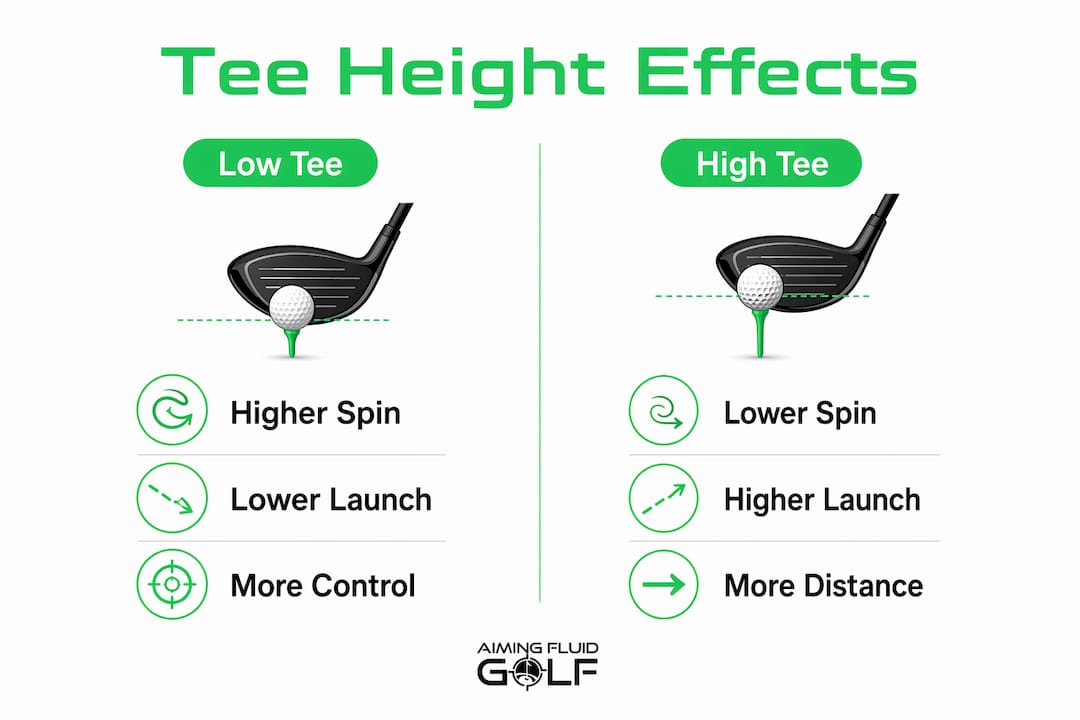
A 2006 study found that golfers gained 12 yards on average with a medium to high tee height compared to a low tee, driven by better ball speed and reduced spin from center-face contact. That 12-yard gain represents roughly a full club of distance recovered simply by adjusting setup. For amateur golfers averaging 230 yards off the tee, that is a 5% distance increase with zero swing change.
The table below summarizes the measured performance differences across three tee height settings:
| Tee height | Ball visibility above crown | Launch angle | Spin rate | Primary outcome |
|---|---|---|---|---|
| Low | 25% | 8.2° | 3,800 RPM | Higher spin, tighter dispersion, less distance |
| Optimal | 50% | 12.3° | 2,600 RPM | Maximum ball speed, best distance and control |
| High | 75% | 17° | 1,900 RPM | Higher launch, lower spin, wider dispersion |
The tradeoff between spin and launch angle is the core tension in tee height strategy. Lower spin with higher launch is the high-launch, low-spin trajectory that expert golfers pursue as the ideal driving condition. Tee height is the primary lever for reaching that trajectory, not swing speed or shaft flex. A golfer hitting 95 mph with optimal tee height will consistently outperform the same golfer at 95 mph with a low tee.
Shot dispersion data reinforces the tradeoff. High tee settings increase the risk of pop-ups and off-center contact, widening the shot pattern. Low tee settings tighten dispersion but sacrifice carry distance. The optimal 50% setting balances both, which is why it produces the best overall driving statistics across skill levels.
How tee height shapes draws, fades, and shot accuracy
Tee height does not only affect distance. It directly influences side spin and shot shape, which means it is a legitimate shot-shaping tool that most amateur golfers overlook. When the ball is teed higher, the upward attack angle reduces gear-effect side spin on centered strikes. When the ball is teed lower and contact moves toward the heel or toe due to the altered swing plane, gear effect amplifies side spin and produces draws or fades.
Extreme tee heights outside the optimal range create gear-effect spin that leads to slices or hooks and reduces ball speed from off-center impacts. This explains why many golfers who slice the ball find that lowering their tee height slightly reduces the severity of the curve. The lower tee promotes a steeper path that can neutralize an open face at impact.
Practical shot-shaping applications by tee height:
- Tight fairway with out-of-bounds left: Lower the tee slightly to promote a fade-friendly, controlled launch that keeps the ball right of trouble.
- Hole playing into a headwind: Lower the tee to produce a lower, more penetrating ball flight with higher spin that holds its line.
- Wide open hole needing maximum carry: Raise the tee to 50 to 75% above the crown to launch higher with lower spin for peak carry distance.
- Downwind hole with a wide landing zone: A high tee setting with its lower spin rate lets the ball ride the wind for extra rollout.
Teeing the ball two-thirds above the crown launches higher with lower spin for carry distance, while one-third above the crown launches lower with higher spin for accuracy. Golf Digest confirms this as an effective strategy that requires no swing adjustment. Knowing which setting to use on a given hole is a tactical skill that separates consistent drivers from erratic ones.
How to find and maintain your optimal tee height
Consistency in tee height setup is as important as the height itself. A golfer who sets the tee at a different height on every hole introduces a variable that undermines repeatable impact positions. The tee setup guide from Aimingfluidgolf outlines a repeatable process for building this habit into your pre-shot routine.
Follow these steps to establish and maintain your optimal driver tee height:
- Set the baseline. Place the tee so that 50% of the ball sits above the driver crown when the club rests flat on the ground. This is the standard starting point for most golfers.
- Check your contact pattern. Use foot powder spray or impact tape on the clubface for five drives. Strikes near the top of the face indicate the tee is too low. Strikes near the sole indicate the tee is too high.
- Adjust in small increments. Move the tee up or down by a quarter inch at a time. Large adjustments make it harder to isolate the effect on ball flight.
- Test in different conditions. Hit drives into a headwind and downwind at your adjusted height. Wind exposes spin problems that calm conditions can mask.
- Lock in the height with a reference point. Mark your preferred tee depth on the tee itself with a permanent marker, or use a tee with a built-in depth stop for consistent placement every time.
Pro Tip: A simple three-level gauge, one setting for driver, one for fairway woods, and one for irons, simplifies tee height setup and removes guesswork during a round. Some golfers use colored tape on their tees to mark the correct insertion depth for each club category.
The most common mistake is teeing the ball at whatever height feels comfortable rather than what the physics demand. Comfort is not a reliable guide here. Many golfers have grooved a low-tee habit over years of play and genuinely feel that higher tees are wrong, even when the data shows they are losing significant distance.
How tee height varies by club type
The 50% rule applies specifically to the driver. Every other club in the bag follows different guidelines, and tee height per club type should be treated as a separate decision.
| Club type | Recommended tee height | Reason |
|---|---|---|
| Driver | 50% ball above crown | Maximizes upward attack angle and center-face contact |
| Fairway wood | Just above top edge of club | Promotes shallow sweep without catching the ground |
| Hybrid | Just above top edge of club | Allows slight downward strike for clean contact |
| Long iron | Almost flush with ground | Supports downward attack angle for compression |
| Short iron | Flush with ground or no tee | Irons are designed for ground-level contact |
Wind and course layout add another layer to tee height decisions. On links-style courses where low, running shots are preferred, even driver tee height should drop toward the one-third setting to keep the ball below the wind. On parkland courses with soft fairways and elevated greens, the higher tee setting maximizes carry over obstacles. Swing type matters too. Golfers with a positive angle of attack, meaning they hit up on the ball, benefit most from the 50 to 75% range. Those with a negative angle of attack should stay closer to the 50% mark to avoid excessive spin from high tee contact.
Key takeaways
Tee height is the single most controllable setup variable for improving driver distance and accuracy, and the optimal position is 50% of the ball above the driver crown.
| Point | Details |
|---|---|
| Optimal tee height defined | Set 50% of the ball above the driver crown to align center-face contact and maximize ball speed. |
| Distance impact is measurable | Golfers gain an average of 12 yards switching from low to medium or high tee height. |
| Spin and launch are linked | Lower tees increase spin and tighten dispersion; higher tees reduce spin and increase carry distance. |
| Tee height shapes shots | Adjusting tee height up or down changes attack angle and gear-effect spin, influencing draws and fades. |
| Club-specific rules apply | Fairway woods and hybrids tee just above the club edge; irons tee flush or at ground level. |
What I’ve learned from watching golfers ignore this for years
Most golfers I observe on the range spend 20 minutes working on their swing and zero seconds thinking about tee height. That is backwards. Tee height is the one variable you control completely before the swing starts, and it sets the physical conditions for everything that follows. A bad tee height does not give your swing a chance to succeed.
The misconception I see most often is that tee height is a personal preference rather than a performance variable. Golfers will tell me they have always teed it low because it feels more controlled. What they are actually doing is adding 1,200 RPM of spin to every drive and leaving 12 yards on the tee box. That is not control. That is a habit masquerading as a strategy.
The golfers who improve fastest are the ones who treat tee height as a diagnostic tool. When a drive goes wrong, they ask whether the tee height contributed before they question their swing. This mindset shift alone changes how you practice and how you play. I recommend dedicating one full range session per month specifically to tee height testing. Hit 10 balls at each of three heights, track the results, and let the data tell you where your optimal setting is. The tee height and dispersion research backs this up consistently. Your swing is probably better than you think. Your tee height setup may be the thing holding it back.
— Gary
Gear that supports consistent tee height every round
Getting your tee height right on the range is one thing. Replicating it on the course under pressure is another. The tee itself matters more than most golfers realize. Inconsistent tee materials, broken tips, or variable lengths all introduce the same setup errors you worked to eliminate.

Aimingfluidgolf designs precision golf tees built for consistent depth and repeatable setup on every hole. Each tee is engineered to the same dimensional standard so your 50% height setting holds from the first tee to the 18th. If you want to build the habits this article describes, start with equipment that does not fight you. Browse the full range of golf accessories at Aimingfluidgolf to find tees, divot tools, and setup aids that keep your game organized and your focus on the shot.
FAQ
Why does tee height affect driving distance?
Tee height controls the vertical impact point on the clubface, which determines launch angle and spin rate. The optimal 50% setting produces a 12.3° launch with 2,600 RPM spin, generating maximum ball speed and carry distance.
What is the correct tee height for a driver?
Set the tee so that 50% of the ball sits above the driver crown at address. This aligns the ball center with the clubface center for the most efficient energy transfer and lowest spin rate.
Does tee height affect shot accuracy?
Yes. A lower tee setting increases spin rate and tightens shot dispersion, improving accuracy at the cost of distance. A higher tee reduces spin and increases carry but widens the shot pattern.
Should tee height change for fairway woods and irons?
Fairway woods and hybrids should be teed just above the top edge of the club. Irons should be teed almost flush with the ground or placed directly on the turf, as they are designed for a downward strike.
Can changing tee height fix a slice?
Lowering the tee slightly can reduce the severity of a slice by promoting a steeper attack angle that limits gear-effect side spin. It does not fix swing path issues but can reduce the impact of an open clubface at contact.
Recommended
- Step-by-step golf tee setup guide for consistency – Aiming Fluid Golf
- Master golf tee placement workflow for consistent drives – Aiming Fluid Golf
- Golf tee selection tips to improve your game performance – Aiming Fluid Golf
- Why Golf Tees Affect Consistency, Launch & Dispersion | Aiming Fluid G – Aiming Fluid Golf


