


TL;DR:
- Tee performance, primarily influenced by consistent tee height, significantly affects driver launch, spin, and distance. Adjusting tee height and design can yield measurable improvements of 2 to 4 yards per shot, emphasizing the importance of testable setup variables. Focusing on repeatable tee height and proper technique offers a simple, cost-effective way to optimize your drives and enhance overall performance.
Tee performance is the measurable impact that tee height and tee design have on your driver’s launch angle, spin rate, and driving distance. Most golfers treat the tee as an afterthought, yet it is the only piece of equipment you fully control before every drive. Research shows that optimizing tee setup can produce 2 to 4 yards of additional driving distance per round, and the gains compound over 18 holes. Understanding tee performance means treating your tee height and tee type as testable variables, not personal habits.
What is tee performance and why it matters for your drives
Tee performance refers to how the combination of tee height, tee design, and tee material influences the contact point on your driver face, the resulting launch conditions, and the final ball flight. The industry does not use a single standardized term for this concept. Golf instructors and equipment researchers discuss it under labels like “tee height optimization,” “launch condition management,” and “tee friction analysis.” Understanding tee performance means recognizing that every tee decision shapes where the ball contacts the clubface, and that contact location determines everything else.
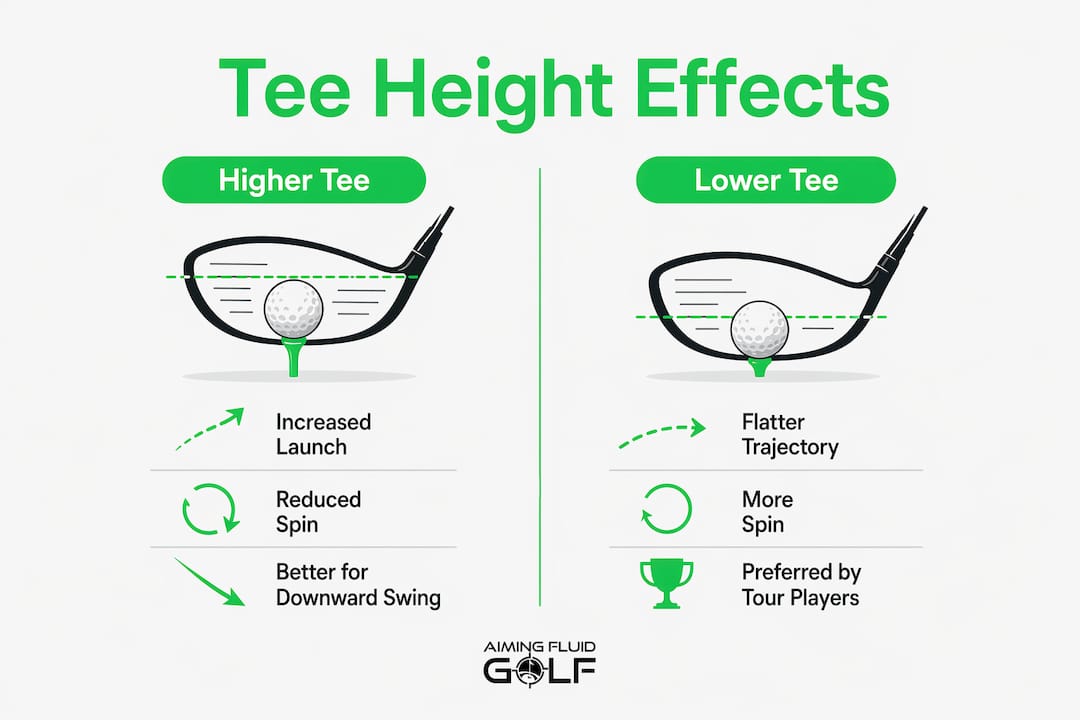
The physics are direct. When the ball sits higher on the tee, you are more likely to strike the upper portion of the driver face. That contact point promotes higher launch and lower spin, which is the combination most golfers need to maximize carry distance. When the ball sits too low, contact shifts toward the lower face, producing lower launch and excess spin that causes the ball to balloon and lose distance. Neither extreme is optimal, and the difference between them can be a matter of half an inch.
Named entities that define this space include GOLF.com researcher Alan Parente, instruction platform GolfTEC, and equipment analysis site ExactGolf.com. Each has published data confirming that tee height is a measurable performance variable, not a stylistic preference. Aimingfluidgolf designs its precision tee lineup around this principle, building consistent insertion depth into every product so that your tee height is repeatable from the first hole to the last.
How tee height affects driver launch and spin
The standard benchmark for driver tee height is positioning roughly half the golf ball above the top edge of the clubface. This setup encourages center-to-upper-face contact, which produces the high launch and low spin combination that generates maximum carry distance for most swing types.
Deviating from this benchmark produces predictable consequences:
- Too high: The ball sits above the sweet spot, promoting sky shots or thin contact off the crown. Launch angle spikes, but the strike loses compression and distance suffers.
- Too low: Contact shifts to the lower face or even the sole, generating low launch with high spin. The result is a ballooning flight that loses carry and rolls out poorly.
- Correct height: Center-to-upper-face contact delivers the optimal launch-to-spin ratio for your swing speed, maximizing both carry and total distance.
Attack angle also changes the equation. Golfers who hit down on the ball at impact need a higher tee to reduce spin and promote a longer flight. Golfers with a natural upward attack angle are less sensitive to tee height variation because their swing geometry already encourages low spin. Knowing your attack angle, even as a rough estimate, tells you which direction to adjust.
Tour players use tee height as a deliberate shot-shaping tool. A lower tee produces a flatter, more penetrating ball flight that holds its line in crosswinds. A higher tee promotes a higher, softer carry that stops quickly on firm fairways. Tour players adjust tee height strategically based on wind and course conditions, and there is no reason amateur golfers cannot apply the same logic.
Pro Tip: Mark your tee with a permanent marker at your target insertion depth. Push it into the ground until the mark disappears, and your height is consistent on every hole without guessing.
How tee design and material affect friction and distance
Tee design is the second major tee performance factor, and it operates through a mechanism most golfers overlook: friction. When the ball rests in a traditional shallow cup tee, the contact surface between ball and tee is relatively large. That contact creates friction at impact, which adds spin to the ball and reduces distance.
Pronged or prong-style tees reduce that contact area to three or four small points. Less contact means less friction, which means lower spin at impact and more distance. Research by Alan Parente cited by GOLF.com confirms that golfers can gain 2 to 4 yards in driving distance by switching from a high-friction shallow cup tee to a low-friction pronged design, depending on their angle of attack.
Here is a direct comparison of the most common tee types:
| Tee type | Contact surface | Friction level | Best for |
|---|---|---|---|
| Shallow cup (plastic) | High | High | Beginners, irons |
| Pronged (plastic) | Low | Low | Drivers, distance focus |
| Standard wooden | Medium | Medium | All-around use |
| Biodegradable/bamboo | Medium | Medium | Eco-conscious golfers |
Material choice matters less than tee height consistency, but it is not irrelevant. Wooden tees are the traditional standard and perform well, but they break frequently and make repeatable insertion depth harder to achieve. Plastic tees with marked depth indicators solve the repeatability problem. Biodegradable options made from bamboo or compressed paper offer a lower environmental footprint without a significant performance penalty, though they tend to be less durable than plastic.
The practical takeaway is to match your tee type to your primary goal. If distance is the priority, a pronged tee design reduces friction and spin. If consistency is the priority, any tee with a depth marker or consistent cup depth gives you repeatable height. The two goals are not mutually exclusive, and the best tees address both.
How to test and optimize your tee performance on the course
Improving tee performance does not require a launch monitor or a fitting session. A structured on-course mini-test, as recommended by GolfTEC, produces reliable data from your actual swing in real conditions. The process is methodical and takes fewer than three rounds to yield clear patterns.
Follow these steps to run your own tee performance analysis:
- Establish a baseline. For five consecutive drives, use your current tee height and tee type. Note the ball flight pattern: high, low, left, right, or consistent. This is your control condition.
- Change one variable at a time. Adjust tee height by a quarter inch up or down for the next five drives. Keep everything else identical, including your pre-shot routine and club selection.
- Record the outcome. You do not need precise measurements. Note whether the ball flight improved, worsened, or stayed the same. Pay attention to strike location on the face if you use foot powder spray or impact tape.
- Test tee type separately. Once you have identified your optimal height, switch tee designs while holding height constant. Compare the distance and dispersion patterns over another five drives.
- Lock in your setup. Once you find the combination that produces the most consistent, longest drives, standardize it. Use a consistent tee placement workflow on every hole.
Repeatable insertion depth is the single most important mechanical detail in this process. If your tee height varies by half an inch from shot to shot, you cannot isolate what is working. Visual markers, consistent tee cup depth, or a tee with a built-in depth stop all solve this problem.
Pro Tip: Wind conditions change the optimal tee height mid-round. In a strong headwind, drop your tee a quarter inch to produce a lower, more penetrating flight. Into a tailwind, raise it slightly to maximize carry. Treat tee height as a live adjustment, not a fixed setting.
Common misconceptions and mistakes in tee performance
Most amateur golfers make the same errors with tee setup, and those errors cost distance and consistency in predictable ways.
- Random height adjustment: Many golfers push the tee in until it “feels right” without any consistent reference point. This produces variable contact location from drive to drive, making it impossible to diagnose swing problems or replicate good shots.
- Believing tee material is the main variable: Material affects friction and spin at the margins. Consistent strike location on the driver face is far more important than whether you use wood, plastic, or bamboo. Golfers who obsess over tee brand while ignoring height consistency are solving the wrong problem.
- Teeing extremely high to maximize distance: The logic seems sound, but contact above the sweet spot loses compression and produces weak, high-spinning drives. The goal is upper-face contact, not crown contact.
- Using the same tee height for every shot shape: A draw requires a slightly different attack path than a fade, and tee height can support or undermine that path. Treating tee height as a fixed setting removes a useful shot-shaping tool from your kit.
- Ignoring tee height when troubleshooting drives: When drives go wrong, most golfers adjust their grip, stance, or swing path. Tee height is rarely examined, yet it is the fastest and easiest variable to change. A step-by-step tee setup guide should be part of every golfer’s troubleshooting process.
The corrective principle is simple: treat tee height as a skill, not a habit. The principle that tee setup shapes strike location on the driver face means every tee decision is a technical choice with measurable consequences.
Key takeaways
Tee performance is determined primarily by tee height consistency and secondarily by tee design, with height controlling strike location and design controlling friction-driven spin.
| Point | Details |
|---|---|
| Tee height benchmark | Half the ball above the driver face promotes center-to-upper-face contact for optimal launch and spin. |
| Attack angle matters | Golfers who hit down need a higher tee to reduce spin; upward hitters are less sensitive to height variation. |
| Tee design and friction | Pronged tees reduce ball-to-tee contact, lowering spin and adding 2 to 4 yards of driving distance. |
| Test one variable at a time | Change height or tee type separately over five-drive blocks to isolate what actually improves your ball flight. |
| Consistency beats material | Repeatable insertion depth produces more consistent drives than any tee material upgrade alone. |
Why tee performance deserves more of your attention
I have spent years watching golfers spend hundreds of dollars on driver fittings and shaft upgrades while pushing their tee into the ground without a second thought. The tee is the only variable in your entire setup that you control completely, on every single drive, at zero cost to change. That makes it the most underused performance lever in amateur golf.
What changed my perspective was running the mini-test described above during a casual round. I dropped my tee height by a quarter inch for five drives and immediately saw a lower, more penetrating flight that held its line in a crosswind. I had been teeing too high for my swing for years without realizing it. The fix took 30 seconds and cost nothing.
The broader lesson is that small tee height changes are a fast, measurable lever for performance gains that most players ignore by treating height as personal preference rather than a testable parameter. If you are serious about improving your driving consistency, start with the tee. It is the simplest variable you have, and it is almost certainly not optimized.
— Gary
Upgrade your tee box setup with Aimingfluidgolf

The right tee is only as effective as the routine around it. Aimingfluidgolf designs precision golf tees with consistent cup depth and clear depth markers so your tee height is repeatable from the first drive to the last. Pair them with the Aimingfluidgolf magnetic towel system, which keeps your gear accessible at the tee box without digging through your bag, and you have a setup built for focus and consistency. Every product in the Aimingfluidgolf lineup is engineered to remove friction from your routine so you can concentrate on the shot in front of you.
FAQ
What is tee performance in golf?
Tee performance is the measurable effect that tee height and tee design have on driver launch angle, spin rate, and driving distance. It is determined by where the ball contacts the clubface and how much friction the tee generates at impact.
What is the correct tee height for a driver?
The standard benchmark is positioning roughly half the golf ball above the top edge of the driver face. This promotes center-to-upper-face contact, which produces higher launch and lower spin for most swing types.
Do different tee types actually affect distance?
Yes. Research by Alan Parente cited by GOLF.com shows that pronged tees reduce ball-to-tee friction, which lowers spin and can add 2 to 4 yards of driving distance compared to shallow cup tees.
How do I improve my tee performance without a launch monitor?
Run a structured on-course mini-test by adjusting tee height in quarter-inch increments over five-drive blocks and recording ball flight patterns. GolfTEC recommends this incremental feedback approach as a reliable method for identifying your optimal tee setup.
Does tee material matter more than tee height?
No. Consistent strike location on the driver face, controlled by repeatable tee height, produces more improvement than any material upgrade. Tee material affects spin at the margins; tee height controls the fundamental contact point.
Recommended
- Why Golf Tees Affect Consistency, Launch & Dispersion | Aiming Fluid G – Aiming Fluid Golf
- Precision Golf Tee Benefits: Improve Consistency and Play Smarter – Aiming Fluid Golf
- Step-by-step golf tee setup guide for consistency – Aiming Fluid Golf
- Master golf tee placement workflow for consistent drives – Aiming Fluid Golf


