


TL;DR:
- Shot readiness in golf is a structured four-step process involving assessment, visualization, setup, and a trigger to ensure focused, confident execution. Maintaining consistent timing within 28 to 42 seconds and using a physical trigger helps transition the brain from conscious thinking to subconscious trust under pressure. Effective routines are tailored to individual pace, practiced thoroughly, and supported by organized gear to improve on-course consistency.
Shot readiness in golf is defined as the consistent sequence of mental and physical steps a golfer performs before every shot to prepare the mind and body for focused, committed execution. Coaches widely refer to this as the pre-shot routine, and the two terms describe the same structured process. The routine covers four core components: assessment behind the ball, visualization, physical setup over the ball, and a timed execution trigger. Coach Mike Bender popularized the 8-second execution window as the standard for the over-the-ball phase, arguing that anything longer invites overthinking. Understanding what is shot readiness in golf gives you a repeatable framework to perform under pressure, not just on the range.
What is shot readiness in golf and what are its phases?
Shot readiness breaks into four distinct phases. Each phase has a specific job, and skipping one creates a gap that shows up in your ball flight.
Phase 1: Behind-the-ball assessment. Stand behind the ball and read the situation. Assess the lie, wind direction, distance to the target, and any hazards. This is where club selection happens. The assessment phase is deliberate and analytical. It is the only phase where conscious thinking is the goal.
Phase 2: Visualization. Tour-level golfers spend 10–15 seconds visualizing the shot during this phase. You picture the exact trajectory, the apex of the ball flight, and the landing zone. This primes the brain’s motor system to reproduce the movement it just imagined. Skipping visualization is the equivalent of giving your brain a destination without a map.
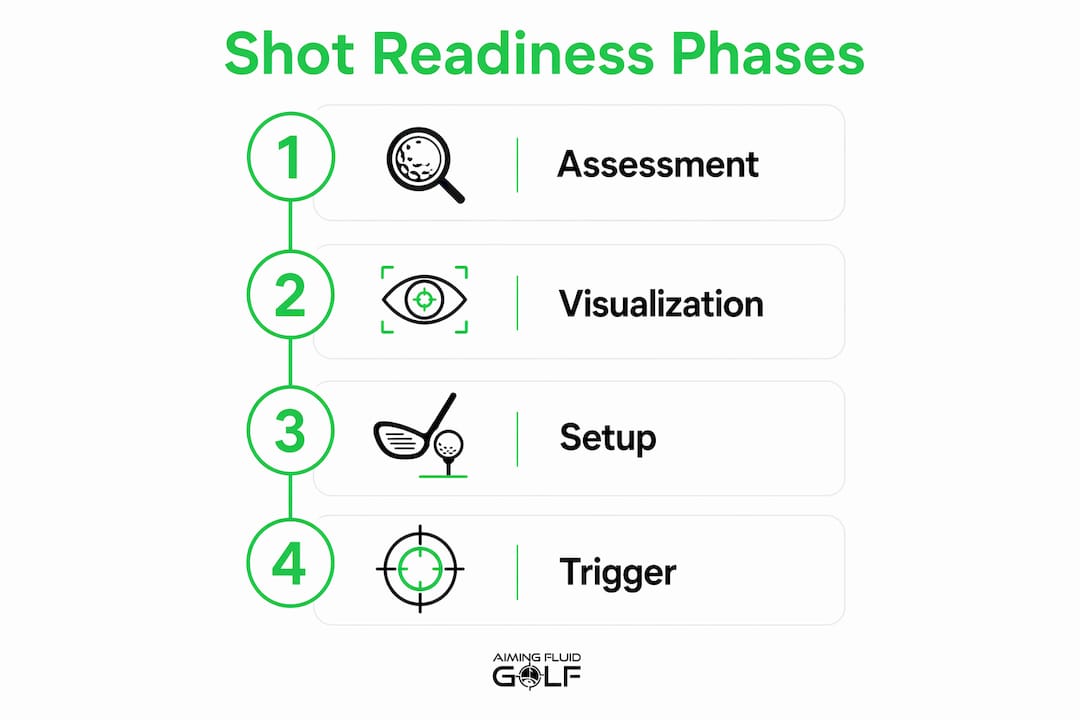
Phase 3: Setup over the ball. Walk into your address position and align your clubface first, then your body. Using an intermediate target 1–3 feet in front of the ball, such as a leaf or a discolored patch of grass, dramatically improves alignment accuracy. Aiming at a point three feet away is far more precise than aiming at a flag 150 yards out.
Phase 4: Execution trigger. A physical trigger, such as a waggle, a forward press, or a specific breath, signals the end of preparation and the start of the swing. The pre-shot routine acts like a performance checklist where thinking ends at the trigger and execution begins with trust in the subconscious.
- Assessment: Read lie, wind, distance, and select club
- Visualization: Picture trajectory and landing zone for 10–15 seconds
- Setup: Align clubface to intermediate target, then set body position
- Trigger: Use a waggle or forward press to initiate the swing
Pro Tip: Pick your intermediate target while still standing behind the ball. Once you walk into your stance, your perspective shifts and you lose the clean line of sight you had from behind.
How do elite golfers maintain shot readiness under pressure?
Pressure does not change the routine. That is the defining characteristic of a tour-level pre-shot routine. The routine stays identical whether the shot is a tap-in putt or a 72nd-hole approach with a one-shot lead.

Research published in the Golf Science Journal describes the STOP S.L.O.W. GO model as a framework for managing the two attentional systems golfers use on the course. The stimulus-driven system reacts to distractions like crowd noise or a bad lie. The goal-directed system focuses on the intended shot. Elite players learn to shift between these systems deliberately, using the routine as the mechanism for that shift. The model gives golfers a structured way to reset attention before every shot.
A four-step pressure protocol used by many competitive players works as follows:
- Decide the shot in one sentence. “I am hitting a draw to the left edge of the green.” No debate, no second-guessing.
- Lock an intermediate target. Pick a specific point 1–3 feet in front of the ball and commit to it.
- Rehearse the specific feel. Take a practice swing that matches the shot you just decided on.
- Exhale and execute within 3–4 seconds of settling into your stance.
Cadence words like “pick, aim, feel, go” keep the rhythm consistent and prevent the routine from stretching under stress. When pressure builds, routines tend to slow down. Cadence words act as a metronome.
“The moment you step into your address position, the decision is made. Your only job is to execute what you already decided.” This is the mental contract that separates consistent players from streaky ones.
Equal preparation for all shots is non-negotiable. Reserving your best routine only for difficult shots trains your nervous system to associate easy shots with careless preparation. That inconsistency shows up on the scorecard.
What are common pitfalls in shot readiness and how to avoid them?
Most golfers understand the concept of a pre-shot routine. Fewer execute it correctly under real conditions. These are the failure modes that appear most often.
- Fixing mechanics mid-routine. Attempting to fix swing mechanics during the routine increases conscious interference and reduces effectiveness. The routine’s purpose is to shift the nervous system from a thinking state to a sensing state. Introducing a swing thought at address reverses that shift entirely.
- Standing over the ball too long. Effective players keep the over-the-ball phase within 3–4 seconds. Beyond that window, muscle tension builds and indecision creep sets in. If you do not feel ready within that window, step away and reset. Resetting is not weakness. It is discipline.
- Skipping breathing and tension release. Controlled breathing is not optional. An exhale before the trigger lowers heart rate, releases grip tension, and signals the nervous system to shift from alert to ready. Golfers who skip this step often grip the club 20–30% tighter than optimal without realizing it.
- Inconsistent timing across shots. A routine that takes 25 seconds on the range and 45 seconds on the course is two different routines. The nervous system responds to consistency. Inconsistent timing means inconsistent preparation.
- Practicing without pressure simulation. Range sessions without consequences do not build the nervous system regulation needed for real rounds. Practicing routines under simulated pressure, such as playing a game where a missed shot costs something, builds what researchers call “autonomic competence.”
Pro Tip: Record your routine on video during a practice round. Most golfers are shocked to see how much their timing and body language change between easy shots and difficult ones. The video does not lie.
How do you build a personalized shot readiness routine?
A reliable golf shot preparation routine is not copied from a tour player. It is built around your tempo, your decision-making speed, and the conditions you typically play in. The framework below gives you a starting structure to personalize.
| Routine phase | Recommended duration | Key action |
|---|---|---|
| Assessment behind the ball | 10–15 seconds | Read lie, wind, distance; select club |
| Visualization | 10–15 seconds | Picture full trajectory and landing zone |
| Walk-in and setup | 5–8 seconds | Align clubface to intermediate target |
| Over-the-ball execution | 3–4 seconds | Trigger motion and swing |
| Total routine | 28–42 seconds | Full sequence from behind ball to swing |
A well-designed pre-shot routine lasts 20–40 seconds from behind the ball to swing initiation. Shorter routines risk careless preparation. Longer routines risk overthinking and slow play. The table above targets the middle of that range.
Build your routine in this order:
- Start with the assessment phase at the range. Practice reading every shot as if it matters, even on the range.
- Add visualization. Stand behind the ball for a full 10 seconds before every practice shot. This feels slow at first. That discomfort is the adaptation.
- Develop your trigger. Experiment with a waggle, a forward press, or a specific breath. The trigger must feel natural and automatic.
- Time your full routine. Use a stopwatch during practice sessions to confirm you are hitting the 28–42 second window consistently.
- Log compliance. After each round, note whether you completed the full routine on every shot. Tracking this metric reveals where the routine breaks down under pressure.
Your golf preparation routine is a performance tool, not a superstition. It works because it regulates your nervous system, not because it is lucky. Treat it with the same seriousness you give to club fitting or swing mechanics.
For a deeper look at efficient golf routines that translate from the range to the course, Aimingfluidgolf has compiled proven methods that complement the framework above.
Key Takeaways
Shot readiness in golf requires a four-phase routine, consistent timing of 28–42 seconds, and a physical trigger that shifts execution from conscious thought to subconscious trust.
| Point | Details |
|---|---|
| Four-phase structure | Every routine needs assessment, visualization, setup, and a trigger to function reliably. |
| Timing discipline | Keep the over-the-ball phase within 3–4 seconds to prevent tension and indecision. |
| Consistent application | Apply the same routine to every shot, including short putts, to build nervous system reliability. |
| Pressure management | Use cadence words and the STOP S.L.O.W. GO model to maintain rhythm under competitive stress. |
| Practice with consequences | Simulate pressure during range sessions to build autonomic competence before real rounds. |
Why most golfers misunderstand what shot readiness actually does
I have watched golfers spend thousands of dollars on club fitting and zero minutes building a repeatable pre-shot routine. That imbalance is the single biggest gap between their practice performance and their on-course performance.
The misunderstanding is this: most golfers think the routine is about mechanics. It is not. The routine is about nervous system regulation. When you stand over a shot with your heart rate elevated and your grip tightening, no amount of swing thought will save you. What saves you is a routine that has been practiced enough to run automatically, shifting your brain from analytical mode to motor mode before the club moves.
The STOP S.L.O.W. GO model from the Golf Science Journal changed how I think about attentional management. The idea that you are actively switching between two different brain systems during a round, and that the routine is the switch, reframes everything. Your routine is not a ritual. It is a neurological tool.
The other thing most golfers overlook is the role of physical gear in supporting the routine. When your towel is buried in your bag, when your tees are scattered across three pockets, when your divot tool is missing, your attention fragments before you even start the assessment phase. Organization is not separate from shot readiness. It is part of it.
My honest advice: build the routine first, then build the environment that supports it. A consistent routine in a chaotic setup will always underperform.
— Gary
Gear that supports your shot readiness on every hole

A well-built routine depends on more than mental discipline. When your equipment is organized and accessible, your attention stays on the shot, not on finding your gear. Aimingfluidgolf designs accessories specifically to keep your tools ready at every station on the course. The magnetic towel system puts a clean clubface within reach in seconds. The 5-in-1 divot tool keeps your green repair and ball marker in one place. Precision tees are consistent in height every time you tee up. Browse the full selection of expert-picked golf accessories to find gear that supports your preparation from the first tee to the final putt.
FAQ
What is shot readiness in golf?
Shot readiness in golf is the structured sequence of mental and physical steps a golfer performs before every shot, including assessment, visualization, setup, and an execution trigger. Coaches recommend keeping the over-the-ball phase within 8 seconds to prevent overthinking.
How long should a pre-shot routine take?
A complete pre-shot routine should last between 20 and 40 seconds from behind the ball to swing initiation. Shorter routines risk careless preparation, while longer routines increase tension and slow pace of play.
What is an intermediate target in golf?
An intermediate target is a specific point 1–3 feet in front of the ball, such as a leaf or a patch of discolored grass, used to improve clubface alignment. Aiming at a nearby point is significantly more accurate than aiming directly at a distant flag.
Why do routines break down under pressure?
Pressure causes routines to lengthen and timing to become inconsistent, which increases muscle tension and indecision. Using cadence words like “pick, aim, feel, go” maintains rhythm and prevents the routine from stretching during high-stakes shots.
How do I practice shot readiness effectively?
Practice your full routine on every shot at the range, including short chips and putts, and simulate pressure by adding consequences to missed shots. This builds autonomic competence, meaning the routine runs reliably even when stress is high.


