


TL;DR:
- Modular pouches use standardized attachment systems to attach to different carry systems, enabling quick and tool-less reconfiguration. They improve organization by containing gear in dedicated units, allowing faster access and easier bag transfers. This design approach benefits golfers by reducing waste, enhancing flexibility, and simplifying gear management across multiple bags.
Pouch modularity is defined as a design principle built around removable, swappable, and reconfigurable storage units that attach to and detach from different carry systems through standardized interfaces. The core attachment methods include PALS webbing, Velcro, and magnetic snaps, each enabling rapid, tool-less reconfiguration without disassembling your entire bag. For golfers, this means your tee pouch, divot tool holder, and rain gear compartment can each move independently between your stand bag, cart bag, or travel case. Aimingfluidgolf builds this principle directly into its utility pouch lineup, treating every accessory as a relocatable unit rather than a permanent fixture.
What is pouch modularity and how does it work?
Pouch modularity works by using standardized attachment interfaces that create a common “language” between pouches and carry systems. A pouch built for PALS webbing fits any PALS-compatible bag, regardless of brand or bag type. That compatibility is what separates true modular design from bags that simply have many pockets.

The three primary attachment systems each serve a different use case. PALS webbing, which stands for Pouch Attachment Ladder System, uses interlocking nylon loops to create a firm, load-bearing connection. Velcro panels offer faster attachment and removal but carry less weight reliably. Magnetic snaps, the method Aimingfluidgolf uses in several of its accessories, provide one-handed operation and near-instant repositioning without threading or pressing.
Laser-cut laminate slots represent the most durable PALS-compatible format available. They outperform traditional nylon webbing loops by eliminating wobble and resisting wear over thousands of attachment cycles. For golf accessories that see daily use across multiple seasons, that durability difference is material.
True modularity also requires flexibility across three dimensions: form (physical size and shape), operation (how the pouch opens and closes), and configuration (how it connects to the carrier). A system that locks you into one bag size or one attachment method is not modular. It is just a bag with extra pockets.
Pro Tip: Before buying any modular pouch, check whether its attachment interface matches your existing golf bag. A PALS pouch on a bag with no PALS webbing is just dead weight.
| Attachment type | Strength | Speed | Best use case |
|---|---|---|---|
| PALS webbing | High | Moderate | Heavy tools, divot kits, multi-item pouches |
| Velcro panel | Moderate | Fast | Light accessories, tee holders, score cards |
| Magnetic snap | Moderate | Very fast | One-handed access, towels, small valuables |
What are the benefits of pouch modularity for golfers?
Modular pouches eliminate the “black hole” effect that plagues fixed-compartment bags. That effect occurs when items shift freely inside a large, undivided space, forcing you to dig through the bag every time you need a tee or ball marker. Each modular unit contains a specific category of gear, so retrieval becomes a single motion.
The practical benefits for golfers extend well beyond faster access:
- Pre-packed mission kits. You can build a “wet weather” pouch with a rain glove, extra tees, and a towel clip, then swap the entire unit onto any bag before a rainy round. No repacking required.
- Faster bag transitions. Golfers who own both a stand bag and a cart bag can migrate their gear in under two minutes by moving pouches rather than individual items.
- Weight distribution control. Modular systems enable intelligent gear arrangement, placing heavier items low and centered to reduce fatigue during a walking round.
- Component-level repair. When a zipper fails or a seam tears, you replace one pouch, not the entire bag. That extends the accessory system lifecycle and reduces long-term cost.
- Customization for travel. A travel-specific pouch with valuables, a scorecard, and a divot tool can attach to a rental cart bag or a loaner stand bag without any adjustment.
Pro Tip: Build three standard kits: a tee and marker pouch, a tool pouch with your divot tool and ball cleaner, and a weather pouch. Those three units cover 90% of on-course needs without adding bulk.
The sustainability angle deserves specific attention. Modular pockets support circularity by allowing individual component replacement rather than full product disposal. A golfer who replaces one worn pouch instead of an entire bag system generates less waste and spends less money over a five-year horizon.
How do modular pouches differ from fixed admin panels?
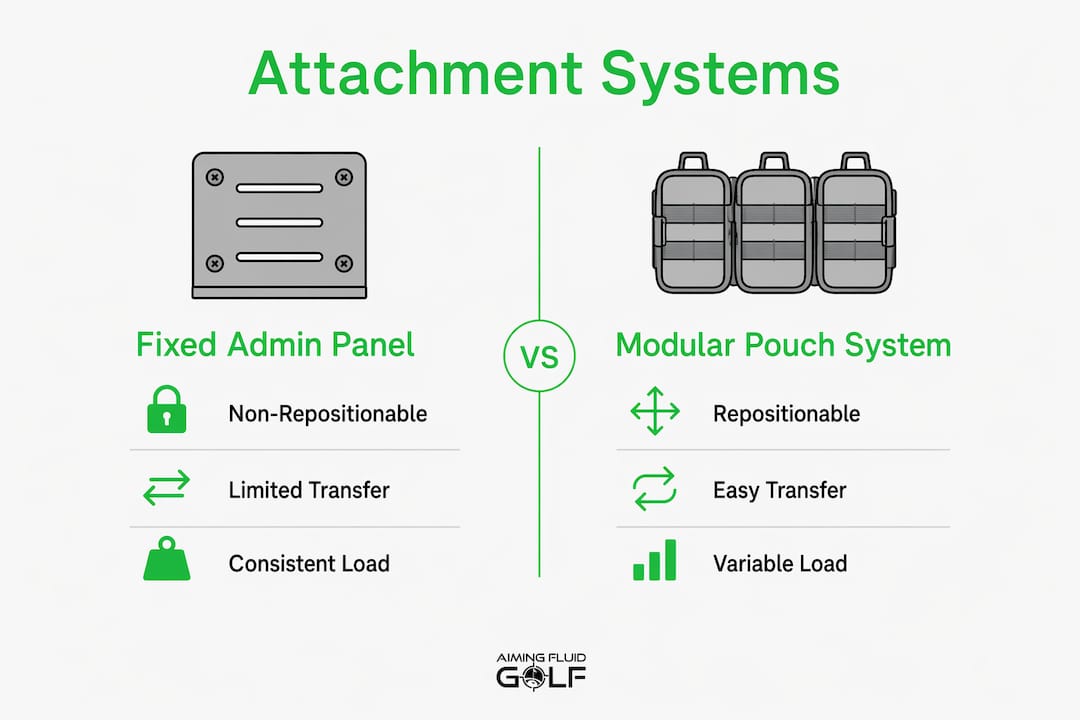
An admin panel is a fixed, built-in organizational compartment sewn directly into a bag. It cannot be removed, repositioned, or transferred to another carry system. A modular pouch is a detachable unit that attaches and detaches independently. The choice between the two depends on workflow, not personal preference.
Admin panels work well for golfers who use one bag exclusively and carry a consistent set of accessories every round. The fixed layout becomes muscle memory. Retrieval is fast because nothing ever moves. The tradeoff is zero flexibility. If you switch bags, you start over.
Modular pouches work best for golfers who own multiple bags, travel frequently, or change their gear loadout based on course conditions. The ability to move a fully packed pouch from one system to another without repacking is the core value proposition.
A hybrid approach, retaining a minimal fixed admin panel for the most-used items while adding modular pouches for variable gear, is often the most practical solution. Aimingfluidgolf’s on-course accessories guide covers this hybrid model in detail.
| Feature | Fixed admin panel | Modular pouch system |
|---|---|---|
| Repositionable | No | Yes |
| Transfers between bags | No | Yes |
| Setup time | None | Low |
| Repair cost | Full bag replacement | Single pouch replacement |
| Best user profile | Single-bag, consistent loadout | Multi-bag, variable conditions |
| Organization depth | Fixed categories | Fully customizable |
How to apply pouch modularity in golf accessory design
Applying modular design principles to golf accessories starts with function mapping. Before selecting a pouch, identify exactly what it will carry and how often you will access those items during a round. A tee pouch needs a wide opening for one-handed retrieval. A valuables pouch needs a secure closure and a soft interior lining. Mixing those requirements into one large pouch defeats the purpose.
Follow this sequence when building or selecting a modular golf kit:
- List your on-course items by access frequency. Items you reach for every hole (tees, ball markers, divot tools) belong in the most accessible pouch. Items you use once per round (rain gear, extra glove) can sit in a secondary pouch.
- Match pouch size to contents. Correct sizing prevents item migration inside the pouch. A pouch that is too large allows contents to shift and create noise, which signals poor fit.
- Confirm interface compatibility. Check your golf bag’s exterior attachment points before purchasing. PALS webbing, Velcro panels, and clip-based systems are not interchangeable without adapters.
- Avoid over-packing individual pouches. The most common modularity failure is stuffing too many items into one pouch, which creates bulk and slows retrieval. Pack by function, not by volume.
- Build mission-specific kits. A “tournament kit” pouch might hold your scorecard holder, a spare glove, and two ball markers. A “practice kit” might hold alignment sticks, a putting mirror, and extra tees. Each kit moves as a single unit.
- Plan for maintenance. Choose pouches with replaceable components where possible. Reinforced weaves and tested fasteners extend service life. When a component wears out, replace it rather than the full system.
Accessory designers applying these principles should treat each pouch as a platform, not a container. The modular design standard requires that a platform support unforeseen future components. Design your attachment interface first, then build pouches around it. That sequence produces systems that golfers can expand as their gear needs evolve.
Aimingfluidgolf’s approach to gear preparedness follows this exact model, treating each accessory as an independent, relocatable unit within a larger carry system.
Key Takeaways
Pouch modularity is the most practical organizational upgrade available to golfers who use multiple bags or change their gear loadout by course or condition.
| Point | Details |
|---|---|
| Core definition | Pouch modularity means removable, swappable storage units connected via standardized interfaces like PALS webbing or magnetic snaps. |
| Attachment system matters | Laser-cut PALS slots outperform traditional webbing loops for durability and wobble-free mounting across high-use accessories. |
| Build mission-specific kits | Pre-packed functional kits move as single units, eliminating repacking when switching between bags or conditions. |
| Hybrid systems work best | Combining a minimal fixed admin panel with modular pouches gives you fast access for constants and flexibility for variables. |
| Sustainability advantage | Replacing one worn pouch instead of an entire bag system reduces cost and waste over a multi-year ownership horizon. |
Why modularity changed how I think about golf gear
The conventional wisdom on golf bag organization focuses on which pocket holds which club. That framing misses the real problem. The real problem is that your gear loadout changes constantly, and your bag does not.
I spent years watching golfers repack the same items into different bags before every trip, every tournament, and every weather change. The repacking itself was the failure point. Items got left behind. Pouches got overstuffed. Bags turned into junk drawers by the third hole.
Modular design solves a workflow problem, not a storage problem. When you treat each pouch as a relocatable unit rather than a permanent compartment, your bag becomes a platform. You stop thinking about where things are and start thinking about the shot in front of you.
The designers who get this right build attachment interfaces first and pouches second. They ask what the golfer needs to do, not what the bag needs to hold. That sequence produces accessories that actually improve pace of play and reduce frustration, which is the only metric that matters on the course.
The balance point is simplicity. Three well-chosen modular pouches outperform eight poorly chosen ones every time. Modularity is not about adding more. It is about making what you carry work harder.
— Gary
Aimingfluidgolf utility pouches built for modular carry
Aimingfluidgolf designs its utility pouches as independent carry units, built to move between bags without repacking. Each pouch in the lineup uses a secure attachment system, a structured interior, and materials tested for on-course durability.
The Leather Golf Utility Pouch features a 360-degree metal clip, zippered closure, and soft interior lining, making it a direct application of modular carry principles for valuables and small accessories. For a broader look at how Aimingfluidgolf’s accessories fit into a complete modular system, the expert picks guide covers cart, carry, and practice configurations in one place.
FAQ
What is the pouch modularity definition in simple terms?
Pouch modularity is a design principle where storage units are removable and interchangeable across different carry systems using standardized attachment interfaces like PALS webbing, Velcro, or magnetic snaps.
How does pouch modularity improve on-course organization?
Modular pouches eliminate the “black hole” effect by containing specific gear categories in dedicated units, allowing one-motion retrieval and fast bag-to-bag transfer without repacking.
What attachment systems are used in modular pouch design?
The three primary systems are PALS webbing for load-bearing connections, Velcro panels for fast light-duty attachment, and magnetic snaps for one-handed operation. Laser-cut laminate slots offer the most durable PALS-compatible format.
When should a golfer choose modular pouches over fixed admin panels?
Modular pouches suit golfers who own multiple bags or change their gear loadout by course and condition. Fixed admin panels work best for single-bag golfers with a consistent, unchanging accessory set.
What is the biggest mistake golfers make with modular pouches?
Over-packing a single pouch is the most common failure. The correct approach is building mission-specific kits, each pouch carrying one functional category of gear rather than a mix of unrelated items.
Recommended
- How to Organize Your Golf Bag Like a Pro: The Peter Finch Method – Aiming Fluid Golf
- How to Organize Your Golf Bag Like a Low Handicap – Complete Modern Gu – Aiming Fluid Golf
- Golf Course Accessory Placement Tips That Save Strokes – Aiming Fluid Golf
- Boost your game: must-have modular golf gear for efficient play – Aiming Fluid Golf


