


TL;DR:
- Course-ready golf equipment is immediately accessible, reliable, and positioned to support smooth gameplay. Proper setup reduces retrieval time, preserves focus, and enhances on-course performance. Maintaining a well-organized system prevents delays, ensuring a faster and more consistent round of golf.
Course-ready equipment is defined as golf gear optimized for immediate accessibility, functional design, and reliability to support uninterrupted play and peak performance on the course. The term “course-ready” is the practical standard golfers and gear designers use to describe tools that are positioned, maintained, and configured before a round begins. Generic golf gear sits in your bag. Course-ready gear is where you need it, when you need it, without a second thought. Aimingfluidgolf builds its entire product line around this principle, engineering accessories that reduce retrieval time and keep your focus on the shot, not the search.
What is course-ready equipment, and how does it differ from generic gear?
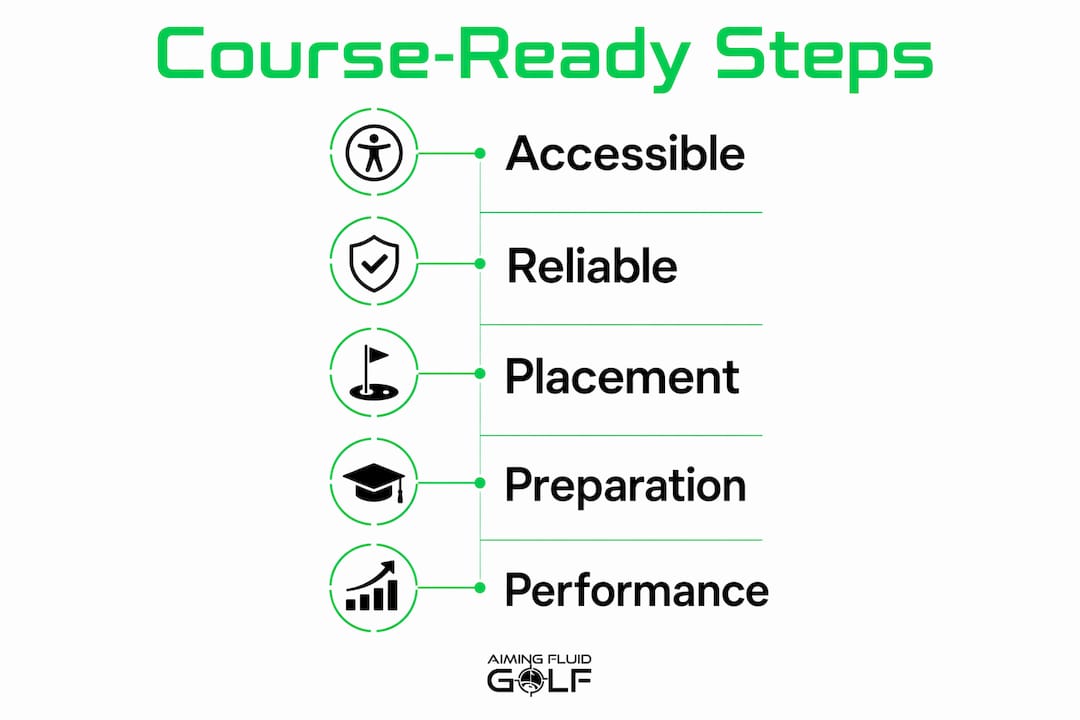
Course-ready equipment is gear that meets three criteria: it is immediately accessible, functionally reliable, and positioned to match the flow of play. Fit-for-purpose standards define this as equipment that is not just present but maintained and placed to support peak performance. Generic golf gear fails this test because it requires searching, decoding, or repositioning before use.

The clearest way to understand the difference is through the concept of retrieval time. Course-ready tools are designed to be usable within 1–2 seconds, eliminating the micro-interruptions that accumulate over 18 holes. A towel buried in a side pocket is not course-ready. A magnetic towel clipped to your bag at hip height is.
| Feature | Course-ready gear | Generic golf gear |
|---|---|---|
| Accessibility | Within 1–2 seconds | Requires searching or unpacking |
| Positioning | Pre-set to match round flow | Stored for transport, not use |
| Condition standard | Inspected before each round | Used until failure |
| Design intent | Reduces retrieval friction | Prioritizes price or novelty |
| Reliability under pressure | Consistent and dependable | Variable |
The table above shows that course-ready gear is a system, not a product category. Any item, from a divot tool to a tee holder, can be course-ready if it meets these criteria. The question is whether your current setup actually does.
Key characteristics of course-ready gear include:
- Immediate accessibility: No digging, unzipping, or searching required.
- Fit-for-purpose condition: Clean, functional, and inspected before play.
- Deliberate placement: Positioned where you will reach for it naturally.
- Reliability: Performs consistently under weather, pressure, and repeated use.
How does course-ready equipment enhance on-course performance?
The performance benefit of course-ready gear is cognitive, not just physical. Eliminating the search process preserves cognitive capacity for the game itself, reducing friction and pace-of-play disruptions. Every time you dig through your bag mid-round, you break concentration. That break costs more than seconds.
A ready state feels invisible because golfers do not consciously think about tool location or function. When gear is positioned correctly, the mind stays on the shot. When it is not, the mind shifts to logistics, and that shift is where scores climb.
Top performers treat their gear as a designed system configured before pressure moments, not assembled reactively during a round. Amateur golfers tend to reach for gear only when they need it and discover problems at the worst possible time. A divot tool that requires two hands to open, a towel that is wet and folded at the bottom of the bag, or tees scattered loose in a pocket all represent system failures.
Durability plays a direct role here. Gear that fails under pressure, a clip that loses magnetic force in cold weather, a pouch zipper that sticks, does not meet course-ready criteria regardless of its design intent. Reliability under performance conditions is a non-negotiable requirement, not a premium feature.
Pro Tip: Before your next round, reach for each piece of gear with one hand and count the seconds. If any item takes more than two seconds to access and use, it is not course-ready.
A consistent, predictable gear experience keeps your focus on performance, not gear management. That consistency compounds over 18 holes. Golfers who eliminate retrieval friction report fewer pace-of-play frustrations and better mental endurance through the back nine.
What are the key elements of a course-ready equipment system?
A course-ready system is built around placement, condition, and retrieval speed. Magnetic mounts and quick-attach systems are the most effective mechanisms for achieving sub-two-second access because they require no alignment, no unzipping, and no two-handed operation. Aimingfluidgolf’s magnetic towel and landing pad system is a direct application of this principle: the towel snaps on and off with one motion, keeping it accessible at all times.
The core items in a course-ready setup are:
- Magnetic golf towel: Mounted at bag height, accessible mid-stride, and clean before the round starts.
- Divot tool: Clipped or pocketed at a consistent location, not loose in the bag.
- Golf tees: Stored in a dedicated pouch or slot, not mixed with ball markers or coins.
- Ball markers: Separated from other small items so they are retrievable in under two seconds.
- Utility pouch: Organized by use frequency, with the most-used items at the top or front.
Placement matters as much as the item itself. A divot tool in the right front pocket works if you always put it there. The same tool in a different pocket each round is not course-ready because the retrieval process requires a decision.
Proper placement and maintenance aligned to round flow prevents multiple minutes of time lost per round. That time adds up across a season and directly affects pace of play for you and the group behind you.
Preparation steps for maintaining course readiness:
- Inspect each item the night before. Check magnetic clip integrity, towel cleanliness, and tee supply.
- Assign a fixed location for every item. Consistency removes the decision step during play.
- Test retrieval speed at home. Reach for each item with one hand. If it takes more than two seconds, reposition it.
- Replace worn or damaged items before the round. A fraying towel or a sticky zipper is a readiness failure waiting to happen.
- Reset the system after every round. Restock tees, clean the towel, and return every item to its assigned location.
Pro Tip: Treat your pre-round gear check the same way a pilot treats a preflight checklist. It takes three minutes and prevents problems that would otherwise cost you ten.
For golfers who travel to courses by vehicle, arriving prepared means your gear system is already configured before you step out of the car, not assembled in the parking lot.
What are the most common mistakes golfers make with course-ready gear?
The most frequent mistake is treating readiness as a convenience feature rather than a performance standard. True course readiness demands gear that works flawlessly under performance pressure. Convenience without reliability is not readiness. It is optimism.
A second common error is equating more gear with better preparation. Intentional curation of essential, accessible, and reliable items outperforms a bag stuffed with redundant or rarely used tools. When your bag feels like a junk drawer, nothing is truly accessible because everything competes for the same space and attention.
Common mistakes that undermine course readiness:
- Skipping pre-round condition checks. Failing to inspect magnetic clips, towel condition, or tee supply is the most frequent cause of on-course frustration.
- Inconsistent item placement. Moving gear between rounds forces a retrieval decision every time.
- Prioritizing quantity over quality. Twelve items you might need beats six items you will need, but only if all twelve are accessible. They rarely are.
- Ignoring maintenance. A worn clip, a dirty towel, or a depleted tee supply all represent readiness failures.
- Confusing organization with readiness. A neatly packed bag is not course-ready if the items inside require unpacking to use.
Improper setup causes cumulative time losses of 5–10 minutes per round. Across a full season, that is a meaningful amount of disrupted focus and slower play. The fix is not more gear. It is better placement, consistent maintenance, and honest self-assessment of what you actually reach for during a round.
Key Takeaways
Course-ready equipment is defined by immediate accessibility, reliable condition, and deliberate placement, not by brand, price, or quantity.
| Point | Details |
|---|---|
| Accessibility is the core standard | Gear must be reachable and usable within 1–2 seconds to qualify as course-ready. |
| Placement beats quantity | A fixed location for every item removes the retrieval decision during play. |
| Condition checks prevent failures | Inspect magnetic clips, towel cleanliness, and tee supply before every round. |
| Cognitive load drives performance | Eliminating gear searches preserves mental focus for the shot, not logistics. |
| Curation outperforms accumulation | Fewer, well-placed items outperform a full bag of poorly organized gear. |
What I’ve learned about course readiness after years on the course
Most golfers think about equipment in terms of what they own, not how they access it. That distinction took me longer to understand than I’d like to admit. I spent years adding items to my bag and wondering why rounds still felt disorganized. The problem was never the gear. It was the system, or the absence of one.
The golfers I’ve watched play their best rounds share one habit: they never visibly search for anything. Their towel is where it always is. Their divot tool comes out of the same pocket every time. That consistency is not accidental. It is the result of intentional gear curation and a pre-round routine that takes less time than a warm-up putt.
My honest advice is to audit your current setup with one question: can you access every item you carry with one hand in under two seconds? If the answer is no for even one item, that item is not course-ready, regardless of how much it cost or how well it works in isolation. Start there. Fix the placement before you buy anything new.
— Gary
Gear built for course readiness from Aimingfluidgolf
Aimingfluidgolf designs accessories specifically around the principles covered in this article: immediate access, reliable condition, and placement that matches how golfers actually move through a round.
The magnetic towel and landing pad system eliminates the most common retrieval failure on the course. The 5-in-1 divot tool consolidates multiple functions into one consistently placed item. Every product in the Aimingfluidgolf lineup is built to meet the course-ready standard, not just to fill a slot in your bag. For a curated list of accessories that support on-course efficiency and organization, the best golf accessories guide is the right starting point. You can also explore the full range of magnetic golf towels designed for one-handed, sub-two-second access.
FAQ
What does “course-ready” mean for golf equipment?
Course-ready means gear is immediately accessible, reliably functional, and positioned to match the flow of play before a round begins. The standard requires retrieval in 1–2 seconds without searching or repositioning.
How is course-ready gear different from standard golf accessories?
Standard accessories are designed for transport or general use. Course-ready gear is configured for active play, with fixed placement, pre-round condition checks, and mechanisms like magnetic mounts that eliminate retrieval friction.
What equipment should every golfer have course-ready?
The core items are a magnetic towel, a divot tool, golf tees, ball markers, and a utility pouch. Each item needs a fixed, consistent location and a pre-round condition check to qualify as truly course-ready.
Does course-ready equipment improve pace of play?
Yes. Improper gear setup causes cumulative time losses of 5–10 minutes per round. Eliminating retrieval delays through deliberate placement and maintenance directly supports faster, more consistent pace of play.
How often should golfers check their gear for course readiness?
The pre-round inspection should happen before every round. Check magnetic clip integrity, towel cleanliness, tee supply, and item placement. Reset the system after each round so it is ready before the next one begins.


