


TL;DR:
- A tee caddy is a golf accessory that either holds individual tees or collects broken ones at tee boxes, improving organization and pace of play. Personal tee caddies attach to bags for instant access, while ground-staked caddies help reduce litter and maintain course cleanliness. Using a tee caddy enhances efficiency, reduces tee loss, and simplifies pre-shot routines for golfers of all skill levels.
If you’ve searched “what is a tee caddy” and landed on results about tea storage boxes, you’re not alone. The term is widely confused with tea caddy, which Oxford Learner’s Dictionaries defines as a lidded container for storing tea leaves. A tee caddy, spelled differently and used in an entirely different context, is a golf-specific accessory. It either holds your tees during a round or collects broken tees on the course. This guide covers the tee caddy definition in full, breaks down both types, and explains the practical tee caddy benefits that make it worth using.
Table of Contents
- Key Takeaways
- What is a tee caddy and how it works for golfers
- Broken tee caddies and their role on the course
- Personal tee caddies vs. broken tee caddies
- How a tee caddy improves your golf experience
- Complementary accessories that pair with tee caddies
- My take on why golfers underestimate tee caddies
- Gear up with the right accessories from Aimingfluidgolf
- FAQ
Key Takeaways
| Point | Details |
|---|---|
| Two distinct types exist | Personal tee caddies clip to golf bags; broken tee caddies stake into turf at tee boxes. |
| Personal caddies speed up play | Clip-on tee holders give golfers instant tee access, reducing delays and frustration. |
| Broken tee caddies serve courses | Turf-staked receptacles collect used tees and reduce litter at the teeing area. |
| Design specs matter | Spike length, material, and footprint determine how well a broken tee caddy integrates with turf. |
| Tee caddies complement other gear | Pairing a tee caddy with divot tools and ball markers creates a more organized, efficient setup. |
What is a tee caddy and how it works for golfers
A tee caddy is a purpose-built accessory that solves a specific problem most golfers encounter every round: knowing exactly where your tees are when you need them. The tee caddy definition in golf covers two distinct products that share a name but serve very different users.
The first type is a personal tee caddy, designed for individual golfers. These attach directly to your golf bag and hold multiple tees in a compact, accessible housing. Products like clip-on tee holders clip to bags and hold up to 6 tees, letting players replenish on the go without digging through pockets or bag pouches. The clip attachment mechanism is the key feature. It keeps tees separated from the general contents of your bag so they don’t scatter to the bottom.
The second type is a broken tee caddy, which operates at the facility level. These are receptacles staked into the turf at tee boxes, giving golfers a designated place to deposit broken or unused tees. Instead of leaving debris on the fairway or teeing ground, players drop tees into these containers as they pass.
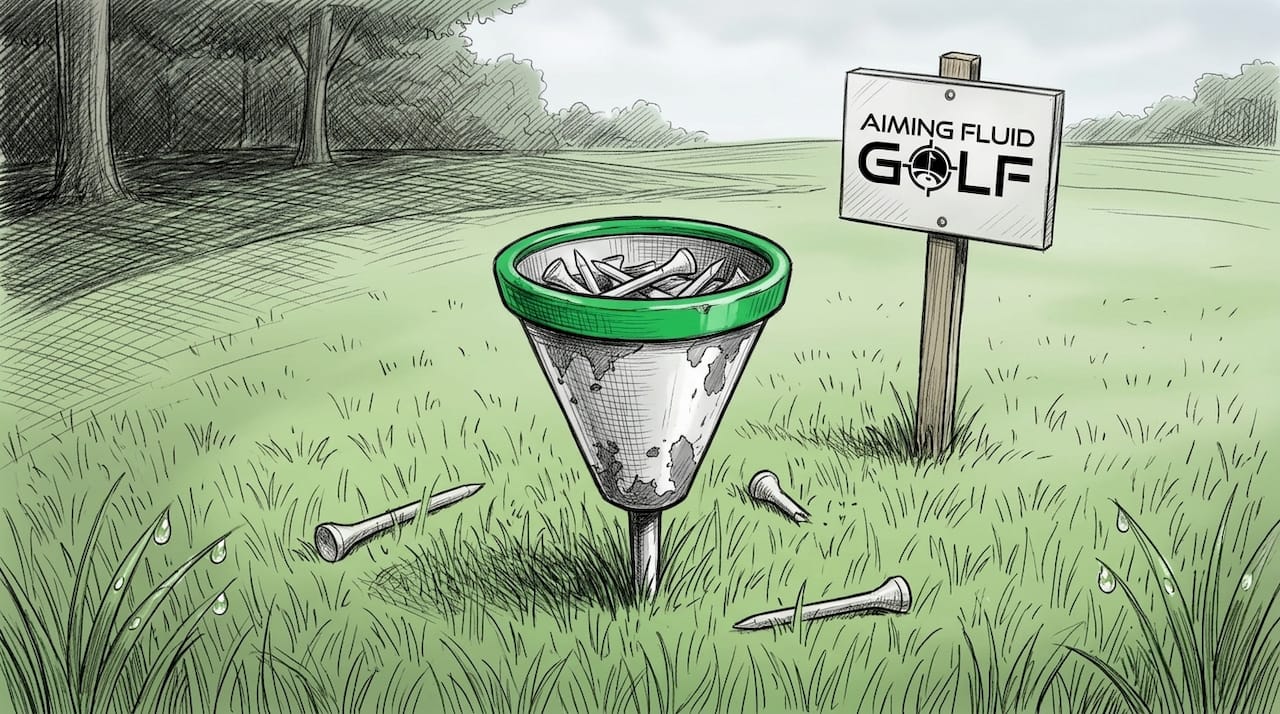
Both products fall under the tee caddy for golf category, but they differ in design, mounting, and the problem they solve.
Types of personal tee caddies
Personal tee caddies come in several styles. Here are the most common:
- Clip-on bag attachments: The most popular format. A molded plastic or rubberized housing with a carabiner or hook clip attaches to bag straps, belt loops, or external D-rings. Capacity typically ranges from 4 to 8 standard tees.
- Pouch-style holders: Soft fabric pouches with an elastic opening that cinch tees in place. These fit into side pockets or can be clipped externally. Less rigid than clip-on models but offer more capacity.
- Retractable tee caddies: A niche design where tees are stored on a small retractable cord. The player pulls a tee free and the cord retracts, keeping the caddy flush with the bag. Useful for frequent tee users.
- Integrated bag panels: Some premium golf bags have dedicated tee slots built into the external panel fabric. These aren’t standalone products but function identically to a clip-on caddy.
Materials range from injection-molded ABS plastic to aluminum alloy and neoprene. Durability varies, but most clip-on models are built for years of repeated use.
Pro Tip: If you play more than once a week, choose a clip-on tee caddy with a locking gate clip rather than a simple snap hook. A locking gate won’t accidentally release when your bag brushes against a cart, tree, or other equipment.
Broken tee caddies and their role on the course
The second type is less familiar to recreational golfers but plays a direct role in course maintenance. A broken tee caddy is a turf-staked receptacle placed at teeing areas specifically to collect broken tees and reduce litter on the course.
The function of a tee caddy in this context is environmental as much as organizational. Broken tees left on tee boxes become a safety and aesthetics issue. They can interfere with mowing equipment and create an untidy appearance that reflects poorly on the facility. A properly positioned broken tee caddy gives golfers a frictionless disposal point, which means they actually use it.
Standard Golf’s recycled broken tee caddy is a widely used example. It is cone-shaped and powder-coated steel with a 5-inch spike designed to anchor it cleanly in turf. The unit costs approximately $66 each and is built from recycled materials, which aligns with sustainability goals many modern courses pursue.
Here is a breakdown of key design specifications to understand before a facility purchases one:
| Feature | Specification | Why It Matters |
|---|---|---|
| Spike length | 5 inches (13 cm) | Ensures stable anchoring without damaging root systems |
| Material | Recycled powder-coated steel | Resists corrosion and endures outdoor exposure |
| Shape | Cone | Allows tees to slide in easily and stack without jamming |
| Footprint | Small diameter opening | Reduces interference with mowing paths |
| Cost per unit | ~$66 | Scales reasonably for multi-tee-box installations |
Spike size and physical dimensions are critical factors in broken tee caddy selection because incorrect installation depth can cause the unit to tip or become dislodged during mowing operations. Course superintendents typically evaluate spike length relative to soil density and irrigation schedules before choosing a model.
Pro Tip: For courses installing broken tee caddies for the first time, place one unit per teeing complex rather than one per individual tee marker. That positions a receptacle within easy reach of all players regardless of which tee they play from.
Personal tee caddies vs. broken tee caddies
These two products share a name, but comparing them side by side makes the distinction clear.
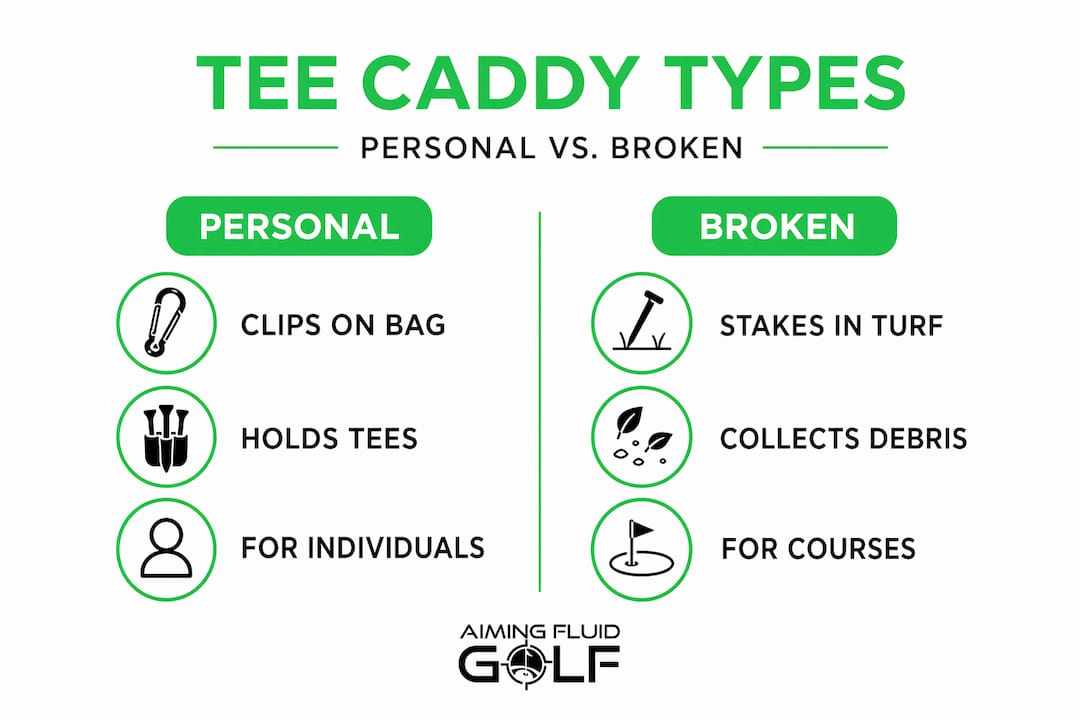
| Category | Personal tee caddy | Broken tee caddy |
|---|---|---|
| Primary user | Individual golfer | Golf course facility |
| Mounting method | Clip or hook on golf bag | Steel spike staked into turf |
| Primary function | Tee storage and access | Broken tee collection and disposal |
| Typical size | Small, palm-sized | Medium, ground-level container |
| Material | Plastic, rubber, or aluminum | Steel or recycled polymer |
| Cost range | $5 to $30 | $50 to $100 per unit |
| Longevity | 2 to 5 years with regular use | 5 to 10 years with minimal maintenance |
| Movement | Travels with the player | Fixed at specific course location |
Purchasing decisions require distinguishing between these two products clearly because they are frequently listed together in golf accessory searches. A recreational golfer searching for a tee caddy online does not need a ground-staked steel unit. A course manager searching for litter control equipment does not need a bag clip.
The use case determines the product. If you carry a bag and want faster access to your tees during a round, a personal clip-on model is the correct choice. If you manage a teeing area and want to reduce debris, a broken tee caddy staked into the turf is what you need.
How a tee caddy improves your golf experience
The practical tee caddy benefits extend beyond simple organization. Here is a structured look at how using one improves the experience on the course:
-
Faster tee retrieval. When your bag feels like a junk drawer, you waste time searching during tee preparation. A clip-on caddy puts tees in the same spot every time. Faster tee retrieval directly supports pace of play, which matters for you and the group behind you.
-
Reduced tee loss. Loose tees in a bag pocket scatter, fall out during cart transport, and end up at the bottom of your bag. A dedicated holder keeps them contained and accounted for.
-
Consistent tee height setup. When you know exactly where your tees are and can grab one quickly, you spend more mental energy on consistent tee height and shot preparation rather than logistics.
-
Better bag organization overall. A tee caddy is one component of a broader organization system. Once tees have a fixed location, you begin allocating dedicated spots for other items too, which reduces overall bag clutter.
-
Benefits across all skill levels. Beginners benefit from not losing tees every round. Experienced players benefit from the time savings and the mental reduction of micro-frustrations. The tee caddy for golf is not a performance tool, but it removes friction that affects focus.
If you are selecting a personal tee caddy, prioritize capacity and clip mechanism quality. A caddy that holds 6 tees and clips securely covers most rounds without needing to reload. Read about tee selection tips if you also want to match your tee type to your driver and swing speed, since both decisions work together.
Complementary accessories that pair with tee caddies
A tee caddy works best as part of a coordinated gear system. Complementary golf accessories enhance the overall player experience by keeping all necessary tools accessible and organized throughout the round.
The most practical accessories to pair with a tee caddy include:
- Divot tools: A magnetic divot repair tool with a built-in ball marker attaches to the same bag clip zone as your tee caddy, so both are accessible before you step onto the green.
- Ball markers: Keeping markers with or near your tee caddy creates a single-access zone for pre-shot preparation gear. No searching in three separate pockets.
- Magnetic golf towels: A towel that attaches magnetically to your bag means one-hand retrieval for club cleaning, without removing anything from your bag organizational system.
- Utility pouches: A belt or bag-mounted pouch can house your tee caddy, a divot tool, and a few ball markers together, functioning as a compact pre-shot toolkit.
The principle is fixed locations for frequently used items. A tee caddy is the starting point for that habit.
My take on why golfers underestimate tee caddies
I’ve watched golfers spend $400 on a driver fitting and then lose two minutes per hole digging through their bag for a tee. The tee caddy sits at the intersection of convenience and attention. It’s a $15 fix to a real problem.
In my experience, the golfers who adopt a clip-on tee caddy early rarely go back to loose tees. The habit forms fast because the payoff is immediate. You step onto the tee box, the tee is already in your hand, and your focus stays on the shot. That cognitive savings is small per hole but compounds across 18.
What I find more interesting is the broken tee caddy side of this. Course facilities that install these receptacles at every tee complex see measurable reductions in debris without any behavior change campaign. The container does the work. Golfers deposit tees naturally when a receptacle is within arm’s reach. It’s a design-driven outcome, which is the same logic behind products built for on-course efficiency at Aimingfluidgolf.
For newer golfers, I’d say a tee caddy is a better first purchase than a new glove or an extra sleeve of balls. It solves a concrete problem from round one.
— Gary
Gear up with the right accessories from Aimingfluidgolf
If this article clarified what a tee caddy does and you’re ready to build a smarter on-course setup, Aimingfluidgolf has put together an expert-curated selection worth checking out.
The best golf accessories guide from Aimingfluidgolf covers cart, carry, and practice gear including tees, divot tools, magnetic towels, and utility pouches. Every item on the list is selected based on practical function, not novelty. If you want a complete picture of what a well-organized golf bag looks like, that page is a useful reference. For tees specifically, the DON’T SUCK golf tees come in a 50-pack format that pairs well with any clip-on tee caddy, giving you enough supply to reload without thinking about it mid-round.
FAQ
What does a tee caddy do for golfers?
A personal tee caddy clips to a golf bag and holds multiple tees in a fixed, accessible location. It reduces time spent searching for tees and supports a more organized bag system.
What is the difference between a tee caddy and a tea caddy?
A tee caddy is a golf accessory for storing or collecting golf tees. A tea caddy is a lidded container used to store tea leaves, an entirely unrelated household item.
What is a broken tee caddy on a golf course?
A broken tee caddy is a turf-staked receptacle placed at tee boxes to collect broken and discarded tees, reducing litter and keeping the teeing area clean.
How do I use a tee caddy effectively?
Load the caddy with 4 to 6 tees before your round, clip it to an easily reached strap or D-ring on your bag, and reload it at the turn or whenever you drop below two tees remaining.
Are tee caddies worth it for casual golfers?
Yes. Casual golfers lose more tees per round on average and benefit most from a fixed storage point. The cost is low and the organizational habit it builds transfers to better overall bag management.
Recommended
- Golf tee selection tips to improve your game performance – Aiming Fluid Golf
- Golf caddie tools: Boost your game with pro-level gear – Aiming Fluid Golf
- What is a golf tee system? Boost your game with smart tee solutions – Aiming Fluid Golf
- Step-by-step golf tee setup guide for consistency – Aiming Fluid Golf


