


A snap-back magnetic system is a golf towel and landing-pad setup that uses embedded magnets and snap-style attachment points to keep your towel and small accessories docked to your bag or cart, ready to grab and release in one motion. The towel snaps to a landing pad or metal surface, holds through your swing and the ride down the fairway, then snaps back the instant you need it.
Two benefits drive why golfers upgrade to this kind of setup:
- Faster pace of play. No digging through a bag pocket between shots.
- Less bending and better organization. You can lift the towel off the pad with a clubhead, and everything has a fixed home instead of floating loose in your bag.
The rest of this guide breaks down the mechanics, what separates a durable system from a gimmick, and how to buy, install, and maintain one so it actually holds up over a season.
Key Takeaways
A snap-back magnetic system works because it pairs a strong, properly encapsulated magnet with a stable landing surface, eliminating both the search time and the bending that slow down a round.
| Point | Details |
|---|---|
| Core definition | A towel and landing-pad setup using embedded magnets and snap-style mounts for instant docking and retrieval. |
| Magnet type matters | Neodymium magnets outperform generic ceramic types for consistent hold under vibration. |
| Pull vs. shear | Shear resistance, not just pull strength, determines whether a towel stays put on bumpy cart paths. |
| Buy for encapsulation | Fully sealed magnet housings resist water and impact damage far better than exposed designs. |
| Aiming Fluid Golf’s fix | The Magna-Anchor™ System and Magnetic Landing Pad target encapsulation, landing interface, and shear failure directly. |
Table of Contents
- How Does a Snap-Back Magnetic System Work?
- What Practical Benefits Does It Bring to Your Round?
- What Should You Look for When Choosing One?
- How Do You Install and Use One on the Course?
- How Do You Maintain and Troubleshoot a Snap-Back System?
- How Does Aiming Fluid Golf Fix These Common Failures?
- Why Aiming Fluid Golf Built the System This Way
- Ready to Upgrade Your Golf Bag Setup?
- Sources
How Does a Snap-Back Magnetic System Work?
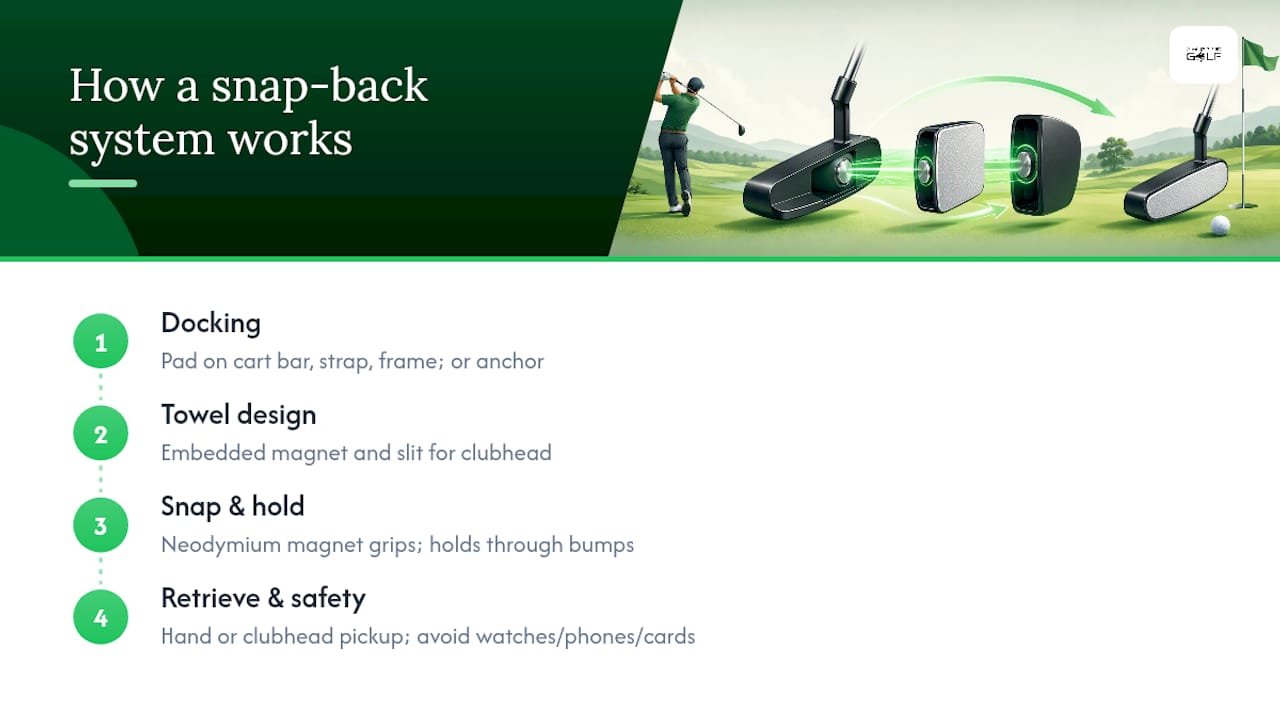
Three components do the work. The landing pad is the docking surface, usually mounted on a cart bar, bag strap, or cart frame, that gives the towel a fixed, findable spot every time. The towel carries an embedded magnet, often paired with a slit sized to slip over a clubhead. The snap anchor is the point of contact, whether that’s the pad itself or a metal surface on your cart, where the magnet actually grips.
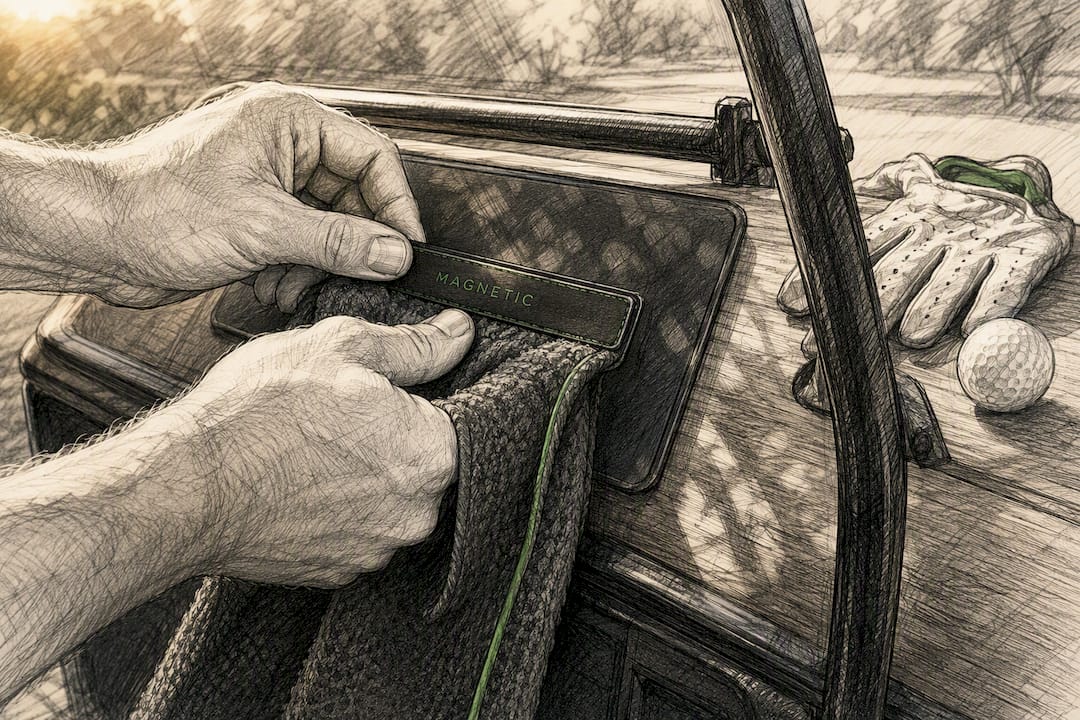
The interaction is simple in practice: you dock the towel against the pad or anchor, it snaps into place and holds through bumps and swings, and you retrieve it either by hand or by tapping a clubhead into the slit and lifting. Drop it back near the anchor and it snaps home again without any fumbling.
Most quality systems use neodymium (rare-earth) magnets rather than generic ceramic ones, because neodymium delivers far more holding force for its size. Aiming Fluid Golf’s technical guide breaks down how encapsulation and docking geometry affect real-world performance, which matters more than raw magnet type alone.
Statistic callout: One product review found an industrial-strength neodymium magnet held a 0.36-pound towel steady on bumpy cart paths while still allowing clean pickup with an iron head. Treat that as a real-world benchmark, not a universal spec. Weight, fabric, and mounting angle all shift what “enough hold” actually means for your setup.
A quick safety note: keep magnets away from watches, phones, and credit cards with magnetic strips, and avoid repeated hard metal-on-metal contact between a clubhead and the magnet housing, which can chip finishes over time.
What Practical Benefits Does It Bring to Your Round?
The appeal isn’t theoretical. It shows up in small, repeated moments across eighteen holes.
- Faster access between shots — no bag-pocket search while your group waits.
- Less bending, which matters if your back complains after a few holes.
- A protected dry zone for hands and grips, especially with towels built around an internal pocket.
- Secure docking on carts and bags even over rough terrain.
- Easier club cleaning since the towel is always at hand, not buried under headcovers.
Magnetic golf towels save real time on the course precisely because they attach directly to metal surfaces like cart frames or clubheads rather than requiring a search-and-retrieve routine every time. Picture a wet approach shot: instead of unzipping a pocket, you tap your wedge to the towel, wipe down, snap it back, and you’re already walking to your ball.
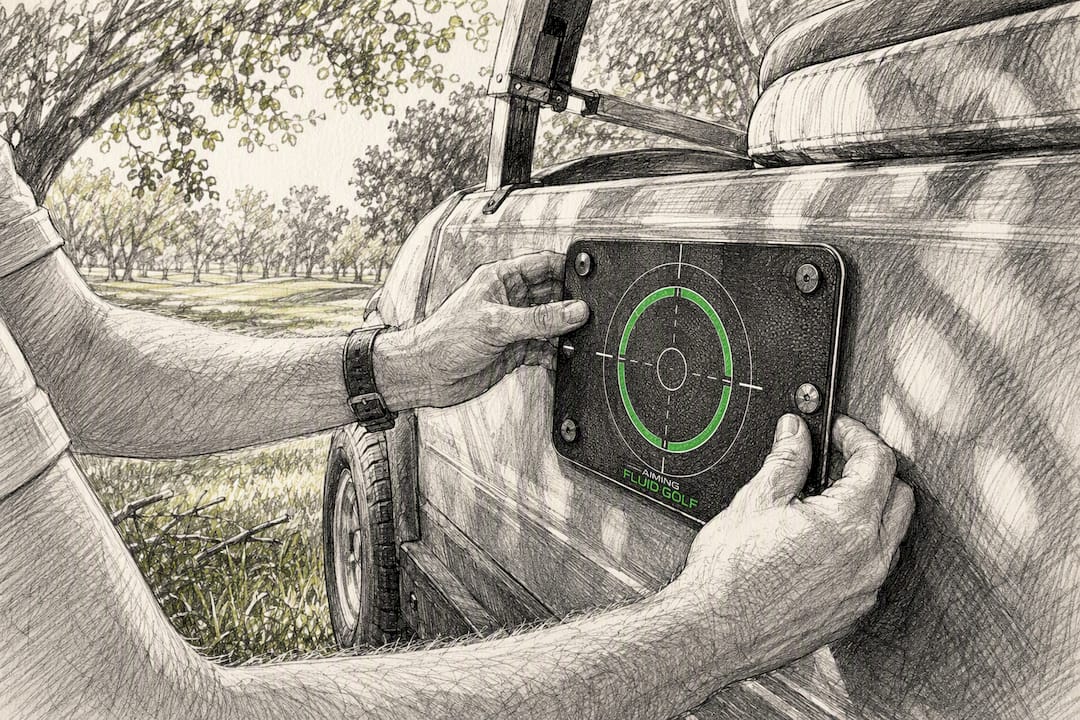
Pro Tip: Mount the landing pad on a vertical cart pillar rather than a horizontal bag strap if speed matters most to you. Vertical placement keeps the towel visible at eye level and avoids interference when you’re pulling clubs, though a bag strap mount works better for walkers who never use a cart.
What Should You Look for When Choosing One?
Not every “magnetic towel” performs the same, and the differences show up fast once you’re on the course. Use this checklist before you buy:
- Magnet strength and type. Neodymium outperforms generic ceramic magnets at the same size.
- Enclosure quality. A fully encapsulated magnet resists water and impact damage better than an exposed housing sewn onto fabric.
- Pull versus shear behavior. Pull rating measures straight-line holding force; shear measures resistance to sideways sliding, which matters more on a bumpy cart path than pull alone.
- Material and dryability. Microfiber with a dedicated dry pocket cleans better than a single flat towel.
- Size and compatibility. Confirm the towel and pad fit your bag strap, cart bar, or clubhead slit.
- Internal dry pocket or brush. A built-in brush turns one accessory into two tools.
Comparative testing between magnetic towels and magnetic clips found that dedicated towels with an internal pocket deliver better cleaning performance and a genuine dry zone, while clip-style retrofits trade that function for flexibility across different towels you already own.
Statistic callout: A patent filing for a magnetic towel assembly recommends a magnet area of roughly 4 square inches as sufficient for reliable slit-and-lift function. That’s a design guideline, not a purchasing rule, but it’s a useful reference point when comparing magnet footprints across products.
Metal-on-metal contact between a clubhead and an exposed magnet housing can dent or scratch a clubface over repeated use. Look for products with a fabric or polymer buffer between the magnet and the contact point.
How Do You Install and Use One on the Course?
Setup takes a few minutes and pays off for the rest of the season.
- Prepare the mounting surface. Wipe down the cart bar, bag strap, or frame section where the pad will sit.
- Place the landing pad. Position it where your dominant hand naturally swings toward it, mid-thigh height works for most cart setups.
- Thread the towel slit or set the magnet. If your towel has a clubhead slit, feed it through before your first snap test.
- Test the snap action. Tap a clubhead against the magnet and lift to confirm a clean, secure grab.
- Confirm hold while moving. Walk a few steps or drive the cart a short distance to check the towel stays docked over bumps.
Right-handed golfers generally do better with the pad mounted on the left side of a cart bar or bag strap; lefties should mirror that placement. Cart golfers get more mounting real estate on the frame, while walkers should keep the pad on the bag strap within easy reach without swinging into their takeaway.
Daily use is simple: pick the towel up with a wedge instead of bending, keep the internal dry pocket away from standing water in your cart’s cup holder, and recheck the snap after rounds on rough cart paths where vibration is highest.
Pro Tip: If you carry your bag more often than you ride, mount the landing pad slightly below your shoulder so you can grab the towel mid-stride without breaking pace, rather than reaching down every time.
How Do You Maintain and Troubleshoot a Snap-Back System?
Rinse the towel after wet or salty rounds and let it air-dry rather than tossing it straight into a bag pocket while damp. Machine washing is fine for most microfiber towels if the manufacturer confirms it, but always check the magnet encapsulation first. Inspect the magnet and stitching monthly for early signs of wear.
Common problems and quick fixes:
- Slipping under vibration: the towel may have a strong pull rating but a weak shear rating for bumpy cart paths. Understanding shear versus pull helps explain why a towel that holds still on a bench can slide loose on a moving cart.
- Magnet detachment: usually a stitching or encapsulation failure. This isn’t repairable at home, and it’s a sign to replace the towel.
- Alignment issues: reposition the landing pad slightly closer to your natural reach point.
- Wet saturation reducing grip: wring and air-dry before docking again; a saturated towel adds weight the magnet wasn’t rated to hold.
How Does Aiming Fluid Golf Fix These Common Failures?
Most of the failures above trace back to the same three causes: weak encapsulation, a poor landing interface, or a magnet that holds under pull but fails under shear. Aiming Fluid Golf’s Magna-Anchor™ System addresses all three directly rather than treating them as unavoidable wear.
- Secure encapsulation keeps the magnet sealed against moisture and stitching stress instead of exposed to repeated flexing.
- Optimized magnet area balances hold strength with a towel that doesn’t feel bulky in hand.
- Engineered shear resistance targets the specific failure mode that causes towels to slide off during cart travel over rough terrain, not just when sitting still.
The companion Magnetic Landing Pad works as a stable docking station with broad compatibility across bag and cart setups, so the anchor point is as reliable as the magnet itself. Picture a golfer mid-round on a par 5, wiping down a mud-caked wedge with one tap-and-lift motion, then snapping the towel back before their cart partner even finishes their approach. That’s the entire design goal in one motion.
For the full engineering rationale behind encapsulation choices and docking geometry, the technical guide covers the specs in more depth.
Why Aiming Fluid Golf Built the System This Way
Gary built the Magna-Anchor™ System because most magnetic towels fail the same way twice: they slide off on rough cart paths, and they don’t hold up wet… The goal was straightforward: something that snaps on, stays on, and snaps back without you thinking about it.
Ready to Upgrade Your Golf Bag Setup?
Everything covered above, magnet type, encapsulation, shear resistance, comes together in Aiming Fluid Golf’s towel and landing pad combination, built specifically to solve the failures that plague generic magnetic towels. If you’ve dealt with a towel that slides off on cart bumps or a magnet that gave out after one wet season, this is the fix engineered around those exact problems.
Browse the Magnetic Towels collection to find the right size and color for your bag, or check the Magnetic Landing Pad buyer’s guide if you want the full docking setup explained side by side. Every purchase includes access to Aiming Fluid Golf’s customer support and replacement parts information, so a worn towel or a shifted landing pad doesn’t mean starting over. Pick your setup and get it mounted before your next round.
Sources
- VIGLORY Magnetic Golf Towel Review 2026: Worth It? – GolferHive
- Magnetic Towel vs Magnetic Clip | Which Golf Towel System Actually Works? – GolfDeft
- MAGNETIC GOLF TOWEL ASSEMBLY AND METHOD OF USE - Patent Application


