


TL;DR:
- Golf accessories that conform to Rule 4.3 and are used passively are typically penalty-free in casual and sanctioned play. Items like towels, tees, ball markers, and gloves are allowed, but accessories that interpret play data or modify equipment mid-round can trigger penalties. Always verify local rules and avoid devices that process real-time information to stay compliant during tournaments.
“Penalty-free golf accessory” is not an official USGA designation. It is shorthand used by golfers and retailers to describe items that conform to Rule 4.3 and are unlikely to trigger penalties in casual or competitive play. The practical implication: if you stick to organization-focused, non-performance items, you are almost always safe.
Accessories that routinely qualify as penalty-free in common play include:
- Golf towels (including magnetic-attachment versions)
- Tees (wooden, plastic, or molded composite)
- Ball markers and divot repair tools
- Non-electronic utility pouches and carrying aids
- Resins, drying powders, and simple gloves
Pro Tip: If you plan to use any accessory in a sanctioned tournament, check the event’s local rules before the round. Committees can restrict items that are otherwise permitted under the base Rules of Golf.
Table of Contents
- What does Rule 4.3 actually say about golf accessories?
- Which accessories are routinely allowed on the course?
- What accessories can trigger penalties or need extra scrutiny?
- How do you verify an accessory is allowed before competitive play?
- Practical tips for buying accessories that minimize penalty risk
- Key Takeaways
- The case for building around organization, not performance claims
- Aimingfluidgolf accessories built for organization and tournament compatibility
- Useful sources and further reading
What does Rule 4.3 actually say about golf accessories?
The USGA does not publish a list of approved accessories or a “penalty-free” product category. Accessory legality is governed entirely by Rule 4.3, which focuses on how equipment is used rather than what it is called.
Rule 4.3 draws a clear line between two categories of use. Allowed uses include obtaining distance or directional information, checking weather data, using gloves, and applying resins or drying powders. Prohibited uses are those that “artificially eliminate or reduce the need for a skill or judgment that is essential to the challenge of the game.” That language is the operative test. An item is not illegal because of its form; it is illegal because of what it does to the skill equation.
Rule 4.3(b): “A player must not use equipment in an abnormal way that is likely to give an unfair advantage over other players.” Devices that process or interpret playing information during a round — producing real-time club recommendations, for example — fall squarely into this prohibition.
Committees add another layer. Under the Model Local Rules framework, tournament organizers can restrict items that the base rules allow, such as distance-measuring devices. That is why “penalty-free” is always context-dependent: an item legal under USGA rules can still be barred at a specific event.
Which accessories are routinely allowed on the course?
Organization and maintenance items are the safest category of golf accessories without penalties because they do not affect skill-based outcomes. Towels, resins, and drying powders are explicitly permitted under Rule 4.3(a)(5). Tees, ball markers, and divot tools serve purely mechanical or administrative functions and carry no performance-altering mechanism.
Common accessories that are routinely permitted:
- Magnetic golf towels: Passive organizational tool; no data processing, no performance effect.
- Precision tees: Molded or composite tees conform to equipment standards; no skill substitution.
- Divot repair tools: Maintenance only; no play-affecting function.
- Ball markers: Required for marking position; explicitly contemplated by the rules.
- Utility pouches and bag clips: Storage and carrying aids with no active mechanism.
- Gloves and gripping agents: Permitted under Rule 4.3(a)(4) provided they do not provide an abnormal grip advantage.
One subtlety worth knowing: sharing non-club equipment is completely legal. You can use another player’s tee, towel, rangefinder, or ball without penalty. Clubs are treated differently. Accidentally using another player’s club during a round triggers a general penalty, and the club must immediately be declared out of play once the error is recognized.
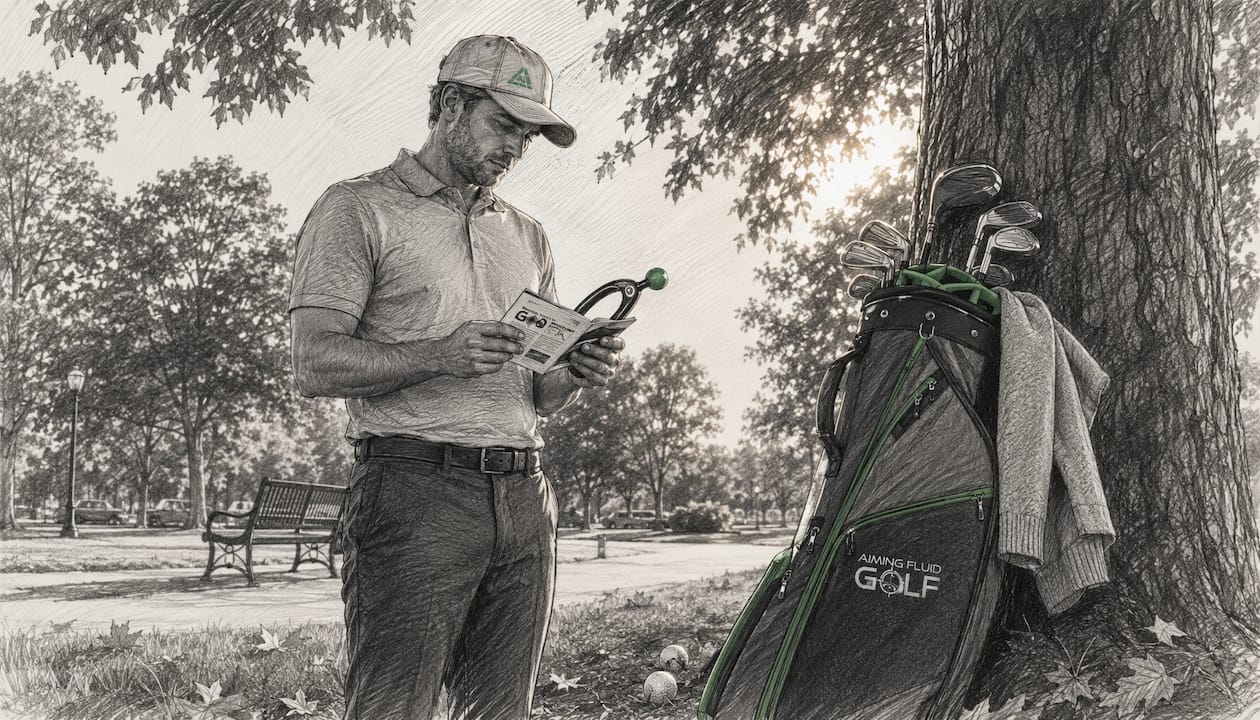
Swing trainers occupy a gray zone. You can carry one in your bag, but using a training aid during a practice swing or stroke on the course can breach the rules as “unusual use of equipment.”
What accessories can trigger penalties or need extra scrutiny?
Anything that eliminates essential skill or interprets play in real time can be illegal under Rule 4.3. The risk is not always obvious from the packaging.
Risky categories to watch:
- Electronics that recommend club selection based on real-time shot data — prohibited regardless of how they are marketed.
- Adjustable components altered during a round to change performance characteristics (adding or removing weights, changing loft settings mid-round).
- Training aids used during a stroke or practice swing on the course, which can constitute abnormal equipment use.
- Equipment deliberately positioned to stop or redirect a ball — this is the general penalty, not an accidental-contact situation.
The distinction between accidental and deliberate contact matters enormously here. Since the 2019 rules update, accidental deflections between a ball and your equipment generally carry no penalty under Rule 11.1. The modern rules removed penalties for bad luck in most accidental-contact cases. Intentional interference is a different matter entirely.
Rule 11.1 principle: Accidental deflection by equipment is penalty-free in most cases. Deliberate use of equipment to stop or redirect a ball carries the general penalty. Intentionality is the deciding factor.
Tournament vs. casual play also diverges on electronics. Committees may ban distance-measuring devices outright, or prohibit audio and video playback during a round, even when those functions are technically allowed under the base rules.
How do you verify an accessory is allowed before competitive play?
Verify via the USGA rule text, the tournament’s local rules sheet, and manufacturer claims — in that order, with manufacturer claims treated as the least authoritative of the three.
- Check Rule 4.3 and Rule 11.1 on the USGA website directly. Read the rule text, not a summary.
- Obtain the event’s local rules sheet before the round. Committees can restrict items the base rules permit, including distance devices and certain electronics.
- Confirm the device does not process or interpret real-time playing data. A GPS unit that shows yardage is generally allowed; an app that analyzes your swing and recommends a club is not.
- Ask the committee or a rules official when uncertain. Present the item before play begins and request a ruling. A pre-round ruling prevents penalties and preserves the integrity of the round.
For electronics specifically, the test is straightforward: does the device record data for post-round review, or does it produce recommendations during the round? The former is generally permissible; the latter is not. When asking a rules official, two useful questions are: “Does this device interpret playing conditions in real time?” and “Does the event’s local rules sheet restrict this category of device?”
Practical tips for buying accessories that minimize penalty risk
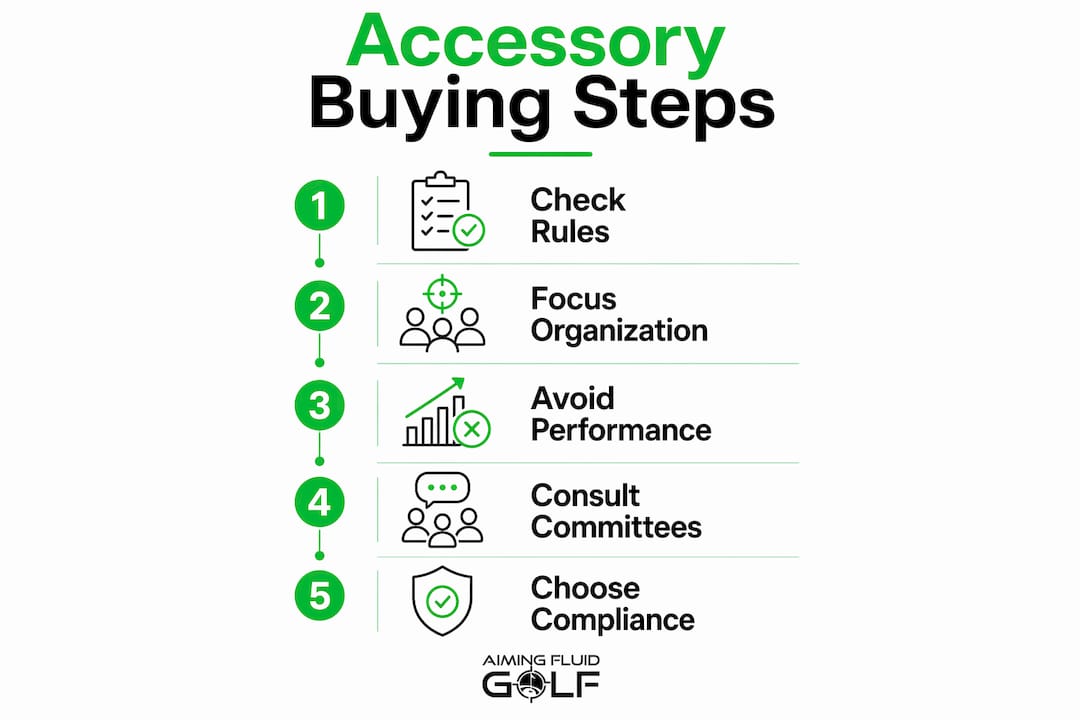
Favor organization and durability over performance-enhancing claims when shopping for legal golf equipment. An accessory that keeps your gear accessible and your pace of play fast is almost always rules-safe. One that promises to improve your decision-making during the round deserves scrutiny.
Buying criteria to apply:
- No real-time data processing or club-recommendation function
- Secure attachment mechanism (magnetic, clip, or zipper) that prevents accidental repositioning
- Simple mechanical function with no adjustable performance components
- Clear manufacturer statement about tournament compatibility, verified against Rule 4.3
On-course use tips:
- Keep electronics in airplane mode or powered off if the event permits them only for non-playing functions.
- Position your bag and accessories so they cannot be interpreted as deliberate backstops; accessory placement on the course affects both pace of play and rules exposure.
- Tightening a loose screw or replacing a worn grip mid-round is ordinarily allowed; changing performance settings such as removing or adding weights is not.
Pro Tip: Organization-focused accessories — magnetic towels, zippered pouches, molded tees — reduce rules friction because they have no active mechanism to scrutinize. When your bag functions like a well-organized system rather than a junk drawer, you spend less time searching and zero time worrying about equipment penalties.
Aimingfluidgolf designs its product line around exactly these criteria. The accessory guide on the brand’s site covers bag layout and accessory selection with tournament compatibility in mind.
Key Takeaways
The safest golf accessories are organization-focused, non-performance items that conform to Rule 4.3 and carry no real-time data-processing function.
| Point | Details |
|---|---|
| No official “penalty-free” label | The USGA governs accessories through Rule 4.3 use standards, not a product-approval list. |
| Accidental contact is generally safe | Rule 11.1 removes penalties for accidental ball deflections off equipment in most cases since 2019. |
| Electronics need extra scrutiny | Devices that interpret real-time playing data and recommend club selection are prohibited under Rule 4.3. |
| Committees can restrict more | Local rules at any event may ban items the base USGA rules allow; always check the local rules sheet. |
| Aimingfluidgolf’s design approach | Aimingfluidgolf builds organization-first accessories — magnetic towels, utility pouches, precision tees — that align with Rule 4.3 by design. |
The case for building around organization, not performance claims
Most golfers shopping for penalty-free golf gear focus on the wrong question. They ask, “Is this item legal?” when the more useful question is, “Does this item have any mechanism that could become illegal?” Those are not the same thing.
A rangefinder is legal under the base rules but can be banned by a committee. A swing trainer is legal to carry but illegal to use during a stroke. An adjustable club is legal at the start of a round but becomes a penalty if you change its settings mid-round. The pattern is consistent: the more a product does, the more conditions attach to its legality.
Organization-focused accessories sidestep this entirely. A magnetic towel has no moving parts that affect play. A molded tee has no adjustable mechanism. A zippered utility pouch stores your valuables and nothing else. These items are not penalty-free because they passed some test; they are penalty-free because there is nothing in them to penalize.
The practical takeaway for competitive golfers: build your accessory kit around passive, organizational tools first, then add electronics only after you have confirmed both the base rules and the event’s local rules allow them. That sequence protects your scorecard and your pace of play.
Aimingfluidgolf accessories built for organization and tournament compatibility
Aimingfluidgolf’s product line is built on the same principle the rules reward: organization over performance claims. Every product in the lineup is designed to keep your gear accessible, your round moving, and your rules exposure at zero.
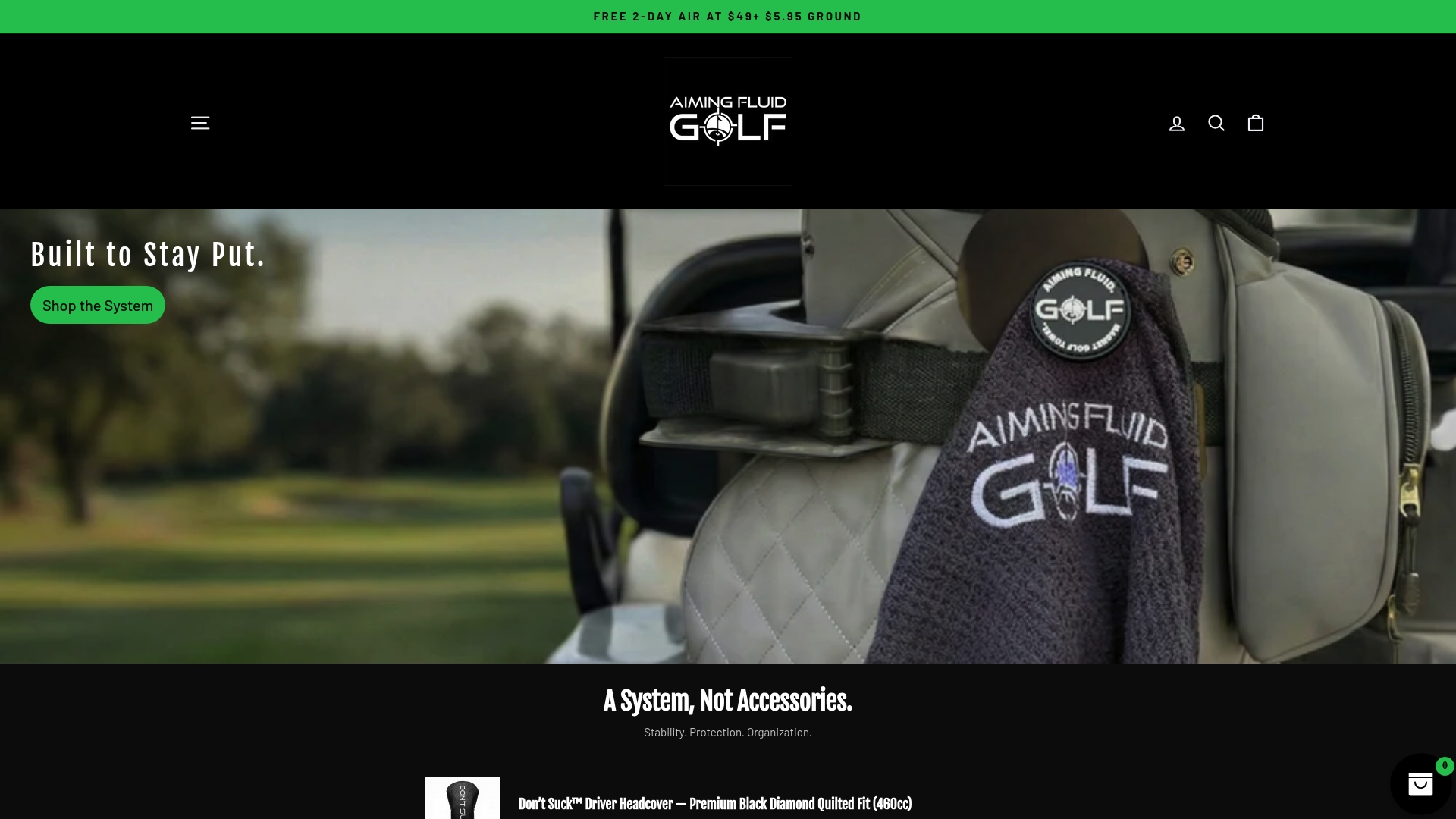
The core product families map directly to penalty-friendly criteria:
- Magnetic golf towels: Passive attachment, instant access, no electronic components — the definition of a rules-safe accessory.
- Precision tees: Molded composite construction, consistent performance, no adjustable mechanism.
- Divot tools: Maintenance-only function, no play-affecting feature.
- Luxury utility pouches: Secure zippered closure and 360-degree metal clip keep valuables organized without repositioning risk.
Browse the full accessory lineup to find organization-first gear built with tournament compatibility in mind. As always, confirm your event’s local rules before competitive play.
Useful sources and further reading
These primary and expert sources cover the rule text and practical guidance referenced throughout this article.
- USGA Rule 4 — The Player’s Equipment: The authoritative rule text governing equipment use, including Rule 4.3 on allowed and prohibited uses. Start here for any equipment question.
- MyGolfSpy — Ball Hits Your Bag or Equipment: Is It a Penalty?: Clear explanation of Rule 11.1 and the 2019 changes that removed penalties for most accidental deflections.
- Golf Digest — Using Powder/Dry Grips: Legal, Penalty or Not?: Rules review confirming that towels, resins, and drying powders are permitted under Rule 4.3(a)(5).
- Golf.com — 6 Ways Your Golf Gear Could Be Illegal: Practical breakdown of equipment violations, including adjustable components and performance-altering changes mid-round.
- GCAA Rules Corner — Unusual Equipment and Unusual Use of Equipment: Expert guidance on training aids, unusual equipment, and the pre-round ruling process.
- Golf.com Rules Guy — Borrowed Tee: Confirms that sharing non-club equipment (tees, towels, rangefinders) carries no penalty.
Note: Event-specific local rules may restrict items that the base USGA rules permit. Always obtain and read the local rules sheet before any competitive round.


