


TL;DR:
- A golf routine system is a structured sequence of mental and physical steps performed before each shot to ensure consistency. It involves three phases—decision, alignment, and execution—that should be completed within 10 to 20 seconds to be effective. Practicing and applying this routine to every shot, including short putts, builds automaticity and improves pressure management.
A golf routine system is a defined sequence of mental and physical steps performed before every shot to produce consistent, confident execution. The system controls nerves, sharpens focus, and prepares the body for natural athletic movement. Research supports a 10–20 second duration per shot as the standard window for an effective pre-shot routine. PGA coaching frameworks and validated models like the STOP S.L.O.W. GO method confirm that a repeatable routine is the single most reliable tool for improving scoring consistency. Without a system, golfers default to reactive thinking, which produces erratic results.
What is a golf routine system and why does it matter?
A golf routine system is the structured process that replaces guesswork with a repeatable sequence before every shot. The industry standard term is “pre-shot routine,” and the broader system includes pre-round preparation, practice session design, and in-round execution habits. Together, these layers form a complete golf training system that governs how a golfer prepares mentally and physically from the parking lot to the final putt.
The core function of the system is nervous system regulation. When a golfer faces a pressure shot, cortisol and adrenaline spike. A consistent routine interrupts that stress response and redirects attention to the task. The STOP S.L.O.W. GO model, validated by the International Journal of Golf Science, was specifically developed to shift golfers from mind-wandering to goal-oriented focus. That shift is the mechanism behind every well-executed shot under pressure.
Golfers who skip a defined system often describe their game as “streaky.” That streakiness is not a talent problem. It is a preparation problem. A golf routine system solves it by creating a reliable mental and physical state before each swing.
What are the core components of an effective golf routine system?
Every effective pre-shot routine contains three phases: decision, alignment, and execution. Each phase has a specific job, and skipping any one of them breaks the chain.

Phase 1: Decision
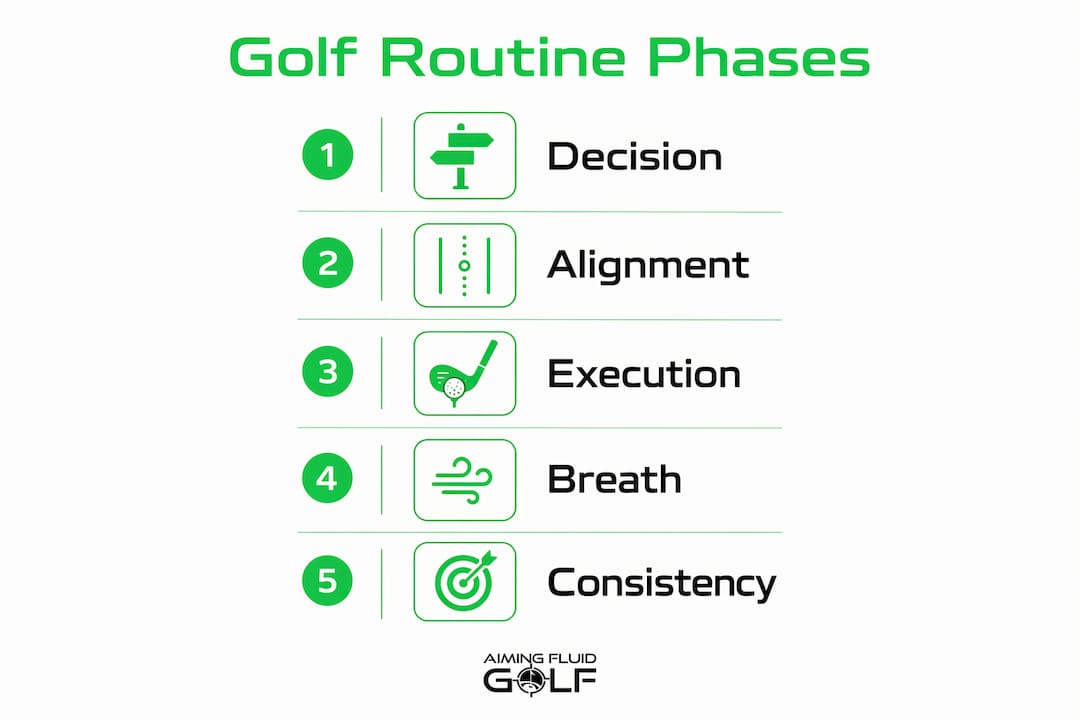
The decision phase happens behind the ball. You select your target, visualize the shot shape, and commit to a club. Commitment is the operative word. Indecision entering the alignment phase produces tension in the swing. Visualization during this phase activates the same neural pathways as physical practice, which is why elite players treat it as non-negotiable.
Phase 2: Alignment
The alignment phase begins when you step toward the ball. You pick an intermediate target, a spot on the ground 2–3 feet ahead of the ball on your target line, and use it to set your clubface. Body positioning follows: feet, hips, and shoulders align to the intermediate target. One or two practice swings belong here, focused on feel rather than mechanics.
Phase 3: Execution
The execution phase starts when you step into your stance. Swing mechanics should not enter your thoughts at this stage. Your only job is to trigger the swing within 3 seconds of settling into your address position. Hesitation beyond that window invites analytical thinking, which disrupts motor patterns. A forward press, a waggle, or a breath serves as the trigger.
- Decision phase: Target selection, shot visualization, club commitment
- Alignment phase: Intermediate target, body positioning, practice swings
- Execution phase: Swing trigger within 3 seconds, full trust in the process
Pro Tip: Take one slow, deliberate breath at the end of your alignment phase. Exhaling before you trigger the swing lowers shoulder tension and resets your nervous system in under two seconds.
Experts recommend timing your routine at 18–20 seconds total. Shorter than 10 seconds and you skip critical steps. Longer than 25 seconds and your muscles tighten from standing still.
How should you structure practice and pre-round routines?
A golf training plan that builds real consistency has two distinct layers: the pre-round warm-up and the practice session structure. Both require intentional design.
Pre-round warm-up
The most effective pre-round warm-up lasts 15–25 minutes. That window is enough to calibrate the nervous system, loosen the body, and establish rhythm before the first tee. A proper warm-up saves 2–4 strokes on opening holes by preventing the cold-start errors that plague the first three holes of most amateur rounds. The “parking lot warm-up” approach, where a golfer arrives at the first tee with no preparation, is one of the most common and costly habits in recreational golf.
When time is short, a condensed 5-minute version works: 3 minutes of dynamic stretching and 2 minutes of putting drills. That minimum activates the body enough to avoid injury and establish feel. For a full breakdown of warm-up steps, the golf warmup guide from Aimingfluidgolf covers 10 structured steps with recommended timeframes.
Practice session structure
- Warm-up block (10 minutes): Short irons, half swings, building to full tempo. No score-keeping.
- Skill block (20–30 minutes): One or two focused technical drills with clear success criteria.
- Skills games (10–15 minutes): Competitive drills with measurable targets, such as landing 7 of 10 chips within 3 feet. Skills games should occupy at least 20% of practice time for skills to transfer to the course.
- Finisher (5 minutes): Simulate on-course pressure by playing a 9-hole game on the putting green.
Optimal practice sessions last 30–60 minutes. Performance declines significantly beyond 45 minutes, which means two focused 45-minute sessions produce better results than one 90-minute grind. Quality of attention matters more than total time on the range.
Pro Tip: Practice your full pre-shot routine on every range shot, not just on the course. Golfers who repeat the full routine on every practice shot build the automaticity that holds up under tournament pressure.
What common challenges hinder effective golf routine development?
The most damaging mistake golfers make is treating the pre-shot routine as a vehicle for swing thoughts. Technical cues like “keep your elbow in” or “rotate your hips” belong on the practice range, not inside the routine. Swing mechanics during shot execution reduce performance by engaging the analytical brain at the exact moment the motor system needs to run freely.
Three other pitfalls consistently undermine routine development:
- Inconsistent application: Golfers use their routine on full shots but skip it on short putts and chip shots. Every shot deserves the same process. Selective use trains inconsistency.
- Timing drift: Routines that grow longer under pressure are a warning sign. A routine that takes 15 seconds in practice but 35 seconds on the 18th hole indicates the golfer is using the routine to delay rather than prepare.
- Mechanical confusion: Many golfers confuse the decision phase with the execution phase. Decision-making is analytical and deliberate. Execution is instinctive and physical. Mixing the two modes in the wrong phase produces paralysis.
“The routine is not a checklist you think through. It is a sequence you feel your way through. The moment you start auditing your own process mid-routine, you have already left the athletic state you were trying to reach.”
Self-monitoring helps. After rounds where the routine broke down, note which phase collapsed and under what conditions. That data reveals patterns. Patterns reveal fixes. Fixes get practiced. This is how nervous system rhythm regulation applies directly to golf: the body needs consistent cues to perform consistently.
How do you personalize and maintain your golf routine system long-term?
A golf routine system that feels unnatural will not survive pressure. The structure of the three phases is fixed, but the specific actions within each phase belong to you. Some golfers take two practice swings; others take none. Some use a verbal cue during alignment; others use a visual image. The goal is a sequence that produces calm and readiness, not one that matches someone else’s process.
- Film your routine: Record yourself on the range and on the course. Compare the two. Differences in timing or body language reveal where pressure is changing your behavior.
- Time every routine: Use a stopwatch during practice sessions to confirm your routine stays within the 18–20 second window. Drift in either direction signals a problem.
- Apply it to every shot: Chips, putts, and bunker shots all get the full routine. Selective use is the fastest way to erode the habit.
- Reflect after pressure situations: After a round where you felt tight, identify the exact moment the routine changed. That moment is your training target for the next session.
PGA pro Tom Patri frames long-term skill development around Process, Practice, Patience, and Persistence. He notes that slow-motion repetitions may feel worse before they feel better, because they disrupt ingrained habits. The same principle applies to routine building. The first 20 rounds with a new routine will feel mechanical. By round 40, it becomes automatic. Automatic is the goal.
Pro Tip: Set a measurable target for routine consistency: aim to complete your full routine on 90% of shots during a practice round. Track it on your scorecard. The act of measuring accelerates the habit.
For a structured approach to building this habit across sessions, the step-by-step practice guide from Aimingfluidgolf provides a session-by-session framework.
Key Takeaways
A golf routine system is the most reliable structure a golfer can build to produce consistent performance across every round and every shot type.
| Point | Details |
|---|---|
| Define the three phases | Every routine needs a decision phase, an alignment phase, and an execution phase in that order. |
| Target 18–20 seconds | Routines shorter than 10 seconds skip steps; routines longer than 25 seconds create muscle tension. |
| Practice the full routine on every shot | Applying the routine to chips and putts builds the automaticity that holds under pressure. |
| Keep practice sessions under 45 minutes | Attention and skill acquisition decline sharply beyond 45 minutes; shorter sessions yield better results. |
| Eliminate swing thoughts at execution | Technical cues belong on the range, not inside the routine, where they disrupt natural athletic movement. |
Why routines matter more than most golfers realize
Most golfers I observe on the course have a routine in name only. They stand behind the ball, take a glance at the target, and swing. That is not a system. That is a habit of skipping the system.
What surprises me is how quickly a real routine changes the experience of a round. The calm that comes from a consistent process is not psychological fluff. It is a measurable shift in how the body responds to pressure. Golfers who commit to a defined sequence report that difficult shots feel less threatening, not because the shots get easier, but because the preparation becomes familiar.
The part most golfers resist is applying the routine to every shot, including a 2-foot putt in a casual round. That resistance is exactly why their game stays inconsistent. The routine only becomes automatic when it is practiced without exception. Coaches who follow the four Ps framework, Process, Practice, Patience, and Persistence, understand that the boring repetitions are the ones that actually change behavior.
My honest observation: golfers who build a real routine system stop blaming their swing and start managing their preparation. That shift in focus produces better scores faster than any swing change.
— Gary
Gear that supports your golf routine and preparation
A well-built routine depends on preparation, and preparation depends on having the right gear ready when you need it. Aimingfluidgolf designs accessories specifically to keep your equipment organized, accessible, and ready for every shot.

From magnetic golf towels that attach instantly to your bag without searching, to precision tees and a 5-in-1 divot tool that keeps your kit tight and functional, every product is built to remove friction from your pre-shot process. When your gear is organized, your attention stays on your routine. Explore the full range of expert-picked golf accessories at Aimingfluidgolf and find the tools that match how you play.
FAQ
What is a golf routine system?
A golf routine system is a repeatable sequence of mental and physical steps performed before every shot to produce consistent execution. It typically includes a decision phase, an alignment phase, and an execution trigger, completed within 10–20 seconds.
How long should a pre-shot routine take?
Experts recommend 18–20 seconds as the optimal total duration. Routines shorter than 10 seconds skip critical preparation steps, while routines longer than 25 seconds cause muscle tension and invite overthinking.
What is a good golf warm-up routine before a round?
A full pre-round warm-up lasts 15–25 minutes and includes dynamic stretching, short iron work, and putting drills. When time is limited, a 5-minute version with 3 minutes of stretching and 2 minutes of putting provides a functional minimum.
Should I use my routine on every shot, including short putts?
Yes. Applying the full routine to every shot, including chips and short putts, builds the automaticity that holds up under pressure. Selective use trains inconsistency and weakens the habit when it matters most.
How long does it take to make a golf routine automatic?
Building a fully automatic routine typically requires consistent application across many rounds and practice sessions. PGA pro Tom Patri’s four Ps framework, Process, Practice, Patience, and Persistence, frames this as a long-term commitment where early repetitions feel mechanical before the habit becomes instinctive.


