


TL;DR:
- Proper golf bag organization prevents gear loss by assigning each pocket a single purpose and using dedicated pouches. Implementing a five-minute post-round reset and marking valuables greatly reduces the risk of losing essential items on the course. Magnetic towel systems and robust accessories enhance visibility and accessibility, ensuring gear stays within reach during play.
Stop losing gear mid-round by doing five things before you tee off: assign every bag pocket a single purpose, store small items in a dedicated pouch, attach a magnetic towel and landing-pad system, mark or label valuables, and run a five-minute reset after every round. These five steps address the root causes of on-course loss — clutter, inconsistent storage, and no end-of-round audit. Vela Green notes that overstuffed pockets are a leading, avoidable cause of lost gear because clutter hides small items and breaks consistent storage habits. Premium organizers like Aimingfluidgolf’s magnetic systems and leather utility pouches are built specifically around these failure points.
Do these right now:
- Assign each pocket one category only (tees, balls, valuables, wet gear)
- Move tees, ball markers, and divot tools into a dedicated pouch or clip-on organizer
- Attach a magnetic towel and landing pad to your bag or cart frame
- Write your name or phone number on your valuables pouch and rangefinder
- Schedule a five-minute bag audit after every round
Table of Contents
- What should you check before every round to prevent gear loss?
- How should you set up your bag so small items stay visible?
- Where should tees, markers, and divot tools actually live?
- How do magnetic towel systems actually reduce lost gear?
- How do labeling and redundancy stop permanent gear loss?
- Which on-course habits cut gear losses the most?
- What should you do the moment you notice something is missing?
- How does premium organizer design actually reduce lost gear?
- Key Takeaways
- Why organization is the part of golf most golfers underestimate
- Aimingfluidgolf gear that solves these problems directly
- Sources and further reading
What should you check before every round to prevent gear loss?
A 60–90 second pre-round checklist catches problems before they become losses. Run it once at the car or bag drop, and you will rarely leave the course missing something.
- Pockets assigned — confirm each pocket holds only its designated category
- Magnets attached — verify the towel is clipped and the landing pad is docked
- Spares loaded — at least six tees, two ball markers, and one spare divot tool
- Valuables secured — phone, wallet, and keys in the lined valuables pocket, zipper closed
- Tees and markers — in the small accessory pouch, not loose in a ball pocket
- Rangefinder — in its own pocket or pouch, not resting on top of a club
- Putter — in its dedicated well, not leaning against the bag
Pro Tip: Inspect zippers, magnetic housings, and bag clips for wear before every round. A fraying zipper or a weakened magnet housing is a failure mode waiting to happen. Swap worn hardware before it drops something important on hole four.
How should you set up your bag so small items stay visible?
Assign every pocket a single purpose, and keep that assignment identical round after round. When your tee pocket always holds tees and nothing else, a missing tee is immediately obvious. When that same pocket also holds scorecards, a glove, and a granola bar, a missing divot tool disappears without a trace.
Bag setup guides consistently recommend assigning one pocket per category so golfers always know where an item lives. Use a multi-way full-length divider system for clubs: long irons and woods at the top, irons in the middle, wedges near the bottom, putter in its own well. Assigning clubs to consistent divider slots makes a missing club immediately obvious at the end of a hole.
“Overstuffed pockets make small items hard to see and are a frequent, avoidable cause of on-course loss. Dedicated pouches for tees and markers solve this directly.” — Vela Green, Golf Bag Organization 2026
A practical pocket map for a premium player:
- Top/side pocket: balls only
- Small accessory pocket: tees, markers, divot tool (in a dedicated pouch)
- Lined valuables pocket: phone, wallet, keys
- Apparel pocket: glove, rain jacket
- Lower pocket: snacks, water bottle, extra balls
- External hook or magnetic mount: towel
High-use items belong near the top or side; bulk and wet gear go in larger lower compartments. That placement hierarchy reduces rummaging and keeps the items most likely to be set down and forgotten within arm’s reach.
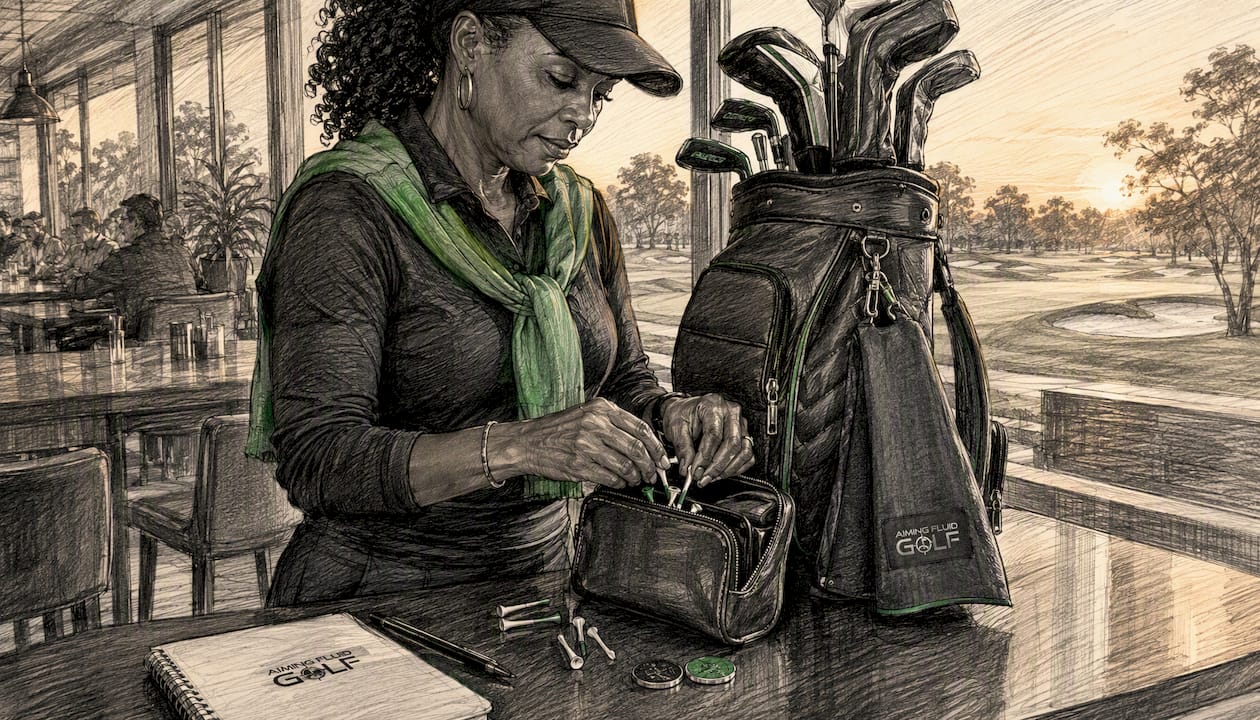
Where should tees, markers, and divot tools actually live?
Store small items in a dedicated pouch or built-in organizer, never loose in a general pocket. A loose tee in a ball pocket is one rummage away from the fairway grass. A tee in a zippered accessory pouch stays there until you reach for it deliberately.
Pouch options by mounting style:
- Zippered leather pouch — clips to the bag exterior via a 360-degree metal clip; best for valuables and markers
- Mesh pouch — lightweight, breathable, good for tees and spare balls
- Magnetic clip-on pod — attaches to cart frame or bag rail; single-handed detach and reattach
- Built-in accessory pocket — works when the pocket has a single assigned purpose and is not overstuffed
Aimingfluidgolf’s premium leather utility pouch addresses the valuables problem directly: a soft interior lining protects phone and wallet, a secure zipper closes the compartment, and a 360-degree metal clip keeps it fixed to the bag exterior where it stays visible. For tees, the DO NOT SUCK™ precision tees come in a 50-pack, giving you enough spares that running out mid-round is not a realistic scenario.
Pro Tip: Keep a small clear pouch for spare tees and markers so you can see the contents at a glance without opening it. Use a separate, opaque lined pouch for phone and wallet — the distinction between “consumables” and “valuables” storage is worth maintaining.
How do magnetic towel systems actually reduce lost gear?
Magnetic towels and landing pads keep your towel and small metal accessories within sight and single-hand reach at all times. That visibility is the mechanism: an item you can see is an item you do not leave behind.
Magnetic towels attach quickly to metal surfaces and stay where you place them, reducing the bending and searching that typically leads to forgotten towels. The pace-of-play benefit is direct: no searching through a bag pocket, no towel dropped on the green and walked away from.
“Magnetic towel systems directly reduce the amount of searching and bending during a round, which lowers the likelihood of leaving towels or clip-on accessories behind.” — Sinking Birdies
Aimingfluidgolf’s magnetic towel and landing-pad system is built around three design choices that support retention:
- Wash pocket — built into the towel for a ball or tee, reducing the number of separate items you need to track
Multiple guides recommend hanging towels externally rather than stuffing them in pockets — the towel stays drier, more visible, and far less likely to be left at the green. Pair the magnetic towel with a landing pad on the cart frame and you have a fixed retrieval zone for every hole.
How do labeling and redundancy stop permanent gear loss?
Always carry small redundancies and mark personal items so that found items are returned quickly. Permanent loss usually happens when an item has no identifying mark and no spare exists to replace it.
Practical labeling and redundancy tactics:
- Write your name and phone number inside the valuables pouch and on the rangefinder strap
- Use a custom-engraved or uniquely colored ball marker so it is identifiable if found
- Color-code tees or apply a sticker band to your rangefinder for quick visual ID
- Carry a Bluetooth tracker (Apple AirTag or Tile) inside the valuables pouch for phone and rangefinder recovery
- Keep a duplicate set of tees, markers, and a spare divot tool in your car for travel days
Bluetooth trackers are useful for high-value items; however, low-tech redundancy and labeling solve the majority of loss cases for everyday accessories. A spare set of tees costs almost nothing. Losing a $400 rangefinder with no ID mark and no tracker costs considerably more.
Pro Tip: A designated valuables pocket — velour-lined or zippered — reduces anxiety over expensive items and makes them easier to locate after a round. Guides recommend using a small zippered pouch inside that pocket for an additional layer of containment.
Which on-course habits cut gear losses the most?
A few reliable habits deliver the biggest reduction in lost gear: check the bag at key moments, use single-handed retrieval zones, and perform a brief spot-check after every green.
- Before leaving the tee box — confirm the headcover is on and the tee pouch is closed
- After every shot — return the club to its assigned divider slot before walking
- Approaching the green — move only what you need (putter, ball marker, towel) and leave the bag in a fixed spot
- After replacing the flagstick — check the green for ball markers and tees before walking to the next tee
- Exiting the cart — scan the seat and floor for any items set down during the hole
- After the round — run the five-minute reset: clear trash, check every pocket, confirm magnetic tools are docked
Tie the green check to an existing action: always inspect your pockets while replacing the putter cover. That pairing builds the habit without requiring separate mental effort. For amateur golfers planning a full season, building these micro-habits early in the year pays dividends across every round.
Pro Tip: Communicate with your playing partners. Ask them to flag it if they see you leave something on the green or in the cart. Two sets of eyes catch what one misses, and the social accountability makes the habit stick faster.
What should you do the moment you notice something is missing?
Stop, retrace the last few actions, check every pocket and pouch, scan the immediate hole area, notify the starter or clubhouse, and log the missing item for follow-up. Speed matters: the sooner you act, the higher the recovery odds.
- Stop and check pockets first — the item is often in the wrong pocket, not actually lost
- Retrace the last 3–5 minutes — mentally replay the last shot, the green, and the cart
- Scan the tee box, fairway, and green from the last hole
- Ask playing partners to re-walk the last hole with you if the item is high-value
- Notify the starter or pro shop immediately with a specific description: color, brand, any unique mark
- Check the course lost-and-found before leaving the property
- Log the item with your name and contact information at the clubhouse
Pro Tip: If you attached a Bluetooth tracker to the valuables pouch, open the app immediately — most trackers show the last known location on a map. Give the course staff a precise description rather than a generic one: “black Aimingfluidgolf leather pouch with diamond stitching and a 360-degree metal clip” recovers faster than “a small black bag.”
How does premium organizer design actually reduce lost gear?
Aimingfluidgolf’s combination of strong magnet housings, purpose-built pouch geometry, and durable closures materially reduces lost gear by making items visible, clipped, and easy to return after every use. The design logic is not cosmetic — each feature targets a specific failure mode.
Design dimensions that matter:
- Magnet housing strength — rated for single-handed detach and reattach; a weak magnet that requires two hands slows retrieval and gets bypassed, which means the towel ends up in a pocket instead
- Clip orientation — a 360-degree metal clip keeps the pouch stable on the bag rail regardless of bag angle on a slope
- Dedicated valuables lining — soft interior prevents phone screen abrasion and keeps the pocket from doubling as a general-purpose dump zone
- Zipper quality — a heavy-gauge zipper on the leather utility pouch does not fail mid-round the way a thin nylon zip does
- Pouch geometry — a pouch sized for its contents keeps small items from shifting and disappearing under larger ones
“Premium organizer design choices that materially reduce loss include magnet housing strength rated for single-handed detach/attach, lined valuables pockets with secure zips, pouch geometry that keeps small items from shifting, and dedicated external mounting points for towels and landing pads.” — Aimingfluidgolf design rationale
Gary, Aimingfluidgolf’s gear contributor, notes that the magnetic towel’s wash pocket is one of the most underrated retention features: storing a ball or tee inside the towel itself removes one more item from the “things I might set down and forget” category. The leather utility pouch and magnetic towel collection are the two products that address the widest range of loss scenarios in a single purchase.
Key Takeaways
Preventing gear loss on the course comes down to three durable habits: assign every pocket a single purpose, use magnetic and pouch systems to keep items visible, and run a five-minute reset after every round.
| Point | Details |
|---|---|
| Pocket assignment | Give each pocket one category only; clutter is the primary cause of small-item loss. |
| Magnetic systems | A magnetic towel and landing pad keep your towel visible and retrievable with one hand, reducing forgotten items. |
| After-round reset | A five-minute end-of-round audit — clear trash, check pockets, dock magnetic tools — is the single most effective loss-prevention habit. |
| Redundancy and labeling | Carry spare tees and markers; mark valuables with ID so found items are returned quickly. |
| Aimingfluidgolf gear | The leather utility pouch, magnetic towel, DO NOT SUCK™ tees, and 5-in-1 divot tool each target a specific gear-loss failure mode. |
Why organization is the part of golf most golfers underestimate
Most golfers treat bag organization as a housekeeping task. It is not. It is a pace-of-play variable and a focus variable, and both affect how you actually play.
Every time you rummage for a tee, set a towel on the green and walk away, or spend two minutes at the cart looking for your ball marker, you are breaking concentration at exactly the moment you need it most — between shots. The golfers who play with the most confidence are rarely the ones with the best swing mechanics alone. They are the ones who know where everything is, retrieve it without thinking, and move on.
The after-round reset matters for the same reason. A bag that gets audited after every round never becomes the junk drawer that hides a divot tool under three broken tees and a rain glove. Consistent maintenance is what separates a bag that works for you from one you are constantly fighting. For tournament players focused on pace of play, this discipline is non-optional — but recreational golfers gain the same benefit every time they step on the course.
Aimingfluidgolf gear that solves these problems directly
The five products below map directly to the loss scenarios covered in this article. Each one targets a specific failure mode rather than adding bulk to your bag.

- Magnetic towel + landing-pad system — keeps the towel on the cart frame or bag rail, visible and single-hand accessible; eliminates the “towel left on the green” scenario entirely
- Leather utility pouch — soft-lined interior, heavy-gauge zipper, and 360-degree metal clip; the right solution for phone, wallet, and keys on any round
- DO NOT SUCK™ precision tees — 50-pack volume means you carry enough spares that running out is not a loss scenario; visible, durable, and consistent
- 5-in-1 divot tool — multi-function redundancy in a single clip-on tool; fewer items to track, fewer items to lose
Browse the full golf accessories collection to find the combination that fits your bag setup. Check magnet housing strength and pouch fit before purchasing — those two dimensions determine whether a product actually stays where you put it.
Sources and further reading
- How To Organize Your Golf Bag: A Complete Guide — Golf Guide Book — divider strategy, pocket placement, valuables pockets, and Bluetooth tracker guidance
- How to Organize Your 14-Divider Golf Bag — The Golf Hub — single-purpose pocket assignment and divider slot consistency
- 10 Ways to Avoid Lost Golf Gear This Season — Aimingfluidgolf — expanded practical advice for keeping equipment tracked during play
- Organization Strategies for Amateur Golfers That Work — Aimingfluidgolf — deeper pocket assignment and bag-setup strategies
- On-Course Gear Retrieval: Techniques for Efficient Play — Aimingfluidgolf — retrieval techniques used by low-handicap players


