


TL;DR:
- Golf scoring accessories include counters, scoreboards, digital scorekeepers, and organizational gear. Matching the tool to your play style and complying with USGA rules can enhance pace and focus on the course. Organizational accessories prioritize workflow, making scoring easier and more reliable during rounds.
Golf scoring accessories fall into four distinct categories: on-body and clip-on counters, portable or post-mounted scoreboards, digital remote-operated scorekeepers, and supporting organizational gear such as magnetic towel systems, ball markers, and utility pouches. For performance-focused golfers, the clearest recommendation is to anchor your setup with organizational accessories first, then layer in a counter or display that matches your mounting preference and USGA compliance requirements.
Quick-scan taxonomy:
- On-body/clip-on counters — worn on the belt, wrist, or bag strap; manual click or dial operation
- Portable and table scoreboards — tabletop flip cards, folding scorer tables, fence-mounted boards
- Digital remote-operated scorekeepers — USB-rechargeable displays with wristband or waistband remotes
- Organizational support gear — magnetic towels, landing pads, metal ball markers, multi-tools, utility pouches
Table of Contents
- What are the main types of scoring accessories for golfers?
- How do you choose the right scoring accessory?
- How scoring accessories improve pace of play and focus
- What USGA rules apply to score-keeping accessories?
- Installation, care, and maintenance for scoring accessories
- How Aimingfluidgolf products work with your scoring setup
- Key Takeaways
- Why organization beats gadgetry every time
- Aimingfluidgolf’s picks for scoring and organization
- Useful sources and further reading
What are the main types of scoring accessories for golfers?
Each category serves a different play context. Understanding the mechanical differences helps you match the tool to the round.
On-body and clip-on counters
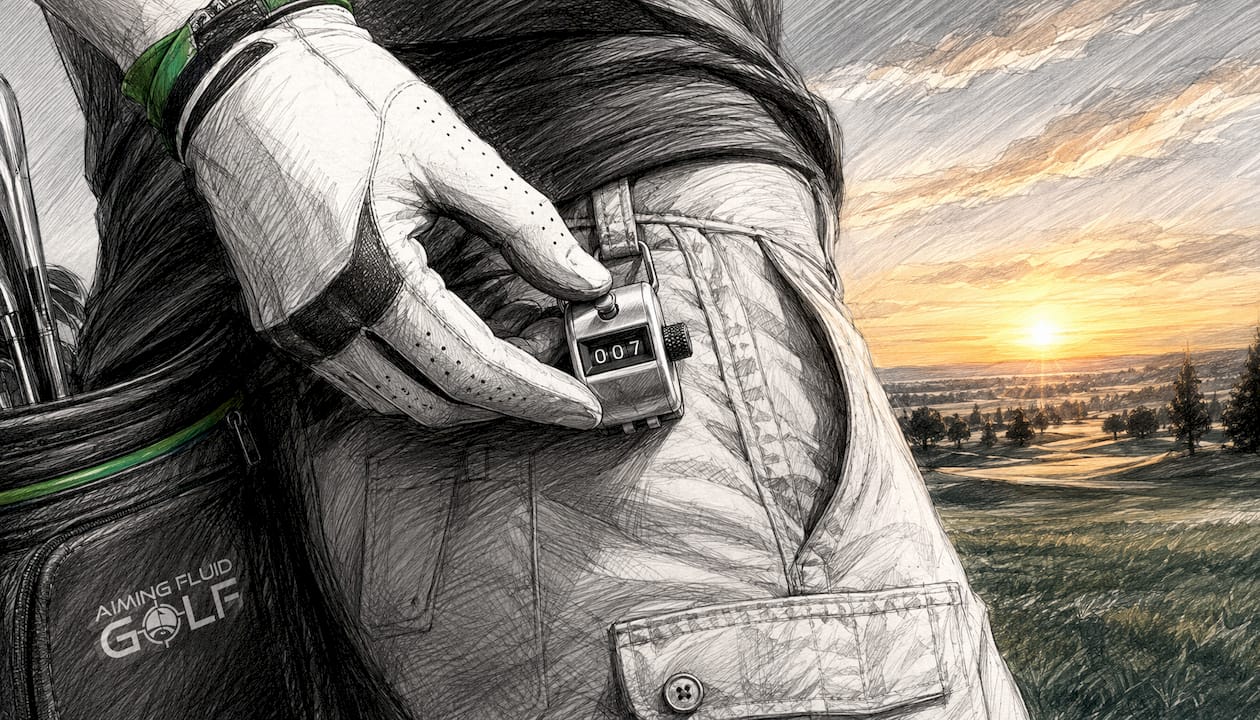
These are the smallest and most portable scoring tools available. They attach to a belt, bag strap, or glove, and most operate with a single click or dial rotation per stroke. The core advantage is that you never break your pre-shot routine to record a number. On-racquet units in racket sports are very lightweight, and golf-specific clip counters are similarly minimal. The tradeoff is a small display that can be hard to read in bright sunlight, and most lack memory for multi-hole tracking.
Portable and table scoreboards
Tabletop flip-card scoreboards and folding scorer tables serve club events, league play, and officiated rounds. Facility managers treat scorer tables as central command points that keep timers, scorebooks, and communication tools organized and protected, reducing downtime caused by clutter. Fence-mounted boards extend this concept to spectator-facing scoring. These solutions are durable and visible at distance, but they require a fixed position and are impractical for solo or walking rounds.
Digital remote-operated scorekeepers
Remote-operated systems include a USB-rechargeable display and a one-click remote worn on the waistband or wrist. These systems typically offer both a fence mount and a standard 1/4" tripod mounting point, giving you flexibility beyond a single fixed location. The display stays visible from several feet away, and scoring requires no break in concentration. Battery management is the main maintenance consideration.
Organizational support gear
Magnetic towel systems, landing pads, metal ball markers, multi-tools, and utility pouches are not scorekeepers in the traditional sense, but they directly affect scoring workflow. When your ball marker is always in the same pocket and your towel snaps back to its landing pad in one motion, you spend less time searching and more time focused on the next shot. Magnetic towel and landing pad systems allow instant access and return without digging through the bag.
| Type | Best use case | Key pros | Key cons |
|---|---|---|---|
| Clip-on/on-body counter | Walking rounds, solo practice | Minimal weight, hands-free | Small display, limited memory |
| Table/post scoreboard | Club events, league play | High visibility, organized | Fixed position, not portable |
| Digital remote scorekeeper | Cart rounds, competitive play | Remote operation, flexible mount | Charging required, higher cost |
| Organizational gear | All round types | Speeds workflow, reduces errors | Not a standalone scoring solution |
How do you choose the right scoring accessory?
The decision comes down to five variables. Work through them in order before you buy.
- Play frequency and format. Competitive golfers who play multiple rounds per week benefit from a digital remote system with memory and display. Casual players often need nothing more than a clip counter and a reliable ball marker.
- Mounting preference. Decide whether you need hands-free wrist operation, cart-mounted display, or fence visibility. Accessories with a standard 1/4" mounting point attach to camera tripods, post mounts, and other inexpensive hardware, giving far more ergonomic flexibility than proprietary fence-only brackets.
- Weather and material durability. US coastal courses expose gear to salt air; inland summer rounds mean direct UV exposure for hours. Outdoor scoring accessories should use weather-resistant materials and UV-stable components to prevent premature fading and brittleness. Avoid slide-card systems with non-UV-stabilized plastics if you play more than a few rounds per season outdoors.
- Power and servicing. Rechargeable systems reduce long-term cost but require a charging routine. Disposable-battery counters are simpler but create ongoing supply needs. Confirm replacement-part availability before committing to a less common brand.
- USGA compliance. Any device that measures slope, wind, or provides advice is prohibited in most competitive formats. A simple stroke counter or score display is generally permitted. Verify with your local committee before an official event.
Pro Tip: Before purchasing a digital scorekeeper, confirm that its mounting thread matches the 1/4"-20 camera standard. That single specification determines whether you can use any off-the-shelf tripod or post mount, or whether you are locked into the manufacturer’s proprietary bracket.
How scoring accessories improve pace of play and focus
Slow play is rarely about slow swings. Most delays come from disputes, lost gear, and the mental overhead of tracking numbers without a reliable system. Remote-controlled scorekeepers eliminate the need to shout scores or walk to a central board, producing a measurably smoother match experience with fewer interruptions.
The compounding effect is real. Consider a four-ball casual round where one player uses a wrist counter, another uses a phone app, and two are relying on memory. By the 12th hole, at least one dispute is likely. A shared visible display removes that friction entirely.
Organizational gear compounds these gains. Tailored accessories speed on-course routines by keeping every tool in a predictable location. When your ball marker is clipped to your landing pad and your towel snaps back magnetically, the 15-second search per hole disappears. Across 18 holes, that adds up to meaningful time recovered.
- Fewer scoring disputes per round with a visible shared display
- Faster green-to-tee transitions when markers and tools are immediately accessible
- Reduced mental load from memory-based scoring, freeing concentration for shot execution
- Consistent pre-shot routine preserved when counters require no stance break
What USGA rules apply to score-keeping accessories?
The USGA draws a clear line between tools that record information and tools that assist decision-making. Stroke counters and score displays fall on the permitted side. Devices that measure wind speed, slope, or provide club recommendations cross into prohibited territory under Rule 4.3.
Practical compliance checklist:
- Clip-on stroke counters: generally permitted in all formats
- Digital score displays (display only, no advice function): generally permitted
- GPS devices showing distance only: permitted under most local committee decisions
- Devices measuring slope or wind: prohibited unless the committee has adopted the Local Rule allowing distance-measuring devices
- Any device that recommends a club or shot: prohibited in all formats
One rule of thumb: if the device outputs a recommendation rather than a measurement, it is almost certainly prohibited. If it only shows you a number you could have calculated yourself, it is likely fine.
Pro Tip: Always carry a paper scorebook or a simple clip counter as a backup for official events. Local committee decisions can restrict even permitted devices, and a disqualification for a dead battery is entirely avoidable.
Installation, care, and maintenance for scoring accessories
Proper setup and routine care extend the lifespan of every scoring tool you carry.
- Install clip-on counters on a bag strap or belt loop that stays stationary during your swing. A counter that shifts position mid-round is one you will stop using.
- Mount digital displays using the 1/4" thread when possible. Tighten the mount before each round; vibration from cart travel loosens connections over time.
- Charge rechargeable units the night before play, not the morning of. Most USB-rechargeable scorekeepers reach full charge in a few hours, and a partial charge is a reliability risk.
- Clean magnetic surfaces on towels and landing pads with a damp cloth after muddy rounds. Grit trapped in the magnetic interface reduces pull force and causes premature wear on the fabric backing.
- Protect UV-exposed plastics by storing scoreboards in a bag or case between rounds. Direct sun through a car windshield accelerates degradation faster than outdoor play.
- Check all fasteners before each round. A fence mount that felt secure last week may have loosened after temperature swings.
Pro Tip: Use standardized 1/4"-20 camera mounts throughout your setup. When a bracket fails, any camera shop or online retailer carries a replacement for a few dollars. Proprietary mounts often require a direct order from the manufacturer and a multi-week wait.
How Aimingfluidgolf products work with your scoring setup
The most effective scoring systems are not built around a single gadget. They are built around a workflow where every tool has a fixed location and returns to it automatically.
Aimingfluidgolf’s product line is designed around exactly that principle. The magnetic golf towel and landing pad system snaps the towel back to its mount in one motion, so you are never searching for it between shots. The leather utility pouch carries a clip-on counter, spare ball markers, and a remote control in one secure, clipped location on your bag.
Practical pairings by round type:
- Four-ball casual round: Clip-on counter on the bag strap + magnetic landing pad for ball markers + leather utility pouch for the remote
- Club match or competitive round: Digital remote scorekeeper mounted at cart level + metal ball markers clipped to the landing pad + DON’T SUCK™ precision tees pre-loaded in the pouch
- Solo practice: On-body counter on the belt + 5-in-1 multi-tool for green repair + magnetic towel for quick club cleaning between shots
The 5-in-1 multi-tool handles divot repair, ball marking, and groove cleaning without requiring you to open the bag. Metal ball markers stay flat and visible on the green, reducing the chance of a misplaced mark causing a scoring error. The DON’T SUCK™ precision tees standardize tee height, which removes one variable from the pre-shot routine and keeps the pace moving.
Pro Tip: Clip the leather utility pouch to the same D-ring every round. Muscle memory for gear location is as valuable as muscle memory for your swing.
Key Takeaways
The right scoring accessory is the one that matches your format, mounting preference, and USGA requirements, then pairs with organizational gear that keeps every tool immediately accessible.
| Point | Details |
|---|---|
| Match type to format | Clip counters suit walking rounds; digital remote systems suit cart play and competitive formats. |
| Prioritize 1/4" mounts | Standard camera-thread mounts offer far more placement flexibility than proprietary fence brackets. |
| Check USGA compliance | Devices that display scores are generally permitted; devices that recommend shots or measure slope are not. |
| Organizational gear compounds gains | Magnetic towels, landing pads, and utility pouches reduce per-hole search time and support consistent scoring workflow. |
| Aimingfluidgolf system | Magnetic towel, landing pad, metal markers, DON’T SUCK™ tees, 5-in-1 multi-tool, and leather pouch integrate directly with any scoring accessory type. |
Why organization beats gadgetry every time
Most golfers who struggle with pace of play are not missing a better scorekeeper. They are missing a system. A $200 digital display mounted to a cart does nothing for your round if you spend 20 seconds per hole locating your ball marker or wiping down a club with a towel that has slipped to the bottom of the bag.
The conventional wisdom in golf gear circles is that scoring technology is the fix. The more useful frame is that scoring technology is the last layer, not the first. Build the organizational foundation first: a magnetic towel that returns to the same spot, a pouch that holds your counter and markers in one place, metal markers that are heavy enough to feel in your pocket. Then add the scorekeeper that fits your format.
There is also a compliance dimension that gadget-focused guides tend to understate. The more features a scoring device has, the more carefully you need to read the USGA rules before carrying it into a competitive round. A simple clip counter never raises that question.
Aimingfluidgolf’s picks for scoring and organization
Aimingfluidgolf offers a direct answer to the organizational gap that undermines most scoring setups. The magnetic towel and landing pad system, metal ball markers, DON’T SUCK™ precision tees, 5-in-1 multi-tool, and leather utility pouch are available direct-to-consumer online, with no intermediary markup. Each product is designed to pair with the scoring accessory types covered in this guide, whether you carry a clip counter or a full digital remote system.
Browse the full curated lineup at Aimingfluidgolf’s expert picks and check product pages for mounting compatibility notes. If you want to see how these tools fit a fast-play philosophy, the 4-Hour Round Manifesto maps the full gear and habit system.
Useful sources and further reading
- Scoring Right — product data on on-body counter weight and attachment mechanics for at-a-glance scoring
- Scorbly Scorekeeper — specifications for digital remote-operated systems including mounting options and power details
- Gopher Sport Scoring Tables & Accessories — facility-management perspective on scorer tables as organized command points
- Tennis Court Supply Scorekeepers — material and durability guidance for outdoor scoring accessories
- PlayGoSports Outdoor Accessories — all-weather scoreboard and accessory options for outdoor play
- Aimingfluidgolf — Fast Golf Accessory Access — brand documentation of the magnetic towel and landing pad workflow
- Aimingfluidgolf — Best Golf Accessories — curated guide to penalty-free accessories that improve on-course performance
- USGA Rules of Golf, Rule 4.3 — primary authority for equipment and device compliance in official play


