


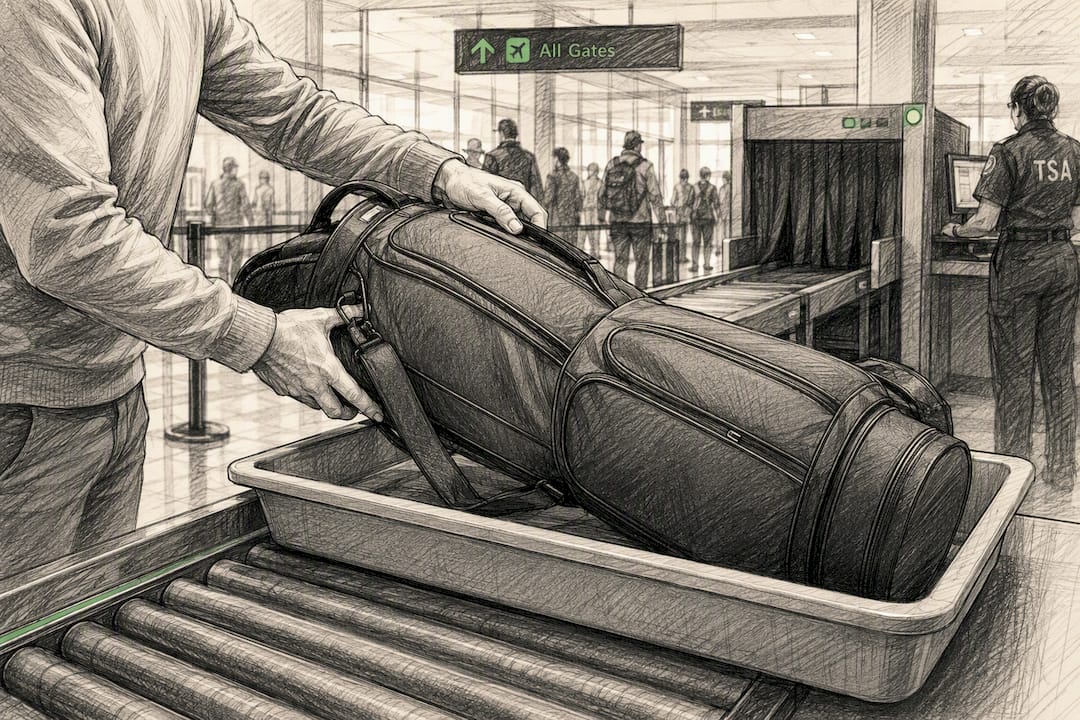
Golf clubs cannot go in carry-on luggage under any circumstance and must travel in checked baggage, per official TSA golf club guidance. Most small accessories clear security in either bag. Tees, golf balls, gloves, non-sharp divot tools, and metal ball markers are generally allowed in carry-on and checked luggage, though the officer at the checkpoint makes the final call on any specific item.
Before you head to the airport:
- Pack every club, including a single putter, in your checked golf bag.
- Keep rangefinders, GPS units, and other electronics in your carry-on to avoid damage.
- Photograph your bag’s contents before you leave home in case of a claims dispute.
- Confirm your airline’s specialty-equipment policy for golf bags before you book.
Quick fact: TSA’s sporting and camping guidance classifies clubs as items that can be used as bludgeons, which is why they’re barred from the cabin outright.
Key Takeaways
TSA compliance for golf gear comes down to one rule and one habit: clubs always get checked, and everything else stays organized and visible for inspection.
| Point | Details |
|---|---|
| Clubs are checked, no exceptions | Every golf club, including single putters, must go in checked baggage per TSA policy. |
| Small accessories usually clear carry-on | Tees, balls, gloves, markers, and non-sharp divot tools are generally allowed in either bag, subject to officer discretion. |
| Electronics belong in the cabin | Rangefinders and GPS units should travel in carry-on to avoid damage in the cargo hold. |
| Lock checked bags properly | A TSA-accepted lock, like those from Master Lock, lets agents inspect without cutting your lock off. |
| Aiming Fluid Golf keeps small gear organized | Utility pouches and magnetic towel systems from Aiming Fluid Golf speed inspections and protect valuables in transit. |
Table of Contents
- Which Golf Accessories Are Allowed in Carry-On and Checked Bags
- The Golf Clubs Rule: Why Every Club Must Be Checked
- Packing and Protecting Your Gear for the Flight
- How Airline Baggage Policies Affect Your Golf Bag
- What Happens if TSA Flags Your Golf Bag for Inspection
- A Travel-Ready Packing Checklist From Aiming Fluid Golf
- Why Most Travel Advice on This Topic Misses the Point
- Travel-Ready Gear That Makes Packing and Inspection Easier
- Sources
Which Golf Accessories Are Allowed in Carry-On and Checked Bags
Small gear generally moves through security without issue. TSA’s golf tees page confirms tees are fine in either bag, and the complete alphabetical items list does the same for golf balls. Here’s what typically sails through:
- Golf tees (wood, plastic, or bamboo)
- Golf balls, in any reasonable quantity
- Gloves
- Metal ball markers
- Divot tools without sharp or pointed blades
Rangefinders and GPS devices deserve separate handling. Nothing in TSA policy bans them from checked bags, but the batteries, lenses, and circuit boards inside make them poor candidates for the cargo hold, where temperature swings and rough handling do real damage. Carry them on instead.
TSA doesn’t cap how many tees or balls you can bring. That said, every item, no matter how ordinary, remains subject to officer discretion at the checkpoint. A divot tool with an unusually sharp edge or an oddly shaped ball marker can still get pulled for a closer look.

Pro Tip: Store your tees, markers, and divot tool in one small, clear pouch instead of loose in a pocket. Officers can glance at the contents and wave you through faster than if they have to fish items out one at a time.
The Golf Clubs Rule: Why Every Club Must Be Checked
TSA policy on this point leaves no gray area. Golf clubs of any type, including a single travel putter or a partial half set, cannot pass through the checkpoint and must go into checked baggage.
“Golf clubs” are not permitted in your carry-on bag. They are only allowed in checked baggage.
That’s the language straight from TSA’s own guidance, and it applies with no carve-out for length, weight, or how “harmless” a putter looks compared to a driver. The reasoning ties back to the same category that governs baseball bats and hockey sticks: anything long, rigid, and swingable qualifies as a potential bludgeon under TSA’s sporting equipment rules.
If someone tries to bring a club through the checkpoint anyway, the outcome is predictable. The officer refuses passage, and the traveler either walks back to the airline counter to check the item last-minute (often at a higher fee than pre-booking) or surrenders it. Neither option beats packing it correctly the first time.
Packing and Protecting Your Gear for the Flight
A checked golf bag takes a beating between the counter and the cargo hold. How you pack it determines whether your clubs and accessories survive the trip intact, so check out this away league match checklist for cross-sport tips on organizing and protecting your gear while traveling.
- Choose the right case. Hard travel cases protect against crushing and impact but add weight and bulk. Soft padded bags are lighter and easier to store but offer less defense against a rough baggage handler. If you’re checking premium clubs, the hard case earns its extra pounds.
- Lock it with a TSA-accepted lock. A Master Lock TSA-accepted lock lets agents open your bag with a master key if it’s flagged for inspection. Use a non-approved lock, and they’ll cut it off, leaving your bag unsecured for the rest of the flight.
- Photograph the contents before you close it. A quick series of photos documents what went in, which matters if anything goes missing or gets damaged in transit.
- Move electronics to your carry-on. Rangefinders, GPS devices, and anything with a lithium battery belong in the cabin, not the hold.
- Limit spare balls and extras. A sleeve or two is plenty. A dozen loose balls just adds weight you’ll pay for at the counter.
Pro Tip: A leather utility pouch keeps your ball markers, tees, and divot tool contained and visible in one spot, which matters more than most golfers realize when a bag gets opened for a secondary inspection. For more on avoiding common errors, see common golf gear packing mistakes to avoid.
How Airline Baggage Policies Affect Your Golf Bag
TSA controls what goes through security. Your airline controls what it costs to check that bag and how it gets handled once it’s out of your hands, and the two sets of rules don’t always align neatly.
Most major carriers classify golf bags as specialty sports equipment rather than standard luggage. American Airlines’ specialty and sports baggage policy is a good example: golf bags are accepted with specific size allowances, but they still count toward your checked-bag total and can trigger extra fees depending on weight and dimensions.
Watch for these common cost triggers:
- Standard checked-bag fees, which apply to a golf bag the same as any other suitcase.
- Overweight surcharges, which commonly kick in once a bag crosses the 50-pound threshold.
- Oversize fees for bags that exceed the carrier’s linear dimension limit.
- Special handling instructions for hard cases versus soft carry bags.
Call your airline or check its sports-equipment page before you fly. Policies vary enough between carriers that assuming last year’s rules still apply is a good way to get surprised at the counter.
What Happens if TSA Flags Your Golf Bag for Inspection
The TSA officer on duty has final discretion over anything that crosses the checkpoint, and that authority extends past the printed list of allowed and prohibited items. A tee that looks fine on paper can still get a second look if it’s packed oddly or triggers something on the scanner.
If your bag gets pulled for a physical check, here’s what typically happens:
- The officer asks you to open the bag or step aside while it’s searched.
- You may be asked to identify or explain higher-value items, so having a receipt or serial number handy speeds things along.
- Any non-TSA-approved lock gets cut rather than picked, so use an accepted lock from the start.
- Items get repacked, sometimes less carefully than you packed them, so a rigid case or organized pouch limits the damage.
Organized packing shortens this whole process. A bag where tees, markers, and a divot tool are all in one labeled pouch is easier to inspect and reassemble than one where loose items are scattered through side pockets.
A Travel-Ready Packing Checklist From Aiming Fluid Golf
Years of building gear meant to stay organized on the course translate directly to the airport. The same principles apply: know where everything is, protect what’s fragile, and don’t make an officer or a baggage handler guess.
- Photograph your bag’s contents before departure.
- Separate valuables (rangefinder, GPS watch, wallet) into your carry-on.
- Pack tees, markers, and a divot tool into one utility pouch rather than loose pockets.
- Use a magnetic towel and landing pad system so small accessories aren’t buried under gloves and headcovers.
- Lock your case with a TSA-accepted lock before it leaves your hands.
Pro Tip: A magnetic towel that snaps to a landing pad means you’re not digging through a jumbled side pocket when an officer asks you to show what’s inside. Everything has one place, and that place is obvious at a glance. For a fuller packing framework, see the golf bag essentials checklist.
Why Most Travel Advice on This Topic Misses the Point
Most guidance on flying with golf gear stops at reciting the rules: clubs get checked, tees are fine, don’t argue with the officer. That’s accurate, but it treats compliance and protection as the same problem when they’re not. TSA rules tell you what’s allowed. They say nothing about whether your $200 driver survives the baggage carousel intact.
The bigger risk isn’t getting a tee confiscated. It’s a scratched clubface, a lost rangefinder, or twenty extra minutes at the checkpoint because your bag looks like a junk drawer to the officer searching it. Compliance without organization still leaves you exposed.
What actually helps: pack electronics in the cabin, lock checked bags with TSA-accepted hardware, and keep small accessories contained instead of loose. That last piece gets underrated constantly. A bag that opens cleanly, with tees and markers in one visible pouch, moves through inspection faster than one where an officer has to hunt through side pockets. The rules matter, but how you pack around them matters just as much.
— Gary
Travel-Ready Gear That Makes Packing and Inspection Easier
Aiming Fluid Golf is built around one problem every traveling golfer knows: gear that’s hard to find is gear that’s hard to protect. A premium leather utility pouch keeps tees, ball markers, and a divot tool contained in one place, so opening your bag at a checkpoint takes seconds instead of minutes of digging through side pockets.

The magnetic towel and landing pad system solves a related problem: small accessories that shift around during transit and end up crammed under headcovers or lost in a bag’s bottom seam. Pair either with a hardshell case and a TSA-accepted lock, and your checked bag arrives the way you packed it.
If you’re outfitting your bag for a trip, start with the travel-ready accessories collection to see the utility pouches, magnetic towels, and precision tees built for exactly this kind of travel.
Sources
Recommended
- Penalty-Free Golf Accessories: USGA Rules and Buying Tips – Aiming Fluid Golf
- How to Carry a Divot Tool Safely on Course and in Flight – Aiming Fluid Golf
- On-Course Accessories Guide: Organize Your Golf Bag – Aiming Fluid Golf
- Fast Golf Accessory Access: Methods That Work on the Course – Aiming Fluid Golf


