


The most common rookie golf mistakes, at a glance
Most beginners struggle not because golf is impossibly hard, but because they repeat the same preventable errors. The top rookie golf mistakes fall into six categories, and recognizing them early is the fastest path to real improvement.
- Poor swing mechanics: Unstable head position, incorrect grip, and broken body sequence produce fat, thin, and topped shots consistently.
- Wrong club selection: Reaching for the driver first builds frustration instead of confidence.
- Unstructured practice: Hitting bucket after bucket without a plan reinforces bad mechanics rather than correcting them.
- Neglecting etiquette: Slow play, noise during swings, and unrepaired divots damage both the course and your reputation.
- Unrealistic expectations: Expecting rapid progress leads to frustration and early dropout.
- Poor course organization: Disorganized gear wastes time, breaks focus, and slows your group down.
Each of these errors compounds the others. A beginner who swings poorly, practices without purpose, and shows up disorganized will struggle to enjoy the game, let alone improve. The sections below address each mistake with specific, correctable guidance.
Table of Contents
- 1. Swing, club selection, and practice mistakes you need to stop making
- 2. Golf etiquette essentials every beginner should know
- 3. Managing expectations and frustration as a beginner
- 4. How the right accessories reduce rookie errors on the course
- 5. Poor course management and shot selection
- 6. Why neglecting physical fitness hurts your golf game
- 7. Ignoring the mental game costs you more than bad mechanics
- 8. Improper grip and stance fundamentals
- Gear that supports your improvement
- Key Takeaways
1. Swing, club selection, and practice mistakes you need to stop making
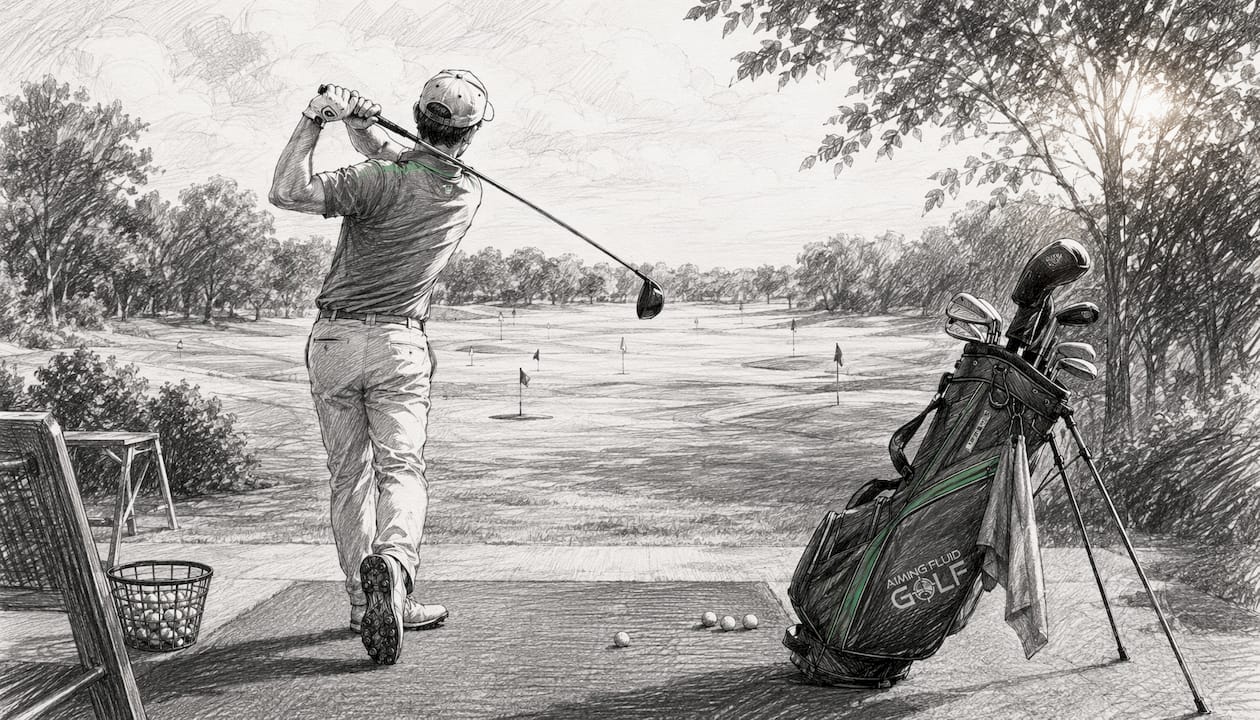
The single highest-leverage fix for most beginners is head stability during the swing. When your head moves laterally or vertically through impact, the club’s low point shifts, producing fat shots, thin shots, and topped balls. Locking in a stable head position addresses the root cause of the majority of mishits beginners face.
Grip and stance matter too, but they are secondary to head control. A neutral grip, where neither hand dominates, allows the clubface to return square at impact. Stance width should roughly match shoulder width for mid-irons, narrowing slightly for short irons and widening for the driver.
Club selection is where ego most often derails beginners. Instructors consistently advise starting with lofted, forgiving clubs rather than the driver. A 7-iron or hybrid builds ball-striking fundamentals far more efficiently than a driver, which punishes every mechanical flaw. Once contact becomes consistent, the driver follows naturally.
Practice structure is equally critical. Purposeful, intentional sessions with specific goals outperform raw repetition every time. Hitting small sets of 5–7 balls with a clear target, then changing clubs and targets, simulates course conditions far better than grinding through a full bucket on autopilot. Unstructured range sessions tend to lock in whatever mechanics you already have, good or bad.
Pro Tip: Before each practice session, write down one specific mechanical goal and one target outcome. Two focused goals per session produce more measurable progress than an hour of undirected hitting. A step-by-step practice routine gives you a repeatable framework to build on.
Professional instruction accelerates all of this. A qualified PGA instructor identifies mechanical faults you cannot see yourself and prevents bad habits from calcifying. Early lessons are among the highest-return investments a beginner can make.
2. Golf etiquette essentials every beginner should know
Golf etiquette is not optional courtesy. It is a social framework built on safety and respect, and PGA instructors consistently rank it alongside swing fundamentals in importance. Violating it makes you unwelcome on the course regardless of your score.
The foundational rules every beginner must internalize:
- Tee box positioning: Always tee up between the markers, never in front of them.
- Shout “Fore!” immediately when your ball travels toward other players. Hesitation is not an option.
- Silence during swings: Stay motionless and quiet while others play. Talking, moving, or jingling coins are all distractions that experienced players notice immediately.
- Repair your damage: Replace divots, repair ball marks on the green, and rake bunkers after every shot. These actions take seconds and preserve course quality for everyone.
- Pace of play: Keep up with the group in front of you, not just the group behind. Have your club selected and be ready to hit the moment it is your turn.
The pace rule deserves particular attention. Prepare your club selection and tee during other players’ shots so you are ready immediately when your turn arrives. If your group falls behind, invite the group behind you to play through. Most 18-hole rounds can be completed in four hours by a group of four when everyone maintains proper pace.
For a deeper look at how etiquette plays out in real rounds, the golf etiquette stories resource from Aimingfluidgolf covers practical scenarios beginners encounter most often.
3. Managing expectations and frustration as a beginner
Unrealistic expectations are among the most damaging beginner golf errors, and they rarely get discussed alongside swing mechanics. Most new golfers expect steady, linear improvement. Golf does not work that way. Progress comes in bursts separated by plateaus, and some rounds will feel like regression even when your mechanics are improving.
The comparison trap makes this worse. Measuring your progress against a playing partner with three years of experience produces nothing useful. The only productive comparison is your own baseline, tracked over time with measurable benchmarks like fairways hit, greens in regulation, or putts per round.
Structured coaching and purposeful practice reduce the randomness that fuels frustration. When you know what you are working on and why, a bad shot becomes data rather than a personal failure. That shift in framing is what separates golfers who improve from those who quit.
Patience and consistency matter more than intensity. Short, focused sessions several times per week produce better results than occasional marathon range sessions. Set one measurable goal per month, track it honestly, and adjust based on what the numbers show.
4. How the right accessories reduce rookie errors on the course
Disorganized gear is a common beginner golf error that most instruction articles ignore entirely. When your bag feels like a junk drawer, you waste time searching for tees, towels, and ball markers, which breaks concentration and slows your group’s pace.
Premium accessories solve specific organizational problems:
- Magnetic towels: A towel that attaches magnetically to your bag or cart is accessible in one motion and returns just as fast. No searching, no draping over a bag pocket that snags on everything.
- Precision tees: Consistent tee height is a mechanical variable most beginners never control. Precision-engineered tees remove that variable entirely.
- Divot tools: A multi-function divot tool keeps you compliant with etiquette rules without requiring a separate search through your bag.
- Utility pouches: A structured pouch keeps ball markers, tees, and small accessories in a fixed location so your pre-shot routine stays consistent.
Aimingfluidgolf designs each of these products around the principle that organization and focus are inseparable on the course. The magnetic towel system attaches and detaches in under a second, which matters when you are trying to maintain pace. The precision golf tees are engineered for consistent height and durability, removing one more variable from your setup.
Pro Tip: Build a fixed pre-shot routine that includes a specific pocket for every accessory. When everything has a home, your mental bandwidth stays on the shot, not on finding your tee.
5. Poor course management and shot selection
Beginners consistently overestimate what they can execute under pressure. Attempting a low punch shot under tree branches, or trying to carry a water hazard that requires a career-best strike, produces double and triple bogeys that wreck a scorecard.
Effective course management starts with honest self-assessment. Know your actual carry distances with each club, not your best-ever distances. Play to the fat part of the green rather than attacking a tucked pin. When in doubt, the safer shot to a wider landing zone almost always produces a better outcome than the aggressive line.
Tee selection is part of course management too. Playing tees that match your current skill level keeps the course playable, reduces lost balls, and lets you practice the shots you actually need to improve. Playing from tees that are too long forces long irons into greens after every tee shot, which is not a productive learning environment for a beginner.
6. Why neglecting physical fitness hurts your golf game
Golf is a rotational athletic movement, and flexibility directly determines how much of your potential swing mechanics you can actually execute. Tight hip flexors and limited thoracic rotation force compensations that no amount of technical instruction can fully correct.
A basic flexibility routine targeting the hips, thoracic spine, and shoulders takes 10–15 minutes and produces measurable improvements in swing range of motion. The golf warmup routines resource from Aimingfluidgolf outlines a structured pre-round sequence that addresses these areas specifically. Skipping the warmup and walking straight to the first tee cold is one of the most consistent predictors of a poor opening nine.
Core strength supports posture throughout the round. Fatigue-driven posture breakdown on the back nine is a real mechanical failure mode, and it is preventable with consistent off-course conditioning.
7. Ignoring the mental game costs you more than bad mechanics
Concentration on the golf course is a skill, not a personality trait. Beginners who treat it as fixed, either you have focus or you do not, miss the fact that mental routines are trainable with the same deliberate practice applied to swing mechanics.
A pre-shot routine is the primary concentration tool available to every golfer at no cost. It creates a repeatable behavioral sequence that narrows attention to the current shot and blocks out the previous hole’s mistakes. PGA Tour players use pre-shot routines precisely because they work under pressure, not just in calm conditions.
Managing shot-to-shot emotional response is equally important. A three-putt on hole seven does not affect the physics of your tee shot on hole eight, but it will affect your mechanics if you carry the frustration forward. Developing a reset trigger, a breath, a specific phrase, or a physical cue, gives you a mechanism to close out a bad shot and refocus.
8. Improper grip and stance fundamentals
Grip pressure is the most commonly misunderstood fundamental in beginner golf. Most new players grip the club far too tightly, which restricts wrist hinge, reduces clubhead speed, and produces a tense, armsy swing. A grip pressure of roughly 5 on a scale of 1–10 is the standard reference point most instructors use.
Stance alignment is the other foundational variable that beginners routinely neglect. Feet, hips, and shoulders should align parallel to the target line, not pointing directly at the target. A closed or open stance introduces swing path errors that no amount of mid-swing correction can fix. Use alignment sticks during practice to verify your setup before the movement pattern becomes automatic.
Ball position varies by club: forward in the stance for the driver (opposite the lead heel), center for mid-irons, and slightly back of center for short irons. Getting this wrong by even a few inches changes the angle of attack and produces inconsistent contact. These are the beginner golf essentials that pay dividends across every other aspect of your game.
Gear that supports your improvement

Aimingfluidgolf builds accessories specifically for golfers who take organization and on-course efficiency seriously. The magnetic towel collection keeps your clubs clean and your routine uninterrupted. The best golf accessories guide covers the full range of gear designed to reduce friction and keep your focus where it belongs: on the shot in front of you.
Key Takeaways
Fixing the top rookie golf mistakes requires addressing mechanics, etiquette, mindset, and organization together, not in isolation.
| Point | Details |
|---|---|
| Head stability is the priority fix | Stabilizing your head during the swing reduces fat, thin, and topped shots more than any other single adjustment. |
| Purposeful practice beats volume | Hitting small sets with specific goals and changing targets produces better results than unstructured range sessions. |
| Etiquette is non-negotiable | Pace of play, silence during swings, and repairing divots are foundational to being welcome on any course. |
| Expectations must match reality | Progress in golf is nonlinear; tracking personal benchmarks beats comparing yourself to other players. |
| Organization reduces mental load | Accessible, well-organized gear keeps your pre-shot routine consistent and your focus on execution. |
Recommended
- Top Beginner Golf Mistakes That Kill Your Score (And How to Fix Them) – Aiming Fluid Golf
- Common Golfing Mistakes List: Fix Your Game Fast – Aiming Fluid Golf
- Best Golf Balls for Beginners — Forgiving Distance Balls + Essential A – Aiming Fluid Golf
- Golf Rules for Beginners: The 10 Essential Rules You Must Know – Aiming Fluid Golf


