


TL;DR:
- Effective on-course efficiency combines strategic decision-making, disciplined routines, and useful technology to lower scores and enhance the golf experience. Proper course management and pace control improve flow, reduce errors, and maximize individual and overall course throughput. Organized gear and data-driven choices are essential for consistent, stress-free play across all skill levels.
On-course efficiency in golf is defined as the practice of managing your time, decisions, and movements strategically to improve both your score and your overall experience during a round. Most golfers focus almost entirely on swing mechanics, yet the role of on-course efficiency, which professionals call course management, often determines the gap between a 90 and an 80 more than ball-striking ability does. GPS devices, game-tracking sensors like Arccos, and pre-shot routine frameworks give every golfer access to the same decision tools the pros use. The question is whether you apply them.
How does on-course efficiency impact golf performance and scoring?
Course management is the shot-by-shot execution of smart decisions on the course. Strategy is what you plan before you tee off. Understanding that distinction matters because course management often outweighs ball-striking skill for mid-handicappers trying to lower their scores.

The data on amateur decision errors is specific and sobering. The average golfer misses 27% of tee shots right and over 60% of approach shots short. Those are not random misses. They are predictable patterns that a disciplined golfer can plan around by aiming left off the tee and always clubbing up on approaches.
Playing to your average, not your best shot, is the foundation of efficient scoring. Playing to reliable average distances rather than your ideal carry reduces the frequency of big numbers. A golfer who hits a 7-iron 155 yards on a perfect strike but averages 145 yards should always plan for 145. That single adjustment removes a class of errors entirely.
Frameworks like DECADE, developed by Scott Fawcett, formalize this thinking. DECADE uses strokes gained data to define optimal target zones based on your actual skill level, not your aspirational one. You do not need to use DECADE specifically to benefit from its core principle: aim where your miss is least costly.
Key decision errors that reduce scoring efficiency:
- Aiming at tucked pins when a center-green miss costs one stroke but a short-side miss costs two
- Choosing a driver on tight par-4s when a 3-wood leaves a full wedge and removes the double-bogey risk
- Underclubbing on approaches because you are measuring to the flag, not the back of the green
- Ignoring wind and elevation adjustments that shift effective carry distance by 10–20 yards
Pro Tip: Before each shot, identify your worst-case miss and ask whether the target you selected makes that miss recoverable. If it does not, move the target. This pre-shot checklist takes under 10 seconds and removes most of the costly errors amateurs make.
Strokes gained analytics quantify exactly where your scoring leaks are. A golfer losing 3.2 strokes per round from 100–150 yards has a different practice priority than one losing strokes on short putts. Data removes guesswork from both on-course decisions and off-course practice.
What role does pace of play have in on-course efficiency?
Pace of play is not just a courtesy issue. It is a structural component of on-course optimization that affects your rhythm, focus, and enjoyment across all 18 holes.
The core principle is simple: the slowest group controls the pace for every group behind them. One slow foursome can add 30–45 minutes to the rounds of every group that follows. That compression creates waiting, which breaks rhythm and raises frustration for everyone on the course.
| Factor | Efficiency Impact |
|---|---|
| Poorly planned hole transitions | Adds 30–40 minutes of non-playing time per round |
| Blind shots without clear sightlines | Increases hesitation and slows group movement |
| Par-3 bottlenecks without forward tee options | Creates consistent backups during peak hours |
| Smart course design with visible targets | Reduces decision time and speeds group flow |
| Consistent group interval management | Maintains pace without requiring faster play |
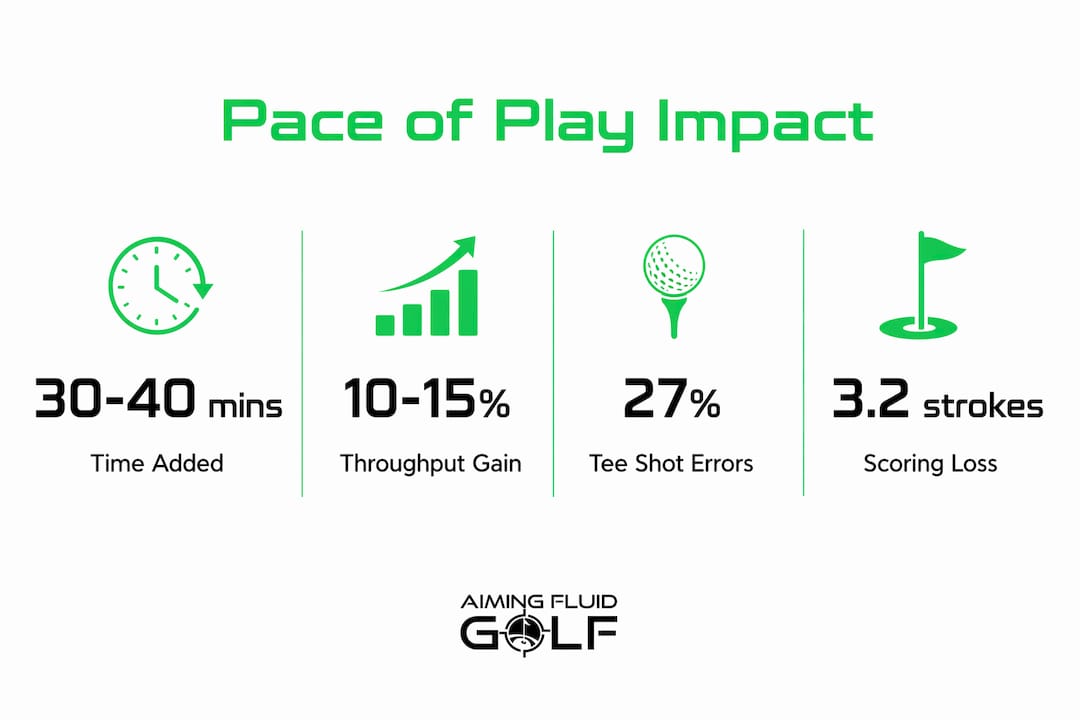
Smart course architecture and pace-of-play management can increase facility throughput by 10–15% without compromising player experience. That figure represents real rounds added per day, which translates directly to revenue for operators and shorter waits for you.
Par-3 holes are the most common bottleneck on any course. Groups must wait for the green to clear before teeing off, and any delay compounds across the round. Courses that address this through forward tee placement, visible green sightlines, and clear cart routing reduce these stalls significantly.
Pro Tip: Ready golf, where you play when ready rather than strictly by honor, is approved by the USGA for casual rounds and can save 15–20 minutes per round without changing how you play.
Your personal contribution to pace is mostly about preparation. Club selection, reading your putt, and knowing your yardage should happen while others are playing, not after you reach your ball.
What practical strategies and tools can golfers use to increase on-course efficiency?
Improving your on-course performance starts before you reach the first tee. Pre-round planning, organized equipment, and the right technology each remove a different category of delay and distraction.
Pre-round planning
- Study the course layout the night before. Identify the two or three holes where your miss pattern creates the most risk and decide your target line in advance.
- Set your bag up in a consistent order so every club, tee, and tool is where you expect it. When your bag feels like a junk drawer, you lose focus before you even address the ball.
- Confirm yardages for your reliable carry distances with a rangefinder or GPS device. Garmin Approach and Bushnell Phantom 2 are two widely used GPS units that provide accurate front, center, and back distances without requiring a phone.
Technology that sharpens decisions
Arccos sensors attach to your club grips and automatically record every shot using GPS. The Arccos AI Caddie then provides club recommendations based on your actual performance data, not generic averages. Golfers using Arccos consistently identify specific distance gaps and course management errors they were previously unaware of.
Strokes gained analysis, popularized by Columbia Business School professor Mark Broadie, breaks your round into categories: off the tee, approach, around the green, and putting. Each category shows you exactly how many strokes you gain or lose compared to a benchmark. That specificity makes practice far more productive.
Equipment workflow on the course
- Keep your rangefinder or GPS unit in the same pocket every round so you reach for it without thinking
- Use a structured equipment workflow to return clubs, towels, and tools to fixed locations after each shot
- Carry only the tees, ball markers, and divot tools you need. Extra items create friction and slow your routine
- Manage your on-course essentials with a system that keeps frequently used items accessible without digging through your bag
A consistent pre-shot routine is the single most transferable efficiency tool in golf. It standardizes your mental process, reduces hesitation, and produces more repeatable execution under pressure.
How does on-course efficiency affect course experience and sustainability?
Individual efficiency compounds across an entire course. When each golfer makes faster decisions, moves with purpose, and manages their equipment without delays, the entire field moves more smoothly. That collective effect reduces congestion, shortens rounds, and raises satisfaction for every player on the property.
U.S. on-course participation has reached 29.1 million golfers as of 2026. That volume puts real pressure on course operators to manage flow without adding infrastructure. Efficiency at the individual and operational level is the primary tool available.
Key benefits of improved on-course efficiency across the full course ecosystem:
- Reduced round times lower fuel and labor costs for cart fleets and maintenance crews
- Higher throughput means more rounds per day without expanding the physical facility
- Shorter waits improve player satisfaction scores, which directly affect repeat bookings and reviews
- Consistent pace reduces the frustration that drives casual golfers away from the game
AI and data analytics now give course operators real-time visibility into group positions, pace deviations, and bottleneck locations. Platforms using GPS-integrated tee sheet data can alert marshals to specific slow groups before delays cascade. Technology sharpens human judgment here rather than replacing it.
Traditional course management relied on marshals observing pace visually and intervening manually. Modern operations use GPS tracking, tee time interval modeling, and predictive analytics to manage flow proactively. The difference is the same as navigating with a paper map versus a live GPS: both work, but one removes the guesswork.
Key takeaways
Efficient on-course play requires disciplined decision-making, consistent routines, and the right tools working together across every round.
| Point | Details |
|---|---|
| Course management drives scoring | Playing to average distances and avoiding high-risk targets removes most costly errors. |
| Pace of play affects everyone | The slowest group controls pace for all behind them; individual preparation is the fix. |
| Technology removes guesswork | Tools like Arccos sensors and strokes gained data identify specific weaknesses with precision. |
| Equipment organization reduces friction | A structured workflow keeps gear accessible and prevents delays that break focus. |
| Efficiency benefits the whole course | Individual efficiency compounds across the field, improving flow and satisfaction for all players. |
What i’ve learned about efficiency that most golfers ignore
Most golfers I talk to treat course management as something pros do and amateurs aspire to. That framing is wrong. Course management is not a skill level. It is a decision framework, and it works at every handicap.
The uncomfortable truth is that most rounds are lost in the 10 seconds before the swing, not during it. Choosing the wrong target, ignoring your miss pattern, or rushing a club selection because the group behind you is watching: those are the real scoring killers. A better swing will not fix a bad target.
I have also seen golfers invest in Arccos, Garmin GPS units, and premium rangefinders and then ignore the data because it contradicts what they want to believe about their game. The data shows you carry your 6-iron 162 yards on average. You believe you carry it 175. That gap costs you strokes on every approach. Honest assessment of your actual numbers is the prerequisite for everything else.
Organization matters more than most golfers admit. When your towel is buried in your bag, your tees are loose in three pockets, and your divot tool is missing, you are spending mental energy on logistics instead of shot planning. That friction accumulates across 18 holes. Golfers who stay organized on the course consistently report better focus and less frustration, regardless of their score.
Efficiency is not about playing faster. It is about playing with less waste: fewer mental errors, fewer equipment delays, and fewer decisions made without data. That is where the strokes are.
— Gary
Gear that supports your efficiency on the course
Aimingfluidgolf designs accessories specifically to remove the organizational friction that slows golfers down and breaks focus. The magnetic towel and landing pad system keeps your towel docked to your bag and instantly accessible without searching. Precision tees, a 5-in-1 divot tool, and structured utility pouches keep your essentials organized and ready at every hole.

Every product in the Aimingfluidgolf lineup is built around one principle: your gear should work with your routine, not against it. Browse the full expert-picked accessories guide to find the tools that match how you play, whether you walk, ride, or practice.
FAQ
What is on-course efficiency in golf?
On-course efficiency is the practice of managing your time, decisions, and movements during a round to improve scoring and reduce wasted effort. It combines course management, pace of play, and equipment organization into a single performance system.
How does course management improve your score?
Course management reduces big numbers by directing you to play to your average distances and aim where your miss is least costly. Research shows that over 60% of approach shots by average golfers land short, a pattern that disciplined club selection directly corrects.
What tools help golfers improve on-course decision-making?
GPS devices like Garmin Approach, rangefinders like Bushnell Phantom 2, and game-tracking sensors like Arccos provide accurate distance data and strokes gained analytics. These tools replace guesswork with specific, repeatable data that improves both on-course decisions and practice focus.
Why does pace of play matter for individual golfers?
Slow pace breaks your rhythm, increases waiting time, and raises frustration across the round. Managing group intervals consistently and practicing ready golf are the two most effective ways to maintain pace without rushing your actual shots.
How does equipment organization affect on-course performance?
Disorganized gear forces you to search for items between shots, which interrupts your mental routine and adds unnecessary delays. A structured system where every tool has a fixed location keeps your focus on shot planning rather than logistics.


