


Return policies are a core trust and risk-management signal in golf shopping. They determine whether you buy with confidence and what options you have if the club, bag, or accessory does not perform as expected. Before you hit checkout, scan for these five elements:
- Return window: a window is typically provided, sometimes extended during holidays; check specific retailer terms
- Item condition rules: whether opened or tested items qualify, and what “new condition” means
- Refund type: cash refund, store credit, or exchange only
- Shipping responsibility: who pays return freight and whether a prepaid label is included
- Exclusions: custom-fitted clubs, hygiene items, final-sale products, and demo gear
Golf gear has category-specific rules that differ from general retail. A driver you hit on the range may be treated as “used.” A custom-fitted iron set is almost always non-returnable. Knowing these distinctions before you buy protects both your money and your time.
Key Takeaways
adults factor it into their choice of where to shop.
| Point | Details |
|---|---|
| Window is not the whole story | Condition rules, shipping costs, and refund type matter more than the headline return window. |
| Custom clubs are non-returnable | Custom-fitted clubs are almost universally final sale; confirm warranty coverage before ordering. |
| Document everything at delivery | Photograph packaging and keep original tags until the return window closes and refund posts. |
| Escalate in writing | A written escalation email with policy screenshots gives you leverage for disputes and chargebacks. |
| Aimingfluidgolf reduces return risk | Clear product specs and durable construction narrow the gap between expectation and delivery. |
Table of Contents
- How return policies work for golf clubs, bags, and accessories
- What should you check on the product page before buying?
- Special cases: range-tested clubs, custom fits, and hygiene items
- What to do if a retailer refuses to honor its published return policy
- Why return policies change buying behavior, according to the research
- Practical steps to reduce your return risk before and after purchase
- The part of return policies most golfers overlook
- Aimingfluidgolf accessories come with purchase confidence built in
- Sources
How return policies work for golf clubs, bags, and accessories
Most golf retailers structure their policies around four core mechanics: the return window, condition requirements, refund method, and cost allocation. Understanding how each one works helps you read a product page accurately rather than assuming the best.
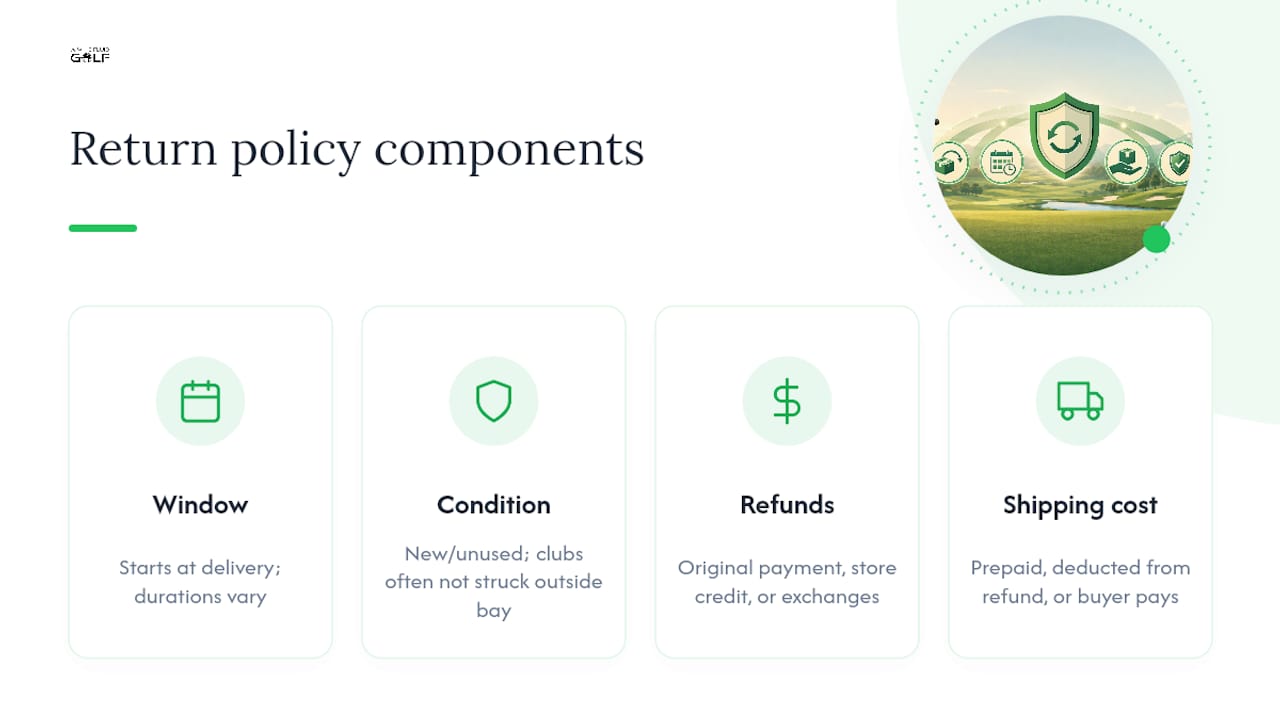
**Return windows generally provide a defined period from delivery for returns, with some retailers offering extended windows during holidays, but exact durations vary. The window clock usually starts at delivery, not at purchase, so keep your shipping confirmation.
Condition requirements are where most golf returns get complicated. Retailers generally require items to be in new, unused condition with original tags and packaging intact. For clubs, “unused” often means not struck outside a store fitting bay. Some retailers allow a limited number of range swings for fitting purposes, but that allowance is rarely spelled out clearly in the policy text.
Refund methods vary. A full cash refund to the original payment method is the best outcome. Store credit and exchange-only policies are common for opened or tested items. Some retailers charge restocking fees on higher-value items, with amounts and conditions varying, especially if items are returned without original packaging.
Online vs. in-store returns follow different mechanics. In-store returns are typically processed immediately, with refunds posted within 3–5 business days. Online returns require you to ship the item back, which adds 7–14 days to the refund timeline. Who pays return shipping varies: some retailers provide a prepaid label, others deduct the label cost from your refund, and a few require you to arrange your own carrier. Industry guidance confirms that operational mechanics like prepaid labels and fast refund processing drive customer satisfaction more than the headline window length alone.

The data on why this matters is clear. According to eMarketer reporting, 68% of U.S. adults consider return policies when choosing where to shop. A policy buried in fine print or written in conditional language is itself a red flag.
What should you check on the product page before buying?
The policy language on a product page tells you more than the star rating does. Three places to look: the product page itself (often a linked “Returns” tab or icon), the order confirmation email, and the retailer’s dedicated help or returns page. If you cannot find the policy in under 60 seconds, that difficulty is a signal.
Green flags in policy language:
- “Free returns” or “prepaid return label included”
- Explicit window stated in days (“30-day return window from delivery date”)
- “Refund to original payment method within 5–7 business days”
- “Holiday return extension through January 31”
- Clear statement that opened items in original packaging are eligible
Red flags to watch for:
- “All sales final” or “final sale” on any product you are not certain about
- “Restocking fee may apply” without a stated percentage
- “Return shipping at buyer’s expense” with no label provided
- “Unused and in original condition” with no definition of “unused” for clubs
- Warranty language substituted for return language (these are different protections)
Pro Tip: Search the retailer’s returns page for the word “restocking” before you buy. If it appears without a clear cap or percentage, email customer service and save their written response. That response can be used as evidence if a dispute arises later.
Shopify’s guidance on return policy design confirms that clear, consumer-friendly language reduces cart abandonment and increases conversion. Vague or buried terms do the opposite. Use that dynamic to your advantage: if a retailer’s policy is hard to find or full of conditional language, a competitor with a cleaner policy is worth the comparison.
A useful pre-purchase habit is to check the online golf gear sizing guide for any apparel or fitted item before ordering. Fit-related returns are among the most common, and most are avoidable with the right measurements upfront.
Special cases: range-tested clubs, custom fits, and hygiene items
Three categories of golf gear carry return restrictions that catch shoppers off guard.
Demo and range-tested clubs occupy a gray zone. Most retailers permit a brief fitting-bay swing to confirm feel, but once a club leaves the store or is struck outdoors, it is typically classified as “used.” Used clubs are either non-returnable or subject to a significantly reduced refund. If you buy online and want to test a club before committing, look for retailers that offer a formal demo program with documented terms, not just a vague “try it” promise.
Custom-fitted clubs are almost universally non-returnable. A club built to your shaft length, lie angle, grip size, and loft specification cannot be restocked and resold. Before ordering a custom build, confirm in writing whether the retailer offers any warranty coverage for manufacturing defects, because that is your only recourse if something is wrong. Warranty and return are separate mechanisms: a warranty covers defects in materials or workmanship; a return policy covers buyer’s remorse or fit issues.
Hygiene-sensitive items and personalized accessories follow stricter rules. Grips, gloves, and wearable items that contact skin are typically excluded from standard returns once opened. Personalized items (embroidered bags, custom ball markers) are almost always final sale. Some retailers apply a restocking fee to opened accessory packaging even when the item itself is unused.
- Confirm grip and shaft swap policies before purchase if you plan to re-shaft or re-grip immediately
- Ask whether a “demo” designation on a used club comes with documented swing counts or condition grading
- Check whether small accessories like divot tools or ball markers are excluded from return eligibility once the package seal is broken
Pro Tip: When buying a demo or open-box club, ask the retailer for written documentation of the club’s condition grade and any prior use. A photo of the face and sole at pickup, timestamped and emailed to yourself, creates a baseline record that protects you if a return dispute arises later.
What to do if a retailer refuses to honor its published return policy
A published policy is a merchant’s commitment. If a retailer refuses to honor it, you have a clear escalation path.
- Document the policy immediately. Screenshot the return policy page with the URL and date visible. Save your order confirmation, shipping receipt, and any delivery confirmation. Note the exact date you initiated the return request.
- Contact customer service in writing. Email is better than phone for this purpose because it creates a timestamped record. State the policy language, your order number, and the specific refund or exchange you are requesting. Keep the tone factual.
- Escalate to a supervisor. If the first representative denies the request, ask for a manager or escalation team in the same written thread. Request a written explanation of why the return is being denied.
- Use the merchant’s formal dispute process. Most retailers have an internal appeals or dispute process. Reference the published policy language directly and attach your screenshots.
- File a payment dispute with your card issuer. If the retailer refuses to honor a clearly published policy, a chargeback through your credit card or PayPal is a legitimate remedy. Most card issuers treat a merchant’s failure to honor stated terms as a valid dispute basis. Act within your card’s dispute window, typically 60–120 days from the charge date.
- File with external bodies. The Better Business Bureau (BBB) at bbb.org and your state’s consumer protection office (reachable through usa.gov/state-consumer) both accept complaints about deceptive or unfulfilled return policies. These filings create a public record and often prompt merchant response.
Sample escalation email opening: “I am writing to request a return per your published policy, which states [exact policy language]. My order number is [X], delivered on [date]. I am requesting [refund/exchange] and have attached documentation of the policy, my order confirmation, and delivery receipt. Please confirm the return authorization and next steps within 48 hours.”
Why return policies change buying behavior, according to the research
The data on return policy influence is consistent across multiple industry sources. Industry reporting from eMarketer found that 97% of consumers say a positive return experience increases their likelihood of buying from that retailer again, with 72% strongly agreeing. That figure puts return handling on par with product quality as a loyalty driver.
The macro cost to merchants is substantial. Signifyd’s industry analysis cites NRF data estimating returns cost merchants nearly $850 billion in 2025. That scale explains why retailers design policies with friction: exchange-first flows, selective prepaid labels, and restocking fees are all mechanisms to steer returns toward lower-cost outcomes.
For shoppers, the practical implication is this: retailers are not designing return policies to be generous. They are designing them to balance conversion against reverse-logistics cost. Knowing that, you can read a policy more accurately.
- Exchange-first flows offer a faster resolution path but lock you into store credit. Accept this when you are confident you want the same item in a different spec.
- Free returns for exchanges only is a common structure that incentivizes exchange over refund. It is a fair trade if the product line is one you trust.
- Instant refund programs (where the refund posts before the item is received) signal a retailer confident in its fraud controls and willing to invest in customer experience.
adults consider return policies when choosing where to shop](https://www.emarketer.com/content/retailers-lose-shoppers-returns-policy--not-returns-counter). For golf retailers competing on similar product catalogs, policy clarity is a genuine differentiator.
Practical steps to reduce your return risk before and after purchase
The best return is the one you never need to make. Most golf equipment returns trace back to three causes: wrong fit, unmet expectations, or packaging damage at delivery.
Before you buy:
- Choose retailers with explicit, easy-to-find return windows and free-return or prepaid-label language
- Use the retailer’s size and fit guides for apparel and footwear; for clubs, visit a fitting bay before ordering online
- Read the product description for spec details (shaft flex, loft, grip size) rather than relying on the product photo
- Check whether the retailer offers a demo or trial program for clubs before committing to a full purchase price
At delivery:
- Photograph the outer packaging before opening it, especially for high-value items
- Keep all original packaging, tags, and documentation until your return window closes
- Register the product for warranty coverage immediately if the manufacturer offers it
Pro Tip: Keep a simple folder on your phone or computer for each golf purchase: one screenshot of the return policy, one photo of the item at receipt, and the order confirmation. If a dispute arises 45 days later, you will have everything in one place rather than searching through email.
Choosing between refund, exchange, and store credit depends on the item type. For a club that does not fit, a full refund is the right call because fit is personal and a replacement of the same model will have the same problem. For a bag with a manufacturing defect, an exchange is often faster than a refund and reorder. Store credit makes sense only when you are confident you will buy from that retailer again and the credit does not expire quickly.
Efficient gear management practices also reduce return risk indirectly: when your equipment is organized and accessible, you notice damage or defects faster, within the return window rather than after it closes.
The part of return policies most golfers overlook
Most golfers read the headline window (“30-day returns”) and stop there. The window is the least important variable. What actually determines your outcome is the condition definition, the shipping cost structure, and whether the retailer honors its own terms consistently.
A 90-day window with a vague “unused condition” requirement and buyer-paid return shipping on a $400 driver is a worse policy than a 30-day window with a prepaid label and a clear definition of what “unused” means. The research on policy clarity supports this directly: a short, consistently enforced window builds more trust than a long, conditional one that leaves shoppers guessing.
There is also a category-specific point that most general retail guides miss entirely. Golf clubs are not like shoes. A shoe you try on and walk around in for five minutes is still returnable at most retailers. A driver you take to the range for one bucket of balls is “used” by most golf retailer standards, regardless of how the policy is worded. That asymmetry means the pre-purchase fit check matters more in golf than in almost any other equipment category. Get fit before you buy, not after.
Aimingfluidgolf accessories come with purchase confidence built in
When you buy a premium accessory and it does not meet expectations, the return process should not feel like a negotiation. Aimingfluidgolf designs its products with clear specifications, durable materials, and consistent quality standards precisely to reduce the gap between what you expect and what arrives. The magnetic towel system, leather utility pouches, and precision tees are built to perform as described, which means fewer returns and more confidence at checkout.
For shoppers who want to know what they are getting before they buy, the best golf accessories guide walks through each product category with the spec detail and condition transparency that makes a purchase decision straightforward. If you are ready to add a magnetic towel system or a leather utility pouch to your bag, the product pages include the information you need to buy with confidence. Browse the full accessories range and place your order at Aimingfluidgolf.
Sources
The following sources support the research-backed claims in this guide:
- Retailers lose shoppers at the returns policy, not the returns counter
- Ecommerce Return Policy Best Practices for Retailers 2025
- How To Write a Return Policy in 2026 (+ Free Template) - Shopify
- How to write a returns policy that customers actually trust


