


Higher price tiers in golf accessories buy you three things, consistently: better raw materials, tighter construction, and stronger warranty support. That’s it. A $45 magnetic towel isn’t better because of a logo or a marketing story. It’s better because the terry loops are denser, the magnet holds at a rated pull force instead of a guessed one, and the manufacturer stands behind it if the stitching fails. The role of price tiers in golf accessories comes down to which of those three levers a brand actually pulls, and which ones it just implies.
Here’s the quick version, sorted by how often you play:
- Occasional player (fewer than 12 rounds a year): Stay in the budget-to-mid tier ($10 to $30) for consumables like tees, gloves, and towels. Your usage doesn’t justify premium durability costs.
- Regular weekend player (25 to 50 rounds a year): Mid-to-premium ($25 to $60) on anything you touch every hole. Towels, gloves, and bag organization earn the upgrade; decorative items don’t.
- Serious or frequent player (50+ rounds a year, or a competitive schedule): Premium tier ($50+) on core-use accessories. At that usage rate, cost-per-use flips the math in favor of durability even at double or triple the sticker price.
Where to save regardless of profile: tees, ball markers, and divot tools rarely justify premium pricing since their function is simple and failure modes are low-stakes. Where to spend: anything with a mechanism (magnetic closures, zippers, clasps) or anything you’ll touch hundreds of times a season.
Key Takeaways
Higher price tiers in golf accessories buy better materials, tighter construction, and stronger warranty support, but only when you check the specs instead of trusting the price tag alone.
| Point | Details |
|---|---|
| Match tier to frequency | Occasional players save on consumables; frequent players should upgrade high-touch items like towels and bags. |
| Use cost-per-use math | Divide retail price by expected rounds or months of use before comparing two products. |
| Watch the $20–$50 band | This range holds roughly 39% of tracked listings, so quality varies widely at the same price point. |
| Check inspectable specs | Denier, magnet pull force, leather grade, and stitching visible in photos reveal real quality differences. |
| Spend unevenly on purpose | Aiming Fluid Golf’s magnetic towels, leather pouches, and precision tees show how premium construction should target high-touch items while low-stakes accessories stay budget-friendly. |
Table of Contents
- The Role of Price Tiers in Golf Accessories: A Working Definition
- How Price Actually Maps to Value
- Materials and Construction Differences Worth Checking
- Price-Tier Breakdown: What You Get at Each Band
- Turning Price Into Performance: The Cost-Per-Use Math
- How to Choose Without Getting Fooled by Price Alone
- Why I Push Golfers to Spend Unevenly, Not Everywhere
- Where Aiming Fluid Golf Fits in the Premium Tier
- Sources
The Role of Price Tiers in Golf Accessories: A Working Definition
Before comparing bands, it helps to define the category itself, because “golf accessories” gets used loosely and that looseness is exactly what lets marketing get away with vague price justifications.
Golf accessories are the supporting gear that doesn’t hit the ball but shapes how the round feels: towels, tees, divot tools, ball markers, headcovers, bags, umbrellas, gloves, and organizational items like utility pouches and landing pads. They matter for four practical reasons: comfort (a glove that fits reduces blister risk), pace of play (a towel you can find in two seconds instead of twenty), organization (a bag where things live in the same spot every round), and protection (headcovers that prevent shaft dings during transport).
| Accessory category | Primary role on the course |
|---|---|
| Towels | Cleans clubs and balls; access speed affects pace of play |
| Tees | Sets ball height for driver and iron shots; consumable |
| Divot tools | Repairs turf damage; etiquette and course-condition tool |
| Ball markers | Marks ball position on the green; low mechanical complexity |
| Headcovers | Protects clubheads from dings during transport and storage |
| Bags | Carries and organizes all other gear; structural backbone |
| Utility pouches | Secures valuables (phone, keys, wallet) during the round |
| Umbrellas | Weather protection; canopy size and frame quality vary widely |
These eight categories reappear throughout this article whenever we compare how price tiers change materials, lifespan, or performance. Keep the table as a reference point. It’s the taxonomy the rest of the piece builds on.
How Price Actually Maps to Value
Price and quality correlate, but not automatically, and not evenly across categories. Five mechanisms explain most of the gap between a $12 towel and a $45 one:
- Materials and construction: Higher-grade cotton or microfiber blends, reinforced stitching, and better hardware cost more to source and assemble.
- Design for usability: Engineering time goes into things like magnet placement, zipper pull ergonomics, or a divot tool’s leverage geometry. That time shows up in price.
- Quality control and testing: Brands that test pull force, seam strength, and colorfastness before shipping absorb costs that untested private-label goods skip entirely.
- Packaging and perceived value: This one is legitimate but slippery. A nicer box can signal real quality control upstream, or it can be pure theater covering a generic product.
- Warranty and after-sale support: A brand willing to replace a failed product for free is making a bet on its own manufacturing consistency. Cheap goods rarely come with that bet attached.
Retail dynamics complicate the picture further. Private-label accessories sourced through OEM factories can carry remarkably low landed costs. Manufacturing data for small golf accessories shows minimum order quantities around 500 units with FOB costs as low as fifty cents per ball marker, and a roughly 45-day turnaround from factory to shelf. A pro shop or online seller can take that same $0.50 marker, add branded packaging, and sell it for $15 with a healthy margin, no material upgrade required. Price alone doesn’t tell you which side of that equation you’re on.
Pro Tip: Run the frequency math before you upgrade. If you play once a month, a $15 towel that lasts two seasons costs you about $0.31 per round. A $45 towel that lasts five seasons costs about $0.19 per round, but only if you actually play often enough to hit that lifespan window. Below a certain frequency, the premium option never pays for itself.
Materials and Construction Differences Worth Checking
This is where price tiers stop being abstract and become something you can verify with your eyes or your fingers. Specific, inspectable differences separate budget accessories from premium ones, and most of them are visible in a good product photo.
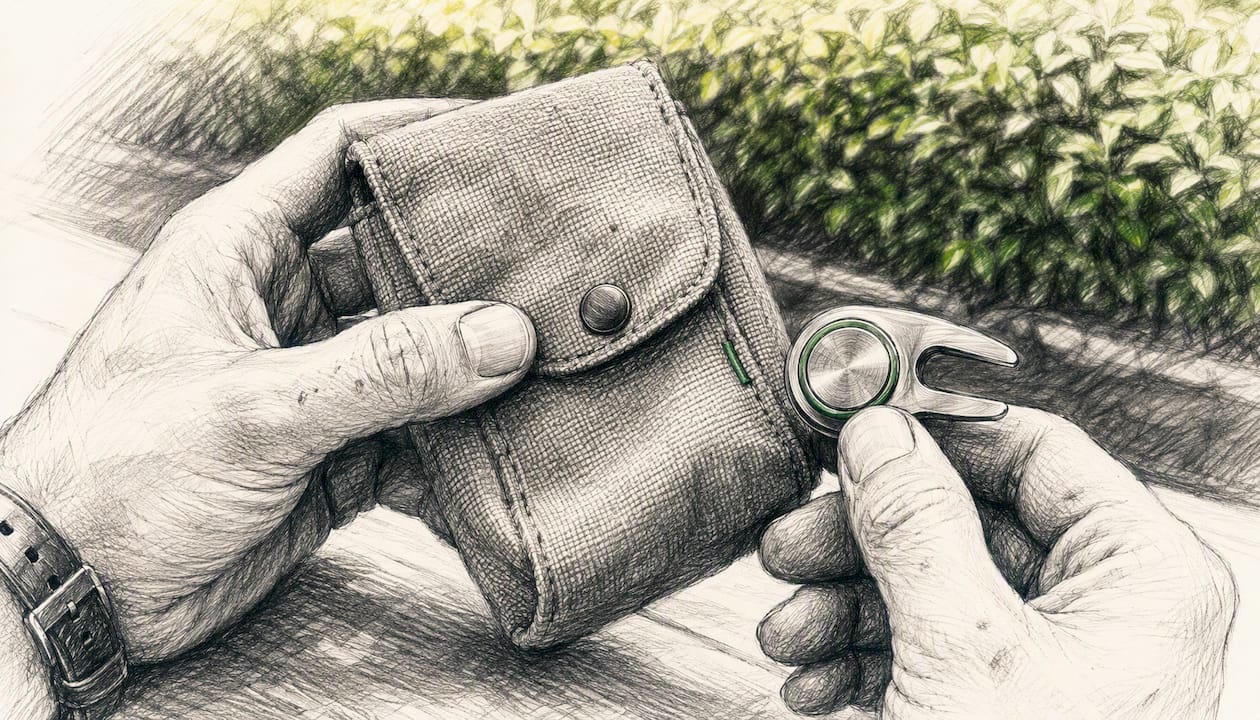
Metal hardware grades from thin stamped steel (budget) to solid brass or stainless steel with a proper plating process (premium). Enamel-filled logos and markers hold color for years; printed or painted finishes chip within a season.
Leather grades matter enormously for pouches and grips. Full-grain leather develops a patina and resists cracking; bonded or “genuine leather” (a lower grade despite the reassuring name) delaminates and cracks within a year or two of regular use.
Nylon denier is the thickness rating of the fabric weave, and it’s one of the few specs printed plainly on quality bag and pouch listings. Higher denier numbers (600D and up) resist abrasion and punctures far better than 210D or 300D fabrics common in budget gear.
Magnet strength on towel and landing-pad systems determines whether the attachment survives a cart ride over rough terrain or pops loose on the third hole. Rated pull force, measured in pounds, is the honest spec here. Vague claims like “super strong” without a number are a red flag.
Stitching and seams separate reinforced double-stitched seams (premium) from single-pass stitching that unravels at stress points (budget). Sealed or taped seams on umbrella canopies and bag rain hoods keep water out longer than raw stitched seams.
When shopping online, a few photo-inspection habits go a long way:
- Look for a close-up shot of stitching, not just a full-product glamour shot.
- Check whether the listing states a specific denier, magnet pull rating, or leather grade rather than vague adjectives.
- Search the listing for warranty language; its absence is itself informative.
- Compare hardware in the photo against known reference points (a zipper pull that looks flimsy usually is).
Price-Tier Breakdown: What You Get at Each Band
Retail data on golf accessory listings shows a clear concentration pattern. Roughly a significant portion of tracked “golf accessories kit” listings on Amazon fall in the $20 to $50 band, making it the most crowded and competitive price range in the category. That concentration matters for buyers because it’s also where the widest quality variance lives. Sellers know this band converts, so both genuinely well-made products and dressed-up cheap ones compete for the same shelf space.
Here’s how the common bands typically shake out:
| Price band | Typical materials | Expected lifespan | Performance impact | Best for | Warranty/support |
|---|---|---|---|---|---|
| Under $10 | Basic polyester, stamped metal, single-layer fabric | Months to one season | Functional but fragile; frequent replacement | Casual players, gifts, backup items | Rarely offered |
| $10–$20 | Improved stitching, mid-grade nylon, painted hardware | One to two seasons | Noticeably more reliable than sub-$10 tier | Occasional to regular players | Limited, often 30 days |
| $20–$50 | Reinforced seams, branded hardware, mid-to-high denier fabric | Two to four seasons | Solid daily-use durability; where most buyers should shop | Regular weekend players | Common; 1 year typical |
| $50–$60 | Premium leather or high-denier technical fabric, rated magnets, sealed construction | Four-plus seasons | Meaningful gains in comfort, weatherproofing, reliability | Frequent players, serious hobbyists | Standard; often 1 to 2 years |
| $50+ | Full-grain leather, aerospace-grade hardware, custom engineering | Five-plus years with care | Marginal performance gains beyond the $50 range unless replacing a full system (e.g., premium bag) | Competitive players, collectors, gifting | Extended warranties, sometimes lifetime on hardware |
A concrete example: a generic private-label divot tool sourced at a factory-direct cost of roughly $1.00 to $3.50 per unit can retail anywhere from $8 to $25 depending on branding and packaging, with no material difference at all. Compare that against a multi-tool divot repair device with a folding mechanism and integrated ball marker, which justifies its higher price through actual engineering, not just branding.
Margin data across the category tells a similar story. Accessories that source for roughly $3 to $12 per unit commonly retail between $19 and $49, producing gross margins in the 55% to 75% range before marketing costs. That’s not inherently a problem. It’s simply the accessory business model. But it means the retail price in that band tells you more about the seller’s margin target than it does about what you’re getting.
Pro Tip: In the crowded $20 to $50 band, cross-check the listing’s material specs against a competing listing’s specs before you buy on price alone. Two products at $28 can differ enormously in denier, stitching, or magnet rating, and the listing copy usually reveals which one actually invested in the product.
Turning Price Into Performance: The Cost-Per-Use Math
The most useful number in this entire discussion isn’t the retail price. It’s cost-per-use: retail price divided by the number of rounds or months you’ll realistically get out of the product before it fails or gets replaced.
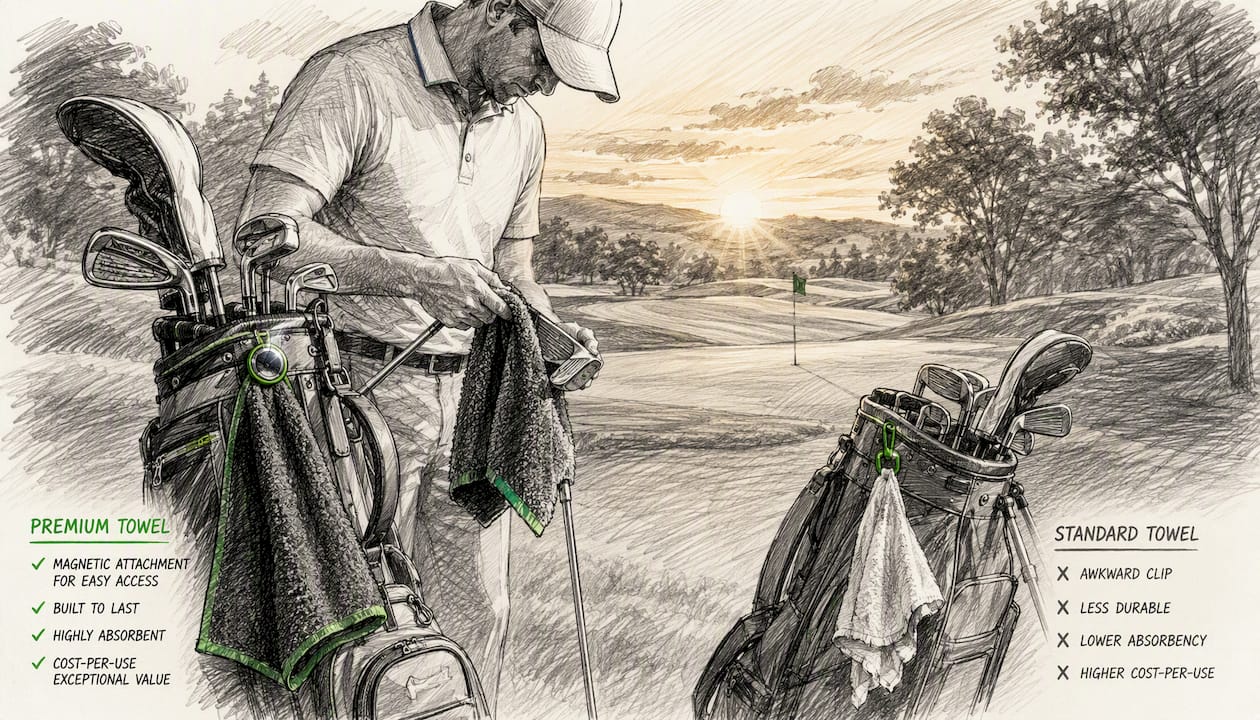
Take two towels. A $12 budget towel lasts about 20 rounds before the fabric thins and the attachment clip loosens. That’s $0.60 per round. A $42 premium towel with reinforced stitching and a rated magnetic attachment lasts closer to 120 rounds before it needs replacing. That’s $0.35 per round, less than the cheap option, even though the sticker price is more than triple.
Umbrellas make the case even more clearly. Standard umbrellas with fiberglass frames and higher-denier canopy fabric retail between $25 and $80 and hold up through wind and repeated use far longer than a $10 drugstore umbrella, which often fails at the first strong gust. If you play in variable weather even occasionally, the $60 umbrella that survives five seasons beats replacing a $10 umbrella three times in the same span.
| Item | Price | Estimated lifespan | Cost-per-use (rounds) |
|---|---|---|---|
| Budget towel | $12 | 20 rounds | $0.60 |
| Premium towel | $42 | 120 rounds | $0.35 |
| Budget umbrella | $10 | 8 uses (frequent failure) | $1.00 to $3.50 |
| Premium umbrella | $60 | 60+ uses | $1.00 |
Care habits shift these numbers meaningfully. Rinsing a towel instead of leaving it caked with mud extends its usable life. Storing an umbrella dry instead of shoving it wet into a bag pocket prevents frame corrosion. A maintenance routine can make a mid-tier product outlast a neglected premium one, which is worth remembering before you assume price alone solves durability.
A short maintenance checklist worth keeping in your bag or car:
- Rinse towels after muddy or dusty rounds rather than letting debris set in.
- Dry umbrellas fully before folding and storing them.
- Check magnetic attachments and zippers periodically for early wear signs.
- Replace tees and ball markers proactively; they’re cheap enough that hoarding worn ones makes no sense.
- Upgrade to a new item once repair costs (if repairable) approach half the replacement price.
How to Choose Without Getting Fooled by Price Alone
A reliable buying flow starts with three questions, answered honestly before you look at a single product listing: How often do you actually play? What’s the primary goal for this accessory (durability, weight savings, or style)? And what’s your hard budget cap for this category this season?
Once you have those answers, run through this priority checklist before buying:
- Check the materials spec. Does the listing state denier, leather grade, or magnet pull force, or does it rely on vague adjectives like “durable” and “heavy duty”?
- Find the warranty terms. A brand confident in its manufacturing usually states a specific warranty period; a brand that says nothing usually has nothing to offer.
- Read the return policy before adding to cart. Accessories with hidden restocking fees or “no returns on used items” clauses often correlate with lower manufacturing confidence.
- Look for multiple product photos, including close-ups of stitching and hardware, not just a single lifestyle shot.
- Check compatibility with gear you already own. A magnetic towel system, for example, only helps pace of play if the attachment point fits your existing bag.
Common mistakes tend to repeat across price tiers in predictable ways. Buyers overpay for branding when a private-label item at a third of the price uses identical materials. Others ignore denier or stitching specs entirely and judge quality purely on packaging photos. A single product photo with no close-up shots is itself a signal worth noting, since brands proud of their construction usually show it off. And skipping the return policy before buying leaves you stuck if a magnetic clasp fails in week three.
Copy this shortlist the next time you compare two product pages side by side: material spec stated, warranty period stated, return window stated, multiple angles shown, compatibility confirmed. Five yeses means you’re likely buying from a brand that earned its price tier honestly.
Why I Push Golfers to Spend Unevenly, Not Everywhere
I don’t believe in buying premium across the board, and I don’t believe in buying cheap across the board either. The smarter approach treats your bag as a portfolio: put real money into the two or three accessories you touch every single hole, and spend as little as reasonably possible on everything else.
At Aiming Fluid Golf, that philosophy shapes how we think about product design. A magnetic towel and landing pad system earns premium pricing because you interact with it dozens of times per round, and a weak magnet or thin fabric turns into friction on every single approach shot. A tee, by contrast, does one job once per hole and then either survives or splinters. There’s far less engineering room to justify a big price jump on a tee compared to a towel or bag organization system, which is why we’ve focused precision engineering on the parts of a tee that actually affect launch consistency rather than cosmetic extras.
The industry-wide pricing data backs this uneven-spending instinct. Guidance on category pricing strategy points out that “good, better, best” tiering works because it lets a single brand serve both the occasional buyer and the frequent player without either one overpaying for what they don’t need. The mistake most golfers make isn’t picking the wrong tier. It’s picking the same tier for every item in the bag, when a golf bag full of mixed price points, deliberately allocated, almost always outperforms a bag that’s uniformly cheap or uniformly expensive.
Here’s a vignette worth stealing: a weekend player I’d advise to spend $45 on a premium magnetic towel system and bag organizer, because that’s the equipment they’ll touch every hole for years. That same player should spend $8 on tees, because a splintered tee costs nothing to replace and a $20 “tour” tee doesn’t measurably change ball flight for a recreational swing speed. Spend where friction lives. Save where the item’s job is simple and short-lived.
Where Aiming Fluid Golf Fits in the Premium Tier
Everything covered above (material grades, rated magnet strength, reinforced stitching, warranty backing) is the checklist we designed our own product line against, not an afterthought layered on top of marketing copy.
Our magnetic golf towels use a rated magnetic wash-pocket system built specifically to solve the pace-of-play problem: no digging through a bag pocket between shots. That’s a direct answer to the materials and design levers discussed earlier, not a cosmetic upgrade. Our leather golf utility pouch uses diamond stitching and a 360-degree metal clip specifically because pouches take repeated stress at the same seam points, and thin stitching is exactly where budget pouches fail first. On the other end of the spending spectrum, our precision golf tees prove that a low-cost category item can still be engineered for consistency, which is exactly the kind of “spend where it matters” allocation worth applying across your whole bag. And for the repair tool you’ll use dozens of times a season, our 5-in-1 divot tool folds multiple functions into one piece of hardware instead of forcing you to carry three separate cheap tools that each do one job poorly.
If you’re ready to see how these pieces map to your own bag, browse our full accessory guide and pick the one or two items where your usage actually justifies the premium tier.
Sources
- ASINsight — golf accessories kit report
- Middle East pro shops launch private label golf accessories: 45-day OEM — Yihong Golf
- Is dropshipping golf equipment profitable in 2026? — Scaleorder Web
- Golf umbrella vs regular umbrella: Complete retail profit guide 2025 — Blueprint Umbrella
- The ten things golf companies need to know about pricing — Robert Tinterov (Medium)


