


TL;DR:
- Magnet placement on towels determines attachment strength, ease of access, and durability through washing. Placing magnets at corners or edges provides the best hold and minimal fabric stress, while mid-panel positions weaken both grip and stability. Proper design, including removable pockets and correct magnet size, ensures reliable performance and preserves the towel’s appearance.
Where a magnet sits on a towel determines everything: how fast you grab it, how firmly it holds, and whether it survives the wash cycle intact. The role of magnet placement in towels goes well beyond a simple design choice. Position the magnet at a corner or edge and you get fast one-hand reattachment, balanced hang, and minimal fabric stress. Place it mid-panel or too close to a seam and you get sag, slow access, and accelerated wear.
Key placement effects at a glance:
- Corner or edge placement delivers the fastest reattachment and the most stable hang
- Mid-panel placement weakens effective pull force because the towel folds unevenly under its own weight
- Proximity to seams concentrates stress on stitching and accelerates fabric failure
- Fabric thickness between magnet and target surface directly reduces holding strength
- Removable pocket design protects both the magnet and the fabric during laundering
How does magnet placement affect towel retention and usability?
Retention strength and access speed move together. When the magnet sits at the edge or corner of a towel, the attachment point aligns with the natural hang of the fabric. The towel drops straight, the magnet contacts the target surface cleanly, and reattachment takes one motion. Aimingfluidgolf builds its magnetic golf towel system around this principle, positioning magnets so golfers can pull and replace the towel without breaking stride.
Magnetic field strength drops sharply with distance, so any fabric layered between the magnet and the cart rail, bag frame, or landing pad reduces holding force. Thin, tightly woven pocket material minimizes that gap. A pocket sewn directly onto the under surface of the towel, flush against the edge, keeps the magnet as close to the attachment surface as possible.
Three placement zones produce meaningfully different results:
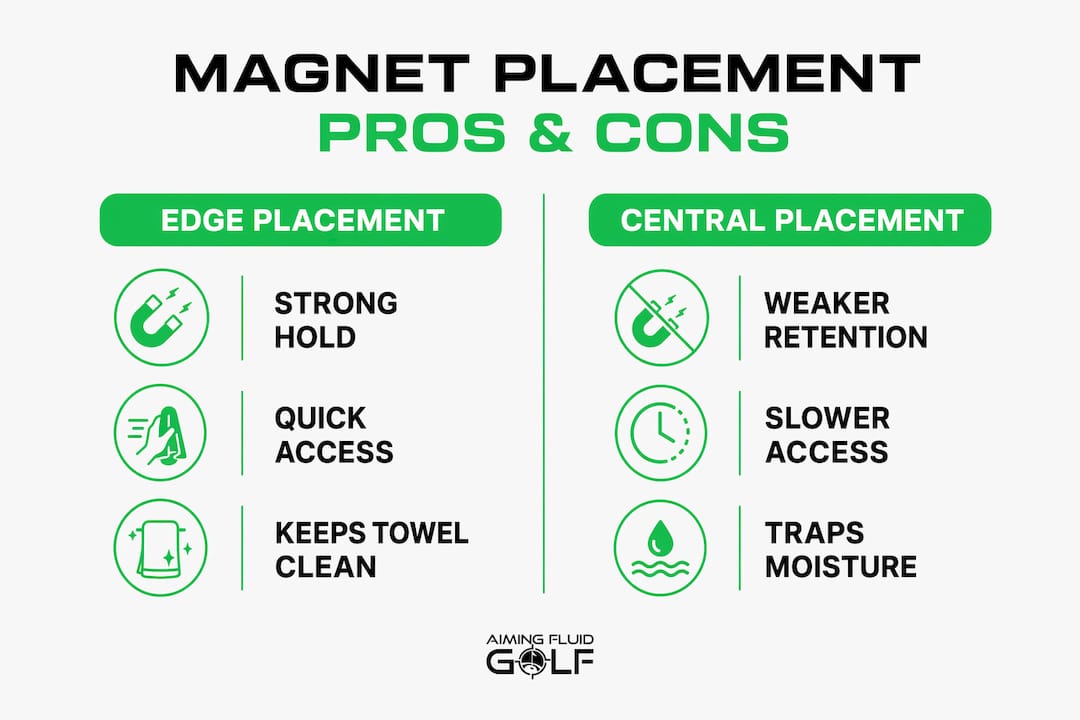
- Corner pockets (adjacent to two edges): Best balance of pull force and hang stability; towel drapes evenly and the magnet contacts the target at a consistent angle
- Mid-edge pockets: Strong hold on flat ferromagnetic surfaces; slightly less stable on curved surfaces like bag frames
- Mid-panel pockets: Weakest effective hold; fabric bunches above the attachment point and the towel sags or rotates
Optimal magnet placement at edges or corners also keeps the towel off the ground, which reduces contamination and preserves the wiping surface between shots.
Common failure modes and how placement contributes to them
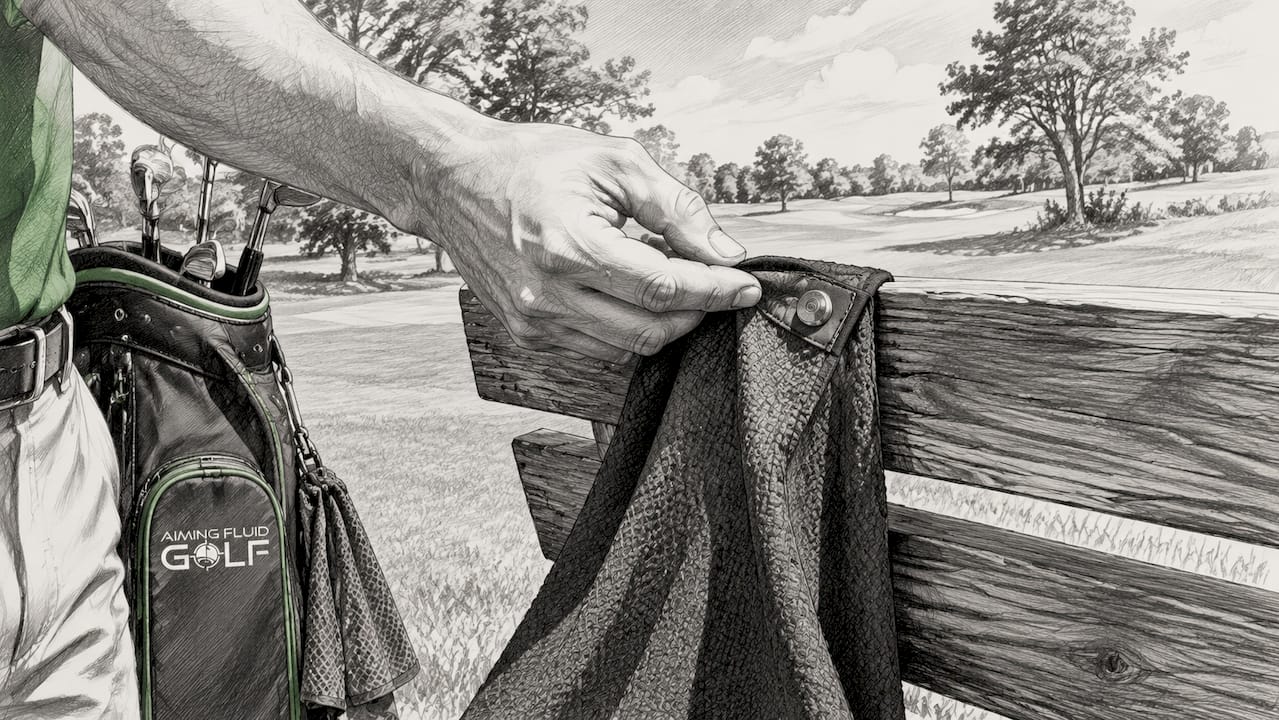
Magnetic towel systems fail in predictable ways, and most trace back to placement decisions made during construction.
Failure modes by type:
- Magnet detachment: Pockets stitched with insufficient perimeter seam allowance pull away from the towel face under repeated attachment and removal cycles
- Fabric pinching: A U-shaped or clip-style magnet placed at the mid-edge grips both towel faces; over time, the clamping force thins and weakens the fabric at that point
- Corrosion during washing: Standard ferrite magnets left inside sewn-shut pockets rust when exposed to water and detergent, staining the towel and degrading pull force
- Aesthetic degradation: Magnets placed near the towel face rather than the under surface create visible lumps and distort the towel’s profile
Removable pocket design directly addresses the corrosion and detachment risks. A pocket with a hook-and-loop or snap closure lets you pull the magnet before washing, eliminating rust risk entirely. Rare earth magnets in sealed corner pockets can survive machine washing and drying, but standard ferrite and ceramic magnets cannot.
Placement near the towel edge also affects drying speed. A thick pocket sewn across the full width of the edge traps moisture and slows drying. Keeping the pocket small, typically 1.5–1.75 inches per side as used in patented anchoring systems, limits that effect.
DIY magnet towel construction: placement tips that actually work
Getting placement right from the start saves you from resewing pockets or replacing magnets after a few rounds.
Core construction steps:
- Cut your pocket material from tightly woven cotton or nylon; avoid stretch fabrics that shift the magnet under load
- Position the pocket on the under surface of the towel, flush against one corner, adjacent to both the side edge and the end edge
- Stitch three sides with a tight perimeter seam, leaving one short side open for magnet insertion
- Add a hook-and-loop tab or snap to close the open end; this allows magnet removal before every wash cycle
- Insert the magnet and test hang before final closure
For a more versatile towel, use a dual-pocket system: one corner pocket holds a magnet, the opposite corner holds a ferromagnetic disc. When you fold the towel, the magnet and disc attract through the fabric, forming a loop you can hang from a non-magnetic object like a golf bag handle or cart rail.
Additional placement tips:
- Offset dual magnets slightly from the exact corner to reduce stress concentration at the corner seam
- Use cylindrical rare earth magnets (0.75–1.25 inches diameter) for the best pull-to-size ratio in a small pocket
- Keep pocket depth shallow so the magnet sits at the outermost edge of the towel, not recessed inward
- Avoid placing pockets over existing seams where fabric layers are already thick; the added bulk reduces effective pull force
Pro Tip: Sew a second, identical pocket on the opposite corner using a ferromagnetic disc instead of a magnet. The towel can now loop around a cart handle or golf club shaft, giving you a hands-free hanging option on various surfaces.
What experts say about magnetic field strength and placement
Magnetic field strength and placement work together, not independently. Q Magnets, whose field-dose-placement framework is widely cited in applied magnetics, identifies placement as the variable most likely to cause failure when ignored. Their core finding: if a magnet is not positioned correctly relative to the target surface, the effective field strength at that surface may be negligible, regardless of the magnet’s rated gauss.
Therapeutic magnets range from 200 to 10,000 gauss, far above the household magnet baseline of around 200 gauss. Golf towel magnets typically fall in the lower portion of that range, which makes placement even more consequential. A weaker magnet has almost no margin for error in positioning.
Aimingfluidgolf applies this logic directly to towel design. Placing the magnet at the corner of the under surface, with minimal fabric between the magnet and the attachment point, keeps the effective field at the target surface as strong as the magnet’s rating allows. The magnetic landing pad system pairs with the towel so the attachment geometry is consistent every time, removing the guesswork from reattachment.
Key expert principles for placement:
- Magnet must contact or nearly contact the ferromagnetic surface; even a few millimeters of extra fabric reduces hold meaningfully
- Magnet geometry (cylindrical vs. disc vs. U-shaped) interacts with placement; cylindrical rare earth magnets in corner pockets outperform U-shaped clip magnets on curved surfaces
- Pocket size and stitching pattern affect how well the magnet maintains its position under repeated use
Pro Tip: When selecting a magnet for a DIY towel, match the magnet diameter to the pocket size so there is no lateral movement inside the pocket. A magnet that shifts even slightly changes the contact angle and reduces pull force at the attachment point.
How magnet placement shapes towel aesthetics and design compatibility
Placement decisions show up visually, not just functionally. A pocket on the towel face creates a visible bump and interrupts any embroidered logo or printed pattern. Positioning the pocket on the under surface keeps the face clean and preserves the towel’s appearance through repeated use.
Corner placement also affects how the towel hangs and folds. A magnet at one corner pulls that corner toward the attachment surface, so the towel hangs at a slight diagonal. For golf towel design, this is intentional: the diagonal hang exposes the wiping surface and keeps the towel from bunching. A mid-edge magnet, by contrast, folds the towel in half at the attachment point, hiding half the wiping surface.
Color, texture, and branding also interact with pocket placement. A small, low-profile pocket sewn flush to the corner edge is nearly invisible from the front. A large pocket centered on the towel face competes with any design element on that surface. Aimingfluidgolf’s towel construction keeps all magnetic hardware on the under surface, so the face remains a clean canvas for color and texture choices.
Fabric compatibility matters too. Thick terry cloth requires a stronger magnet to compensate for the added distance between magnet and target. Thinner microfiber towels work well with smaller, lighter magnets positioned at the corner, and they typically dry faster due to a smaller pocket footprint.
Key Takeaways
Magnet placement at the corner or edge of a towel’s under surface produces the strongest hold, fastest access, and cleanest appearance across both golf and DIY applications.
| Point | Details |
|---|---|
| Corner placement wins | Magnets at the corner of the under surface deliver the best pull force and hang stability. |
| Fabric thickness reduces hold | Every layer between the magnet and the target surface weakens effective field strength. |
| Removable pockets prevent damage | Hook-and-loop or snap closures let you remove magnets before washing, preventing rust and fabric wear. |
| Dual-pocket systems add versatility | Pairing a magnet pocket with a ferromagnetic disc pocket lets the towel loop around non-magnetic surfaces. |
| Pocket size affects aesthetics | Small corner pockets (1.5–1.75 inches per side) keep the towel face clean and minimize drying time. |
Aimingfluidgolf’s magnetic golf towel system puts these placement principles into a production-ready design, so you get consistent attachment geometry every round without the trial and error of DIY construction. For golfers who want the full accessory system, the best golf accessories guide covers how the towel, landing pad, and utility pouch work together as an organized gear system.
Recommended
- Small vs Large Magnetic Golf Towel | Engineered Cleaning System – Aiming Fluid Golf
- Best Magnetic Golf Towels – Aiming Fluid Golf
- Magnetic Golf Towel That Doesn’t Fall Off | What Actually Matters (Shear + Vibration) – Aiming Fluid Golf
- Why Towel Placement Matters for Golf Performance – Aiming Fluid Golf


