


Club rules on accessories exist to draw a defensible line between what members can wear or carry and what puts safety, civility, brand identity, or liability at risk. That is the whole function in one sentence. Every clause in a dress code or house rule book traces back to one of those four pressures.
A few reference points make this concrete. The USGA’s equipment rules permit certain non-permanent attachments for identification but ban anything that creates a performance edge. Institutional house rules, like those published by the Yale Club of New York City, spell out exactly which items are off-limits in which rooms. And on the equipment side, resources like Aimingfluidgolf’s guide to penalty-free accessories help members choose gear that never triggers a rules conversation in the first place.
If you manage a club and need to act today, run this checklist:
- Safety check — does the accessory create a trip, snag, or injury risk in this specific setting (locker room, course, dining room)?
- Accommodation check — could a blanket rule disadvantage a member with a disability or religious practice that needs case-by-case handling?
- Rule-source check — is this accessory already addressed in your constitution, bylaws, or house rules, or are you making a judgment call that needs to be documented and escalated?
Get those three right, and most accessory disputes resolve themselves before they become grievances.
Key Takeaways
Club accessory rules function best when they’re written for a clear rationale, placed in the right governance tier, and enforced through a documented, staged process rather than staff discretion alone.
| Point | Details |
|---|---|
| Know the rationale first | Every accessory rule should trace to safety, fair play, civility, brand identity, or liability. |
| Match the rule to its tier | Keep broad principles in the constitution and specific item lists in house rules for easier updates. |
| Escalate in documented stages | Move from verbal reminder to written notice to restriction to formal hearing, with records at each step. |
| Build in an accommodation path | Separate ADA and religious accommodation requests from routine enforcement, with legal counsel on standby. |
| Choose gear that avoids disputes | Aimingfluidgolf’s magnetic towel, landing pad, and utility pouch designs help members stay compliant without staff intervention. |
Table of Contents
- Why Clubs Regulate Accessories in the First Place
- Common Accessory and Dress-Code Rules, With Examples
- Where Accessory Rules Should Live in Club Governance
- Enforcing Accessory Rules Without Creating a Bigger Problem
- Keeping Enforcement Fair When Not Every Member Feels the Rule Equally
- Rolling Out New or Changed Accessory Rules
- Sample Clauses Managers Can Adapt Today
- Frequently Asked Questions
- Sources
Why Clubs Regulate Accessories in the First Place
Accessory rules are rarely about fashion for its own sake. They come from five overlapping concerns, and knowing which one is driving a specific rule helps you enforce it with confidence instead of guesswork.
- Safety. Dangling jewelry, oversized rings, or loose straps create real hazards in locker rooms, on courts, and around machinery. The FA’s Law 4 requires players to remove jewelry entirely, with referees empowered to pull a player off the field until it’s fixed. That same logic applies to a golf club’s cart barn or a tennis club’s court.
- Fair play and competitive integrity. Equipment that gives an unearned edge undermines the point of competition, which is why golf’s governing bodies police attachments so closely.
- Member experience and civility. A dining room full of ball caps and gym shorts changes the feel of a club faster than almost any other single factor.
- Brand and uniformity. Clubs sell an identity as much as a service. Accessory rules protect that identity the same way a dress code protects a restaurant’s atmosphere.
- Operational and liability concerns. Staff time spent policing violations, and the insurance exposure from an avoidable injury, both factor into how strict a rule gets written.
Regulation is not free of side effects. Research on stricter governance in sports clubs shows that tight enforcement can create incentives to game the system, and rules that feel airtight on paper sometimes push members toward technical workarounds instead of genuine compliance. A rule too rigid to survive contact with real members usually gets ignored, not followed.
There’s also a legal dimension managers can’t skip. Accommodation requests tied to disability, religion, or medical need fall under duty-to-accommodate principles similar to the Americans with Disabilities Act. A blanket “no headwear” rule, for instance, needs a built-in exception process for medical or religious head coverings. When a request doesn’t fit neatly into existing language, that’s the moment to loop in legal counsel rather than improvise.
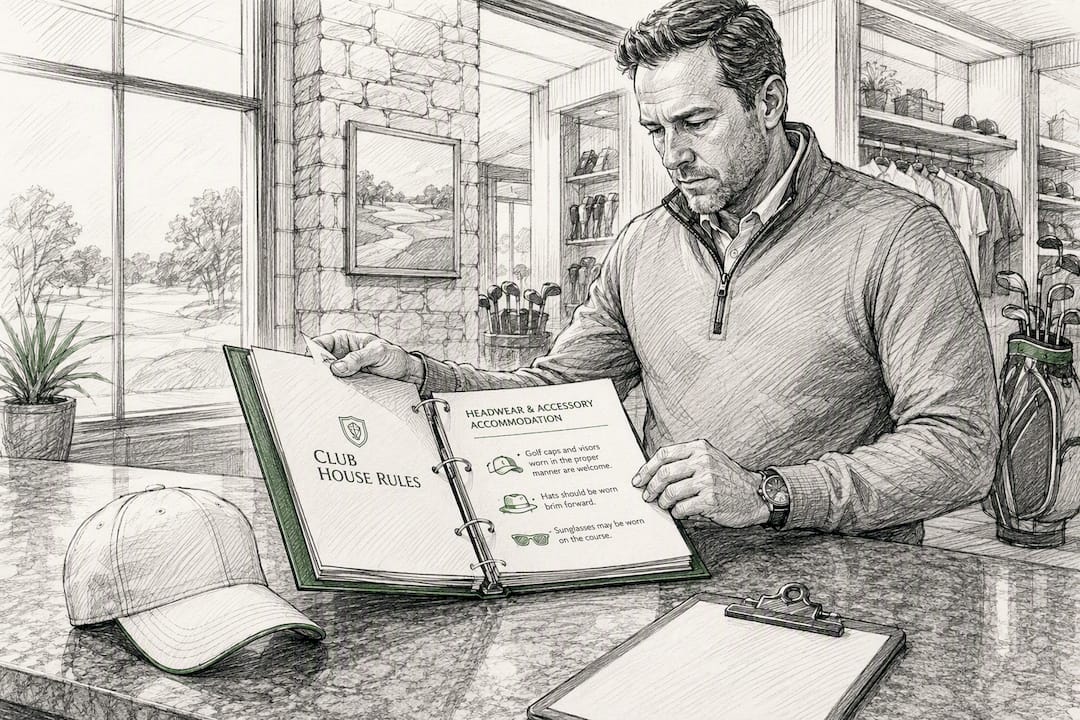
Pro Tip: Before writing any new accessory restriction, ask which of the five rationales it serves. If you can’t name one, the rule probably won’t survive a member challenge.
Common Accessory and Dress-Code Rules, With Examples
Most clubs land on a similar structure once you strip away the specific wording: a short list of clearly permitted items, a longer list of context-dependent restrictions, and a short but firm list of outright prohibitions.
Typically permitted:
- Discreet jewelry (wedding bands, small stud earrings, thin necklaces)
- Functional protective gear (medical alert bracelets, sport-specific padding)
- Staff and member identification badges
- Golf-specific accessories that conform to standard equipment rules, including compliant training aids and alignment tools
Commonly restricted, depending on venue or time of day:
- Sports caps and baseball hats in dining rooms, even ones described as “smart casual.” The Telegraph’s reporting on member-club dress codes specifically flags trainers and caps as items members should double-check before wearing, since staff discretion varies by club.
- Large statement jewelry that could catch on equipment or furnishings
- Noisy accessories (jangling charm bracelets, loud fitness trackers) in quiet lounges or reading rooms
- Athletic wear, tank tops, and flip-flops in formal dining, a restriction the Yale Club’s own house rules state explicitly
Typically prohibited outright:
- Weapons or anything readily mistaken for one
- Metal spikes or cleats on interior flooring outside designated areas
- Accessories that visibly alter equipment performance in competitive settings
A sample clause a club could adapt reads something like: “Members and guests must not wear athletic caps, tank tops, or open-toe athletic footwear in the Main Dining Room after 6:00 PM. Golf attire, including collared shirts and soft spikes, is permitted in designated grill and terrace areas.”
Event context changes everything. A member social might tolerate golf polos and visors that a formal dinner would not, and tournament play introduces a separate layer of rules entirely. This is where golf clubs need to distinguish house dress code from competition equipment rules. The USGA’s interpretations allow certain temporary, non-performance-enhancing attachments for identification purposes, but a club’s own house rules can still be stricter for casual play than USGA rules require for sanctioned competition. Managers running both social and competitive calendars should keep these two rule sets clearly labeled and separately referenced, ideally with a resource like Aimingfluidgolf’s penalty-free accessory guide linked in member communications so golfers can self-check before a round.
Pro Tip: Keep a one-page “quick reference” version of your dress code at the front desk and pro shop counter. Staff who can point to a laminated card resolve disputes faster than staff who have to recite policy from memory.
Where Accessory Rules Should Live in Club Governance
Not every rule belongs in the same document, and putting a rule in the wrong tier is one of the most common governance mistakes clubs make. Think of it as four layers, each with a different amendment difficulty:
- Constitution — high-level principles only (“The Club shall maintain standards of dress and conduct consistent with its character”). Rarely amended, usually requires a membership vote.
- Bylaws — procedural rules governing how policy gets made and enforced, including who has authority to approve house rules.
- House rules / operational policies — the day-to-day detail: specific prohibited items, room-by-room dress codes, enforcement steps. This is where most accessory language actually lives, and it should be the easiest tier to amend.
- Event-specific policies — temporary exceptions for tournaments, holiday parties, or themed nights, published separately and expiring automatically.
When drafting a new clause, run it through this minimal checklist before it goes anywhere near a vote:
- Scope — which spaces, times, or events does this apply to?
- Definitions — what exactly counts as an “accessory” or “attachment”? Vague terms invite disputes.
- Examples — name at least two or three concrete items on each side of the line.
- Exceptions — medical, religious, or event-based carve-outs, stated up front rather than negotiated case by case.
- Enforcement mechanism — who has authority to act, and what’s the first step?
- Appeal path — where does a member go if they disagree with a staff decision?
For approval, most clubs follow a similar cadence: draft language goes to the house committee first, then to the board for a vote, and only structural changes affecting the constitution require a full membership vote. Budget four to eight weeks for this cycle if you want real member input rather than a rubber stamp.
Enforcing Accessory Rules Without Creating a Bigger Problem
A rule nobody enforces consistently is worse than no rule at all, because it teaches members that policy is negotiable. The fix is a staged process that gives staff clear authority at each step without turning every violation into a confrontation.
- Verbal reminder. Front-line staff flag the issue politely, in private where possible, and note it happened.
- Written notice. A repeat violation gets a short written note referencing the specific house rule, sent within a day or two.
- Temporary restriction. For persistent or serious violations, a temporary suspension of a privilege (course access, dining room use) with a clear path back to good standing.
- Formal hearing. Reserved for disputed cases or repeat offenders, heard by the relevant committee with the member given a chance to respond.
Every incident above the first stage needs documentation. A workable incident report should capture the date, location, staff member involved, specific rule cited, member’s response, and the action taken. Clubs that keep this kind of record consistently report fewer repeat disputes, largely because a documented pattern makes the next enforcement conversation easier rather than harder to have.
Pro Tip: Run a short role-play session with front-desk and dining staff twice a year. Practicing the exact wording for a polite correction, before a real member is standing in front of them, cuts down on both over-enforcement and awkward silence.
Keeping Enforcement Fair When Not Every Member Feels the Rule Equally
The fastest way to lose member trust is inconsistent enforcement, particularly when longtime or high-spending members appear to get a pass that newer members don’t. Transparent, written procedures are the best defense against that perception, because they take the decision out of any one staff member’s personal judgment.
Two practices reduce this risk in most clubs:
- Publish the escalation stages described above, so every member knows what happens after a first reminder, and it applies the same way regardless of tenure.
- Build an accommodation pathway for ADA-related or religious requests, separate from routine dress-code enforcement, with a named staff contact who can approve exceptions without a full committee review.
When a request doesn’t fit an existing exception, the safest sequence is: document the request, pause enforcement on that specific case, and consult HR or legal counsel before making a permanent decision. Reacting on the spot, in either direction, tends to create precedent problems later.
Periodic review matters too. A short annual survey asking members whether current accessory rules still feel reasonable catches drift before it becomes resentment, and gives the house committee real data instead of anecdotal complaints from whoever happened to speak up loudest.
Pro Tip: Rotate who reviews accommodation requests every year or two. A single long-serving gatekeeper, however well-intentioned, tends to accumulate informal exceptions that no one else on the committee knows about.
Rolling Out New or Changed Accessory Rules
Members accept new rules far more readily when they see them coming. A short checklist keeps rollout friction low:
- Write the rule in plain language with two or three concrete examples
- Publish a short FAQ addressing the three questions staff hear most often
- Post signage at the point of relevance (locker room, dining entrance, pro shop)
- Brief all front-line staff before the rule takes effect, not after
For timing, give members 30 to 60 days’ notice on any substantive dress-code or accessory change. Reserve same-day or immediate notices for minor clarifications, like confirming that a specific new product category is already covered under an existing rule.
Sample Clauses Managers Can Adapt Today
These templates are starting points, not finished legal language. Have your club’s counsel review anything before it goes into a governing document.
Permitted accessories: “Members may wear discreet jewelry, medical alert devices, and identification badges in all Club areas without restriction.”
Prohibited accessories: “Members and guests shall not wear or carry items that pose a safety risk to themselves or others, including but not limited to unsecured metal spikes on indoor flooring and jewelry likely to cause injury during active play.”
Event exceptions: “For Club-sanctioned social events designated as ‘Casual,’ standard dress code restrictions on athletic footwear and headwear are suspended for the duration of the event.”
Enforcement procedure: “Staff observing a dress code or accessory violation shall issue a verbal reminder in the first instance. Repeated or serious violations shall be documented and referred to the House Committee.”
Appeals: “A member disputing a staff enforcement decision may request review by the House Committee within 14 days of the incident.”
ADA accommodation requests: “Members requiring accommodation due to disability or religious practice may submit a request to the General Manager, who shall respond within 10 business days.”
Golf-specific clause: “All equipment used in Club-sanctioned competitions must conform to current USGA equipment rules. Non-conforming attachments, including performance-enhancing devices not permitted under Rule 2, are prohibited during sanctioned play, regardless of their acceptability under general Club dress code.” This kind of clause matters because it explicitly separates casual-play tolerance from competition-day rules, a distinction golf clubs often blur until a tournament dispute forces the issue. For members trying to stay compliant without memorizing rule text, a plain-language resource like Aimingfluidgolf’s master glossary of golf accessory terms helps translate “conforming” into something they can act on before they show up to the first tee.
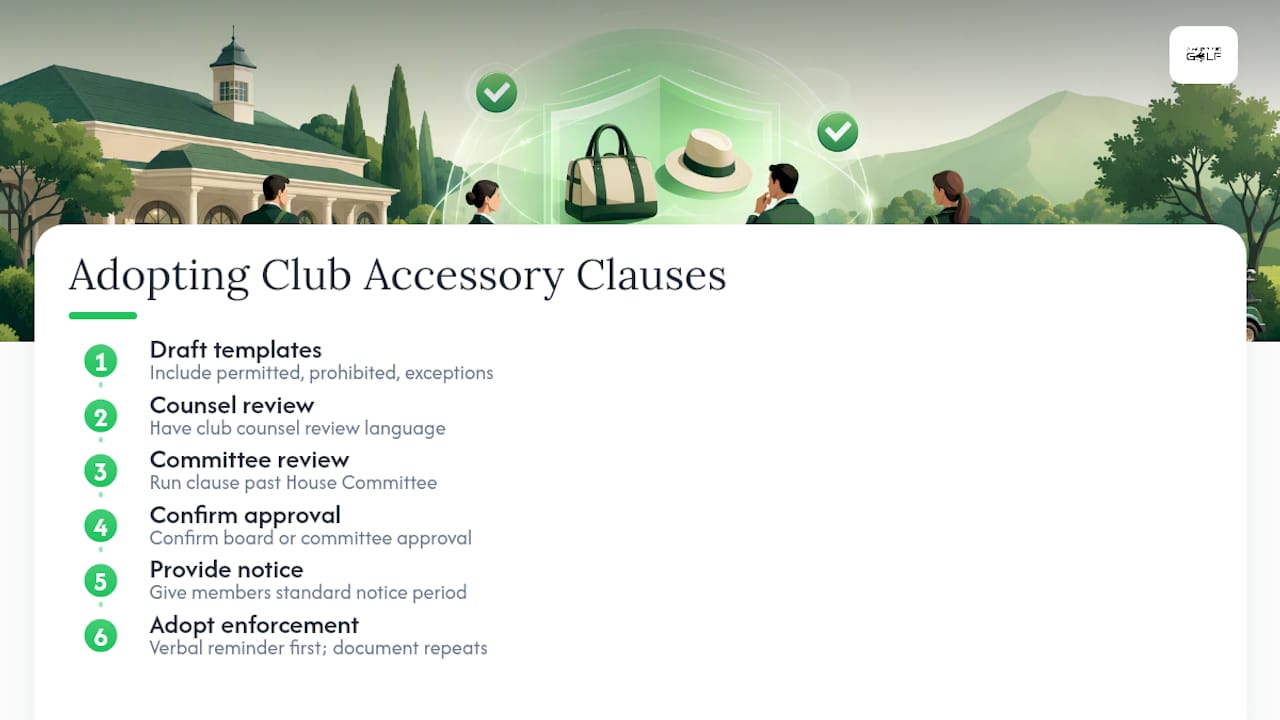
Before adopting any clause, run it past the house committee, confirm whether it needs a full board vote or committee-level approval, and give members the standard notice period described earlier.
A Manager’s View From the Floor
Most disputes I’ve seen aren’t about the rule itself. They’re about a member feeling singled out. The fix is almost always the same: point to the written policy, not your own judgment, and apply it the same way twice in a row.
How Aimingfluidgolf Helps Clubs Stay Rule-Friendly Without the Friction
Compliant accessories are easier to enforce when they’re also the easiest option to reach for. Aimingfluidgolf’s magnetic towel and landing pad system keeps a member’s towel visible and instantly accessible instead of buried in a bag, which cuts down on the slow play and rummaging that often trigger staff intervention in the first place.

The same logic applies to the divot tool, precision tees, and leather utility pouches in the lineup: gear designed to stay organized and course-ready without ever raising a dress code or equipment-rule question. Clubs building a member-facing list of recommended accessories can start with the curated selection of cart, carry, and practice gear, and managers interested in a policy-friendly bundle for their pro shop or member handbook can reach out to request samples directly.
Frequently Asked Questions
What is the main role of club rules on accessories? They set enforceable boundaries between permitted and prohibited items to protect member safety, preserve the club’s identity, and limit legal exposure from injuries or discrimination claims.
Do accessory rules have to be the same for members and guests? Not necessarily. Many clubs apply identical dress and accessory standards to both, but guest-specific exceptions (like a first-time visitor unaware of policy) are common and worth writing into house rules explicitly.
Can a club restrict religious head coverings under a “no headwear” rule? No. A blanket rule that doesn’t carve out religious or medical exceptions is likely to violate accommodation obligations, so any headwear restriction needs a documented exception process from the start.
How often should accessory rules be reviewed or updated? An annual review, paired with a short member survey, catches most drift before it becomes a source of complaints, though operational clarifications can be issued anytime with a short notice period.
Where should golf-specific equipment rules sit relative to general club dress code? Keep them separate. General dress code governs casual and social settings, while sanctioned competition play should reference USGA conforming-equipment standards directly, since the two rule sets can differ on the same accessory.
Sources
- Rule 2 - Interpretations | USGA
- Law 4 - The players’ equipment | The FA
- YCNYC House Rules (Dress Code) | Yale Club NYC
- Navigate members’ club dress codes | The Telegraph
- Assessing the financial regulation of European football clubs | Oxera


