


How branding in golf gift sets drives real marketing results
Branded golf gift sets do one thing generic promotional items cannot: they travel. A logo on a golf ball moves from the corporate tournament to the weekend round at a private club, then to the desk drawer where it catches a client’s eye during a phone call. That repeated exposure is the core mechanism behind the role of branding in golf gift sets, and it is why marketing professionals treat them as a distinct category rather than a premium version of a tote bag.
Research from PPAI shows that a large majority of people remember the advertiser of a promotional product connected to a personal leisure activity like golf. That figure holds because the product is used in a context the recipient genuinely enjoys, which creates a positive association the brand inherits by proximity.
The branding techniques that work best in this category are not the loudest ones. Logo placement, subtle embossing, debossing, and tone-on-tone embroidery all outperform oversized screen prints because they integrate into the product rather than sitting on top of it. A well-branded golf towel or divot tool looks like something the golfer chose for themselves, which is exactly the perception that drives reuse and, by extension, sustained brand visibility.
Key branding functions in golf gift sets:
- Impression reinforcement: Items used across multiple rounds generate repeated exposure without additional spend.
- Identity alignment: Premium materials signal that the brand values quality, not just visibility.
- Relationship depth: A thoughtfully curated set communicates appreciation more clearly than a generic giveaway.
- Event extension: Branded accessories carry the event’s identity well past the 18th hole.
- Social reach: Fellow players see branded items throughout a round, extending impressions beyond the original recipient.
What types of golf gift sets work best for branding?
Not every golf product carries the same branding potential. The items that generate the most sustained impressions are the ones golfers handle repeatedly during a round, not the ones that look impressive in a box and stay there.
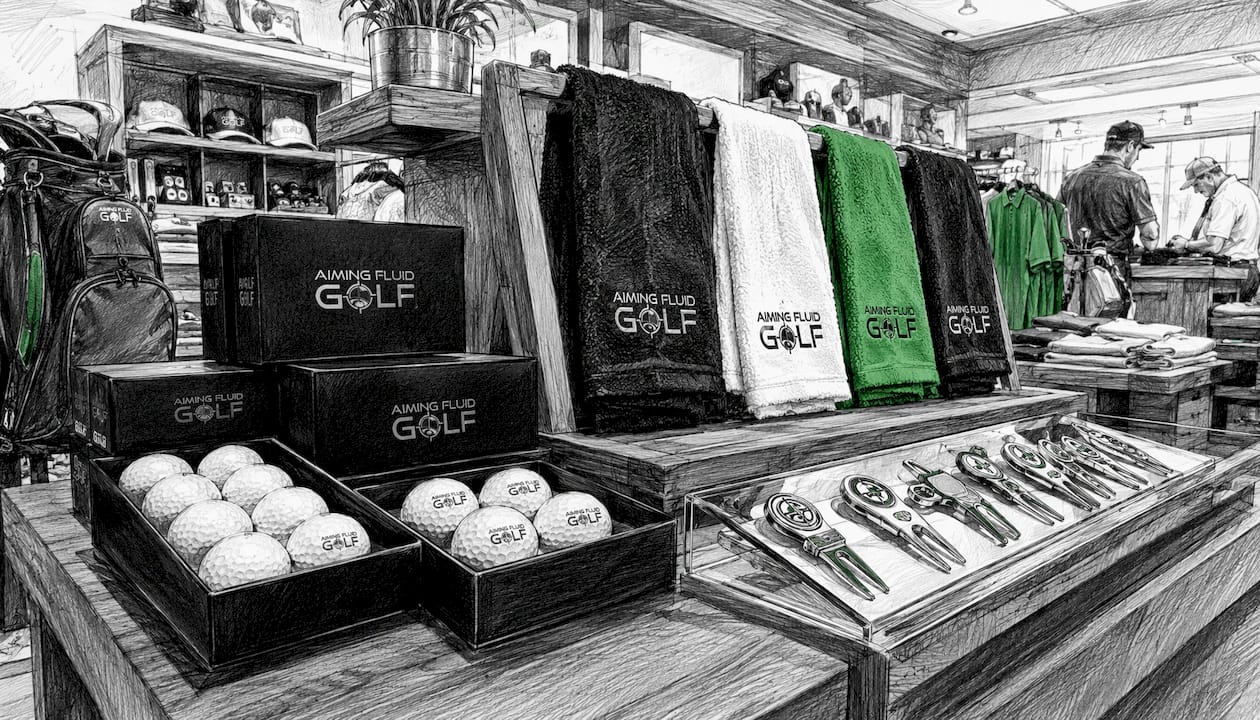
| Gift Type | Branding Visibility | Customization Options | Sustained vs. One-Time |
|---|---|---|---|
| Golf balls | High (every shot) | Logo, text, full color | Sustained (weeks to months) |
| Golf tees | Medium (every tee shot) | Logo, color, text | Sustained (multiple rounds) |
| Golf towels | High (clipped to bag all round) | Embroidery, screen print, emboss | Sustained (seasonal use) |
| Divot tools | High (used on every green) | Engraving, UV print, metal finish | Sustained (years) |
| Ball markers | Very high (every hole) | Engraving, UV print | Sustained (all season) |
| Apparel (caps, polos) | High (worn during and after) | Embroidery, heat transfer | Sustained (ongoing) |
| Golf bags | Very high (visible all round) | Embroidery, patch, deboss | Long-term (years) |
| Utility pouches | Medium (carried regularly) | Deboss, engraving, print | Sustained (daily carry) |
Branded golf balls occupy a unique position because they are simultaneously functional, visible to other players, and durable enough to circulate across multiple rounds and courses. A sleeve of premium balls with a clean logo print carries social currency that a foam stress ball never will.
High-quality accessories like bags, towels, and apparel elevate brand perception by associating the company with products the recipient actively chose to use. That association is the practical definition of brand equity in a gifting context.
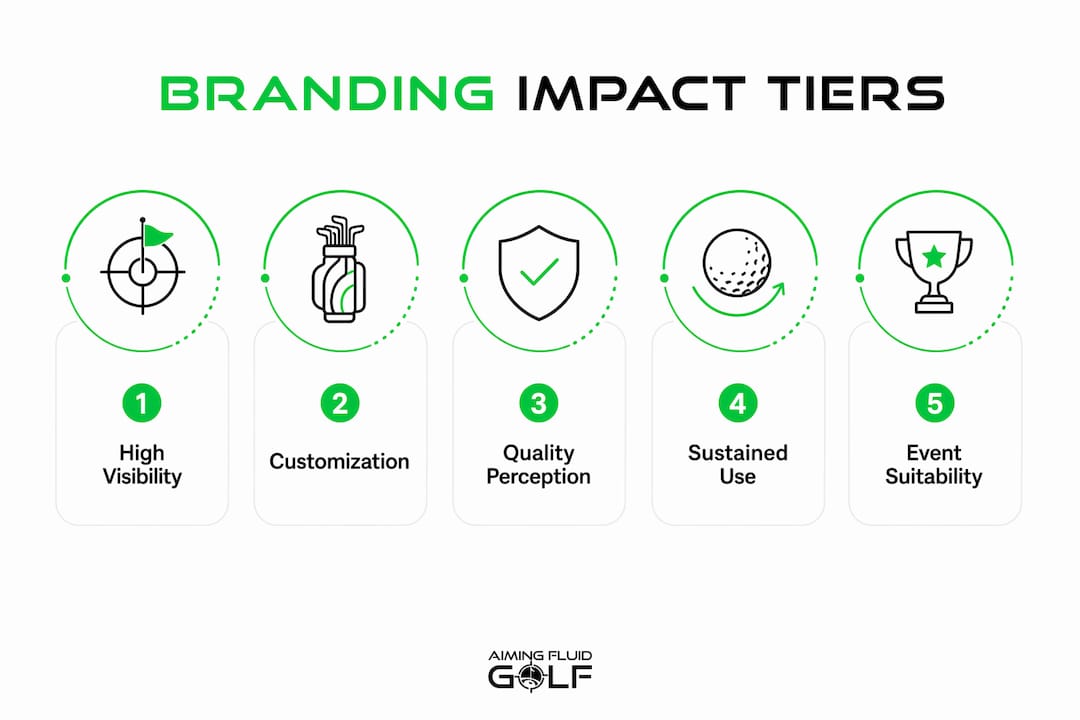
Customization options vary by product. Metal divot tools and ball markers accept laser engraving and UV printing. Towels and apparel take embroidery or tone-on-tone weaving. Golf balls support full-color UV printing with no per-color charges at most suppliers. The choice of decoration method affects perceived quality as much as the product itself.
Branding strategies for corporate golf events that actually work
The first question when planning a corporate golf gift set is not “what items can we brand?” It is “what should this gift accomplish?” A welcome kit for tournament participants needs to be practical and portable. A gift for a senior client requires higher-quality materials and stronger personalization. A sponsor activation needs products that stay visible throughout the day.
Golf gift sets function as experience accelerators at corporate events, deepening business connections in ways that conference room interactions rarely do. Four hours on a course creates unstructured conversation time that builds genuine rapport, and a well-curated gift set reinforces the host brand throughout that entire window.
Branding approach matters as much as product selection. Overt branding (large logos on every surface) creates immediate visibility but reduces the likelihood that recipients will use the items beyond the event. Restrained branding, where the logo is present but integrated, produces the opposite effect: higher reuse rates and longer impression lifespans.
Pro Tip: Match packaging quality to the gift tier. A premium divot tool in a plain poly bag loses half its perceived value before the recipient even touches the product. Coordinated packaging, whether a magnetic-closure box or a branded pouch, sets the tone before anything is unwrapped.
Digital integration extends the gift’s reach beyond the physical product. QR codes on packaging or NFC-enabled accessories can connect recipients to tournament leaderboards, event photography, sponsor content, or post-event promotions. The destination matters: sending a client to a generic homepage wastes the touchpoint. A personalized thank-you page or an event recap with their name on it does not.
Branding objectives by event type:
- Client appreciation outings: Prioritize personalization (initials, names) and premium materials to signal individual recognition.
- Tournament sponsorships: Use branding hierarchy, event logo on high-touch items, sponsor logo on secondary products.
- Networking events: Focus on items that stay visible during the round (towels, caps, ball markers) to maximize peer-to-peer impressions.
- Employee recognition: Coordinate gift sets with internal brand identity to reinforce team culture.
How to choose the right golf gift sets for your brand
Start with the recipient, not the product catalog. A set built for a C-suite client at an executive outing has different requirements than a welcome pack for a 120-person charity scramble. The product mix, quality tier, and branding approach should all follow from that audience definition.
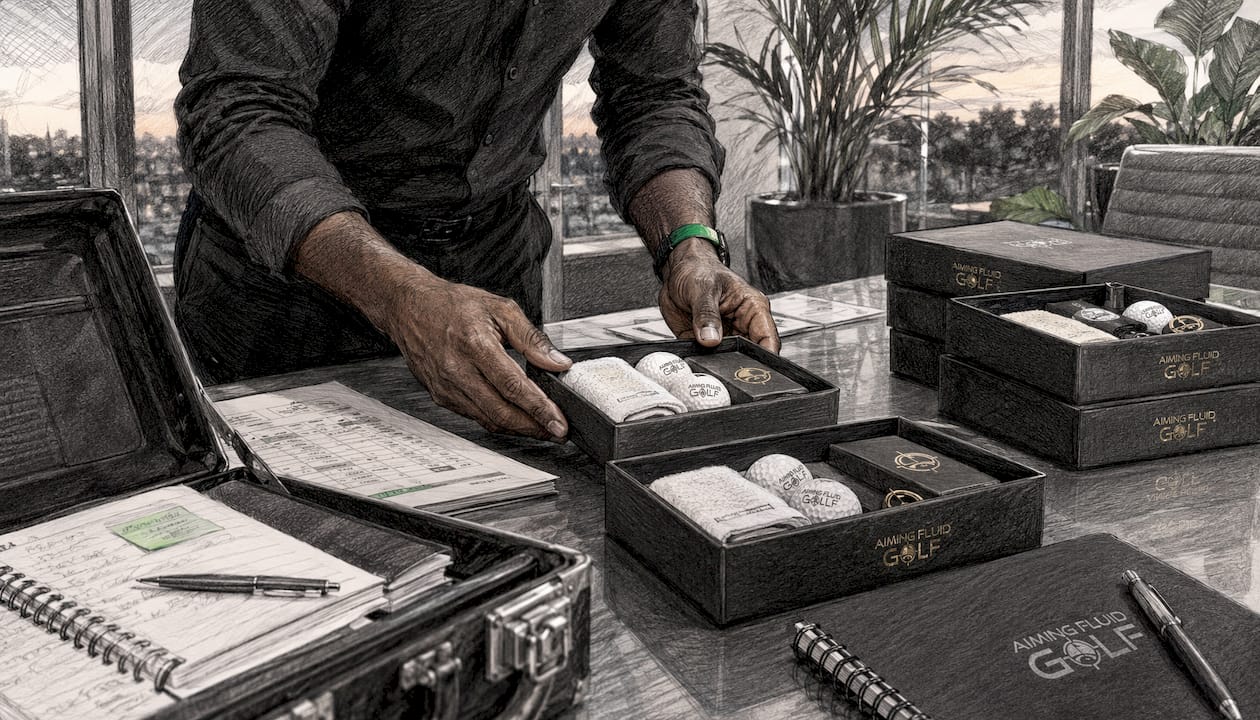
Quality threshold: Low-quality accessories damage brand perception more directly than no gift at all. A poorly printed logo on a flimsy towel communicates the opposite of what a premium brand intends. The product’s material and construction quality is the first signal the recipient reads, before they ever notice the logo.
Budget allocation: Cost per impression is the relevant metric, not cost per unit. Custom golf balls deliver a long impression lifespan relative to their unit cost because they circulate across multiple rounds and courses. A metal divot tool used across hundreds of rounds generates a cost-per-impression that generic items cannot approach.
Criteria for evaluating gift set options:
- Relevance: Does the item solve a real on-course problem the recipient encounters every round?
- Visual identity fit: Do the product colors, materials, and finish align with the brand’s existing aesthetic?
- Branding real estate: Is the imprint area large enough for a clean logo reproduction, or will the design be compromised?
- Reuse likelihood: Will the recipient use this item after the event, or does it stay in the bag and get forgotten?
- Packaging coherence: Does the presentation reinforce the brand story, or does it undercut the product quality?
For budget planning, tiered gift structures work well at events with mixed audiences. Standard player kits focus on course-use items (tees, ball markers, a towel). VIP or sponsor-level kits add premium accessories (engraved metal tools, personalized balls, a leather utility pouch). The visual identity should remain consistent across tiers even when the product mix differs.
Pro Tip: Order all branded products from a single supplier when possible. Color matching across golf balls, towels, and caps is only consistent when the same print process and color profile applies to every item in the set.
Research insights and best practices for branding with golf gifts
The 85% recall rate for promotional products tied to personal leisure activities is the most cited figure in this category, and it holds up under scrutiny because the mechanism is clear: positive emotional context during use creates stronger memory encoding than passive exposure to a banner or digital ad.
Branded golf balls circulate for weeks and sometimes months after an event, generating repeated impressions across courses, clubhouses, and social settings the original organizer never planned for. That organic distribution is the category’s most underappreciated advantage.
85% of people remember the advertiser of a promotional product connected to a personal leisure activity like golf. That recall rate exceeds most digital advertising benchmarks and reflects the sustained, contextual exposure that branded golf accessories deliver across multiple rounds and settings.
Branding hierarchy is the discipline that separates professional gift sets from cluttered ones. Strategic logo placement means reserving the event logo for high-touch items (balls, tees, ball markers) and placing sponsor logos on secondary products (towels, bags, caps). This prevents visual clutter and keeps each product looking intentional rather than crowded.
Subtle branding techniques like embossing, debossing, and tone-on-tone embroidery consistently produce higher reuse rates than overt logo placement. The reason is practical: a golfer is more likely to carry an accessory that looks like premium gear they chose themselves than one that reads as a corporate handout. A golf towel used for several seasons delivers more meaningful exposure than a heavily branded item left in a bag after the event.
Best practices summary:
- Apply event logos to the highest-frequency items (balls, tees, markers) and sponsor logos to larger secondary items.
- Use engraving or debossing on metal accessories for a premium finish that outlasts printed alternatives.
- Coordinate packaging with product colors to create a unified brand story from the first unboxing moment.
- Limit the number of logos per item to one, two at most, to preserve visual clarity.
- Personalize where the budget allows: a recipient’s name or initials on a ball or towel converts a gift into a keepsake.
Who actually receives branded golf gift sets?
Understanding the recipient profile is what separates a gift set that gets used from one that gets forgotten. The corporate golf audience skews toward senior decision-makers, C-suite executives, high-value clients, and business development professionals. These are people who play regularly, care about product quality, and notice when a branded item is genuinely good versus when it is a cheap logo vehicle.
That audience profile has direct implications for product selection. A recreational golfer who plays twice a year will use almost anything. A client who plays 30 rounds a season already owns premium gear and will immediately compare your gift against what is already in their bag. For that recipient, product quality is not a nice-to-have; it is the threshold the gift must clear before the branding even registers.
Secondary audiences at corporate golf events include mid-level managers, sales teams, event staff, and tournament volunteers. These groups warrant a different product tier, practical and well-branded but not necessarily at the executive gift level. Tiered gift structures that match product quality to recipient value are standard practice at well-run corporate tournaments.
Audience segmentation also affects personalization decisions. VIP clients benefit from name or initial personalization, which signals individual recognition rather than mass distribution. Larger player fields are better served by event-specific branding (tournament name, date, logo) that commemorates the occasion without requiring individual customization at scale.
How golf gift sets fit into a broader marketing campaign
A branded golf gift set works best when it is one node in a connected campaign, not a standalone gesture. The most effective programs treat the physical gift as a touchpoint that links to pre-event communication, on-course activation, and post-event follow-up.
Pre-event: sending a custom gift set to a client before a tournament builds anticipation and establishes the brand’s presence before the first tee time. A personalized note with the set connects the physical product to a human relationship, not just a logo.
On-course: coordinated branding across balls, towels, caps, and signage creates the impression of a thoroughly organized event. When a player sees the same visual identity on their ball, on the tee sign, and on the banner at registration, the event feels polished and the brand behind it earns credibility by association. Consistent visual identity across every touchpoint is what separates a memorable event from a forgettable one.
Post-event: the gift set’s job is not finished when the round ends. QR codes on packaging, follow-up emails referencing the event, and social media content featuring branded items all extend the campaign’s reach. A client who shares a photo of a premium branded accessory on social media generates organic impressions for an audience the original event never reached.
For marketing teams building annual programs, corporate golf gifts work most effectively when they are planned as part of the broader client engagement calendar rather than ordered reactively before each event. Consistent product quality and visual identity across multiple touchpoints throughout the year reinforces brand recognition more reliably than a single high-spend event.
Elevate your next event with Aimingfluidgolf
Aimingfluidgolf designs premium golf accessories built for on-course performance and corporate gifting. From magnetic golf towels engineered for instant access to precision divot tools and leather utility pouches, every product in the Aimingfluidgolf lineup is built to the quality standard that makes a branded gift worth keeping. Explore the full range of tournament and corporate accessories to build a gift set that reflects your brand’s standards.
Key Takeaways
Branded golf gift sets generate sustained brand impressions because recipients use them repeatedly across courses, clubhouses, and social settings, making them one of the highest-recall promotional product categories available to corporate marketers.
| Point | Details |
|---|---|
| Recall advantage | 85% of people remember the advertiser of a promotional product tied to a personal leisure activity like golf. |
| Subtle branding wins | Embossing, debossing, and tone-on-tone embroidery produce higher reuse rates than overt logo placement. |
| Branding hierarchy | Place event logos on high-touch items (balls, tees, markers) and sponsor logos on secondary products (towels, bags). |
| Audience-first selection | Match product quality tier to recipient value; senior clients notice when a branded item clears or misses their quality threshold. |
| Campaign integration | Gift sets perform best as one node in a connected program linking pre-event, on-course, and post-event touchpoints. |
Recommended
- Setup Process for Golf Tournament Gifts: 2026 Guide – Aiming Fluid Golf
- Best Corporate Golf Gifts 2026: Premium, Custom & Universal Fit – Aiming Fluid Golf
- Best Golf Gifts for Clients & Tournaments | Premium Corporate Golf Gif – Aiming Fluid Golf
- The Ultimate Golf Gifts Guide: Tech, Accessories, & Corporate Packages – Aiming Fluid Golf


