


For most recreational golfers, light groove sharpening is a safe, low-cost way to recover some spin and control from worn wedges. It is not a substitute for new clubs, but done conservatively, it extends useful life without breaking USGA rules.
Here is what to do right now:
- Clean first. Dirty grooves can reduce spin by at least 20%. Scrub with a stiff brush, soapy water, and a tee to clear packed debris before you decide anything else.
- Test your spin. Hit five or six wedge shots from a clean lie and watch rollout. If the ball is stopping well, cleaning may be all you need.
- Sharpen conservatively if needed. One to three light passes with a handheld groove sharpener is the safe range. Stop there.
- Replace if you play 75–125+ rounds per year or if grooves show visible volume loss. OEM testing shows used wedges at that round count can produce up to ~140% more rollout and ~30% less spin than new ones.
- Competitive players should avoid DIY sharpening. The USGA and R&A set strict groove geometry limits; altering grooves risks non-conformance and disqualification.
Key Takeaways
Light groove sharpening can restore spin for casual golfers, but players with high usage get more reliable performance from replacement than from repeated DIY sharpening.
| Point | Details |
|---|---|
| Clean grooves first | Dirty grooves reduce spin by at least ~20%; cleaning is always the right first step before sharpening. |
| Sharpen conservatively | Limit DIY passes to a few per groove; over-sharpening alters geometry and accelerates wear. |
| Replace at high round counts | At high usage, groove volume loss means sharpening cannot restore new-wedge spin levels. |
| Competitive players: verify conformity | USGA and R&A groove rules apply in sanctioned play; altered grooves risk disqualification. |
| Aimingfluidgolf accessories reduce wear | Magnetic towels and utility pouches keep grooves clean between shots, extending time between sharpening. |
Table of Contents
- What regrooving wedges actually means (and what it doesn’t)
- Why groove condition directly affects your short game
- Should you clean, sharpen, or replace your wedges?
- USGA and R&A rules on groove alterations
- How to sharpen wedge grooves safely at home
- Which groove-sharpening tools are worth buying in the U.S.
- What professional regrooving services do and what they cost
- What OEMs and independent tests say about groove wear
- An honest perspective on wedge maintenance
- Keep your grooves performing longer with the right accessories
- Sources
What regrooving wedges actually means (and what it doesn’t)
The terms “sharpening,” “regrooving,” and “re-cutting” are used interchangeably online, but they describe three different procedures with very different risk profiles.
- Sharpening uses a handheld file or carbide-tip tool to restore edge bite and clear compacted debris from existing grooves. It does not materially change groove geometry when done correctly. This is what most golfers mean when they ask about regrooving wedges at home.
- Regrooving or re-cutting means milling new groove geometry into the face, which is a factory-level process. It changes groove dimensions, wall angles, and edge radii. Done improperly, it renders a club non-conforming.
- Cleaning removes dirt, grass, and moisture from grooves without altering the metal at all. It is always the right first step.
The distinction matters because sharpening is largely reversible and low-risk; re-cutting is not. Most handheld tools sold as “groove sharpeners” or “wedge regroover” tools are designed for sharpening, not true re-cutting, even when their packaging uses the word “regroove.”
Pro Tip: Before buying any tool, check whether it is designed for V-shaped or U-shaped grooves. Modern wedges (manufactured after January 1, 2010) typically use U-shaped grooves. Using a V-profile tool on a U-groove wedge will alter the groove shape and may create a conformity issue.
Why groove condition directly affects your short game
Grooves do two jobs: they channel moisture and debris away from the ball-face contact zone, and their sharp edges create friction that generates backspin. Both the volume of the groove channel and the sharpness of the groove edges matter.
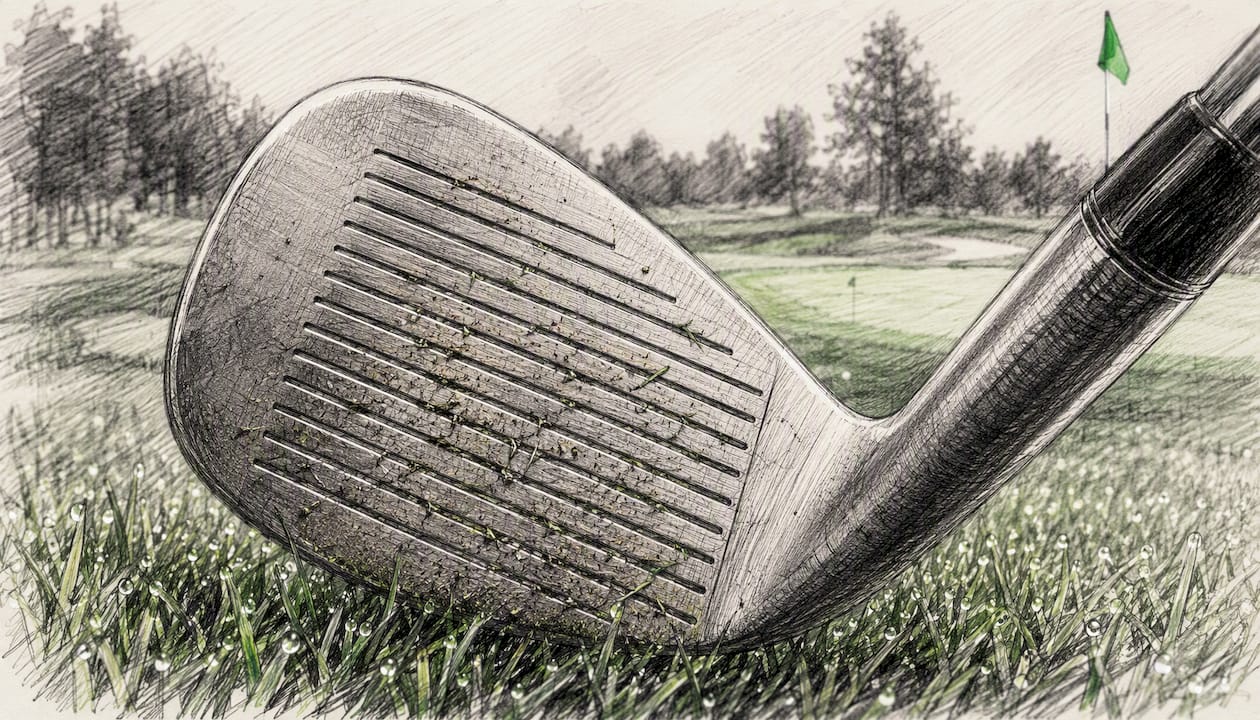
When grooves wear down, edge sharpness degrades first. The ball sits on a smoother surface, friction drops, and spin rate falls. Industry testing cited by Golf Digest shows that a wedge with roughly 125 rounds of use can produce up to approximately 140% more rollout and about 30% less spin compared to a new wedge of the same model. That translates directly to shots that release past the hole instead of checking up.
The groove shape also matters for regrooving viability:
- U-shaped grooves (square-edged, used on most modern wedges) have sharper initial edges that wear faster but respond better to careful sharpening.
- V-shaped grooves (older design, tapered walls) are more forgiving of wear but harder to sharpen without changing the groove profile.
For the science behind moisture interaction and groove performance, the mechanism is straightforward: a groove that cannot evacuate water creates a hydroplaning effect between ball and face, reducing effective friction regardless of edge sharpness.
Should you clean, sharpen, or replace your wedges?
Start with cleaning. Dirty grooves are often the primary cause of spin loss, and cleaning costs nothing. Only move to sharpening if performance does not recover after a thorough cleaning and a few test shots.
Decision checklist:
- Rounds per year under 30: Clean grooves regularly. Sharpening is unlikely to be necessary for several seasons.
- Rounds per year 30–75: Monitor stopping power. Light sharpening (1–3 passes) may help once grooves feel noticeably less grippy.
- Rounds per year 75–125+: Replacement is the more reliable fix. Sharpening can extend life short-term, but OEM testing data suggests performance loss at this stage is structural, not just surface-level.
- Tournament players: Do not sharpen without verifying conformity. The risk of disqualification outweighs the performance gain.
Step-by-step decision process:
- Scrub grooves with a stiff brush and soapy water. Use a tee or groove-cleaning pick to clear packed debris.
- Hit 5–6 wedge shots from a clean fairway lie and compare rollout to your baseline expectation.
- If spin has improved, stop. Cleaning was the fix.
- If spin is still low and grooves look sharp under a magnifying glass, consider 1–3 light sharpening passes.
- If groove edges are visibly rounded, walls are shallow, or you are past 100 rounds, budget for replacement.
For a practical groove-cleaning routine that covers these steps in detail, the process takes under five minutes per club.
USGA and R&A rules on groove alterations
The USGA and R&A regulate groove geometry for all irons, wedges, hybrids, and fairway woods. The rules set maximum limits on groove volume, edge sharpness, and wall angle. For clubs manufactured on or after January 1, 2010, these limits are stricter than for older equipment.
Key points for competitive players:
- Altering groove geometry beyond the original specification can render a club non-conforming, even if the alteration was unintentional.
- Permissible maintenance includes cleaning and removing debris. Light sharpening that restores edge bite without changing groove dimensions sits in a gray area, and the USGA’s guidance is that players bear responsibility for ensuring their equipment conforms.
- If you play in USGA-governed competitions, the safest approach is to avoid DIY sharpening entirely and replace wedges when performance drops.
- If you want to sharpen and still compete, send the club to an OEM service center or a certified clubmaker who can verify conformity after the work.
Recreational players who never enter sanctioned tournaments face no legal risk from light sharpening. The conformity rules apply in competition, not casual rounds.
How to sharpen wedge grooves safely at home
This procedure applies to light sharpening only. Do not attempt to re-cut grooves or change groove geometry.
- Clean the club thoroughly. Soapy water, stiff brush, tee for debris. The face must be clean before you assess groove condition.
- Inspect groove shape. Use a magnifying glass or phone camera. Identify whether grooves are V or U profile. Confirm the tool you have matches the groove type.
- Protect the face. Apply painter’s tape to the toe and heel areas outside the groove pattern to avoid accidental scratching.
- Apply light lubricant. A drop of machine oil or WD-40 on the tool tip reduces friction and prevents metal shavings from embedding in the groove.
- Make 1–3 passes per groove. Use moderate, consistent pressure. Pull the tool along the groove in one direction, following the groove’s angle exactly. Do not press hard.
- Check after each pass. Wipe the face clean and inspect under magnification. Stop when edges feel sharp to a fingernail drag. Over-sharpening removes more metal than necessary and accelerates wear.
- Test on the range. Hit 10 shots with the sharpened wedge and compare spin and rollout to your pre-sharpening baseline. Trackman data from controlled tests shows measurable spin improvement is possible after careful sharpening, though results vary by club condition, groove type, and ball cover.
- Stop if in doubt. If grooves look uneven, walls appear altered, or you are unsure about depth, stop and consult a professional.
What to avoid: Do not use carbide-cutting tools that are designed to mill new groove geometry. Do not apply heavy downward pressure. Do not attempt to widen or deepen grooves beyond their original dimensions.
Pro Tip: Urethane-cover balls (Pro V1, TP5, Z-Star) show the most spin sensitivity to groove condition. If you play a surlyn-cover ball, groove wear has a smaller effect on spin, and sharpening will produce less noticeable improvement.
Which groove-sharpening tools are worth buying in the U.S.
Three tool types dominate the market: file-style sharpeners, carbide-tip tools, and diamond-coated tools. Each has a different durability and risk profile.
- File-style sharpeners use hardened steel teeth to restore edge bite. They are the gentlest option and least likely to alter groove geometry. Best for casual players doing light maintenance.
- Carbide-tip tools are more aggressive and remove metal faster. They work well for heavily worn grooves but carry higher risk of over-cutting if used with too much pressure.
- Diamond-coated tools sit between the two: durable, consistent, and suitable for both V and U grooves when the correct profile tip is used.
Two products appear consistently in U.S. retail searches for wedge groove tools:
Caddy Splash Golf Club Groove Sharpener is a guided handheld tool with multiple tip profiles for V and U grooves. Vendor claims include spin restoration and ease of use for at-home maintenance. It is widely available through direct retail and Amazon.
Bulex Golf Club Groove Sharpener is a budget-friendly Amazon listing marketed as a multifunction tool (sharpen, clean, regroove) compatible with both U and V grooves. Price point is low, making it accessible for casual players who want to try sharpening before committing to a professional service.
| Dimension | Casual player | Competitive player |
|---|---|---|
| Best tool type | File or diamond-coated | Professional service only |
| Ease of use | High (handheld, no setup) | N/A (send to shop) |
| Conformity risk | Low if 1–3 passes | Eliminated by pro service |
| Typical price | $10 for handheld | ~$30 per club (pro service) |
| Groove compatibility | Verify V vs U before buying | Handled by service provider |
Buy from Amazon, Golf Galaxy, or directly from brand websites. Verify the tool specifies compatibility with your groove type before purchasing.
What professional regrooving services do and what they cost
A professional clubmaker or milling service does what a handheld tool cannot: it re-cuts groove geometry to precise specifications using a milling machine, restoring wall angles, edge radii, and groove volume to near-factory tolerances. The result is closer to a new wedge than any handheld sharpening can achieve.
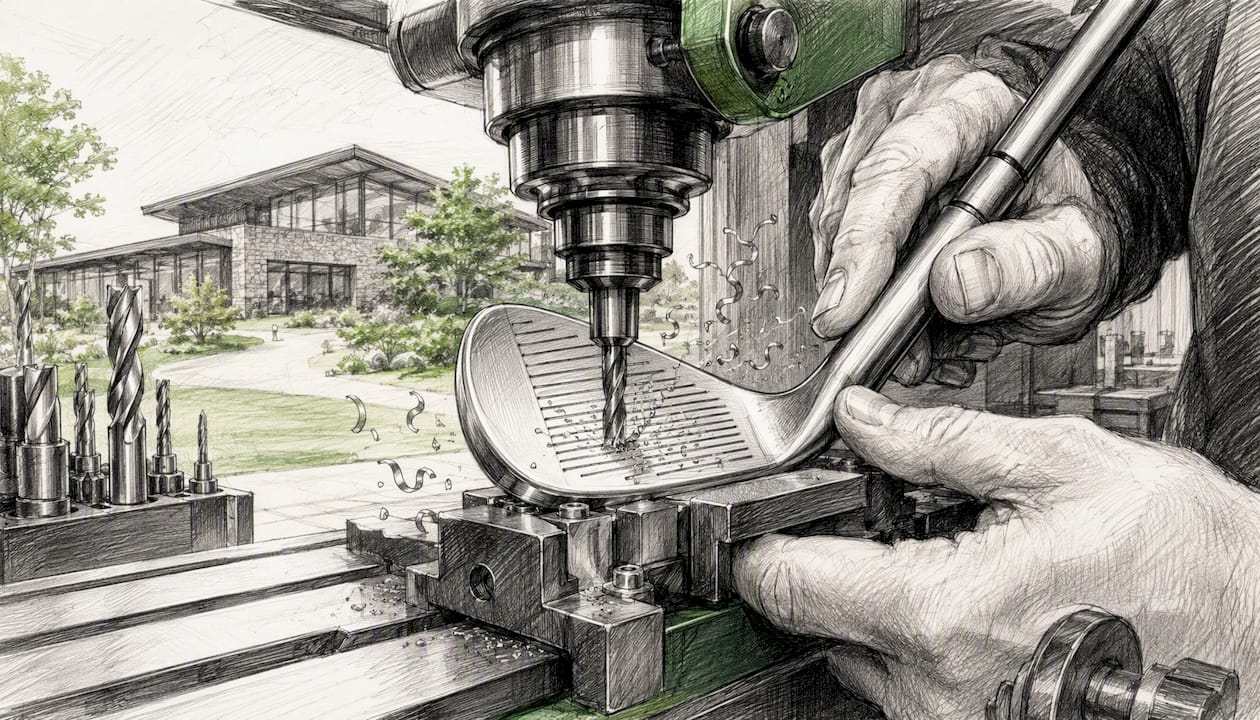
Tiger Nick Golf’s published pricing lists per-club fees around $30 per club as a benchmark for professional milling services. Costs vary by provider and region.
Before sending a club to any service, ask:
- Does the finished club conform to current USGA/R&A groove standards?
- What milling method is used, and does it restore original groove geometry or cut new geometry?
- Is there a warranty or refund policy if the club is damaged during the process?
- What is the turnaround time, and is return shipping included in the price?
Professional service makes the most sense for high-value wedges (premium models you want to extend rather than replace), for competitive players who need verified conformity, and for golfers who play 100+ rounds per year and want a more thorough restoration than a handheld tool provides.
What OEMs and independent tests say about groove wear
OEM engineers at Titleist and Cleveland have stated publicly that handheld sharpening tools cannot replicate factory-milled tolerances. Golf Digest’s reporting on OEM guidance makes the position clear: groove edge radii are milled to specifications measured in ten-thousandths of an inch, and a handheld carbide or file tool cannot reproduce that precision. Their recommendation for players seeking peak performance is replacement, not sharpening.
Independent testing with Trackman and similar launch monitors tells a more nuanced story. Controlled tests show that careful, limited sharpening can produce measurable spin improvement on a worn wedge in some cases. The caveat is significant: results depend on ball cover type (urethane responds more than surlyn), groove profile (U-grooves show more improvement than V-grooves), and the degree of wear before sharpening. A heavily worn wedge that has lost groove volume, not just edge sharpness, will not respond well to surface sharpening.
The practical takeaway: sharpening buys time for casual players. It does not restore a worn wedge to new-wedge performance, and it does not address groove volume loss.
An honest perspective on wedge maintenance
The golf equipment industry has a financial interest in recommending replacement, and OEM guidance should be read with that in mind. That said, the underlying engineering point is correct: a handheld tool cannot mill to factory tolerances. The question is whether factory tolerances matter for your game.
For a recreational player who plays 30–50 rounds per year, hits a mix of lies, and uses a mid-range urethane ball, the performance gap between a carefully sharpened wedge and a new one is real but not decisive. Clean grooves and sharp edges account for most of the recoverable spin. The remaining gap, the part that only a new wedge closes, shows up most clearly on tight lies and in wet conditions.
Where the replacement argument becomes genuinely compelling is at 100+ rounds. At that point, groove walls have lost volume, not just edge sharpness, and no surface tool addresses that. Sharpening a wedge at that stage is maintenance theater: it feels productive but does not change the underlying geometry.
The honest schedule for most recreational players: clean after every round, sharpen once per season if needed, and replace every two to three seasons depending on frequency of play. That routine costs less than one new wedge per year and keeps performance in a range that supports consistent short-game results.
Keep your grooves performing longer with the right accessories
The most effective groove maintenance strategy starts before you ever pick up a sharpening tool. Grooves that stay clean during a round retain spin longer, wear more slowly, and need sharpening less often.

Aimingfluidgolf’s magnetic golf towels attach directly to your bag and stay accessible for a quick wipe between shots, so debris never has time to pack into grooves. The magnetic landing pad system means the towel is always within reach, not buried in a side pocket. Paired with a premium leather utility pouch that keeps a groove brush and tee accessible, the routine takes seconds per hole. Browse the full maintenance accessory lineup to build a bag setup that makes consistent groove care automatic rather than an afterthought.
Sources
- Grooves: Common Questions And Answers
- The grooves on my wedges are worn. Should I try to regroove them myself or just buy new wedges?
- How to Sharpen Wedge Grooves (Full Guide)
- CURRENT PRICING - Tiger Nick Golf
Recommended
- Why Most Divot Tools Damage Greens (Ball Mark Repair Guide) – Aiming Fluid Golf
- Golf Groove Cleaning Science | Why Dirty Grooves Kill Spin & Consisten – Aiming Fluid Golf
- Callaway Switch-Blade Divot Tool: 4-in-1 Magnetic Marker & Cleaner – Aiming Fluid Golf
- Divot Repair Guide: The 4-Step Technique Every Golfer Must Master – Aiming Fluid Golf


