


Most performance and specialty golf tees are legal for tournament play in the United States, provided they satisfy three objective criteria set by the USGA Equipment Rules: the tee must not exceed 4 inches (101.6 mm) in total length, must not be designed to indicate the line of play, and must not unduly influence the movement of the ball. Those three tests apply to every tee type — wooden pegs, brush-style, rubber, and anti-slice designs alike.
The quick legal verdict for tournament players:
- Legal if: total length ≤ 4 inches, no alignment markings or directional fins, no design feature that steers or lifts the ball during the swing.
- Illegal if: any single one of those three conditions is violated — regardless of what the packaging claims.
Pro Tip: Before any tournament round, carry a small ruler or pocket caliper to measure your tee, bring the manufacturer’s conformance statement if you have one, and keep at least two standard wooden tees as a backup. A 30-second check at the bag drop is far cheaper than a penalty stroke on the first hole.
Key Takeaways
Most performance and specialty golf tees are legal for tournament play when they meet the USGA’s three objective criteria: total length at or under 4 inches, no alignment aids, and no design feature that unduly influences ball movement.
| Point | Details |
|---|---|
| The 4-inch rule is absolute | Any tee exceeding 4 inches (101.6 mm) total length is non-conforming, regardless of material or brand claims. |
| Alignment aids disqualify any tee | Directional markings or fins designed to steer the ball make a tee illegal under the Equipment Rules. |
| Verify before the tournament | Measure your tee, check the manufacturer’s conformance statement, and carry a standard wooden backup. |
| Brush and rubber tees can conform | Both types are typically legal if they meet the length limit and carry no ball-influence design features. |
| Aimingfluidgolf tees are rules-built | Measurement specs and conformance documentation are available on the product page for tournament use. |
Table of Contents
- Which rules determine whether a tee is legal?
- Common tee types: which ones are typically permitted?
- How to check whether your tee conforms before a tournament
- What happens if you use a non-conforming tee in a tournament?
- How Aimingfluidgolf designs precision tees with rules compliance in mind
- Aimingfluidgolf’s rules-conscious tees for competitive golfers
- Sources
Which rules determine whether a tee is legal?
The governing text lives in the USGA Equipment Rules (Appendix IV / Part 6, Rule 2) and the parallel R&A guidance, both of which are substantively identical for tees. Three objective limits define conformity.
Breaking down what each limit means in practice:
- Length limit. The 4-inch ceiling applies to the tee’s total length, tip to top. For brush tees, that measurement includes the bristle bundle. For rubber tees with a cup or platform, it includes the cup height. Measure the full structure, not just the shaft.
- No line-of-play indication. A tee cannot carry a printed arrow, alignment stripe, or any feature whose purpose is to aim the clubface or body. A plain logo or brand name does not violate this; a directional arrow pointing toward the target does.
- No undue influence on ball movement. This is the most judgment-dependent test. A tee that cradles, steers, or mechanically redirects the ball during the downswing fails. A tee that simply holds the ball at a consistent height does not. Shield-style anti-slice fins that physically redirect the ball’s path are the clearest violation.
Manufacturers who want a formal ruling submit their tee design to the USGA or R&A for review. The result is either a published conforming ruling or a non-conforming determination. That published ruling is the gold standard for tournament verification.
Pro Tip: If you are a manufacturer or a golfer with a novel tee design, the USGA accepts equipment ruling submissions through its Equipment Standards team. A published ruling eliminates any committee dispute before it starts.
Common tee types: which ones are typically permitted?
The Teeing the Ball guidance catalogs the most common specialty designs and their conformity status. Here is how each category maps to the Rules.
Standard wooden and plastic peg tees are the baseline. They conform in virtually every case, provided the shaft length stays under 4 inches. No alignment features, no influence mechanism. These are the safest choice for competition.
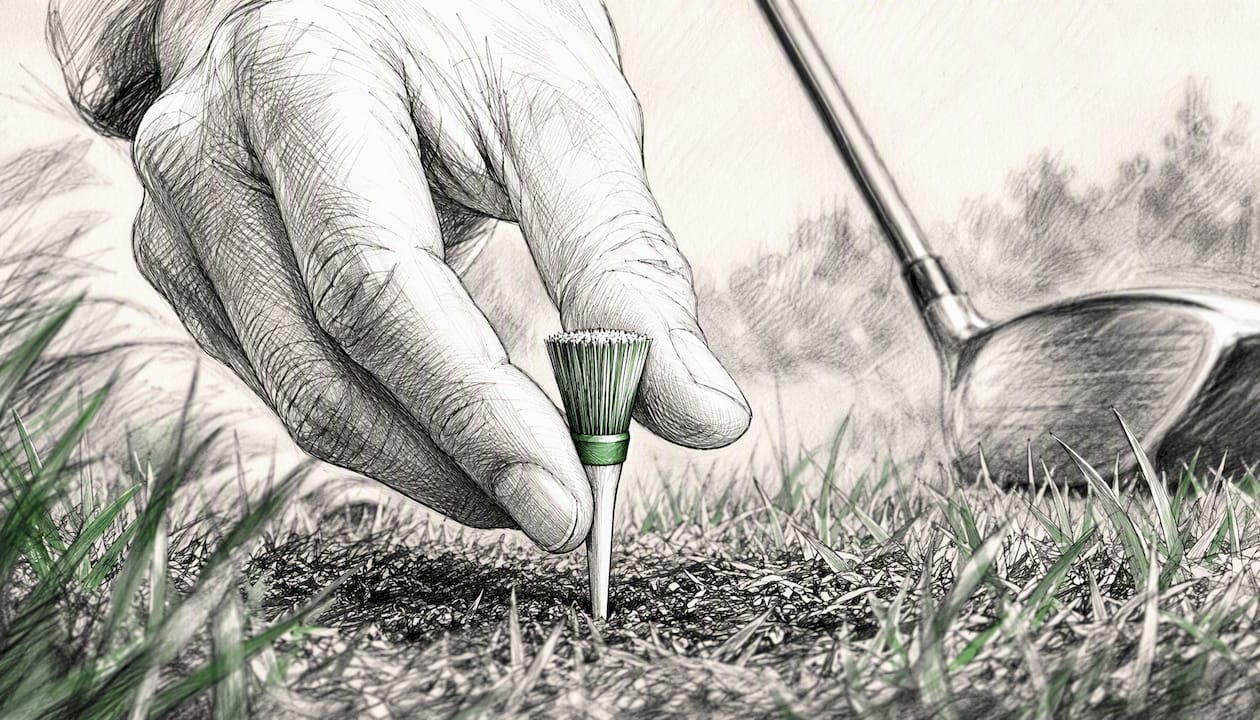
Brush-style tees use a bundle of bristles instead of a solid cup. Many brush tees are legal provided they meet the length limit and are not designed to alter ball movement. The bristles reduce friction at impact, which manufacturers claim improves distance. That performance claim does not disqualify the tee — only a design feature that steers the ball does. However, some brush variants with angled or directional bristle arrangements have been found non-conforming, so verify the specific model rather than assuming all brush tees pass.
Rubber and driving-range style tees are permissible. The Rules Guy at Golf.com confirmed rubber tees are acceptable as long as the total height stays at or below 4 inches. The material is irrelevant; only the dimensions and design features matter.
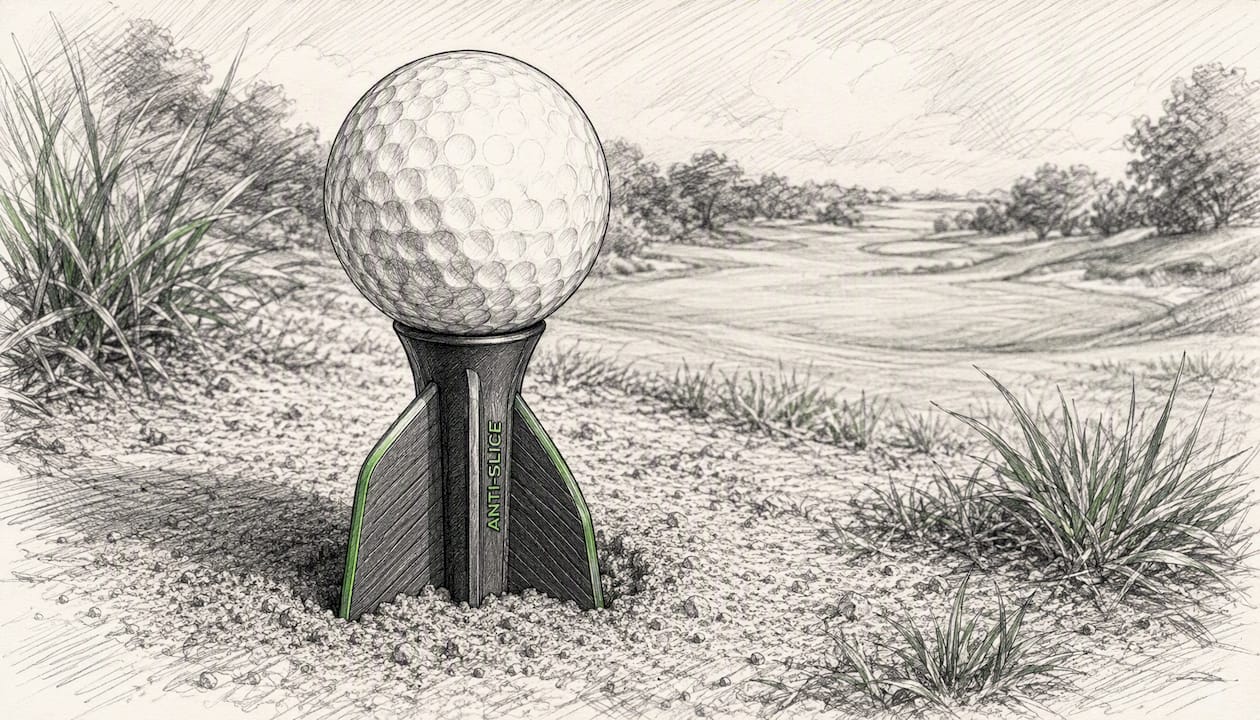
Anti-slice and finned tees carry the highest conformity risk. Fins or shields positioned to redirect the ball’s path during the swing are a textbook violation of the “undue influence” standard. Most finned anti-slice designs are non-conforming. A fin that is purely decorative and makes no contact with the ball during the swing occupies a gray area — get a ruling before using one in competition.
Stacked or connected tees (multiple tees joined by a connector strip) are legal to carry in your bag. The conformity question applies to the individual tee at the moment of use, not the storage format. Separate the tee from the strip before teeing up, and the standard three-part test applies normally.
Promotional distance-claim tees — products marketed with measurable yardage gains — are not automatically non-conforming. A performance claim on the packaging does not equal a rules violation. The tee still passes or fails on the same three objective criteria. Verify independently of whatever the marketing copy says.
Per TellMeMoreGolf’s brush tee analysis, not all brush designs conform — design variation within a single product category is real, and a model-level check is the only reliable approach.
How to check whether your tee conforms before a tournament
A four-step process covers every tee type.
- Measure total length. Use a ruler or caliper. Measure from the ground-contact tip to the highest point of the tee structure — including bristles, cups, or platforms. If the result exceeds 4 inches, the tee is non-conforming. No exceptions.
- Inspect for alignment features. Look for printed arrows, directional stripes, or any marking whose clear purpose is to aim the golfer. A brand logo is not an alignment aid. A target arrow is.
- Assess the ball-influence mechanism. Hold the tee and simulate a ball resting on it. Does any part of the structure contact the ball in a way that would redirect it during a swing? Fins, angled bristle arrays, and cradle-cup designs with directional geometry all warrant scrutiny.
- Check manufacturer documentation. A conformance page (such as the one FlightPath Golf publishes) or a published USGA/R&A equipment ruling is the most defensible evidence you can bring to a committee. If the manufacturer provides explicit measurement specs and a conformity statement, print or screenshot it.
For tournament players specifically:
- Bring the manufacturer’s conformance statement or a link to the published ruling.
- Carry a standard wooden tee as a backup — if a committee questions your specialty tee, you can switch without delay.
- If you are genuinely unsure, contact the tournament committee before the round, not during it. Committees can make local rules that restrict specific equipment, and knowing that in advance prevents a mid-round dispute.
The penalty-free accessories guide at Aimingfluidgolf covers the broader principle: when equipment is in a gray area, the cost of a quick pre-round check is always lower than the cost of a penalty.
What happens if you use a non-conforming tee in a tournament?
Using a non-conforming tee in stroke play is a serious rules breach. Under the Rules of Golf, a player who uses equipment that does not conform to the Equipment Rules may receive a penalty or, in cases of deliberate use, disqualification. The exact consequence depends on the competition’s conditions of play and whether the committee determines the use was knowing or inadvertent.
Committees have authority to:
- Prohibit a specific tee model by local rule before the competition begins.
- Require a player to replace a non-conforming tee immediately upon discovery.
- Apply a penalty stroke or disqualify a player depending on the severity and timing of the violation.
Practical steps to protect your score:
- Confirm allowed equipment in the conditions of competition before you tee off on hole 1.
- If a fellow competitor or marker questions your tee, stop using it and switch to a conforming model while the question is resolved — continuing to use a disputed tee compounds the risk.
- Present measurement evidence and manufacturer documentation calmly and quickly. A committee member who can see a tee measuring 3.5 inches and a printed conformance statement will resolve the question in under a minute.
Pro Tip: Keep your conformance documentation in the same pocket as your tees. When a question comes up on the first tee, you want to answer it in 30 seconds, not spend three minutes searching your bag.
How Aimingfluidgolf designs precision tees with rules compliance in mind
Aimingfluidgolf’s precision tees are built within the objective limits the USGA Equipment Rules establish. The design priorities are straightforward: total length within the 4-inch ceiling, no alignment markings, and no structural feature that contacts or redirects the ball during the swing.
Key compliance design points:
- Measured length specifications are listed on the product page so golfers can confirm conformity before a tournament without guessing.
- No directional markings. The tees carry no arrows, alignment stripes, or aim-assist features.
- Neutral ball contact. The tee geometry holds the ball at a consistent height without cradles or fins that would constitute undue influence.
Golfers preparing for competition can review the full tee collection at Aimingfluidgolf for measurement specs. If you need a manufacturer conformance statement for a tournament committee, contact Aimingfluidgolf directly through the product page — the measurement documentation is available on request.
For a deeper look at how tee geometry affects launch and dispersion, the tee performance guide at Aimingfluidgolf explains the physics without the marketing noise.
A rules-minded golfer’s perspective on tee legality
The three-part USGA test is genuinely simple, yet golfers keep running into trouble because they trust packaging claims instead of measuring. A tee that says “conforms to the Rules of Golf” on the box is stating a manufacturer’s position, not a USGA ruling. Those are different things, and a tournament committee is under no obligation to accept the box claim as proof.
The conservative habit that protects you in competition: carry a wooden tee as your backup, measure any specialty tee before the round, and keep documentation accessible. For most golfers, a well-made standard tee or a brush-style tee from a manufacturer with a published ruling is all you need. The performance gains from exotic tee designs are real but modest; the rules risk from an unverified design is not worth the tradeoff in a competitive round.
If you want documentation for a specific Aimingfluidgolf tee, reach out through the product page before your next tournament.
Aimingfluidgolf’s rules-conscious tees for competitive golfers
Golfers who want a specialty tee they can bring to a tournament without a rules conversation should look at the DON’T SUCK™ Golf Tees from Aimingfluidgolf. The tees are built to the USGA’s three-part standard: length within the 4-inch limit, no alignment aids, no ball-influence geometry. Measurement specs are listed on the product page, and conformance documentation is available on request for tournament players.
The full tee collection includes options at multiple height settings, all designed with the same rules-first approach. Check the product page for specs, or contact Aimingfluidgolf directly to request a conformance statement before your next competition.
Sources
Use these sources to verify any manufacturer’s conformity claim against the official Rules text:
- Equipment Rules
- Teeing the Ball - DocsLib
- Golf
- What Do Brush Tees Do? (and Other Types of Brush Tees) — In 2026
- Are Brush Tees Legal? - JustGolfIn
When a manufacturer states “conforms to the Rules of Golf,” cross-reference that claim against the USGA Equipment Rules text directly. If the tee’s total length, alignment features, and ball-contact geometry all clear the three-part test, the claim holds. If any dimension or feature is undocumented, request the measurement specs from the manufacturer before the round.
Recommended
- Why Golf Tees Affect Consistency, Launch & Dispersion | Aiming Fluid G – Aiming Fluid Golf
- What Is Tee Performance? A Golfer’s Guide to Better Drives – Aiming Fluid Golf
- Precision Golf Tee Benefits: Improve Consistency and Play Smarter – Aiming Fluid Golf
- Best Performance Golf Tees: Why PureFlight™ Tech Replaced Wood – Aiming Fluid Golf


