


Organize golf pocket carry with one rule: clubs go longest to shortest, and every pocket gets exactly one job. Keep your ball marker, a small tool pouch, and your rangefinder in pockets you can reach without breaking stride. Players who prefer pocket carry over digging through a full bag should add a clipped mini pouch for balls and tees. USGA rules require a ball-marker on the green, so where you store it directly affects your speed and compliance.
TL;DR:
- Storing clubs from longest to shortest prevents tangling and protects the shaft during setup, especially on bags with fewer dividers that require logical grouping.
- Assigning each pocket a specific role, such as valuables or snacks, minimizes time spent searching and helps maintain an organized, efficient bag.
- Using a clip-on mini pouch for balls and tees offers faster access for walking players and reduces steps compared to bulkier internal pockets.
- Placing the ball marker in the dedicated ball or tool pocket ensures quick retrieval and compliance with USGA rules.
- Regularly performing a brief pre-round check guarantees essentials are ready and prevents mid-round scrambling, saving time and fatigue.
Table of Contents
- What Is the Right Golf Club Layout for Easy Reach?
- How Should You Assign Pockets by Role?
- When Should You Use a Clip-On Pouch Instead of a Bag Pocket?
- The 6-Step Routine to Set and Maintain Your Bag
- How Do You Organize a 7-Slot or Travel Golf Bag?
- What Does the USGA Say About Ball-Marker Placement?
- An Editor’s Note on Building the Habit
- How Aiming Fluid Golf Products Fit Into Your Pocket System
- Sources
- FAQ
What Is the Right Golf Club Layout for Easy Reach?
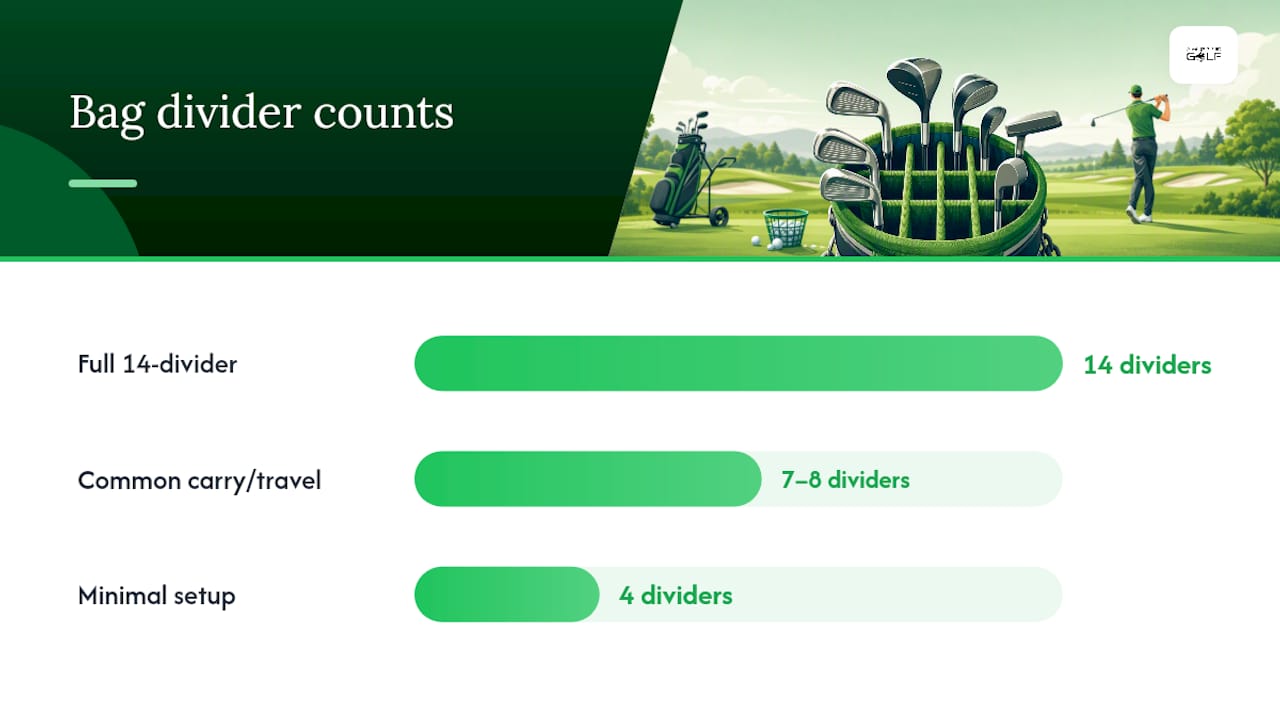
The longest-to-shortest principle exists for a mechanical reason, not just tidiness. Longer clubs, your driver, fairway woods, and hybrids, need more clearance to enter and exit the bag without their heads catching on shorter irons. When you rank clubs by length from the tallest slot to the shortest, you eliminate the tangling that happens when a 5 iron gets wedged behind your 3 wood. Most modern bags have between 4 and 14 dividers. The number you have changes how strict this rule needs to be.
Putter placement has three common options:
- A dedicated putter well, usually a separate slot at the top of the bag, built specifically to protect the grip and keep it isolated from other clubs.
- An external putter tube, common on stand bags, which lets you drop the putter in without threading it through the divider stack.
- An outer slot, useful when your bag lacks a dedicated well but still gives you fast access at the green.
Full 14-divider bags let you assign one club to one slot, which is the cleanest setup and the one that best prevents shaft-to-shaft contact. Fewer dividers, seven or eight slots being common on carry and travel bags, force you to group clubs logically instead. Group woods together, irons together, and wedges together, always maintaining the longest-to-shortest order within each group.
Hybrids and specialty clubs (chippers, alternative wedges) usually slot in wherever their length places them, typically between your longest iron and your fairway woods. Balance matters too. A bag loaded heavy on one side, usually from a rangefinder or water bottle in a single pocket, tips when you set it down on a cart or an incline. Distribute weight across both sides and keep grips pointed away from zippers where friction wears down the rubber over time.
How Should You Assign Pockets by Role?
A pocket without a job becomes a junk drawer. Every item you own competes for the same space, and you end up patting down four pockets to find a ball on the tee box. The fix is a blueprint where each pocket has exactly one purpose, backed by practical pocket-assignment guides that recommend this exact structure.
Here is a pocket-by-pocket map you can copy directly into your own bag:
- Ball pocket. Several balls, kept loose or in a small mesh sleeve so they do not roll into the tee compartment.
- Tee and accessory pocket. A dozen tees, a couple of divot tools, and one or two extra ball markers as backup.
- Valuables pocket. Phone, keys, wallet, and rangefinder battery, ideally the pocket closest to your body or the one with a zippered, weather-resistant flap.
- Apparel pocket. Rain jacket, extra glove, sunscreen, and a hat if you are not wearing one.
- Tool and glove pocket. Your primary glove, a small multitool, and your towel clip or magnetic attachment point.
- Cooler or snack pocket. Water bottle, an energy bar or two, and nothing else, since this pocket takes the most wear from condensation.
A dedicated ball pocket matters because balls are the item you reach for most often, on nearly every hole, and fumbling for one while your group waits is the single most common pace-of-play complaint on public courses. A protected valuables pocket matters for a different reason: security and weather. Phones and wallets need a pocket that zips fully closed and sits away from splash zones.
Small zip pouches, mesh bags, and a spare plastic bag for wet gloves or rain gear keep loose items from migrating between pockets. Internal dividers and removable pouches, the kind that come standard in a leather utility pouch, stop tees and ball markers from settling into the bottom seam where you can never find them.
Pro Tip: Assign your valuables pocket to the side of the bag that faces you when it’s strapped on a cart or slung over your shoulder. You’ll check it without turning the bag around, which saves real time over eighteen holes.
When Should You Use a Clip-On Pouch Instead of a Bag Pocket?
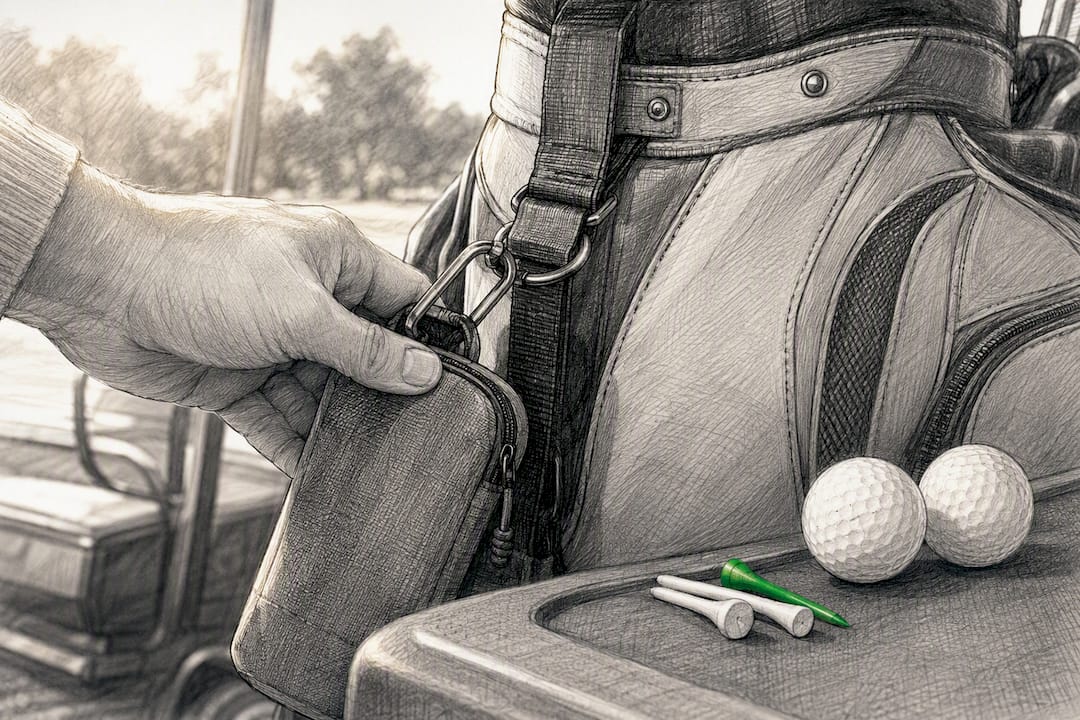
Walking players face a different problem than cart players: every trip into a pocket costs steps and time. A clip-on mini pouch, attached by carabiner to a belt loop or bag strap, solves this by keeping balls and tees within reach of your fingers instead of buried three pockets deep.
Magnetic systems solve a related but distinct problem: towel and marker retrieval. A magnetic towel paired with a landing pad, the approach Aiming Fluid Golf uses in its towel and pad system, snaps back into the same spot every time instead of sliding to the bottom of a pocket after one wipe-down. That consistency matters more on wet mornings, when a soaked towel dragged across grass picks up grit and needs to return to a clean, known location fast.
A few tradeoffs to weigh before clipping anything to your bag or belt:
- Bounce. A pouch loaded too heavy will swing and bang against your leg when walking, so keep it light, balls and tees only.
- Snag risk. Carabiners can catch on cart bars or bag straps if you clip them in a spot where cables or zippers already crowd the space.
- Security. Test the clip’s grip strength before the round. A loose carabiner that pops open mid swing means lost balls on the fairway.
Limit your clip-on load to the essentials. Anything beyond balls, tees, and maybe a marker belongs back in a bag pocket, where zippers and internal structure do a better job of containing it.
The 6-Step Routine to Set and Maintain Your Bag
Setting up a bag correctly once means nothing if it collapses back into clutter by your third round. This routine takes about 20 minutes the first time and keeps the system intact after that, echoing the setup timeline recommended in CaddieHQ’s bag organization guide.
- The Great Empty. Dump every pocket onto a table. You cannot organize around clutter you cannot see, and this step also surfaces the granola bar wrapper from three months ago.
- Sort and purge. Group items into categories, balls, tees, tools, apparel, electronics, and toss anything broken, expired, or duplicated beyond what you actually need.
- Assign pockets using the pocket-role blueprint above. Write it down once if you need to, until the assignments become second nature.
- Pack clubs by the longest-to-shortest layout, then set the bag upright and check that it does not tip to one side.
- Run the Touch Test. Close your eyes and try to locate your ball marker, your rangefinder, and a ball in under 10 seconds. This simple quality check exposes weak pocket placement before you’re standing on the first tee wondering where anything is.
- The 60-second pre-round check. Balls, tees, a clean towel, rangefinder battery charge, and water, confirmed before you leave the parking lot.
That pre-round check is the step most golfers skip, and it’s the one that prevents mid-round scrambling. A quick scan takes less time than tying your shoes, and it catches a dead rangefinder battery while you’re still near the car instead of on hole 6.
How Do You Organize a 7-Slot or Travel Golf Bag?
Limited dividers mean you cannot give every club its own slot, so grouping becomes the organizing principle instead of individual placement. Slide a headcover or club sleeve over your driver and fairway woods before grouping them together; this single habit prevents the shaft scuffing that happens when bare clubheads knock against each other in a shared compartment.
A few adjustments that matter specifically for smaller bags:
- Consolidate tees, markers, and small tools into one modular pouch rather than spreading them across two half-empty pockets.
- Weigh what actually needs to travel. A trunk organizer in your car is the right home for extra gloves, rain gear you rarely use, and backup balls, not your on-course pockets.
- On long walking rounds, every extra pound matters. Leave the second dozen balls and the full rain suit in the car unless the forecast demands otherwise.
- Cart play changes pocket orientation priorities. Since you are not carrying the bag on your shoulder, front-facing pockets you’d normally reserve for quick-grab items can hold slightly bulkier gear instead.
Stand bags and travel bags reward this kind of deliberate consolidation because there simply isn’t room for redundancy. Fewer pockets forces better decisions about what actually earns a spot.
What Does the USGA Say About Ball-Marker Placement?
The USGA requires a ball-marker or your club to mark your ball’s spot on the green, and that marker can be any artificial object, a tee or a coin both qualify. The USGA’s putting green guidance also confirms you need a marker specifically to mark and lift your ball for cleaning.
A ball-marker you can’t find fast is a rules problem, not just an inconvenience. Storing it loose among a dozen tees means fumbling on the green while your group waits, and fumbling on the green is exactly the moment slow play compounds.
Keep your marker in the ball pocket or the tool pocket, never scattered loose. A dedicated spot means you reach the green already prepared, and it also means you’re never tempted to substitute a random object mid-round.
An Editor’s Note on Building the Habit
The 60-second pre-round check works because it removes decision-making. Once pocket assignments are fixed, checking them becomes automatic, the same way you don’t think twice about checking your car mirrors before pulling out. That’s the real payoff: not a cleaner-looking bag, but fewer moments on the course where you’re searching instead of playing.
Aiming Fluid Golf’s accessory placement guide goes deeper into how placement decisions affect pace of play across a full round.
— Gary
How Aiming Fluid Golf Products Fit Into Your Pocket System
A pocket system is only as good as the gear you put in it. Some golf accessories are built specifically for the friction points this article covers, including towel access, marker storage, and small-item organization, so the system you set up actually holds.

The Magna-Anchor™ magnetic towels solve the exact problem walking players hit on wet holes: a soaked towel that slides to the bottom of a pocket after one use. Pair one with the Magnetic Landing Pad and the towel snaps back to the same spot every time, no digging required between shots. For the valuables and tool pocket, the Leather Golf Utility Pouch gives you the internal structure this article recommends, separate compartments for your marker, tees, and small tools instead of one loose jumble. On a rainy back nine, a towel and landing pad combo means you’re wiping down grips and clubfaces in seconds instead of hunting through three pockets while your group waits. Browse the full lineup on the Aiming Fluid Golf shop and build your own pocket system around gear that returns to the same place every time.
Sources
- How To Organize Your Golf Bag: A Complete Guide To Setup And Storage (GolfGuideBook)
- How to set up golf bag pockets (CaddieHQ)
FAQ
What Is the Best Way to Organize the Pockets in a Golf Bag?
Assign each pocket exactly one job, ball pocket, valuables pocket, apparel pocket, tool pocket, and cooler pocket, so you never search more than one place for an item. This approach follows pocket-assignment guidance built around single-purpose pockets rather than mixed storage.
How Do You Organize a 14-Pocket Golf Bag?
With a full 14-divider bag, you can give nearly every club its own individual slot arranged longest to shortest, from driver down to wedges, with the putter in a dedicated well. The extra pockets on a 14-slot bag let you separate small items further, keeping tees, markers, and snacks in distinct compartments instead of combining categories.
How Do You Organize a Golf Bag With 7 Slots?
Group clubs by category, woods, irons, wedges, using headcovers or sleeves to prevent tangling since you can’t give each club its own divider. Consolidate small accessories into one modular pouch and leave nonessential gear, extra balls, backup rain layers, in the car or a trunk organizer rather than the bag itself.
How Do You Stack a Golf Carry Bag?
Stack longest clubs first, driver and fairway woods at the top or in the tallest slots, working down to irons and wedges in the shortest slots. Keep the putter in its own well or external tube so it doesn’t tangle with the iron set, and balance weight across both sides so the bag doesn’t tip when set down.
Where Should I Keep My Ball Marker for Quick Access?
Store your ball marker in the ball pocket or the tool pocket, never loose among a pile of tees where it can get lost. The USGA requires a marker or your club to mark your ball’s spot on the green, so quick access keeps you compliant and keeps play moving.


