


TL;DR:
- Organizing your golf bag and accessories systematically reduces mental fatigue, enhances decision-making, and streamlines play. Implementing a fixed club layout, pocket assignment plan, and pre-round routines improves consistency and efficiency across all holes. Focusing practice time on short game, using structured routines, and applying project management principles accelerates improvement and maintains steady progress.
Organization strategies for amateur golfers are the practice of systematically managing your golf bag, equipment, and on-course routine to reduce friction, speed up decision-making, and free your mind for the shot at hand. When your bag feels like a junk drawer, every round costs you mental energy before you even address the ball. The golfers who consistently play within their ability are rarely the most talented. They are the most prepared. This guide applies project management principles and data-driven practice methods to build an organization system that works from the first tee to the final putt.
How should amateur golfers arrange their golf bag for optimal performance?
The gold standard for bag organization is arranging clubs from longest to shortest: driver, fairway woods, and hybrids at the top or back of the bag, mid-irons in the middle, and wedges at the bottom or front. This layout prevents shaft tangling, maintains bag balance, and lets you pull the right club without looking. For most amateur golfers, that means faster decisions and fewer disruptions to pre-shot focus.
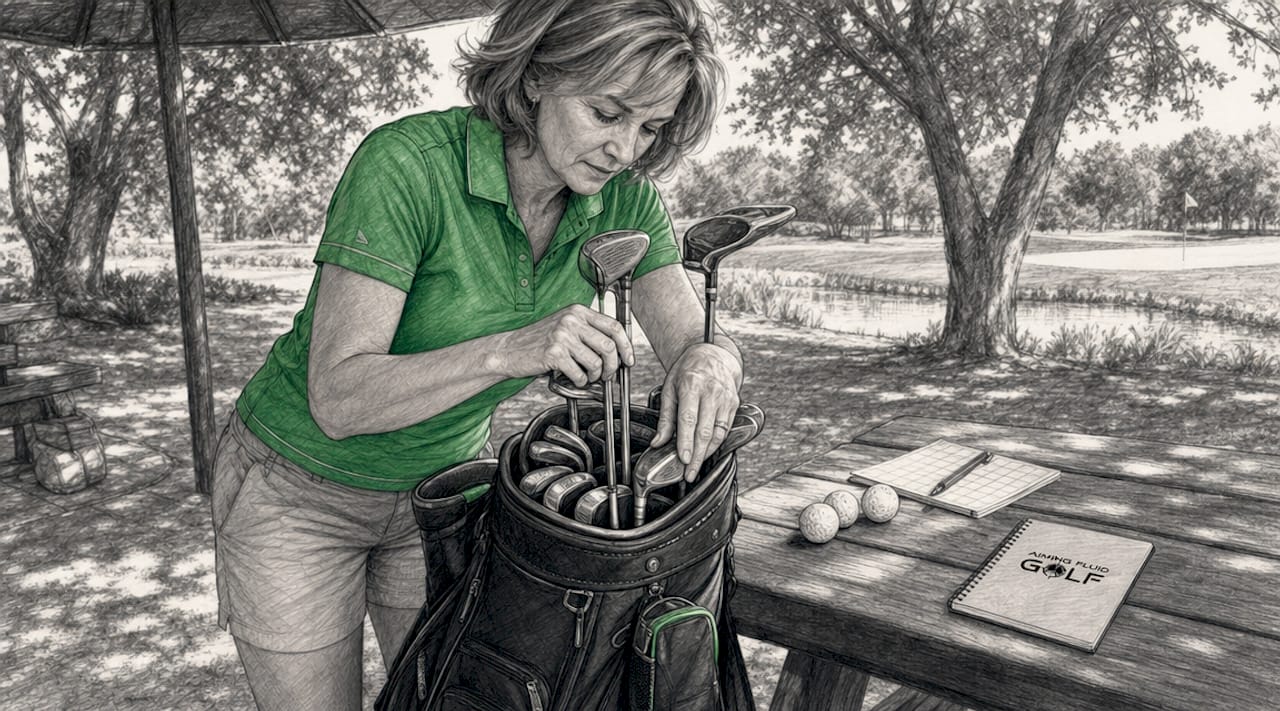
If your bag has fewer than 14 dividers, group clubs by type rather than individual slots. Woods together, long irons together, short irons and wedges together. The goal is consistent access and an easy visual count to confirm you are within the 14-club maximum. Bags with full-length dividers, like the 14-way cart bag reviewed by Aimingfluidgolf, prevent clubs from crossing and protect shafts during transport.
Orientation matters as much as order. Orienting the bag with long clubs farthest from the player prevents tangling and ensures smooth access, particularly during the back nine when fatigue sets in. On a cart, position the bag so the putter and wedges face you. When carrying, the same principle applies: long clubs at the back keep the bag balanced on your shoulder and reduce the pull that causes neck and back strain over 18 holes.
Here is a practical club arrangement framework:
- Top/back slots: Driver, 3-wood, 5-wood, hybrids
- Middle slots: 3-iron through 7-iron (or long irons if you carry them)
- Bottom/front slots: 8-iron, 9-iron, pitching wedge, gap wedge, sand wedge, lob wedge
- Dedicated slot: Putter in its own divider, never mixed with irons
Pro Tip: Before every round, run a 30-second club count from putter to driver. Catching a missing club in the parking lot costs nothing. Catching it on the 7th tee costs a penalty stroke and your composure.
For a detailed breakdown of club placement by bag type, Aimingfluidgolf covers the Peter Finch method for optimizing both cart and carry bags.
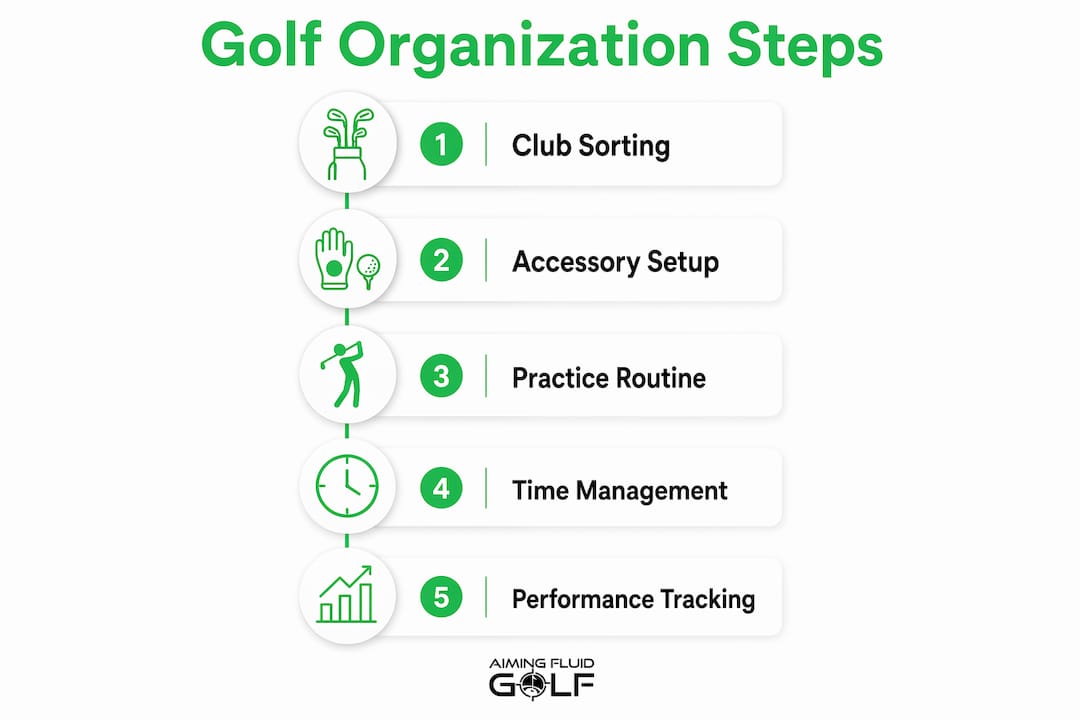
What systems and routines help golfers manage accessories efficiently?
Treating your golf gear as an ecosystem with fixed locations for every accessory reduces retrieval time by an estimated 20 to 30%. That is not a trivial number across 18 holes. Every second you spend searching for a tee or glove is a second your pre-shot routine is interrupted. Fixed locations convert a reactive search into an automatic reach.
The pocket assignment system works like this: assign each pocket a function, then never deviate. Front pockets hold high-frequency items. Side pockets hold medium-frequency items. Bottom or rear pockets hold low-frequency items.
A practical pocket assignment looks like this:
- Front/top pocket: Tees, ball markers, divot tool, glove
- Side pocket: Extra golf balls, rangefinder, scorecard
- Large main pocket: Rain gear, extra layers, snacks
- Bottom pocket: Spare spikes, first aid, sunscreen
Beyond physical placement, standardizing on-course behaviors as standard operating procedures (SOPs) reduces mental load and supports pace of play. SOPs are simply pre-decided actions that remove the need to think in the moment. Examples include repairing your divot immediately after every iron shot, reading your putt while your playing partner putts, and replacing your headcovers after every wood shot.
Build your SOP checklist in this order:
- Tee box: Check yardage, confirm club selection, complete pre-shot routine
- Fairway: Repair divot immediately after the shot, replace headcover if applicable
- Green: Read putt while others play, mark ball if needed, repair ball mark on arrival
- Post-hole: Record score, return accessories to fixed locations before walking to next tee
Pro Tip: Use a utility pouch clipped to your bag for the four items you touch most: tee, ball marker, divot tool, and glove. Aimingfluidgolf’s utility pouches are designed specifically for this kind of fixed-location access.
The Aimingfluidgolf guide on managing on-course essentials expands on this ecosystem model with specific product recommendations.
How can golfers integrate practice routines with organization strategies?
Effective practice is more about structure and varied drills than sheer volume of balls hit. Structured sessions lower handicaps faster than unstructured range time. The organization principle applies to practice just as much as it applies to your bag: a session without a plan produces random results.
Amateur golfers should allocate at least 50% of practice time to the short game, because roughly 60% of strokes occur within 100 yards of the hole. That allocation is the single highest-return adjustment most amateurs can make. Three to four structured sessions per week of 45 to 60 minutes each produces measurable progress within a month.
Structure each session using this four-phase model:
- Warm-up (10 minutes): Stretch, hit half-speed wedge shots, putt from 3 feet to groove feel
- Technical work (15 minutes): One specific swing or technique focus per session, not multiple
- Skill games (20 minutes): Simulate on-course scenarios. Hit from different lies, vary targets
- Pressure practice (10 minutes): Play games with consequences. Make 10 putts in a row or start over
The most common practice mistake is relying on block practice, which means hitting the same club repeatedly to the same target. Block practice builds temporary confidence but does not transfer to the course. Random practice, which varies clubs and targets on every shot, forces mental engagement and builds the adaptability you need when conditions change mid-round.
A practical rule from Clickit Golf: cap block practice at 20 balls per 60-ball bucket and use the remaining 40 shots for random practice. This ratio keeps sessions mentally demanding and directly transferable to scoring conditions.
Track your progress using a simple performance dashboard:
| Metric | What it measures | Target for improvement |
|---|---|---|
| Fairways hit | Tee shot accuracy | Baseline, then trend upward |
| Greens in regulation | Ball-striking quality | Track weekly average |
| Putts per round | Short game efficiency | Below 36 is the amateur benchmark |
| Up-and-down percentage | Short game conversion | Improve by 5% per month |
Aimingfluidgolf’s step-by-step practice routine guide covers how to build this structure from scratch.
What time management techniques improve on-course decision-making?
A pre-round mental stand-up reviewing your game plan and focusing on process goals reduces anxiety and improves on-course decision-making. This takes five minutes in the parking lot or on the practice green. Decide your strategy for the first three holes, identify one swing thought for the day, and commit to it. Golfers who arrive at the first tee without a plan make reactive decisions all round.
Applying a risk-matrix approach to shot selection reduces blow-up holes by up to 60% by encouraging conservative, intentional play. The framework is simple: before every shot, assess the reward against the realistic probability of success. A 220-yard carry over water with a 3-wood is not a risk-reward calculation most amateurs should accept. Laying up to a comfortable yardage and making par is the higher-percentage outcome.
Four time management habits that directly improve pace of play:
- Use a rangefinder or GPS device before reaching your ball so club selection is ready on arrival
- Walk with purpose between shots and use that time to read the upcoming lie and wind
- Limit practice swings to two per shot. More than two is indecision, not preparation
- Decide on your shot shape and target before stepping into your stance. Changing your mind mid-routine costs time and introduces doubt
Pro Tip: Build golf etiquette into your personal SOP. Being ready to play when it is your turn is not just courtesy. It keeps your own rhythm intact and prevents the mental reset that comes from standing idle too long.
For season-level planning strategies that extend these time management principles across a full competitive calendar, the World Amateur Golf Tour blog provides a practical framework for amateur golfers.
Key takeaways
Organization strategies for amateur golfers work because they convert reactive, in-the-moment decisions into pre-planned automatic actions, reducing mental load and improving consistency across all 18 holes.
| Point | Details |
|---|---|
| Bag arrangement by length | Place driver and woods at the top, wedges at the front to prevent tangling and speed club selection. |
| Fixed accessory locations | Assign every pocket a function and never deviate; this reduces retrieval time by an estimated 20 to 30%. |
| Short game practice priority | Allocate at least 50% of practice time to shots within 100 yards, where 60% of strokes occur. |
| Random over block practice | Cap block practice at 20 balls per session and use remaining shots for varied, random club selection. |
| Pre-round game planning | A five-minute pre-round review of strategy and process goals measurably reduces on-course anxiety and poor decisions. |
Why project management thinking changed how I approach golf
The most useful thing I ever did for my golf game had nothing to do with my swing. It was building a skill gap analysis the same way I would for a work project. I listed every part of my game, rated my current performance honestly, and identified where strokes were actually being lost. The answer was not my driver. It was chips from 20 yards and putts from 8 feet. That analysis redirected two months of practice and dropped my handicap faster than any swing change had.
The second shift was treating equipment friction as a real performance variable. Before I standardized my bag and pocket system, I was spending mental energy on logistics during rounds. Where is my ball marker? Did I grab the right wedge? That cognitive load is small per instance but cumulative over 18 holes. Removing it through fixed locations and a pre-round checklist freed up focus for actual shot execution.
The continuous improvement mindset matters most after bad rounds. Instead of frustration, I now do a five-minute post-round review: what cost me strokes, was it physical execution or a decision, and what one thing do I adjust next session. That review loop, borrowed directly from project management retrospectives, is what separates golfers who plateau from those who keep improving. If you are an amateur who has been stuck at the same handicap for two years, the problem is almost certainly not your swing mechanics. It is the absence of a structured system for identifying and fixing the actual gaps.
— Gary
Gear that supports your organization system
The organization systems described in this article only work when your equipment supports them. A utility pouch that clips to your bag keeps your four most-used accessories at a fixed, instant-access location. A magnetic towel system from Aimingfluidgolf attaches directly to your bag and returns to the same spot every time, eliminating the search that interrupts your pre-shot routine. Precision tees and a quality divot tool complete the on-course SOP toolkit. Browse the full range of expert-picked golf accessories at Aimingfluidgolf to find the products that fit your specific organization system and playing style.
FAQ
How should I organize my golf bag for faster play?
Arrange clubs from longest at the top to shortest at the front, assign every pocket a fixed function, and run a 30-second pre-round club count. This layout eliminates searching and keeps your pre-shot routine intact.
How much practice time should amateurs spend on the short game?
At least 50% of practice time should go to the short game, since roughly 60% of strokes occur within 100 yards of the hole. Three to four structured sessions of 45 to 60 minutes per week produces measurable improvement within a month.
What is the difference between block practice and random practice?
Block practice repeats the same club and target repeatedly and builds temporary confidence but does not transfer to the course. Random practice varies clubs and targets on every shot, which forces mental engagement and better mirrors real on-course conditions.
How can a pre-shot routine improve time management on the course?
A consistent pre-shot routine with a two-swing maximum and a committed target before stepping into your stance removes in-the-moment indecision. This keeps your pace steady and prevents the mental reset that comes from prolonged deliberation.
What metrics should amateur golfers track to measure improvement?
Track fairways hit, greens in regulation, putts per round, and up-and-down percentage. These four metrics identify whether stroke loss comes from ball-striking, short game, or putting, and direct practice focus to the highest-return areas.
Recommended
- How to Organize Your Golf Bag Like a Pro: The Peter Finch Method – Aiming Fluid Golf
- Top Things Scratch Golfers Do Differently (That You Should Too) – Aiming Fluid Golf
- Top Beginner Golf Mistakes That Kill Your Score (And How to Fix Them) – Aiming Fluid Golf
- Best Golf Accessories – Top Picks From Aiming Fluid Golf


