


TL;DR:
- Measuring foot length, hand length, and wrist-to-floor height first enables accurate online sizing of golf gear. Following manufacturer-specific charts prevents most fitting errors, while understanding fabric profiles guides appropriate size choice. Checking return windows and product dimensions minimizes risks when ordering premium accessories online.
Measure first, match to the manufacturer chart, verify product-page photos and exact measurements, then confirm the return window before you click Buy. That single rule prevents most online sizing mistakes.
Quick-reference checklist before you order:
- Foot length and width (in inches, measured at day’s end with golf socks on)
- Hand length (wrist crease to middle fingertip, for gloves and grip diameter)
- Wrist-to-floor (standing upright, arms at sides, for club length)
- Head circumference (tape around the widest part, above the ears, for hats and visors)
- Waist measurement (for belts and pants, at the natural waist)
- Pouch or pocket dimensions (length × width × depth in inches, for utility pouches and bag pockets)
- Towel and landing pad footprint (check product listing dimensions against your bag’s attachment points)
- Headcover opening diameter (measure club head width at the widest point)
Manufacturer-specific charts are the preferred source for all of these. Generic letter sizes are unreliable across brands. Mitchell Golf defines grip diameter standards; FootJoy publishes detailed shoe and apparel fitting guidance; Aimingfluidgolf provides sizing resources for its accessory line.
Table of Contents
- What measurements does each golf accessory actually need?
- How do fit profiles and fabric types change the size you should pick?
- How to measure yourself at home for any golf accessory
- What to check on a product page before you click Buy
- What to do when you’re between sizes
- How fit changes after you buy: break-in and long-term expectations
- What premium golf accessories cost and why return windows matter
- Step-by-step guide to sizing golf shoes online
- How to size golf clubs online (grip, shaft length, lie angle)
- How to size GPS watch and rangefinder straps online
- International size conversions for golf apparel
- Key Takeaways
- Why measurement-minded design changes how you shop online
- Aimingfluidgolf accessories are built around exact dimensions
- Useful sources and further reading
What measurements does each golf accessory actually need?
| Accessory | Measurement(s) to capture | Units | Best home method |
|---|---|---|---|
| Golf gloves | Hand length (wrist crease to fingertip) | inches / cm | Ruler on flat surface |
| Golf shoes | Foot length, foot width, arch height | inches / cm | Brannock device or traced outline |
| Hats / visors | Head circumference | inches / cm | Soft tape measure |
| Belts | Natural waist circumference | inches | Soft tape measure |
| Utility pouches | Interior length × width × depth | inches | Rigid ruler |
| Towels / landing pads | Footprint area, attachment point spacing | inches | Ruler or tape |
| Headcovers | Club head width at widest point | inches | Tape measure |
| Grips | Hand length (wrist crease to fingertip) | inches | Ruler |
| Clubs | Wrist-to-floor, height | inches | Tape measure + helper |
| GPS watch straps | Wrist circumference | inches / mm | Soft tape measure |
Record these numbers in your phone notes. Three measurements unlock most sizing decisions: foot length, hand length, and wrist-to-floor. Foot length determines shoe size; hand length maps directly to glove size and grip diameter; wrist-to-floor, combined with height, sets club length. Get those three right and you’ve resolved the majority of fit questions before you open a single product page.
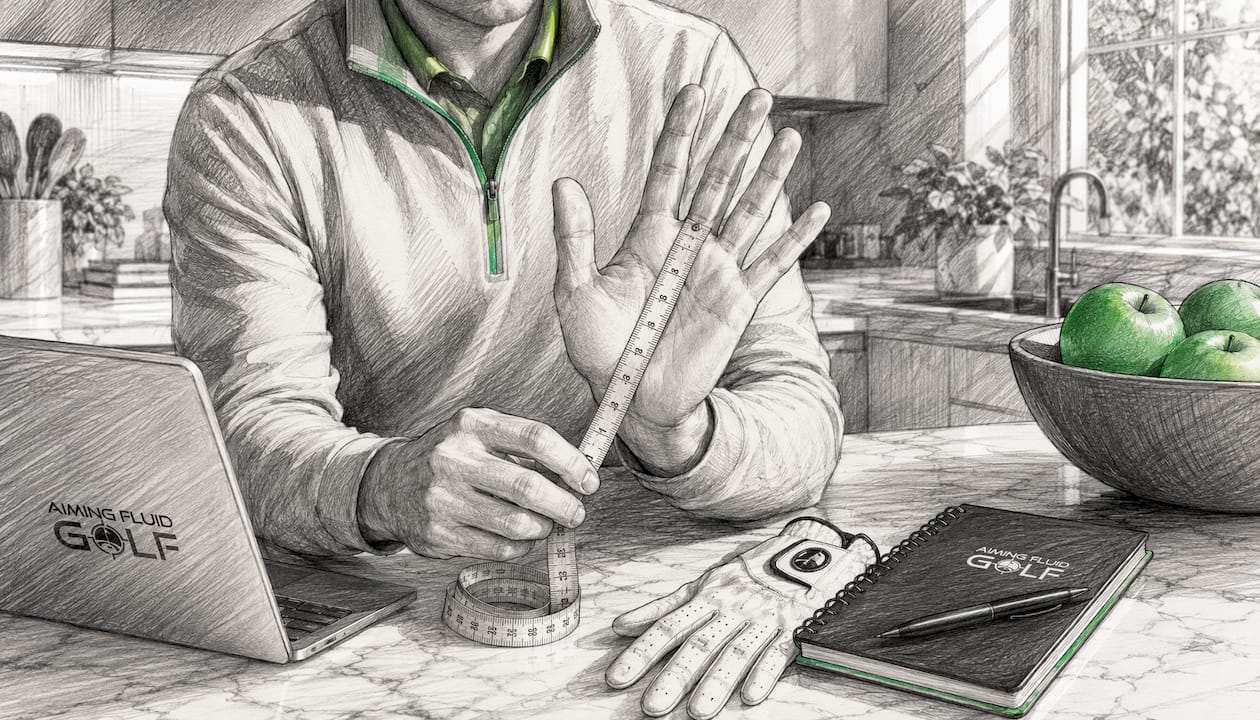
Pro Tip: Save measurements with the gear you wore when you took them — golf socks for foot measurements, a thin base layer for wrist-to-floor. That context matters when you revisit the numbers six months later.
How do fit profiles and fabric types change the size you should pick?
Golf apparel uses three distinct fit profiles: Classic (relaxed), Athletic/Sport (trimmer), and Performance/Stretch. Each one changes how your measured chest or waist translates to a labeled size.
| Fit profile | What it does | Shopper action |
|---|---|---|
| Classic / Relaxed | Extra room through chest and hips; designed for layering | Size down if you prefer a trim look |
| Athletic / Sport | Trimmer through the torso; follows the body | True to chart; size up for layering |
| Performance / Stretch | Body-mapped with stretch fabric; moves with the swing | Size by measurement, not label |
Fabric composition matters as much as the cut. Woven fabrics (most traditional polos) have little give, so your chest measurement maps closely to the size chart. Knit and stretch-blend fabrics can accommodate a range, but performance fabrics with stretch need correct waist and hem placement to avoid restriction during the swing. A polo that pulls across the shoulders at address will cost you rotation, regardless of what the label says.
Pro Tip: When model sizing photos and the written chart conflict, prioritize the manufacturer’s measurement column and the fabric composition note. A model wearing a size Medium at 6’1" tells you almost nothing if you’re 5’9" with a 40" chest.
How to measure yourself at home for any golf accessory
- Foot length and width. Trace your foot on paper at day’s end, wearing the golf socks you’ll use on the course. Measure the longest point (heel to longest toe) and the widest point across the ball of the foot. Record both in inches.
- Hand length. Open your lead hand flat. Place a ruler at the main crease at the bottom of your wrist and measure straight to the tip of your middle finger. This is your grip-size baseline and your glove-size reference.
- Head circumference. Wrap a soft tape measure around your head, roughly one inch above your ears and across the mid-forehead. Keep the tape level and snug but not tight.
- Waist. Measure at your natural waist (just above the hip bone), not at the belt line. Wear the base layer you’d wear on the course.
- Wrist-to-floor. Stand upright in golf shoes, arms hanging naturally at your sides. Have a helper measure from the wrist crease straight down to the floor. Wrist-to-floor is more accurate than height alone for club-length adjustments; the standard 7-iron length for men typically serves as a fitting benchmark.
- Grip diameter cross-check. Use your hand-length number against the Mitchell Golf grip size guide: under 7 inches is undersize (~0.880"), 7–8.75 inches is standard (0.900"), 8.25–9.25 inches is midsize (~0.960"), and above 9.25 inches is jumbo (~1.000").
Common mistakes to avoid: bending the tape around curves instead of measuring straight; measuring foot length in the morning (feet swell during the day); reading only glove size for grip diameter without measuring hand length directly; measuring waist at the belt line rather than the natural waist.
What to check on a product page before you click Buy
Every product page for a premium accessory should answer five questions before you commit:
- Exact measurements in inches and centimeters (not just S/M/L)
- Model height and size worn in product photos
- Material composition and stretch percentage (e.g., 92% polyester / 8% elastane)
- Adjustable features: velcro closures, elastic waistbands, magnetic attachment positions, clip points
- Pocket and pouch interior dimensions (length × width × depth)
Red flags worth noting: “one size fits most” with no measurement listed; no return or exchange information; customer photos that show a noticeably different fit than the product description implies.
Return windows directly affect your financial risk on premium accessories. A 30-day window gives you time to wear the item on the course and assess fit under real conditions. A 14-day window may not cover a full weekend of play. Check whether return shipping is prepaid or at your expense before ordering anything over $50.
Pro Tip: Search the product’s customer photo gallery specifically for someone with a similar build to yours. A photo from a 6’2" golfer tells you little about how a pouch clip sits on a smaller bag.
What to do when you’re between sizes
Borderline fits are common. Here’s how to handle the most frequent cases:
- Grips: Don’t jump straight to a midsize grip. A single extra wrap of build-up tape increases diameter by 1/64 of an inch; four extra wraps effectively equals a midsize grip. Start with one or two wraps to find your exact preference.
- Shoes: Never solve a tight-width fit by going up a full length size. Try a wider width first to preserve arch alignment. Width options (B, D, 2E, 4E) exist precisely for this.
- Gloves: If you’re between sizes, size down. A glove that’s slightly snug will stretch to fit; a loose glove creates excess material that reduces feel.
- Hats: Most premium hats include a sizing liner or adjustable strap. If you’re between a Medium and Large, check whether the hat has an internal sweatband you can trim or a rear adjuster.
- Belts: Order with one extra hole of room in each direction from your measured waist. Leather belts stretch slightly; a belt that fits snugly at purchase will loosen over time.
- Pouches: Check clip-point spacing and whether the attachment is modular. A pouch with a 360-degree metal clip accommodates more bag configurations than a fixed-loop design.
Pro Tip: A thin insole adds volume inside a shoe without changing length, which is useful when a shoe fits in length but feels slightly loose in volume. This is cheaper and faster than reordering a different size.
How fit changes after you buy: break-in and long-term expectations
Leather stretches. Synthetics relax. Knit performance fabrics can loosen with repeated washing and heat exposure. Knowing this upfront changes how you interpret an initial fit.
For leather accessories (gloves, utility pouches, belts), expect 5–10% dimensional relaxation over the first few uses. A leather glove that feels firm at purchase should feel fitted after a round or two. A leather pouch that closes snugly will develop a more natural drape. This is normal and desirable, not a defect.
Shoe cushioning compresses with use, which effectively adds a small amount of length and volume over time. Fit shoes at the end of the day and bring the golf socks you’ll wear on the course. If you use custom orthotics, bring those too, because they displace volume and change the effective fit significantly. Shoes that feel perfect in the morning may feel tight after 18 holes.
Follow manufacturer care instructions for all premium accessories. Washing a performance polo at high heat can shrink the fabric and alter the fit profile permanently. Conditioning leather preserves its dimensional stability.
What premium golf accessories cost and why return windows matter
Premium golf accessories in the United States typically range from around $25–$40 for performance gloves and hats to $60–$120 for leather utility pouches and specialty headcovers. Golf shoes from premium brands generally fall within the $120–$200 range for recreational golfers, with tour-level options going higher.
At those price points, a poor fit is a real financial loss. A 30-day return window is the standard to look for when buying premium accessories online. Shorter windows (14 days or less) increase your risk, particularly for shoes and apparel that need to be worn to assess fit properly. Always confirm whether the return is free or whether you pay return shipping, and check whether the item must be unworn or whether it can be returned after a single use.
Step-by-step guide to sizing golf shoes online
Getting golf shoe fit right starts with two numbers: foot length and foot width.
- Trace your foot on paper at the end of the day, wearing golf socks.
- Measure heel to longest toe for length; measure the widest point across the ball for width.
- Compare length to the brand’s size chart (US sizing). Most brands publish length-to-size conversion tables.
- Compare width to the available width options. Standard men’s is D; wide is 2E or 4E. Women’s standard is B; wide is D.
- Check volume notes if available. High-arch or high-volume feet often need a wider width even when length is correct.
- If your width measurement falls between standard and wide, size to the wider option. A shoe that’s slightly long is manageable; one that’s too narrow causes discomfort and affects your stance.
Never solve a width problem by going up a length size. That shifts the arch support position and can affect your balance through the swing.
How to size golf clubs online (grip, shaft length, lie angle)
Club fit has three variables: grip diameter, shaft length, and lie angle. Each one is measurable at home.
Grip diameter is measured at 2 inches down from the butt cap, the universal reference point used by professional fitters. Use your hand-length measurement against the Mitchell Golf standard brackets to select standard, midsize, or jumbo.
Shaft length uses wrist-to-floor combined with height. Most online club size charts are accurate for golfers within the average height range, but individual differences in arm length mean wrist-to-floor is the more reliable input. A standard men’s 7-iron is 37.5 inches; a driver is typically around 45 inches. If your wrist-to-floor measurement falls outside the standard range, you’ll need custom-length shafts.
Lie angle is harder to self-measure accurately. A general rule: taller golfers with longer wrist-to-floor measurements tend toward more upright lie angles; shorter golfers trend flatter. For online purchases, use the manufacturer’s standard lie as a starting point and plan to verify with a local fitter after purchase. Personal shot data can also guide lie-angle decisions by revealing consistent directional misses.
How to size GPS watch and rangefinder straps online
Wrist circumference is the only measurement you need. Wrap a soft tape measure around your wrist at the point where you’d wear the device, snug but not tight. Record in both inches and millimeters, since strap specs are often listed in millimeters.
Most GPS golf watches use standard lug widths of 20mm or 22mm. Check the product listing for lug width, then verify that your wrist circumference falls within the strap’s adjustment range. Straps typically list a minimum and maximum circumference they can accommodate. If your wrist falls near the minimum, the buckle may sit awkwardly; near the maximum, you may run out of holes.
For rangefinders with wrist or belt-clip carriers, measure the clip opening width against your belt or bag strap width. A carrier designed for a 1.5-inch belt will not sit securely on a 2-inch strap.
International size conversions for golf apparel
Shopping global online stores adds a conversion layer. US, UK, and EU sizing systems use different reference points, and a labeled “Large” in one system is not always a Large in another.
| US Size | UK Size | EU Size | Chest (inches) |
|---|---|---|---|
| Small | Small | — | 34 |
| Medium | Medium | 50 | 40 |
| Large | Large | — | 44 |
| X Large | X Large | — | — |
| XX Large | XX Large | 60 | 50 |
For pants, EU sizing uses waist in centimeters. A US 34-inch waist converts to approximately 86 cm EU. UK trouser sizing typically matches US waist numbers directly but uses different inseam conventions.
The safest approach: ignore the letter or number label entirely and match your measured chest or waist in inches directly to the brand’s measurement column. Brand sizing is rarely uniform across manufacturers, and a labeled “Medium” can fit like a small or large depending on the brand’s origin market.
Key Takeaways
Measure foot length, hand length, and wrist-to-floor first — those three numbers resolve most online golf gear sizing decisions before you open a product page.
| Point | Details |
|---|---|
| Measure before you browse | Foot length, hand length, and wrist-to-floor unlock sizing for shoes, gloves, grips, and clubs. |
| Manufacturer charts over letter sizes | Brand sizing varies significantly; always match your measurement to the brand’s own chart, not a generic S/M/L label. |
| Grip diameter reference | Hand length maps to grip size; the 2-inch-from-butt-cap standard defines standard (0.900"), midsize (~0.960"), and jumbo (~1.000") diameters. |
| Verify return windows | A 30-day return window is the standard for premium accessories; shorter windows increase financial risk on items over $50. |
| Aimingfluidgolf accessories | Aimingfluidgolf products include exact pocket dimensions, adjustable clip points, and magnetic placement specs to reduce fit risk when ordering online. |
Why measurement-minded design changes how you shop online
Most golfers spend real time choosing clubs and almost no time choosing accessories. That’s a mistake. A utility pouch with the wrong clip diameter won’t stay put on your bag. A hat that’s a half-size too large shifts during your swing. A leather glove that’s too loose creates dead spots in your grip pressure. These aren’t minor inconveniences; they interrupt the physical consistency that good ball-striking depends on.
The conventional wisdom says accessories are one-size-fits-most. The evidence says otherwise. Brand sizing inconsistency is one of the largest drivers of returns for online golf apparel, and accessories are no different. The golfers who avoid that cycle are the ones who take three measurements before they open a product page, cross-reference the manufacturer chart, and check the return policy before they commit.
What Aimingfluidgolf builds around is the idea that every accessory dimension should be a deliberate design decision, not an afterthought. Pocket depth, clip-point placement, magnetic attachment spacing — these are measurable, repeatable specs that a golfer can verify before purchase. That’s what reduces returns and keeps gear working the way it should through a full season of play.
Aimingfluidgolf accessories are built around exact dimensions
Aimingfluidgolf designs every accessory with published dimensions and adjustable attachment points so you can verify fit before you order, not after. The premium leather utility pouch lists interior dimensions and features a 360-degree metal clip that fits virtually any bag strap configuration. The magnetic towel system includes placement specs so you can confirm it works with your specific bag setup before it ships.
Every product page on Aimingfluidgolf.com includes material composition, attachment dimensions, and fit notes. Match your saved measurements to those specs directly. Browse the full best golf accessories collection to find accessories sized for your game, and check the return policy details on each product page before you order.
Useful sources and further reading
- Mitchell Golf Grip Size Guide — Defines the four standard grip-size brackets (undersize, standard, midsize, jumbo) and the hand-measurement method used by professional fitters.
- FootJoy Golf Shoe Fitting Guide — Industry-standard guidance on foot measurement, width selection, and fitting at day’s end with golf socks.
- FootJoy Apparel Fitting Guide — Detailed size charts for men’s and women’s shirts, pants, and outerwear with chest and waist measurements in inches.
- GolfOnline Sizing Guide — Explains why manufacturer-specific charts outperform generic letter-size assumptions for golf clothing and shoes.
- Donald Ross Sportswear Fit Guide — Covers Classic vs. Athletic fit profiles and how each affects sizing decisions for golf apparel.
- GolfDecode Club Length Guide — Standard club lengths by iron and driver, plus wrist-to-floor charts for custom-length decisions.
- CaddieHQ Grip Size Calculator — Step-by-step hand measurement guide and build-up tape math for fine-tuning grip diameter.
- Golf Data Analysis Best Practices — Practical guidance on using self-measured data to verify fit recommendations and inform online gear choices.
Prioritize manufacturer-specific size charts over any generic guide, including this one. Save your three primary measurements (foot length, hand length, wrist-to-floor) and update them annually, since foot dimensions and grip preferences can shift over time.
Recommended
- Efficient Gear Management for Golfers: 2026 Guide – Aiming Fluid Golf
- Personal gear in golf: cut retrieval time by 50% – Aiming Fluid Golf
- Ultimate Beginner’s Golf Guide: Essential Gear, Tips & Etiquette – Aiming Fluid Golf
- Golf gear ergonomics: boost performance with smarter design – Aiming Fluid Golf


