


TL;DR:
- Minimalist golf gear focuses on carrying only essential clubs and accessories for improved focus.
- Lighter, organized setups reduce physical fatigue and decision-making distractions during play.
- Strategic packing enhances organization, speed, and mental clarity, leading to better performance.
More gear doesn’t mean better golf. That idea runs counter to what most equipment marketing tells you, but expert reviews consistently frame bag organization and weight as direct performance factors. When your bag feels like a junk drawer and your pre-shot routine involves hunting for a tee or towel, your focus fractures before you even swing. Minimalist golf gear rejects that pattern entirely. It’s a deliberate system built around carrying only what you need, organizing it for immediate access, and eliminating the friction that costs you strokes and enjoyment over 18 holes.
Table of Contents
- Defining minimalist golf gear
- Core components of minimalist golf gear
- How minimalist gear enhances organization and efficiency
- Common pitfalls and how to overcome them
- Minimalism in golf: The unconventional advantage
- Find the best minimalist golf gear for your game
- Frequently asked questions
Key Takeaways
| Point | Details |
|---|---|
| Less gear, better focus | Carrying only essentials lets you concentrate on your swing and enjoy the game more. |
| Organization drives efficiency | Minimalist golf gear is designed for easy access, less searching, and quicker rounds. |
| Choose quality over quantity | Select multi-purpose, high-quality items that meet waterproofing, weight, and protection benchmarks. |
| Mindset matters | Minimalism in golf is as much about simplifying your routine as it is about carrying fewer items. |
Defining minimalist golf gear
Most golfers approach bag packing the same way they approach a packing list for an uncertain trip: they bring options for every possible scenario. Extra wedges, backup gloves, three types of tees, a full rain suit even when there’s a 10% chance of rain. The result is a setup heavy enough to create physical fatigue during a walking round, and complex enough to trigger constant micro-decisions between shots.
Minimalist golf gear reverses that logic. The defining principle is simple: carry only what you will actually use during a specific round. This isn’t about gear deprivation. It’s about intentional selection. Minimalist goals focus on reducing distraction and managing the carry load to match the actual demands of the round. A walker at a hilly course has different needs than a cart rider on a flat layout, but both benefit from removing anything that doesn’t serve a direct purpose.
The distinction between a minimalist and a traditional setup comes down to three variables: club count, bag weight, and accessory selection. Traditional setups typically max out the 14-club limit, use feature-heavy cart bags, and pile in accessories that rarely get touched mid-round. Minimalist setups, by contrast, often include simple routines and fewer decisions as part of the philosophy, not just hardware choices. Even warm-up routines, club selection habits, and course management strategies become cleaner when the physical setup supports simplicity.
Here’s what a standard minimalist setup includes:
- 7 to 9 clubs, selected based on the course layout and your shot-making tendencies
- A lightweight stand bag, typically under 4 lbs when empty
- One multi-function divot tool that doubles as a ball marker
- A single quality golf towel, ideally with a secure attachment system
- A small accessory pouch for tees, a spare ball, and a scorecard or yardage book
- Weather protection appropriate to the forecast, not every possible condition
“The best players in the world often simplify their routines, their gear, and their thinking between shots. Simplicity isn’t a lack of preparation. It’s a commitment to what actually works.” This principle appears consistently in profiles of elite golfers who credit mental clarity over equipment complexity.
For a deeper breakdown of what belongs in any well-organized bag, the golf bag essentials hub covers the full hierarchy from beginner to scratch setups.
Core components of minimalist golf gear
Now that the minimalist philosophy is clear, let’s break down the core components and see how minimalist setups differ tangibly from standard gear.
The most useful way to understand the difference is through direct comparison. Traditional setups prioritize maximum capability across all conditions. Minimalist setups prioritize targeted capability with zero excess weight or cognitive overhead.
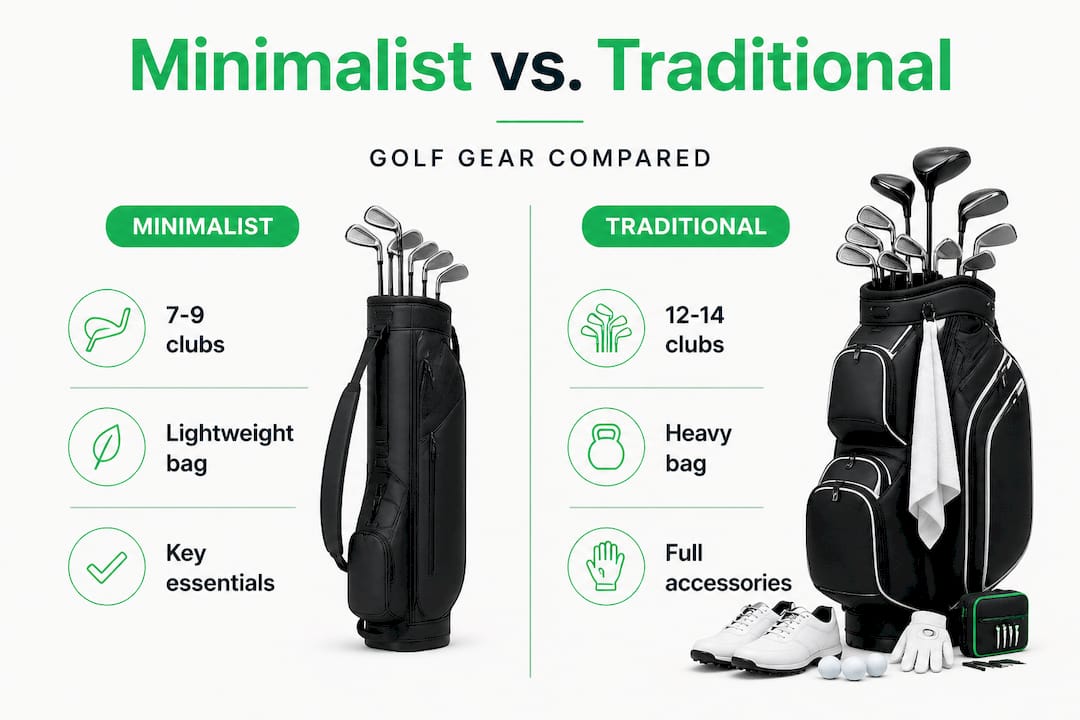
| Feature | Minimalist setup | Traditional setup |
|---|---|---|
| Club count | 7 to 9 | 12 to 14 |
| Bag weight (empty) | 2.5 to 4 lbs | 5 to 10 lbs |
| Bag type | Lightweight stand bag | Cart bag or full-featured tour bag |
| Storage compartments | 3 to 5, clearly labeled | 8 to 12, often redundant |
| Waterproofing | Typically included in quality builds | Varies widely by price point |
| Organization style | Zone-based, immediate access | Category-based, often scattered |
| Accessory count | 3 to 5 essential items | 10 or more, many rarely used |
The weight difference alone is significant. A traditional cart bag loaded with 14 clubs and full accessories can weigh 35 lbs or more. A minimalist stand bag carrying 8 clubs and core gear typically comes in under 20 lbs. Over four hours of walking, that difference is measurable in both physical energy and mental endurance.
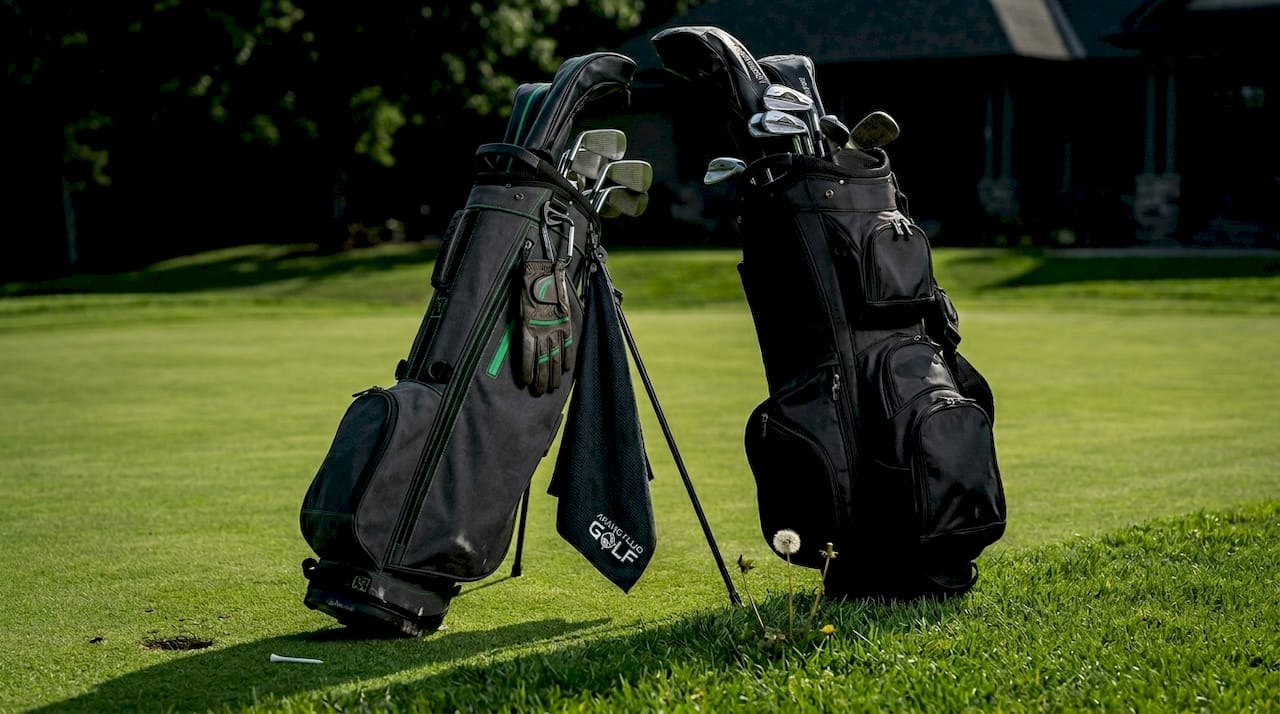
Minimalist bags are designed for essentials rather than maximum storage variety. That’s not a limitation. It’s a design decision that forces intentional packing. The constraints of the bag become a useful filter. If you can’t fit something in, that’s a signal you probably don’t need it.
Practical benchmarks include weight under load, storage access speed, waterproof zippers, and whether the carry system fits your body type and walking habits. These are the factors that determine whether a bag actually improves your round, not the number of pockets.
The absolute essentials for a minimalist round:
- Driver or 3-wood for off-the-tee distance
- A mid-iron (typically a 6 or 7 iron)
- A short iron (9 iron or pitching wedge)
- A sand or gap wedge for approach shots and scrambling
- A putter
- 6 to 8 golf balls (not more, not fewer)
- Tees, enough for the round, stored in one designated pocket
- One divot tool with an integrated ball marker
- One towel, attached and accessible without opening the bag
For a structured approach to selecting and packing these items, the golf bag essentials checklist and complete essentials checklist provide step-by-step guidance. If you’re considering reducing your club count specifically, the Stix Golf minimalist set review covers how a curated 9-club system performs across a variety of course conditions.
Pro Tip: When selecting multi-purpose accessories, prioritize items that eliminate the need for two separate tools. A divot tool with a ball marker, or a towel with a magnetic clip, removes one item without removing any function.
How minimalist gear enhances organization and efficiency
With the basics outlined, it’s time to see how minimalist gear translates into real benefits for your organization and pace during a round.
Organization directly boosts performance and efficiency, not just aesthetics. When every item in your bag has a fixed location and you can retrieve it without looking or rummaging, your pre-shot routine stays clean. That consistency carries into your swing mechanics and decision-making.
The data below reflects key performance specs golfers should evaluate when choosing minimalist gear:
| Spec category | Recommended benchmark | Why it matters |
|---|---|---|
| Empty bag weight | Under 4 lbs | Reduces fatigue over 18 holes of walking |
| Club divider count | 4 to 7 full-length dividers | Prevents club tangling and speeds retrieval |
| Waterproof rating | IPX4 or equivalent | Protects gear in light to moderate rain |
| Towel attachment | External clip or magnetic mount | Eliminates bag-opening for towel access |
| Pocket count | 4 to 6 with logical zoning | Enables instant location of specific items |
| Strap system | Dual strap with hip pad | Distributes weight evenly for walkers |
Weight, waterproofing, and storage logic determine actual organization efficiency in practice. A bag with 10 pockets but no clear zoning is harder to use than a 5-pocket bag with intentional layout.
Here’s a practical checklist to streamline your bag for maximum efficiency:
- Empty the bag completely. Lay everything out and evaluate each item individually.
- Sort items into three categories: always needed, sometimes needed, rarely needed.
- Remove everything in the “rarely needed” category and leave it at home.
- Assign a fixed zone in the bag for each remaining category (clubs, balls, accessories, weather gear).
- Test retrieval speed by reaching for specific items without looking. If you hesitate, reorganize.
- After every round, return items to their designated zones before storing the bag.
- Reassess the setup quarterly as your game and course habits evolve.
For walking golfers specifically, the organization guide for walking golfers covers weight distribution and access strategies in detail. If you want a systematic method for ordering your clubs and gear, organize your golf bag like a pro applies a proven framework. For data on how retrieval time affects performance directly, the cut retrieval time guide provides benchmarks and solutions.
Pro Tip: Avoid the habit of “just in case” packing. Every extra item slows your retrieval time for the things you actually use. Pack for the round you’re about to play, not for every round you’ve ever played.
Common pitfalls and how to overcome them
Even with the best gear, using a minimalist setup comes with unique challenges. Here’s how to avoid the most common ones.
The most frequent mistake is treating a minimalist bag like a traditional bag. Golfers switch to a lighter, smaller setup and then immediately try to fill every available pocket with the same volume of gear they carried before. The result is an overstuffed minimalist bag that performs worse than either option, because minimalist bags are designed for essentials and lack the storage architecture to handle excess items without creating chaos.
Common pitfalls include:
- Overpacking accessories. Extra gloves, training aids, and backup tools belong in the car, not the bag.
- Poor compartment use. Mixing item categories in the same pocket creates retrieval delays. Balls with tees, clubs with rain gear, or snacks with divot tools are all patterns that slow you down.
- Skipping the towel system. Many golfers use minimalist bags but still thread their towel through a ring on the bag. Without a secure, external attachment, that towel ends up inside the bag or on the ground.
- Ignoring weather preparation. Minimalism doesn’t mean unpreparedness. A compact rain jacket in a designated outer pocket is essential, not optional.
- Leaving out key accessories. Tee holders with no fixed home, loose ball markers, and unclipped divot tools all become liabilities when you’re under pressure on a critical hole.
Simple solutions for each of these problems:
- Use a layered packing system: clubs first, then the ball pocket, then accessories in order of use frequency.
- Invest in an accessory pouch that clips to the outside of your bag. It keeps small items organized without consuming interior pocket space.
- Use a magnetic towel attachment that lives on the exterior of the bag at all times. Aiming Fluid’s magnetic system, for example, attaches and detaches with one motion without requiring you to open any pocket.
- Designate one interior pocket exclusively for weather gear, and keep it empty until needed.
For structured methods to maintain a clean, high-function bag setup over time, pro organization methods outline the exact steps tour caddies use to maintain accessibility under pressure.
Pro Tip: Never exceed the intended capacity of your bag. If the zipper is straining or the pockets are bulging, you’ve already compromised the organizational system the bag was designed around.
Minimalism in golf: The unconventional advantage
Practical tips solve the “how,” but the more important question is why minimalist golf is more than a trend. It’s a performance variable that most golfers never measure.
The conversation around minimalist golf often focuses on hardware: lighter bags, fewer clubs, smaller footprint. But the real mechanism is psychological. Minimalism is as much about mental clarity as it is about hardware choices. When you carry fewer items, you make fewer micro-decisions between shots. That conservation of cognitive energy compounds over 18 holes.
Decision fatigue is a well-documented performance limiter in high-concentration activities. In golf, it shows up as indecision over club selection, distraction during the pre-shot routine, and frustration when you can’t find something quickly. A minimalist setup directly reduces the input load that creates those failure points.
Consider how this plays out in practice. A golfer with 14 clubs faces a subtle pressure on every approach shot: which of three wedges is right here? A golfer with 8 clubs doesn’t have that variable. The decision is faster. The commitment is cleaner. The swing follows more naturally. This is not a limitation. It is a structural advantage built into the setup itself.
The parallel to thoughtful golf design is direct. Gear designed around real on-course problems, rather than maximum feature counts, supports the same instinctive decision-making that minimalism promotes. The bag, the towel system, the tee holder, and the divot tool all become frictionless when each is designed with a specific function and an intuitive access mechanism.
The unconventional advantage is this: most golfers invest in gear to fix swing problems. Minimalist golfers invest in gear to eliminate the conditions that prevent good swings from happening in the first place.
Find the best minimalist golf gear for your game
If you’re ready to simplify your setup and improve your efficiency on the course, the right accessories make the transition straightforward rather than complicated.

Aiming Fluid Golf builds accessories specifically for golfers who want smart systems over surplus options. Our magnetic golf towels attach and detach from any bag position in a single motion, eliminating one of the most common retrieval delays during a round. Paired with precision tees, a multi-function divot tool, and a utility pouch designed for minimalist packing, the full system keeps every essential accessible without adding bulk. Browse the full lineup of best golf accessories to find vetted, performance-tested picks that align with a streamlined, organized approach to every round.
Frequently asked questions
What club count is typical for minimalist golf gear?
Most minimalist setups carry 7 to 9 clubs, selected for shot variety without redundancy, since minimalist designs focus on essentials rather than maximum club options.
Does minimalist golf gear sacrifice performance?
No. Weight, protection, and waterproofing are the real performance factors, and minimalist setups that prioritize these specs consistently support faster, more focused rounds than overloaded traditional bags.
What is the main benefit of minimalist golf gear?
The primary benefit is reduced distraction combined with faster access to gear, since minimalist setups focus on eliminating carry friction and keeping the round moving efficiently.
Are minimalist golf bags waterproof?
Many quality minimalist bags use waterproof materials and sealed zippers, though specs vary by model. Golf Monthly recommends verifying waterproofing standards before purchase, especially for regular walking rounds in variable weather.
Recommended
- Stix Golf 9-Club Set Review: Premium Performance, Minimalist Design – Aiming Fluid Golf
- Why robust golf tools matter: improve your game’s efficiency – Aiming Fluid Golf
- Personal gear in golf: cut retrieval time by 50% – Aiming Fluid Golf
- Golf gear ergonomics: boost performance with smarter design – Aiming Fluid Golf
Build a minimalist golf bag around three multi-function tools
The best minimalist golf accessories replace multiple loose items, stay accessible and have one clear place in the bag. Start with a multi-function divot tool, a compact magnetic golf towel system and a small valuables pouch.
Best starting setup: the foldable 5-in-1 divot tool plus the Stubby magnetic towel. Add the utility pouch when small items and valuables still create pocket clutter.
Aiming Fluid Golf designs and sells the products linked in this recommendation. Every original source and backlink in the article remains in place above.


