


If you play more than once a week and want a cover that ages into something better, genuine leather earns its price. If you want low maintenance, wide design choice, and solid value, premium synthetic or PU leather is the smarter buy. The decision comes down to three factors: durability, maintenance tolerance, and the aesthetic you want your bag to carry.
TL;DR:
- Leather headcovers often last more than five years, especially when properly conditioned, but cost significantly more upfront than synthetic options.
- Synthetic covers are easier to clean, resist moisture without maintenance, and typically cost less, making them a better choice for casual or wetter climate players.
- Leather ages by developing a patina and resists stress points better, while synthetics tend to crack and peel at seams faster and fade under prolonged sun exposure.
- For frequent players who value durability and aging appearance, high-quality leather is a worthwhile investment, whereas infrequent players benefit from the lower cost of synthetics.
- Both materials require proper storage, but leather needs more careful conditioning, especially in dry climates, to prevent cracking and sun damage.
Table of Contents
- Leather vs Synthetic Headcovers: Pros and Cons at a Glance
- How Long Do Leather and Synthetic Headcovers Actually Last?
- How Should You Clean and Store Each Material?
- Does Leather Really Look Better Over Time Than Synthetic?
- What Do Leather and Synthetic Headcovers Cost Over Time?
- Getting the Fit Right by Club Type
- Which Headcover Material Should You Actually Buy?
- Which Brands Make Leather and Synthetic Headcovers Worth Buying?
- Is Leather or Synthetic Better for the Environment?
- Aiming Fluid Golf’s Take on Materials That Actually Hold Up
- Round Out Your Bag With Gear Built the Same Way
- Sources
- FAQ
Leather vs Synthetic Headcovers: Pros and Cons at a Glance
Both materials protect clubs well. The differences show up in how they age, how much upkeep they demand, and what they cost over a multi-year ownership window.
Genuine leather:
- Ages into a distinct patina instead of just looking worn
- Resists abrasion and puncture at stress points better than most synthetics
- Signals craftsmanship and pairs well with classic club designs
- Higher upfront cost, typically $100 to $175 for a driver cover
- Needs periodic conditioning or it dries and cracks
- Limited color and print options compared to synthetic
Synthetic/PU leather:
- Wipes clean in seconds and resists moisture without conditioning
- Wide range of colors, patterns, and licensed designs
- Mid-premium covers commonly run $30 to $100, a fraction of leather’s cost
- Consistent quality across a production run since PU is easier to standardize
- Color can fade or crack at seams faster under heavy sun exposure
- Less tactile depth, and it never develops the aged character leather does
Knit and neoprene sit outside this main comparison. Knit covers suit novelty designs and casual bags, while neoprene earns its place in wet climates where moisture resistance matters more than looks, according to material guides from custom headcover manufacturers.
How Long Do Leather and Synthetic Headcovers Actually Last?
Full-grain leather typically outlasts synthetic at the points that fail first: the collar seam, the base stitching, and any spot where the cover flexes every time you pull it on and off. Retailers who sell premium leather driver covers report a multi-year lifespan, often five years or more with proper care. Quality PU covers, by contrast, tend to hold up well for two to four years of regular play before the coating starts to crack or peel at flex points.
The mechanism behind that gap is straightforward. Leather fibers are woven in three dimensions, so stress at a seam distributes across the hide instead of concentrating on a single failure line. PU is a polymer coating bonded to a fabric backing. Once that coating starts to separate from the base layer, usually at a fold or seam, it peels rather than stretches.
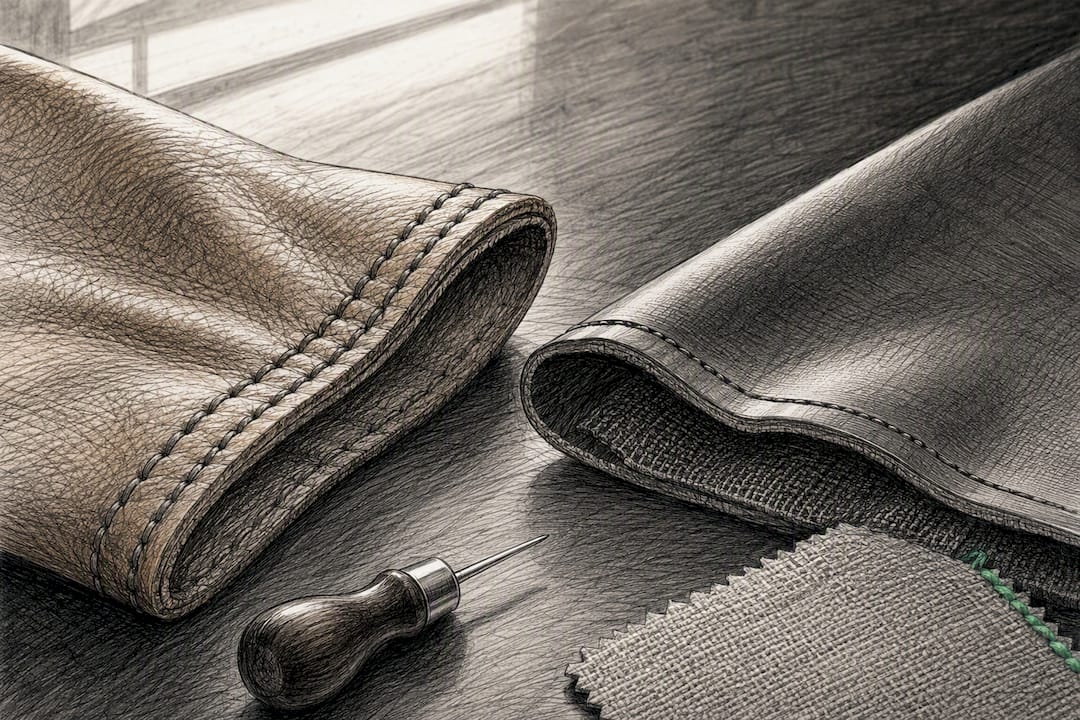
High-density PU has closed much of the performance gap on moisture resistance and color retention, and some premium synthetic covers rival leather on day-to-day durability. Where synthetic still lags is long-term seam integrity under repeated flexing.
UV exposure accelerates wear on both materials, but differently. Leather dries out and stiffens without conditioning, then cracks along the grain. Synthetic coatings yellow or chalk under prolonged sun, and once that surface degrades, moisture gets underneath the coating and speeds delamination. A cart bag left in direct sun all summer will age either material faster than one stored in a bag well or garage.
How Should You Clean and Store Each Material?
Cleaning routines differ enough that using the wrong method on either material shortens its life.
For synthetic and PU covers:
- Wipe down with a damp microfiber cloth and mild soap after wet rounds
- Avoid harsh solvents or bleach, which break down the PU coating
- Let covers air dry fully before storing them in your bag
For leather covers:
- Condition every few months with a leather-specific product, more often in dry climates
- Treat stains immediately with a soft cloth. Never soak leather or run it through a washing machine
- Avoid direct heat sources when drying a leather cover that got wet
Storage matters as much as cleaning. Stuff covers loosely rather than compressing them flat in a crowded bag pocket, since deformation in the collar reduces retention over time. Keep both materials somewhere with airflow. A sealed plastic bin traps moisture and invites mildew, especially on leather.
If you already use magnetic towels for course cleanup, the same wipe-and-dry principle applies to synthetic headcovers. Our guide on how to wash a golf towel covers the material-safe cleaning products that work for both towels and synthetic covers.
Pro Tip: Condition leather covers before the first crack appears, not after. Once the grain splits, no conditioner reverses it.
Does Leather Really Look Better Over Time Than Synthetic?
Leather’s patina is the whole argument for choosing it over synthetic. The hide darkens unevenly, picks up small marks from your bag and travel, and develops a texture that a factory-fresh cover never had. Golfers who like that look are usually the same players who keep the same set of clubs for years and want gear that shows it has been used, not gear that looks new forever.
Synthetic holds its original color and finish far longer, which suits golfers who want their bag to look consistent round after round, or who like bold graphics, team colors, or novelty designs that leather can’t replicate as cheaply. PU also takes printed detail better, so licensed and custom designs skew synthetic almost by default.
Stitching and lining quality affect perceived value on both materials. A leather cover with contrast stitching and a soft fleece lining reads as premium even at a modest price point, and the same is true of a well-finished PU cover. Cheap stitching is the first thing that gives away a low-quality build in either material, regardless of what the outer shell is made from.
What Do Leather and Synthetic Headcovers Cost Over Time?
Genuine leather driver covers typically retail from $100 to $175, while mid-premium synthetic covers run $30 to $100. On sticker price alone, synthetic wins every time.
Cost per year of ownership tells a different story for frequent players. A $150 leather cover lasting five years costs $30 a year. A $60 synthetic cover replaced every three years costs $20 a year, plus the hassle of reordering and matching a new design to an aging set. For golfers who play once or twice a month, synthetic’s lower entry price usually wins outright since the durability gap barely matters at that pace.
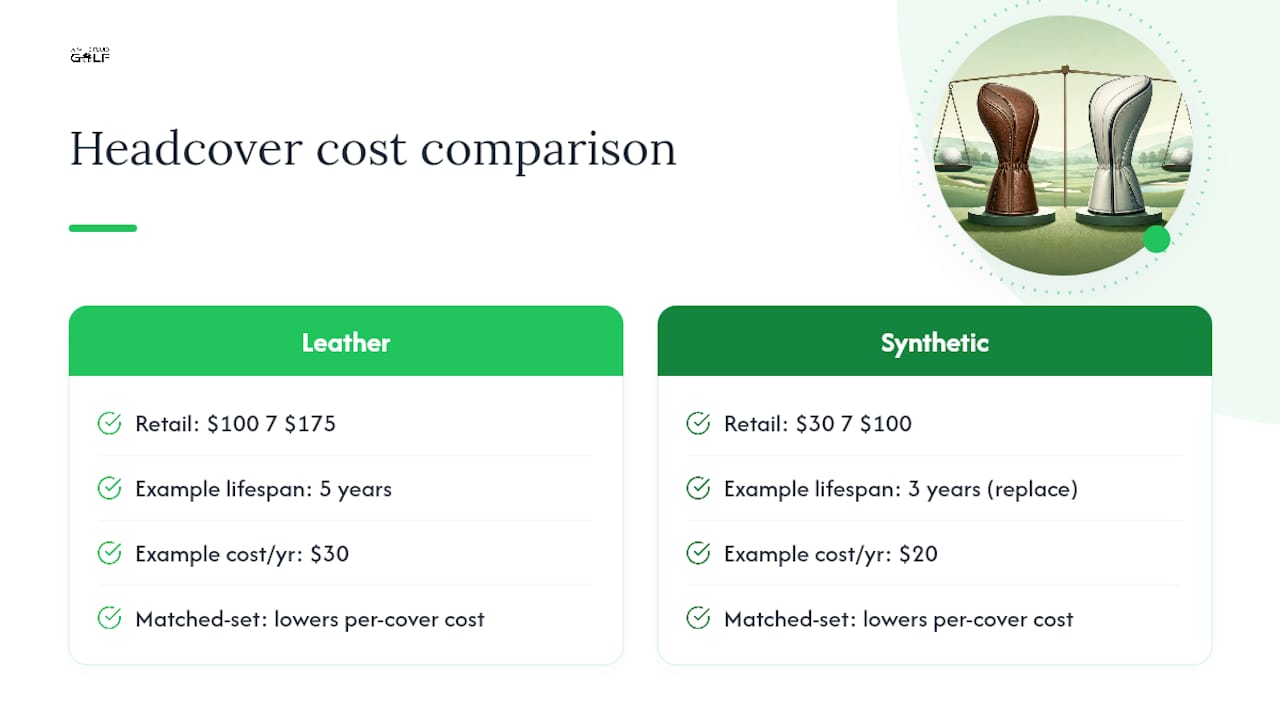
Matched sets (driver, fairway, hybrid in one design) often cost less per cover than buying singles, and this holds true in both materials.
Getting the Fit Right by Club Type
Material affects fit as much as looks. Driver covers need to stretch over 460cc heads without loosening the collar after repeated use, and synthetic with a slight stretch weave tends to hold that snug fit longer than stiff leather. Fairway and hybrid covers see less stress since the heads are smaller, so either material performs well.
Putter covers are a different case. Blade putters need a snug, low-profile fit, while mallets need more room, and leather’s structure holds its shape better on a blade over years of use than a stretched-out synthetic collar. If you swap heads or upgrade your driver often, synthetic’s lower cost makes mixing materials across your bag easier to justify than committing to a full leather set.
Which Headcover Material Should You Actually Buy?
Match the material to how you play, not just how it looks in a photo.
- Frequent players and tourers (three or more rounds a week): genuine leather pays for itself through years of use and improves in appearance the more it travels.
- Weekend players (one or two rounds a month): premium synthetic delivers nearly the same protection at a fraction of the cost, and the durability gap rarely matters at that pace.
- Gift buyers: synthetic offers more design and color options at a friendlier price point, with less risk of the recipient neglecting leather care.
- Wet-climate players: synthetic or neoprene resists moisture without the conditioning leather demands after every soggy round.
Before buying, ask three questions: how often will this cover actually get used, are you willing to condition leather periodically, and does the aged look of leather or the consistent finish of synthetic fit your bag? On any product page, check sizing against your specific club head, confirm the warranty terms, and read the return policy before committing to a full matched set.
Which Brands Make Leather and Synthetic Headcovers Worth Buying?
The headcover market splits cleanly by material focus. Premium leather goods makers lean into heritage styling, often with hand-stitched details and full-grain hides sourced from tanneries that follow Leather Working Group audit standards. That certification matters if you care about how the hide was sourced and processed, since LWG audits track water use, chemical handling, and traceability through the supply chain.
On the synthetic side, most mid-premium brands use high-density PU because it’s the common OEM choice for retail production. It holds color consistently, keeps manufacturing costs predictable, and supports a much wider range of printed and licensed designs than natural hides allow. That’s why you’ll see far more novelty and character covers made from synthetic than leather.
Neither material family has one brand that dominates every category. Tour-style leather makers focus on classic driver and putter covers sold individually or in small matched sets. Synthetic-focused brands tend to compete on design variety and price, releasing seasonal patterns and collaborations that would be cost-prohibitive to produce in real leather. When comparing options, look past the label and check the actual material grade. “Leather” can mean full-grain, top-grain, or bonded leather, and those grades differ significantly in durability even within the same price bracket. “Synthetic” spans everything from thin vinyl to high-density PU, so the durability difference between a cheap and a premium synthetic cover can be as wide as the gap between synthetic and leather itself.
Is Leather or Synthetic Better for the Environment?
Neither material is environmentally neutral, and the honest comparison depends on what you weigh most.
Genuine leather is a byproduct of the meat industry, but tanning is chemically intensive, and sourcing without oversight can involve heavy water use and harsh runoff. The Leather Working Group exists specifically to address that gap, auditing tanneries on water management, chemical safety, and traceability. Buying from a brand that sources LWG-certified leather is the clearest way to reduce the environmental footprint of a leather purchase without giving up the material.
Synthetic PU avoids animal byproducts entirely, but it’s petroleum-based and doesn’t biodegrade on any practical timeline. It also sheds microplastic fibers during production and eventual disposal, a tradeoff that gets little attention compared to the leather industry’s more visible environmental debates.
Longevity is the factor buyers overlook most. A leather cover that lasts five to seven years replaces two or three synthetic covers over the same span, and manufacturing emissions per unit compound with each replacement. A durable product, regardless of material, is often the lower-impact choice simply because it gets replaced less often. That’s the same logic behind building any golf accessory to last rather than cycling through disposable versions every season.
Aiming Fluid Golf’s Take on Materials That Actually Hold Up
Most headcover advice skips the part that matters most: material choice is a bag-management decision, not just a style one. A leather cover that looks great but slows down how quickly you find your putter costs you strokes, not just money.
Gary’s take, built from watching how golfers actually use their gear: prioritize durability at the points your bag stresses most, not the points that look impressive on a shelf. That’s the same principle behind organizing your bag so every tool has a place. Aiming Fluid Golf applies that thinking across our own accessories, choosing materials for how they perform after fifty rounds, not just how they photograph on day one.
— Gary
Round Out Your Bag With Gear Built the Same Way
Whichever headcover material you land on, the same logic that separates a durable leather cover from a cheap synthetic one applies to everything else in your bag. Accessories are built around materials and mechanisms that hold up under real rounds, not just showroom conditions.

Our magnetic golf towels use the same durability-first thinking as a well-built leather cover: a design that gets stronger through use instead of wearing out at the first stress point. If you’re already comparing headcover materials on how they age and perform, browse our best golf accessories picks to see the full lineup, including divot tools and precision tees built with the same standard. Check sizing and material details on each product page, then add what your bag is missing.
Sources
FAQ
Which Is Better, Synthetic or Genuine Leather?
Genuine leather lasts longer and develops a patina, making it better for frequent players who want a cover that ages well. Synthetic wins on maintenance, price, and design variety, making it the better fit for most casual and weekend golfers.
What Headcover Material Does Rory McIlroy Use?
Tour pros commonly use custom leather or premium synthetic covers supplied through equipment sponsorships, often featuring personal branding or charity logos rather than standard retail materials.
What Headcovers Does Tiger Woods Use?
Tiger Woods has used custom leather headcovers featuring his signature tiger-head design, produced as a personalized accessory rather than a standard retail product.
Do Pro Golfers Use Iron Headcovers?
Most pros skip individual iron covers since irons stack directly in the bag without touching each other, but they consistently use covers on drivers, fairway woods, hybrids, and putters where clubhead-to-clubhead contact is a real risk.
How Long Should a Good Headcover Last?
A well-cared-for leather headcover often lasts five years or more, while quality synthetic covers typically hold up for two to four years of regular play before showing seam wear.


