


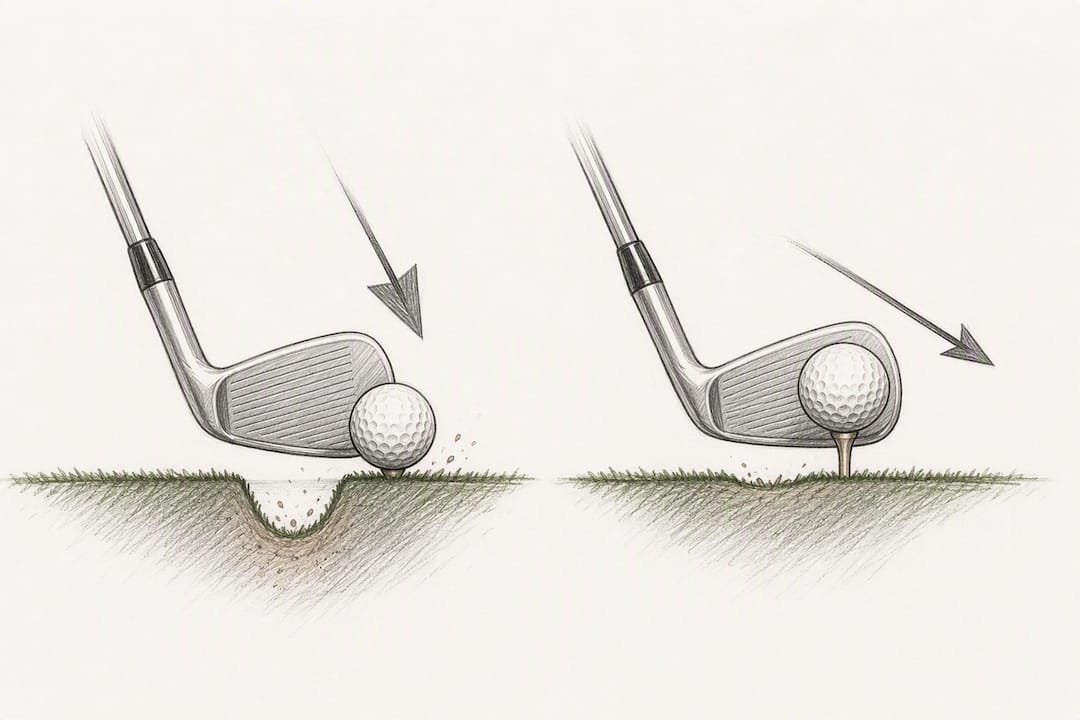
Push the tee flush so only a very small portion of the shaft is visible above the grass. That single adjustment enforces the descending blow irons need for solid, compressed contact. Anything higher invites a level or ascending strike, and that’s where thin and topped shots come from.
TL;DR:
- Setting the tee so only 0 to 0.25 inches of the shaft is visible ensures a downward attack angle, promoting solid, compressed contact with irons.
- Adjusting tee height lower in wind or if prone to thin shots helps maintain a penetrating ball flight and reduces penalty for poor strikes.
- Using shorter tees around 2.125 inches and a consistent setup routine minimizes variability and helps golfers make contact with the club’s low point.
- Impact tape and on-course observation confirm that flush tee height leads to closer-to-center contact and less dispersion, especially compared to raised tees.
- Proper organization tools like magnetic landing pads and a range of tee lengths streamline the routine, supporting repeatable, flush setups across rounds.
Table of Contents
- Iron Tee Height Tips: The Standard Rule And How To Check It
- When To Adjust Tee Height For Conditions And Swing Type
- How To Set Up A Flush Iron Tee Height Every Time
- Equipment Choices That Make A Flush Setup Easier
- Drills That Prove The Flush Tee Works
- Why The Flush Setup Beats Fiddling On Every Tee
- Gear That Makes The Flush Tee Setup Repeatable
- Sources
- FAQ
Iron Tee Height Tips: The Standard Rule And How To Check It
The baseline guideline teaching pros repeat is simple: tee irons “flush” or “low,” meaning the ball sits barely above the turf. Golf pushing the tee fully into the ground so the ball looks essentially un-teed to the naked eye. The measurement most instructors cite is 0 to 0.25 inches of visible tee shaft, which is widely recommended to preserve a downward angle of attack.
You don’t need a ruler on the course. Three visual checks confirm you’ve got it right:
- The fairway-lie test: Set up and look at the ball. It should look like it’s sitting in the grass, not perched above it.
- The finger test: Lay a finger flat on the ground next to the tee. If the cone or top of the tee rises noticeably above your fingertip, it’s too high.
- The club-behind-ball check: Place your clubhead behind the ball at address. If the sole of the club sits below the ball’s equator, the tee is buried at the right depth.
Quick reference: a visible shaft of 0 to 0.25 inches is the number that shows up across teaching-pro guidance and GOLF.com’s club-by-club breakdown alike.
Irons are built to strike the ball on the way down, clipping a divot just past impact. A raised tee changes that geometry. Your swing subconsciously adjusts to avoid hitting the tee, which flattens the attack angle and leads directly to thin contact.
When To Adjust Tee Height For Conditions And Swing Type
The flush rule is your default, not your only setting. A few situational calls are worth knowing.
- Lower it further into wind. A slightly lower tee promotes a more penetrating ball flight that holds up better against a headwind.
- Lower it if you’re prone to catching shots thin. Less margin for error means a truly flush setup punishes a poor strike less severely than a raised one.
- Consider a small raise only if you sweep the ball with a shallow attack angle. Very shallow swingers sometimes pick up a touch more launch this way, but it’s a narrow window, and most golfers aren’t shallow enough to benefit.
Pro Tip: If you’re unsure whether your swing is shallow or steep, default to flush every time. It’s the safer bet for the overwhelming majority of iron swings, and it’s the setup teaching pros build their instruction around.
The trade-off is well documented. Golf Digest’s testing found that higher tees increased carry distance but also widened dispersion, meaning more yardage on your best swings and more trouble on your misses. For irons, where accuracy usually matters more than a few extra yards, that trade rarely favors going higher.
How To Set Up A Flush Iron Tee Height Every Time
Building a repeatable routine takes the guesswork out of every tee shot. Here’s the sequence:
- Pick your spot and push the tee fully into the ground. Don’t just tap it in. Press it down until only that 0 to 0.25 inch sliver of shaft remains visible, matching the flush placement teaching pros recommend.
- Set the club behind the ball and run the visual check. The ball should read like a fairway lie. If the tee cone peeks out or the ball looks perched, push it down further.
- Take a slow, short backswing to feel your path. You’re checking that your swing thought is still “strike down and through,” not “sweep it off the top.”
- Verify with a practice-swing check. Take one practice swing next to the ball and see where the club brushes the grass. If the low point of your swing arrives before the ball’s original position, your setup and tee height are working together correctly.
Pro Tip: Do this same four-step sequence on every iron shot, from a 3 iron to a wedge, until it becomes automatic. Consistency in the setup routine, not just the tee height itself, is what tee setup guidance is built around, and it’s what separates golfers who make solid contact by accident from those who do it on command.
For a deeper look at how tee height changes launch conditions across different clubs, the breakdown in this driver distance guide is worth a read.
Equipment Choices That Make A Flush Setup Easier
Technique sets the rule. Equipment determines how easily you can execute it, round after round.
- Carry shorter precision tees for irons, generally around 2.125 inches, instead of grabbing whatever driver tee is left in your pocket. shorter tees make it easier to hit a flush height without wrestling a 3.25 inch tee into the ground.
- Adjust your technique on firm or dry tee boxes. Hard turf resists a full push, so use a light tamping motion with your heel or a tee tool rather than forcing the tee down at an angle, which can snap it or leave it crooked.
- Keep a mix of tee lengths in your bag so you’re never stuck burying a long tee just to get the short result you actually need.
- Use organizational tools that keep tees within reach. A magnetic landing pad system that keeps your tees, ball markers, and divot tool in one spot cuts down on the fumbling that leads to rushed, sloppy tee placement.
Selecting the right tee length matters as much as the setup routine itself. tee selection guide covers which tee types work best for different clubs and conditions.
Drills That Prove The Flush Tee Works
Reading about tee height is one thing. Seeing the difference in your own contact is what makes it stick.
- Impact tape comparison. Hit five shots with a flush tee, then five with the tee raised about half an inch higher. Impact tape or foot spray on the face shows exactly where contact happens on each set. Flush shots should cluster closer to the center; raised shots often drift toward the top of the face.
- Five-shot on-course check. Play a stretch of holes and note dispersion and contact quality shot by shot. Watch specifically for a tendency to top or thin the ball when the tee creeps higher than it should.
- Launch monitor confirmation. If you have access to a launch monitor, compare spin rate and launch angle between flush and raised setups. Testing on tee height changes has shown higher tees can boost carry distance, but the same data shows dispersion widening right alongside it, which is the number that actually matters for iron play.
These drills convert an abstract rule into something you can see on the clubface after every swing, which is a far better teacher than any written guideline.
Why The Flush Setup Beats Fiddling On Every Tee
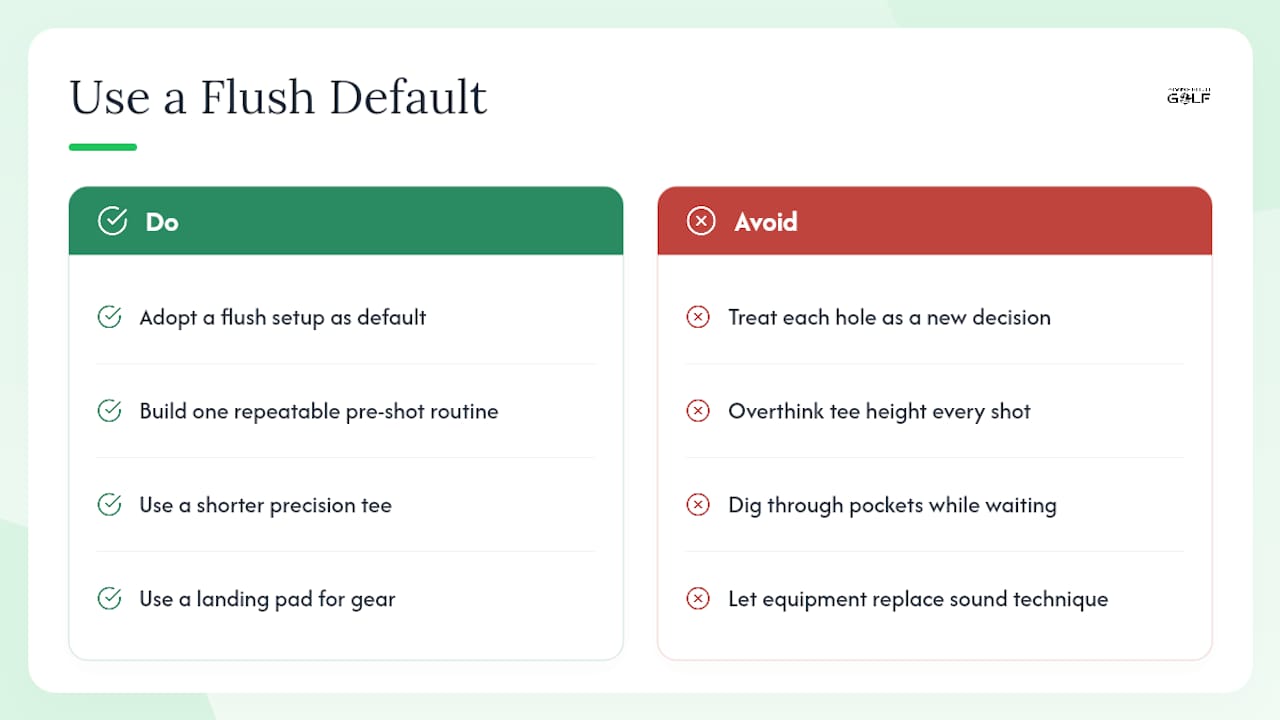
Most golfers overthink tee height because they treat every hole like a fresh decision. It isn’t. The flush setup is a default you build once and repeat without debate, the same way you’d never re-learn your grip on every tee box. What separates golfers who strike irons consistently from those who don’t usually isn’t swing speed or strength. It’s whether their setup routine removes variables before the club ever moves.
Where equipment helps is in removing friction from that routine. A shorter precision tee gets you to flush height in one push instead of three. A landing pad that keeps tees and tools in one place means you’re not digging through a pocket while your group waits. None of that replaces sound technique, but it does mean the technique you already have gets applied the same way, shot after shot, round after round.
— Gary
Gear That Makes The Flush Tee Setup Repeatable
Getting the flush tee height right on paper is easy. Getting it right on your third iron shot after a fast walk to the tee box, with your group waiting, is where most golfers slip. tee and organization systems are designed around that exact moment.

The Golf Tees collection includes shorter, precision-length tees sized for irons, so you’re not fighting a long driver tee into firm ground just to get a low result. Pair that with a magnetic towel and landing pad system, and your tees, marker, and divot tool stay in one accessible spot instead of scattered across pockets and pouches. Technique is still what wins on contact quality. Good gear just means you spend less time fumbling and more time executing the setup routine you already know works. Browse the golf tee collection to build a bag that supports a consistent flush height on every hole.
Sources
The flush-tee rule draws on guidance from Me and My Golf, GOLF.com, and Golf Digest’s tee-height testing. For setup and gear, see the step-by-step tee setup guide and iron consistency guide.
- Why most golfers struggle on par 3s | Me and My Golf
- Golf
- How changing tee height can improve your distance and accuracy | Golf Digest
FAQ
What Is The 70/30 Rule In Golf?
The rule generally refers to weight distribution in the golf stance, with players keeping most of their weight favoring the front side at impact for irons, though exact ratios vary by instructor and shot type.
What Tee Height Does Rory McIlroy Use?
Tour pros, including elite ball strikers, consistently tee irons flush or low so the ball sits just above the grass, matching the same 0 to 0.25 inch visible-shaft guideline recommended for everyday golfers.
How Far Should A 55 Year Old Man Hit A 7 Iron?
Distance varies widely by swing speed, fitness, and equipment, so there’s no single standard number. Focusing on solid, flush contact through proper tee height and setup matters more for consistency than chasing a specific yardage benchmark.
How Tall Should My Irons Be For My Height?
Iron shaft and lie-angle fitting depends on your height, wrist-to-floor measurement, and swing mechanics, which is a separate question from tee height and best confirmed with a proper club fitting rather than a general rule.
Why Does A Higher Tee Hurt Iron Shots?
A higher tee encourages a level or ascending strike instead of the descending blow irons need, which is why teaching pros push the tee flush and why raised tees show up more often in thin or topped contact.


