


TL;DR:
- Adopting efficient on-course habits like Ready Golf and shorter pre-shot routines can reduce golf round times by up to 30 minutes.
- Following USGA rules and proper group management practices further prevents delays, making golf faster and more enjoyable.
Minimizing golf delays is defined as the practice of adopting efficient on-course habits that reduce waiting time between shots and keep your group moving at a steady pace. The two most effective methods are Ready Golf and a disciplined pre-shot routine. Together, they can save 20–30 minutes per 18-hole round without forcing you to rush a single swing. Golfers who understand the USGA’s updated pace-of-play rules, including the 3-minute lost ball search limit, gain a clear structural advantage over groups that play by outdated habits.
How to minimize golf delays with Ready Golf
Ready Golf is the single most effective method to cut waiting time in golf. The concept is straightforward: you hit when it is safe and you are ready, rather than waiting for strict honor order. The USGA endorses Ready Golf as a standard pace-of-play tool, and courses across the country have adopted it as a default expectation.
The time savings are real and measurable. Groups that consistently apply Ready Golf reduce round time by 20–30 minutes per 18 holes. That is the equivalent of an entire hole saved per round.
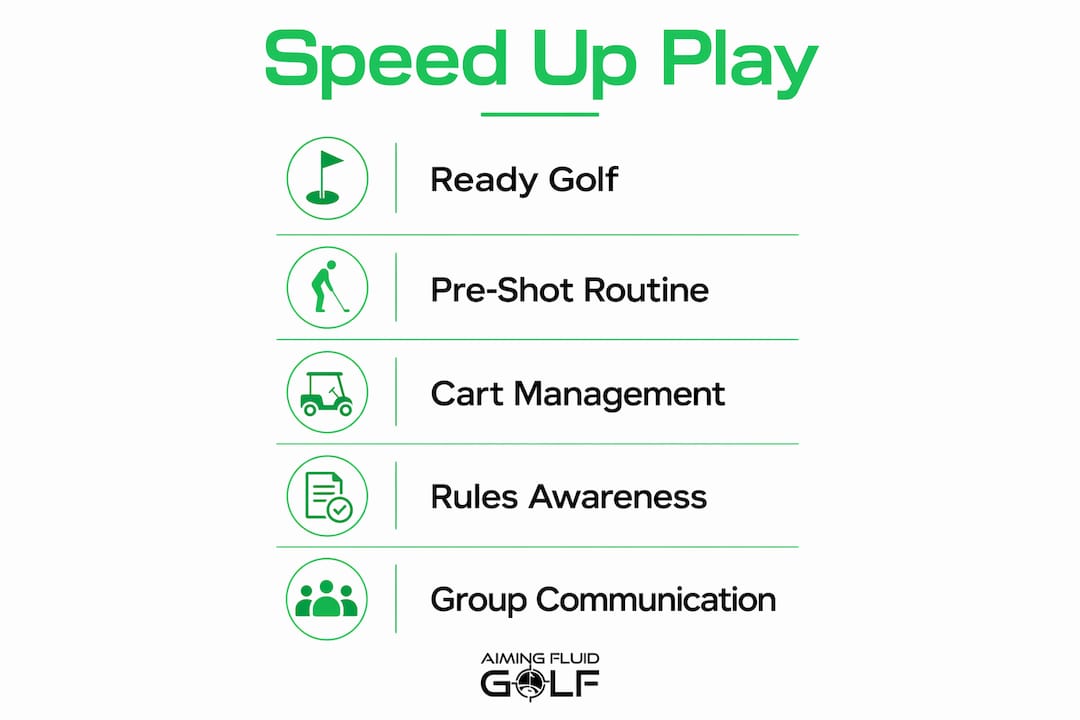
Ready Golf works because it eliminates the dead time created when players stand idle while waiting for the farthest player to hit. In a group of four, that idle time compounds across 18 holes into a significant delay. The key is applying it safely and consistently.
How to apply Ready Golf correctly:
- Hit when ready on the tee if the farthest player is still preparing.
- On the fairway, the player closest to their ball and ready to hit goes first.
- On the green, a player who can putt without interfering with another’s line should go ahead.
- Always call “going” or signal your group before hitting out of turn so no one is caught off guard.
- Never rush your swing. Ready Golf speeds up the time between shots, not the shots themselves.
Pro Tip: Start your pre-shot routine while others in your group are hitting. By the time it is your turn, you should already know your club, your yardage, and your target line.
How to shorten your pre-shot routine without losing focus
A disciplined pre-shot routine is the second pillar of faster golf rounds. The USGA recommends a 20-second routine with no more than 1–2 practice swings. Most recreational golfers take twice that long without realizing it. Cutting your routine in half does not hurt your game. Research consistently shows that efficient pace maintains rhythm and often leads to better performance than slow, tense pacing.

The biggest time drain in most routines is the walk to the ball. Golfers arrive at their ball, then begin thinking about yardage, club selection, and wind. That sequence wastes 30–60 seconds per shot. Reversing it fixes the problem entirely.
A faster pre-shot sequence:
- While walking or riding to your ball: Check your yardage on a rangefinder or GPS device. Identify your target and note wind direction.
- When you arrive at your ball: Your club is already selected. Take one look at the lie and confirm your choice.
- Behind the ball: Visualize the shot shape and pick a specific intermediate target two feet in front of the ball.
- Address: One practice swing maximum. Step in, align, and pull the trigger within 10 seconds.
- After the shot: Move. Do not watch the ball for 15 seconds. Start walking toward your next position.
The commute time between shots is the most underused asset in golf. Golfers who treat that walk as preparation time rather than rest time consistently play faster without feeling rushed. Pair this habit with a quality rangefinder and you eliminate the single biggest cause of slow play: indecision at the ball.
Pro Tip: Visualize your shot shape while walking to your ball. By the time you arrive, your mind is already committed. Committed golfers hit faster and more decisively.
For a structured approach to building efficient golf routines, Aimingfluidgolf has documented eight proven methods that translate directly to faster rounds.
Does cart management really affect pace of play?
Cart management is one of the most overlooked strategies to cut golf delays. Poor cart positioning creates backtracking, congestion near greens, and unnecessary waiting. Fixing it costs nothing and saves real time.
The most effective cart rule is “drop and go.” Drop your partner at their ball, then drive directly to your own ball rather than parking together and walking separately. This single habit can save nearly a minute per hole by eliminating the shared walk between two balls. Over 18 holes, that adds up to 15–18 minutes.
Cart habits that reduce bottlenecks:
- Park carts behind the green, angled toward the next tee. This eliminates the post-putt scramble to reposition.
- Take two or three clubs to your ball instead of one. If your first club choice feels wrong at the ball, you have a backup without a trip back to the cart.
- Never park carts directly beside the green. This blocks other groups and forces awkward exits.
- On par-3 holes, park the cart at the back of the green before you tee off. Walk to the tee, play, and exit directly.
- Avoid congregating carts at the tee box. One cart parks, the other stays on the path and moves forward.
Cart positioning rules like “drop and go” and exit-path planning cumulatively save many minutes per round. Golfers who treat the cart as a logistics tool rather than a waiting room play noticeably faster.
What rules and group habits prevent hold-ups on course?
Rules awareness is a direct tool for pace management. The USGA reduced the lost ball search time from 5 minutes to 3 minutes specifically to prevent course bottlenecks. That rule change alone signals how seriously governing bodies treat slow play as a structural problem.
The table below compares common slow-play behaviors with their faster alternatives.
| Slow-play habit | Faster alternative |
|---|---|
| Searching for a lost ball without a timer | Set a phone timer for 3 minutes; stop when it sounds |
| Waiting to see if ball is lost before hitting again | Play a provisional ball immediately from the original spot |
| Marking and re-marking short putts inside 3 feet | Hole short putts without marking when the line is clear |
| Letting a slow group stack behind you | Invite the faster group to play through at the next par-3 |
| Overreading greens for routine putts | Read the green while others putt; commit within 10 seconds |
Excessive marking of short putts and overreading greens causes more delay than most golfers realize. Often, the putting green is where a round loses 10 minutes that never get recovered.
Group communication is equally important. Before the round, agree on Ready Golf as the default. Assign one person per hole to watch for lost balls so the whole group does not stop. Use a timer during searches and play a provisional ball without debate. These small agreements prevent the friction that turns a 4-hour round into a 5-hour one.
Course management factors like tee time intervals and on-course signage also affect pace significantly. When you know a course runs tight intervals, build that awareness into your group’s habits from the first tee.
Key Takeaways
Faster golf rounds come from consistent habits applied across every hole, not from rushing individual shots.
| Point | Details |
|---|---|
| Ready Golf saves the most time | Hitting when ready and safe cuts 20–30 minutes per round without affecting shot quality. |
| Pre-shot routine target is 20 seconds | Limit practice swings to 1–2 and begin club selection while walking to your ball. |
| Cart positioning matters | Drop partners at their ball and park behind greens facing the next tee to eliminate backtracking. |
| The lost ball limit is 3 minutes | Use a timer and play a provisional ball immediately to avoid prolonged delays. |
| Green habits cause hidden delays | Hole short putts without marking when safe and read greens while others are putting. |
Why faster play is actually better golf
I have played with golfers who treat a slow round as a sign they are being thorough. They take five practice swings, re-read every putt twice, and search for every ball until the marshal shows up. Their scores are not better for it. In my experience, the opposite is true.
When you play at a steady, efficient pace, your body stays warm and your mind stays engaged. The mental drift that happens during long waits between shots is where bogeys and doubles are born. A golfer who commits quickly and moves purposefully is almost always more confident over the ball than one who overthinks every decision.
The mindset barrier is real. Slowing down feels like care. Speeding up feels like carelessness. But the 20-second routine the USGA recommends is not a shortcut. It is a discipline. It forces you to commit, which is the one mental skill that separates consistent golfers from inconsistent ones.
My honest advice: start with one habit. Pick Ready Golf or the pre-shot timer and apply it for a full round. You will finish faster and you will likely score better. Once you feel that rhythm, the other habits follow naturally. The 4-hour round is not a fantasy. It is a standard that any prepared group can meet.
— Gary
Gear from Aimingfluidgolf that keeps your round moving

Slow play often comes down to disorganization. When your towel is buried in your bag, your tees are scattered, and your divot tool takes 30 seconds to find, those seconds add up across 18 holes. Aimingfluidgolf designs accessories specifically to eliminate that friction. The magnetic towel system clips directly to your cart or bag and returns in one motion, so you never dig through pockets mid-round. Precision tees, multi-function divot tools, and leather utility pouches keep your gear where you need it, every time.
Explore the full range of best golf accessories for cart, carry, and practice at Aimingfluidgolf. Every product is built to keep you organized, prepared, and moving.
FAQ
What is Ready Golf and does it really save time?
Ready Golf means hitting when you are safe and prepared rather than waiting for strict honor order. It saves 20–30 minutes per 18-hole round and is endorsed by the USGA as a standard pace-of-play method.
How long should a pre-shot routine take?
The USGA recommends a 20-second routine with 1–2 practice swings maximum. Starting your club selection and yardage check while walking to your ball keeps the clock well within that target.
How long can you search for a lost ball under current USGA rules?
The USGA limits lost ball searches to 3 minutes. Use a phone timer and play a provisional ball immediately from the original spot to avoid delays if the ball is not found.
When should you let a faster group play through?
Let a faster group play through whenever your group has an open hole ahead and the group behind is visibly waiting. The USGA identifies playing through as a key etiquette practice that keeps overall course pace steady.
Does playing faster hurt your score?
Playing at a steady, efficient pace maintains physical rhythm and mental focus. Golfers who commit quickly and move purposefully between shots typically perform more consistently than those who allow long waits to break their concentration.
Recommended
- The 4-Hour Round Manifesto: Gear & Habits for Fast Play – Aiming Fluid Golf
- Master the golf convenience workflow for faster play – Aiming Fluid Golf
- Efficient Tee Box Routine Guide for Better Golf – Aiming Fluid Golf
- 10-Minute Pre-Round Golf Warmup: Prevent Injury & Gain Early Season Di – Aiming Fluid Golf


