


For most golfers, a 16" × 19" to 16" × 24" towel gets the job done. Walkers who clean clubs constantly can drop down in size if they choose microfiber, since it holds more moisture per square inch than cotton. Cart riders and anyone playing in wet conditions should size up toward the 16" × 24" end, or larger.
TL;DR:
- Microfiber towels can be smaller than cotton ones while maintaining moisture absorption, especially for walkers cleaning clubs frequently.
- Compact towels (11" × 18") are suited for quick touch-ups, but not as the main cleaning tool, while oversized towels (22" × 44") are best for caddies managing multiple sets.
- Folded sizes like tri-fold towels often provide less usable surface area than their listed dimensions suggest, typically halving the effective cleaning area.
- Proper attachment methods, such as corner or center grommets and quick-release clips, are crucial to prevent dragging or difficult access during play.
- Washing microfiber towels in cold water without softener and air drying extends their absorbency and lifespan significantly.
Table of Contents
- Golf Towel Size Guide: Standard Dimensions Explained
- What Do Tri-Fold and Oversized Towel Sizes Actually Mean?
- Which Factors Should Change Your Towel Size Choice?
- How Should You Attach a Golf Towel to Your Bag?
- How Do You Wash and Maintain a Golf Towel?
- Which Golf Towel Size Fits Your Situation?
- How We Think About Towel Size and Bag Access
- Why the Standard Size Advice Usually Falls Short
- Ready to Upgrade Your Towel and Bag Setup?
- Sources
Golf Towel Size Guide: Standard Dimensions Explained
Golf towel manufacturers don’t use one universal standard, but four size categories show up again and again in product listings, and knowing them saves you from guessing what “large” or “tour size” actually means on a spec sheet.
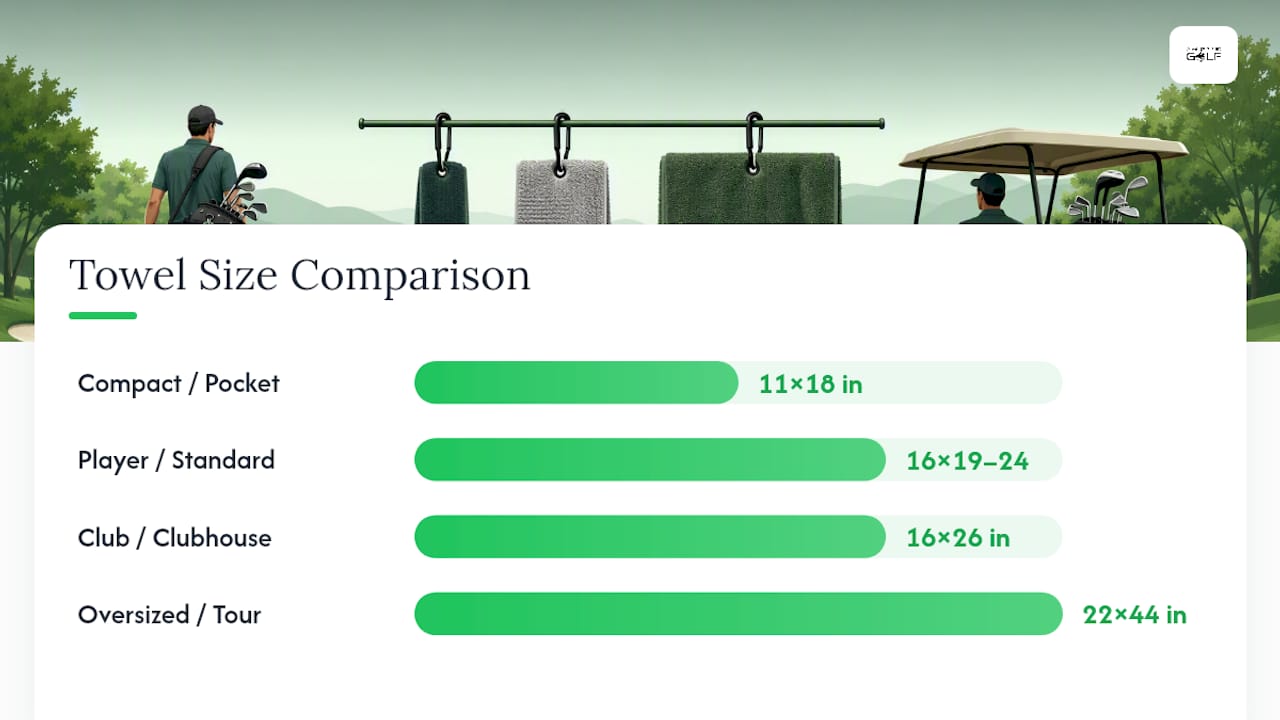
Compact or pocket towels run around 11" × 18". These are secondary towels, the kind you clip near a pocket for quick wipes on a wedge or putter face. They’re not built to be your primary cleaning tool.
Player or standard towels land in the 16" × 19" to 16" × 24" range. This is the size most golfers reach for, and it’s the one most trade guides point to as the practical sweet spot between cleaning surface and portability. It’s big enough to wipe down a full set of irons over 18 holes without wringing it out every three swings, but small enough that it doesn’t flop around or drag on the ground.
Club or clubhouse standard towels typically measure 16" × 26". This size shows up constantly in commercial and wholesale catalogs, and there’s a practical reason: hospitality and wholesale suppliers favor 16" × 24" or 16" × 26" for laundering efficiency at scale. A pro shop washing 200 towels a week wants one consistent size moving through the machines, not six variations.
Oversized or tour towels stretch to roughly 22" × 44". Tour caddies and staff bags use these because they’re wiping down multiple players’ equipment and need serious surface area fast.
A few patterns worth remembering:
- Walkers gravitate toward the compact and player categories to limit weight.
- Cart players have more room to justify the 16" × 24" to 16" × 26" range.
- Clubs standardize on 16" × 26" largely for laundry logistics, not player preference.
- Tour and caddie towels prioritize coverage over portability entirely.
If you’re shopping and see a towel advertised without clear dimensions, treat that as a red flag. A reputable listing states inches, not just “large” or “jumbo.”
What Do Tri-Fold and Oversized Towel Sizes Actually Mean?
Here’s where a lot of golfers get tricked by marketing copy. A towel listed as 16" × 24" tri-fold isn’t giving you 16" × 24" of usable surface when you’re actually cleaning a club. It’s folded into panels, so the flat working area you access without unfolding the whole thing is closer to 8" × 24" per pane. The total flat dimension and the practical working surface are two different numbers, and product pages rarely make that distinction clear.
That’s not a knock on tri-fold towels. The fold keeps a dry section available even after the rest gets soaked, which is genuinely useful in wet conditions. Just don’t assume the listed size tells you how much dry, usable fabric you’ll have at any given moment.
Pocket towels work fine as a secondary towel for golfers who rarely clean clubs mid round, or who want something small clipped to a pocket for quick touch ups. They’re a poor choice as your only towel if you play in rain or on wet turf regularly.
Oversized tour towels trade portability for coverage. Great for a caddie managing a full staff bag, less great for a solo walker who now has extra wet fabric swinging off a strap for four hours.
Grommet and slit placement matters more than most golfers realize:
- Corner grommet: hangs the towel diagonally, keeping more surface accessible without rotating it.
- Center grommet: hangs the towel straight down, symmetrical but sometimes harder to grab one clean section quickly.
- Slit attachment: threads through a strap or D-ring directly, no hardware needed, but can shift position more during a round.
Pro Tip: If you’re buying a tri-fold towel, mentally size up one category from what you’d normally pick. A tri-fold 16" × 24" behaves more like a compact towel in daily use than its listed dimensions suggest.
Which Factors Should Change Your Towel Size Choice?
The 16" × 19" to 16" × 24" range is a starting point, not a rule. A decision framework built around cleaning frequency, bag setup, and climate will move you up or down from that baseline, and it’s worth walking through each variable before you buy.
Bag type and how you play. Walking golfers feel every extra ounce by hole 14, especially once a towel gets soaked. A large cotton towel can add real weight when wet, and that extra load compounds fatigue over a full loop. Cart riders don’t carry that weight personally, so they can afford a bigger, heavier towel without feeling it in their shoulders.

Climate and moisture. Humid climates and wet mornings increase how much surface area you actually need, because a small towel saturates faster and stops absorbing effectively. This is where material choice becomes the real lever, not size.
Cleaning frequency. If you wipe down every club after every shot, you’ll want more dry surface rotated through a round. If you only clean between holes or after a bad lie, a smaller towel keeps pace just fine.
Fabric and GSM. GSM stands for grams per square meter, a measurement of fabric density. Higher GSM microfiber holds more water and lifts more debris per square inch than lower GSM cotton, which is why microfiber often lets golfers choose a smaller size and still match the performance of a bigger cotton towel.
Quick reference for weighting these variables:
- Walking + dry climate + light cleaning = compact or player size, lighter material
- Walking + wet climate + frequent cleaning = player size, high GSM microfiber
- Cart + any climate + frequent cleaning = 16" × 24" to 16" × 26"
- Cart + wet climate + heavy use = club standard or oversized
Pro Tip on weight: A cotton towel that’s saturated can add noticeable dead weight to a strap over 18 holes. Golfers who walk should treat wet-weight as an important factor and lean toward waffle-weave microfiber to keep bulk down.
How Should You Attach a Golf Towel to Your Bag?
Size only matters if the attachment method actually keeps the towel accessible and off the ground. This is where a lot of golfers pick the right dimensions and still end up frustrated, because the hardware doesn’t match how they play.
Corner grommet attachment lets the towel hang diagonally, exposing more clean surface at any given moment without needing to flip it. Center grommet keeps things symmetrical and predictable, but you’ll rotate the towel more often to find a dry patch. Slit-style openings thread directly through a bag strap or D-ring, skip the hardware, but tend to shift position as you walk or ride. Carabiner clips offer the fastest on and off swap between towels, useful if you carry two, a dry one and a wet one.
Before you buy, measure the distance from your intended clip point to the ground. Anything hanging within 3 to 4 inches of the pavement or turf risks dragging, catching on cart wheels, or picking up dirt it’s supposed to be removing. Push-cart users especially need to check this, since wheel wells sit lower than most golfers expect.
- Walkers: prioritize slit or corner grommet for quick access without extra hardware weight.
- Cart riders: center grommet or clip works fine since drag risk is lower.
- Push-cart users: measure clip-to-ground distance carefully before buying anything oversized.
Magnetic landing pad systems solve a different problem entirely: not where the towel hangs, but how fast you can grab and return it. Instead of fishing through a bag pocket between shots, a magnetic system lets you detach and reattach in one motion, which keeps pace of play moving and cuts down on the search-your-bag frustration that slows down a group behind you. Our guide on how to attach a golf towel to your bag covers the mechanics in more detail.
How Do You Wash and Maintain a Golf Towel?
Microfiber performs best when you treat it gently, and most golfers unknowingly wreck their towel’s absorbency within a few wash cycles by using the wrong settings.
- Wash in cold water. Hot water breaks down microfiber’s fine synthetic threads over time, reducing how much moisture it can hold.
- Skip the fabric softener. Softener coats the fibers with a residue that blocks the microscopic gaps responsible for absorbency, turning your towel into something closer to a squeegee than a sponge.
- Dry on low heat or air dry. High heat has the same fiber-damaging effect as hot water washing.
- Treat grass and dirt stains promptly rather than letting them set through multiple rounds before washing.
- Store dry, not folded up damp in a bag pocket, which invites mildew and shortens the towel’s usable life.
Higher GSM microfiber, particularly waffle-weave construction, tends to combine fast drying with strong dirt capture, which means it holds up to this wash cycle better than thin, low-density towels. If your towel starts feeling stiff, smells musty even after washing, or stops picking up dirt the way it used to, that’s your signal to replace it rather than keep pushing another season out of it.
Which Golf Towel Size Fits Your Situation?
Running through a quick checklist before you buy beats guessing based on a product photo. Ask yourself these four questions in order: How far does the towel need to hang from your bag before it risks dragging? How often do you actually clean clubs mid-round? What’s the dominant climate you play in? And do you walk or ride most rounds?
Once you’ve got those answers, match yourself to one of the common player profiles below.
| Player profile | Recommended size | Material | Attachment |
|---|---|---|---|
| Walker, cleans every shot | 16" × 24" | Microfiber, higher GSM | Slit or corner grommet |
| Walker, minimal cleaning | 11" × 18" compact | Microfiber | Slit |
| Cart rider, frequent cleaning | 16" × 24" to 16" × 26" | Microfiber or cotton blend | Center grommet or clip |
| Wet climate, any bag | 16" × 24" or larger | High-GSM microfiber | Corner grommet |
| Push-cart user | 16" × 19" | Microfiber | Slit, measured to avoid drag |
| Staff or clubhouse use | 16" × 26" | Cotton or microfiber blend | Center grommet |
- Measure your bag’s hang clearance before ordering anything oversized.
- Be honest about how often you actually wipe down clubs, not how often you plan to.
- Choose microfiber if you want to shrink your size without losing performance.
- Confirm the attachment style matches your bag’s strap or D-ring setup.
Pro Tip: If the towel you’re eyeing is a tri-fold, bump your target size up one tier from this table. A tri-fold 16" × 24" behaves closer to a compact towel in daily working area, so compensate accordingly.
For golfers building out a full cleaning kit, pairing your towel choice with a dual-head cleaning brush covers grooves a towel alone can’t reach.
How We Think About Towel Size and Bag Access
Some golf accessory designs start from a simple observation: size only solves half the problem. The other half is access speed, which is why magnetic towel and landing pad systems exist alongside size options.
A correctly sized towel that’s buried in a bag pocket between shots still slows down a round. The magnetic system addresses that by letting a golfer detach and reattach a towel in one motion, without fishing through gear or worrying about a grommet catching on a zipper pull.
A few design principles shape how these products get built:
- Attachment hardware should never require two hands to operate mid-swing routine.
- Magnetic contact points need to hold securely through a cart ride over rough terrain, not just on a flat practice green.
- Size options should map to real player behavior (walker vs. cart, frequent cleaner vs. occasional wipe-down) rather than a single one-size listing.
That thinking extends across the magnetic towel line, where the goal has always been reducing the seconds a golfer spends searching, not just picking a bigger towel and calling it solved.
Why the Standard Size Advice Usually Falls Short
Most towel-buying advice stops at “get a 16 by 24 and you’re fine,” and for a lot of golfers that’s a reasonable default. But it treats size as the only variable worth discussing, when attachment and material do more heavy lifting than the dimensions printed on the tag.
A golfer who walks, plays in a dry climate, and cleans clubs twice a round doesn’t need the same towel as someone riding a cart through morning dew in August. The conventional advice flattens both of those golfers into the same recommendation, and that’s where a lot of buyer’s remorse comes from, not from picking the wrong number on a tape measure, but from ignoring how the towel actually gets used between shots.
If there’s one thing worth prioritizing first, it’s attachment. A perfectly sized towel that drags on the ground or takes ten seconds to unclip defeats its own purpose. Get the access method right, then size around your climate and cleaning habits. Material, specifically microfiber GSM, is the lever that lets you downsize without losing performance, and it deserves more attention than most buying guides give it.
— Gary
Ready to Upgrade Your Towel and Bag Setup?
Choosing the right dimensions solves half the equation. The other half is not losing thirty seconds every hole digging through a bag pocket to find the towel you just sized correctly. That’s the specific gap Aiming Fluid Golf’s magnetic towel collection closes: a strong magnetic wash-pocket system that keeps your towel clipped in reach and lets you detach it in one motion instead of hunting for a grommet or slit buried against your clubs.
If you’ve settled on a player-size microfiber towel from the sizing guidance above, the magnetic attachment removes the last friction point walkers and cart riders both run into. And if you’re building out a full kit rather than buying one item at a time, the best golf accessories collection bundles complementary gear designed around the same access-first thinking. Browse the magnetic towel sizes now and match one to the bag setup you already use.
Sources
- Golf Towel Features Every Golfer Needs | Towel Depot
- What Size Golf Towel Do I Need? (The Real Answer Depends on You)
- The Ultimate Guide to Choosing the Best Golf Towels


