


Use a damp towel for cleaning clubs and a separate dry towel for grips and your face. Hang whichever towel is in use so it never touches the ground, and always ask before borrowing someone else’s. That single split, wet for cleaning and dry for control, solves most of what confuses golfers about towel manners, and it takes about ten seconds to set up before you leave the parking lot.
Three actions matter before the first tee shot:
- Wet one towel (or one half of a single towel) and wring it until it’s damp.
- Fold it lengthwise so the wet and dry sections stay separated.
- Hang it on your dominant side, high enough that it can’t drag through mud or catch a spike.
The reasons behind these steps are mechanical, not ceremonial. A damp towel lifts packed dirt out of grooves that a dry one just smears around. A dry towel keeps grips tacky and your palms from getting slick, which affects control more than most golfers realize. And keeping the towel off the ground respects the pace of play and the people playing behind you, who notice more than you’d think.
Key Takeaways
Good golf towel etiquette comes down to separating wet from dry, securing the towel off the ground, and asking before you borrow someone else’s.
| Point | Details |
|---|---|
| Split wet and dry | Use a damp towel or half for cleaning clubs, a dry one for grips, face, and ball. |
| Hang it secure and high | Loop center-slit towels through themselves or use a magnetic mount so nothing drags on turf. |
| Clean in one direction | Wipe wet pass hosel to toe, then dry finish the same direction, checking grooves with a tee. |
| Ask before borrowing | Borrowing is fine casually with permission; bring your own gear for tournament play. |
| Wash without fabric softener | Air-dry when possible and wash separately from lint-heavy clothing to protect absorbency. |
| Choose secure attachment gear | Aiming Fluid Golf’s magnetic towel and landing pad system keeps towels off the ground and within one-handed reach. |
Table of Contents
- How to Set Up Your Golf Towel Before a Round
- Where to Hang Your Golf Towel on a Bag or Cart
- Which Golf Towel Material and Size Should You Carry?
- How to Use a Towel During Play Without Slowing Things Down
- Is It Okay to Borrow a Golf Towel?
- How to Wash and Store Your Golf Towel
- Common Golf Towel Mistakes and Quick Fixes
- Why Towel Design Affects Etiquette More Than Golfers Realize
- A Towel System Built Around These Rules
- Frequently Asked Questions
- Sources
How to Set Up Your Golf Towel Before a Round
The two-towel system is the standard among tour players and serious amateurs for a simple reason: it keeps cleaning and drying functions from contaminating each other. One towel, or one half of a towel, gets used exclusively for scrubbing dirt and grass out of grooves. The other stays bone dry for grips, clubface wipe downs, and your hands. Mixing the two defeats the purpose. A towel that’s cleaned twenty clubfaces of wet turf is not something you want touching a leather grip.
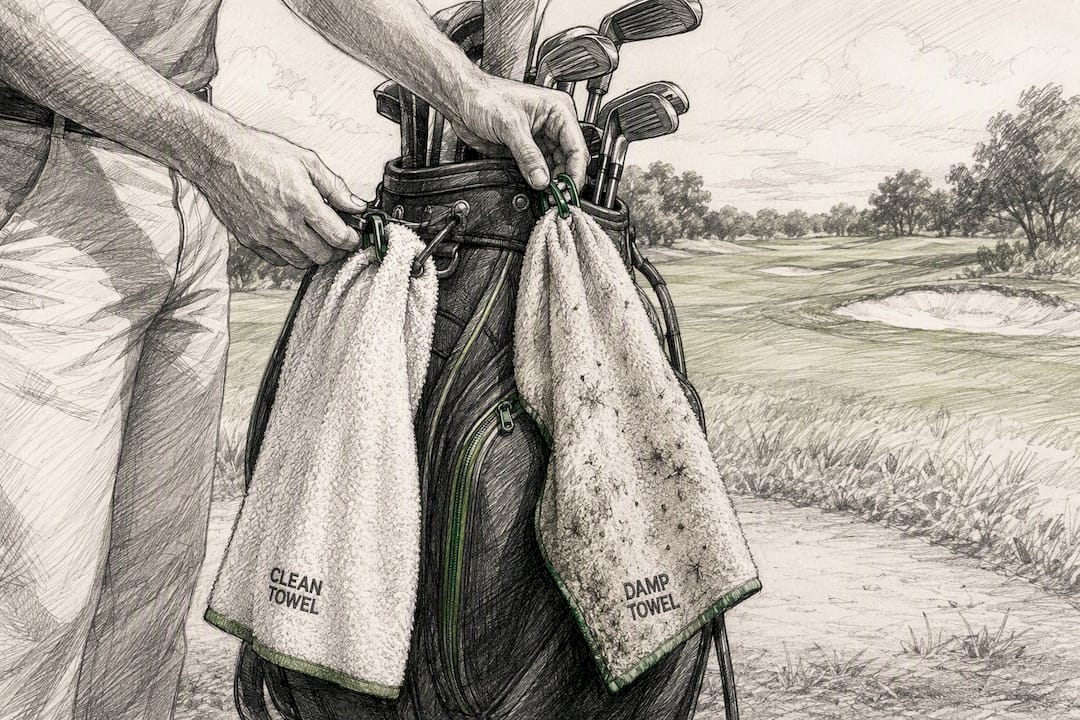
Some golfers get by with one towel folded into wet and dry halves. It’s lighter, takes up less space, and works fine for casual rounds where you’re not grinding through heavy mud. Others, especially anyone playing in wet conditions or carrying a full bag without a caddie, prefer two separate towels: one soaked and dedicated to cleaning, one dry and reserved for everything else. The tradeoff is simple. One towel is more convenient; two towels give you a true dry surface no matter how filthy the cleaning side gets.
Setting up either system takes under a minute:
- Run the towel under a faucet at the clubhouse or a course water station until it’s evenly wet.
- Wring it out until it’s damp rather than soaked. A towel that drips will soak through your bag pocket.
- Fold it lengthwise so one half stays wet and the other stays completely dry, or designate your second towel as the dry one if you’re carrying two.
- Hang the wet half or wet towel lower on the bag, since it’s the one that’ll pick up grass and grit during the swing.
This wet and dry method is a habit borrowed directly from how pros and caddies manage their towels round after round, and it’s the same logic behind bringing a wet towel out onto the course in the first place instead of relying on a dry one to do double duty.
Pro Tip: Rewet your cleaning towel every few holes, especially in dry conditions. A towel that’s dried out in the sun just moves dirt around instead of lifting it out of the grooves.
Where to Hang Your Golf Towel on a Bag or Cart
Attachment point matters as much as the towel itself. A towel that’s clipped loosely or draped over a strap will slide, fall, and eventually end up on the cart path or green, which is exactly the outcome good towel habits are supposed to prevent.
- Center-slit towels loop through their own middle hole, creating a secure knot around a D-ring or strap that resists slipping and keeps more fabric off the ground than a simple drape.
- Carabiner attachments work well on stand bags with a dedicated loop, and they’re faster to unclip mid-round than a knotted towel.
- Grommet and clip designs suit cart bags where the towel hangs from a fixed point and doesn’t need to move often.
- Good anchor spots include the D-ring near your shoulder strap, an alignment stick holder, or a cart rail or umbrella mount if you’re riding.
Bags and carts typically offer several usable attachment points, and a center-slit towel looped through itself provides noticeably better ground clearance than one just tucked under a strap. Whichever spot you choose, put it on your dominant side. Reaching across your body to grab a towel slows down your routine and looks awkward mid-round, while a towel positioned for one-handed access lets you clean a club and get back to your stance without breaking rhythm. That placement detail is worth more to your pace of play than most golfers assume.
Which Golf Towel Material and Size Should You Carry?
Microfiber waffle-weave towels are the better choice for cleaning grooves. The waffle texture grabs debris instead of just pushing it around, and microfiber dries faster than cotton between uses, which matters when you’re wiping down eight or nine clubs over four hours. Cotton still has a place. It’s soft against skin, so plenty of golfers keep a small cotton towel strictly for wiping their face and hands, but cotton tends to shed lint onto clubfaces and grips, which is the opposite of what you want on a dry towel.
Size should match how you play:
- Small towels suit walkers who want something light clipped to a strap.
- Medium towels, roughly 16 by 24 inches, fit most golfers carrying a single stand bag.
- Large tour towels work best for cart golfers or anyone with a caddie, since there’s more surface area for repeated cleaning without needing a rewet as often.
Design details affect etiquette more than they get credit for. Pros and caddies typically favor waffle-weave microfiber paired with a smaller dry towel, and center-slit or magnetic attachment systems exist for a reason beyond convenience: a towel that’s genuinely secure doesn’t fall in the fairway, doesn’t need re-hanging every other hole, and doesn’t become the thing you’re chasing down while your group waits.
How to Use a Towel During Play Without Slowing Things Down
Cleaning a club correctly is a short sequence, not a scrub session. Wipe the wet side of the towel from hosel to toe in one direction, then follow immediately with the dry side moving the same direction to finish. If mud is packed into the grooves, a tee or a groove tool clears it faster than extra towel passes ever will.
- Wet pass: wipe the clubface and grooves with the damp towel, hosel to toe, one direction only.
- Dry finish: follow with the dry towel or dry half, same direction, to lift residual moisture.
- Groove check: if debris remains, use a tee or divot tool to clear it rather than scrubbing harder.
On the green, only the dry side of the towel should ever touch your ball. A ball with cleaning-side residue on it can pick up grass stains that affect how it releases off the putter face, and rubbing a wet towel across the actual putting surface is a habit that irritates everyone playing behind you. Keep the whole process quick. Wipe your grips or your hands, put the towel back, and get back in your stance. A towel routine that drags on for thirty seconds per shot adds up to real minutes over eighteen holes, and pace of play problems are one of the most common sources of on-course frustration.
Pro Tip: Caddies build the wet pass, dry finish sequence into the same ritual for every single club, which is part of why tour players’ clubs perform identically shot after shot. Consistency in the small habits shows up in the results.
Is It Okay to Borrow a Golf Towel?
Borrowing a towel isn’t against the rules of golf, but it comes with an unwritten expectation that you ask first. The USGA’s guidance on equipment and player responsibility makes clear that borrowing isn’t a violation in casual play, but formal and tournament settings carry a different standard: players are expected to arrive with their own gear, and asking to borrow a towel there can read as a lack of preparation.
- In a casual weekend round, a quick “mind if I use your towel for a second?” is normal and rarely refused.
- In tournament or club competition play, bring your own. Asking signals you didn’t prepare, and it can slow down your group.
- Always return a borrowed towel promptly, and don’t use someone else’s cleaning side for your ball or grips without asking specifically.
A muddy towel handed back wet and dirty is its own small etiquette failure. Towel hygiene carries a social weight beyond performance: a grimy towel used on someone else’s grip or ball tends to irritate playing partners more than golfers expect.
How to Wash and Store Your Golf Towel
A towel that sits balled up and wet in your bag pocket after a round is on a fast track to mildew, and it can leave a musty smell in the bag itself. Wash after heavy use or every few rounds, and wash immediately if the towel came home caked in mud rather than letting it sit.
- Skip fabric softener. It coats microfiber fibers and reduces the towel’s ability to grab dirt and moisture.
- Wash towels separately from lint-heavy clothing like fleece or cotton shirts to keep lint off the towel’s surface.
- Air-dry when possible rather than high-heat tucking a microfiber towel, since heat can degrade the waffle texture over time.
- Mid-round, wring the towel out and snap it a few times to refresh dampness instead of soaking it again.
- In rain, keep a spare dry towel sealed in a zip pocket so you always have one dry option no matter how wet everything else gets.
Leaving a wet towel bunched inside a bag pocket is one of the fastest ways to damage both the towel and the bag material around it, so give it a few minutes hanging in open air before you pack up.
Common Golf Towel Mistakes and Quick Fixes
Most towel etiquette problems trace back to a handful of repeated habits. Rubbing side to side across a clubface, instead of hosel to toe in one direction, tends to smear dirt into grooves rather than lift it out. Using the same towel side for both cleaning and drying defeats the entire point of the wet and dry split. And letting a towel drag on the ground between holes picks up grit that then transfers straight onto your grips or ball.
- Mistake: scrubbing side to side. Fix: always wipe hosel to toe in a single direction.
- Mistake: one dirty side doing all the work. Fix: keep wet and dry sides strictly separated, every time.
- Mistake: towel dragging near the ground. Fix: hang it higher, or switch to a center-slit or magnetic attachment for better clearance.
- Mistake: reusing a heavily soiled towel. Fix: rinse it at the nearest water station before it touches another club or grip.
Pro Tip: Carry a second, smaller dry towel just for your face and hands. It keeps sweat and sunscreen off the towel doing your club cleaning, and it dries fast enough to reuse all round. For a deeper look at keeping clubs performance-ready between cleanings, Golf Blab’s equipment care guide covers maintenance habits that pair well with a solid towel routine.
Why Towel Design Affects Etiquette More Than Golfers Realize
Most towel etiquette problems aren’t really about manners. They’re about physics. A towel that hangs loosely or slips off a clip ends up on the ground, and once it’s on the ground it’s picking up grit that gets transferred to a grip or a ball on the next hole. That’s not a discipline failure, it’s a design failure.
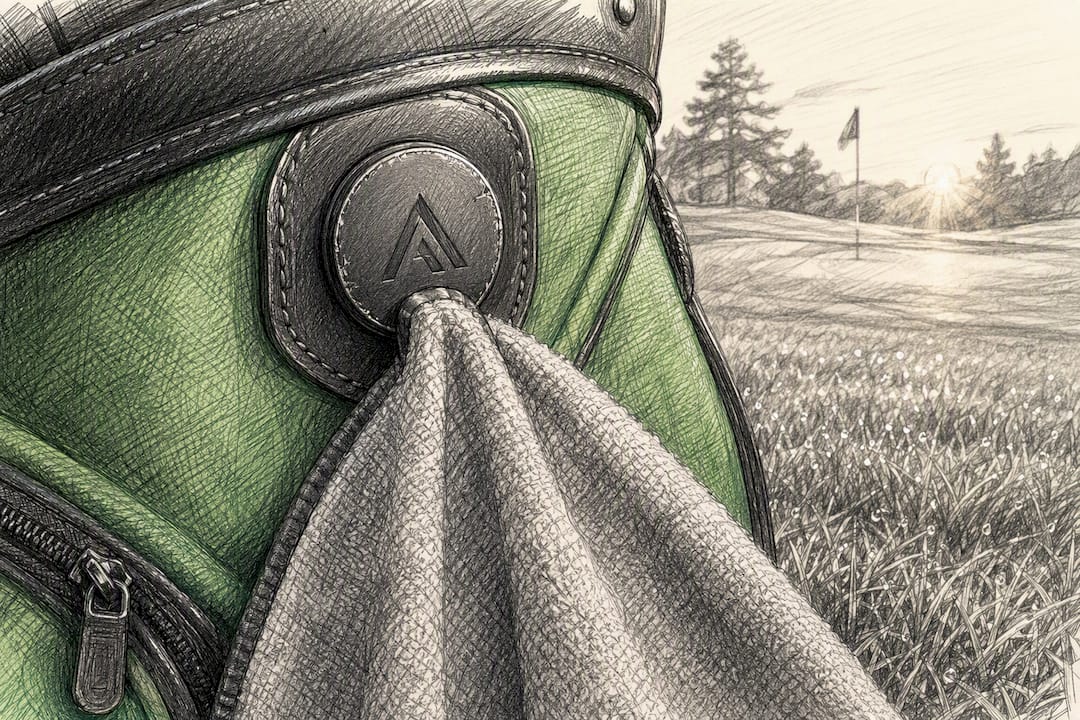
Magnetic attachment systems and landing pads address that directly by giving the towel a fixed, secure point that doesn’t require a loop, a knot, or a clip that can slip loose mid-swing. Less fumbling for a towel that’s fallen behind the cart wheel, or one that’s slid down to the bottom of the bag, means less time between shots and less dirt tracked onto equipment that’s supposed to stay clean. A reliable attachment reduces dropped towels, and fewer dropped towels means less ground contamination over the course of a round. That’s the etiquette payoff hiding inside what looks like a convenience feature.
A Towel System Built Around These Rules
The etiquette rules above only work if your gear cooperates. A towel that keeps slipping off a strap or dragging near the cart wheel undoes every good habit you’ve built. Aiming Fluid Golf’s magnetic golf towels solve the attachment problem directly: a strong magnet locks the towel in place against the bag or landing pad, so it’s there when you reach for it and off the ground when you don’t need it.

The design includes a built in wash pocket so the wet cleaning section stays separate from the dry side, reinforced edges that hold up to repeated grip-and-wipe use, and instant one-handed access that doesn’t require unclipping or untying anything mid-swing. The large grey magnetic towel and landing pad gives you a dedicated surface for both the towel and your clubhead between shots, which keeps your gear off wet grass entirely. If you’re ready to put the wet and dry system on autopilot instead of fighting with clips and knots, check the full towel collection and pick the size that matches how you play.
Frequently Asked Questions
Should you wet a golf towel before a round? Yes. A damp towel lifts packed dirt and grass out of clubface grooves far more effectively than a dry one, which mostly just smears debris around. Keep a separate dry towel or dry half for grips and your face.
Where should you hang a golf towel on your bag? On your dominant side, using a secure attachment point like a D-ring, alignment stick holder, or a center-slit loop, so it’s within one-handed reach and never touches the ground.
Is it rude to ask to borrow a golf towel? Not in casual play, as long as you ask first and return it promptly. In tournament settings, borrowing can signal a lack of preparation, so bring your own.
How often should you wash a golf towel? Wash after heavy use or every few rounds, and immediately if it’s caked in mud. Skip fabric softener, since it reduces microfiber’s ability to grab dirt and moisture.
How many towels should a golfer carry? Most golfers do fine with one towel split into wet and dry halves. Anyone playing in wet or muddy conditions benefits from carrying two separate towels instead.
Sources
- USGA — Rules, Equipment and player responsibility (Rule 4 guidance)
- How to Use a Golf Towel Actual Effective Process — GolfDeft
- What golf towels do the pros use? — CaddieHQ
- Where to hang towel on golf bag: Best spots — Golfers Authority


