


The fastest fix for on-course tee chaos is a clip-on tee caddy or a small zippered tee pouch clipped to your bag; both keep tees at hand without digging through pockets full of ball markers and gloves. At home, a mason jar with a foam base handles daily grab-and-go tees, while a garage organizer with shelving covers bulk storage for the whole season. Some golf accessory pouches and tee packs are built around exactly this on-course use case.
TL;DR:
- Clip-on tee holders attach to belts or cart bars and typically hold up to 18 tees, offering the fastest access during play.
- Zippered tee pouches fit in pockets, can carry two dozen tees along with small accessories, and are suitable for most players.
- Combining tees, gloves, markers, and divot tools in one accessory caddy reduces the need to juggle multiple pockets during a round.
- DIY options like mint tins and mason jars provide cost-effective, personalized storage solutions that keep tees visible and easy to grab.
- Proper placement and pre-loading of tees in your bag or cart pocket enhance muscle memory and help maintain a steady pace of play.
Table of Contents
- Practical On-Course Golf Tee Storage Ideas
- Creative DIY and Repurposed Golf Tee Holders
- Home and Garage Storage for Bulk Golf Tees
- How to Choose the Right Tee Storage for Your Bag
- Placement, Pre-Loading, and Maintenance Tips From Gary
- My Golf Tee Kit: What I Actually Carry
- How Aiming Fluid Golf Solves Your Golf Tee Storage Problem
- Sources
Practical On-Course Golf Tee Storage Ideas
Every golfer eventually hits the same wall: tees scattered loose in a pocket, mixed with ball markers, a divot tool, and lint. The fix depends on how you carry your clubs and how many tees you actually need mid-round.
Clip-on tee holders attach directly to a belt loop, cart bar, or bag strap with a metal or plastic clip. They’re built for speed. Reach down, pull a tee, keep swinging. Capacity runs small, typically three to five tees on leather designs and up to around 18 on plastic clip caddies, so they suit golfers who reload from a bigger stash rather than carrying a full day’s supply on the clip itself.
Tee pouches are the zippered middle ground. Small enough to disappear into a bag pocket, roomy enough to hold two dozen tees plus a divot tool and a couple of ball markers. Most use a drawstring top or a zip closure, and the better ones add a rigid bottom so tees don’t collapse into a tangled pile.
Accessory caddies go a step further, combining a glove slot, tee pocket, and small zip compartment in one unit. Players who use these report that gloves, markers, divot tools, and tees all stay in one place instead of spreading across three different pockets, which cuts down on the mid round patting search everyone recognizes.
Magnetic pouches are the newest category and worth a mention separately, since they skip zippers and clips entirely in favor of a magnetic closure that snaps shut and stays put on a cart bar or bag frame.
Here’s how the main categories stack up on the traits that actually matter when you’re standing over a tee shot:
- Clip-on caddy: attaches to belt, strap, or cart bar; holds 3 to 18 tees depending on material; fastest single-tee access.
- Zippered tee pouch: fits in almost any bag pocket; holds a couple dozen tees plus small accessories; best all-around capacity-to-bulk ratio.
- Accessory caddy: combines tees, gloves, markers, and divot tool in one compartment; ideal for golfers who hate juggling multiple pockets.
- Magnetic pouch: snaps onto metal bag frames or cart rails; no zipper to fumble with cold hands.
Where you put any of these matters as much as which one you buy. Cart golfers do best clipping a caddy to the accessory bar within arm’s reach of the seat, since you’re not walking between shots and don’t need the pouch on your body. Walkers and carry-bag players should look at the top strap pocket or a side pocket near the ball pocket, matching a pattern plenty of golfers already use informally, tucking tees into a small zip bag inside the ball pocket for protected, compact storage.
A few real-world scenarios show how this plays out. A weekend cart golfer who rarely walks nine holes does fine with a basic clip-on caddy snapped to the cart bar, since access speed matters more than capacity. A carry-bag player walking 18 holes wants a zippered pouch riding in a hip-level pocket, because reaching for a shoulder pocket mid-stride gets old fast. A range regular hitting two buckets a week benefits from an accessory caddy that also swallows a spare glove and marker, turning one grab into a full setup. Golfers who already carry Aiming Fluid Golf’s utility pouches for towels and markers can extend the same system to tees, keeping everything in matched, purpose-built compartments rather than mixing loose gear.
Pro Tip: Pick one pocket on your bag and commit to it for tees only. Muscle memory builds fast when the location never changes, and you’ll stop patting down three pockets looking for a tee on the first tee box.
Creative DIY and Repurposed Golf Tee Holders
Not every golfer wants to buy another accessory. Some of the best tee holder options are sitting in a kitchen drawer or a recycling bin right now.
- Mint tin insert. An Altoids-style tin makes a surprisingly good pocket-size holder once you add a printed tray. One free design fits five standard 2.75 inch tees inside a tray measuring roughly 90 by 55 by 10 millimeters, printing flat with no supports needed on a standard 3D printer. The print uses about 15 grams of filament and finishes in 30 to 45 minutes, cheap enough to make three or four and hand them out to your foursome.
- Mason jar display. Fill a wide-mouth mason jar with a foam disc or a layer of cotton at the bottom, then stand tees upright around the edge. It’s a beginner-friendly project that takes an hour or two and keeps tees visible and easy to grab, and it doubles as a decorative piece for a mudroom shelf or a Father’s Day gift when finished with paint, a chalkboard label, or twine wrapped around the neck.
- 3D-printed tray. For anyone with access to a printer, PETG holds up slightly better than PLA in a pocket environment where heat and friction are constant. A 0.2 millimeter layer height with three perimeters and no supports gives a clean, durable tray that slides straight into a mint tin for a finished, pocket-ready holder.
- Pill bottles and small craft boxes. An empty prescription bottle or a small hinged craft box holds a dozen tees loose and tucks into a golf bag’s smallest zip pocket. These work fine for course use but skip the decorative upside of a mason jar, making them better suited to function over form.
The mint tin and 3D-printed tray combination is the standout here: a five-tee capacity is light on a pocket but heavy enough to cover a full nine holes without a refill, and the whole build costs less than a sleeve of new tees once you already own a printer.
Home and Garage Storage for Bulk Golf Tees
On-course pouches solve the grab-and-go problem. They don’t solve the other one: a junk drawer full of loose tees in four different lengths, half of them cracked plastic ones you should have thrown out months ago.
Garage organizers built for golf gear typically hold two full-size bags and add shelving for up to five pairs of shoes, with locking wheels on many models for mobility around a tight garage. That shelving space is exactly where bulk tee storage belongs, in labeled jars or small bins sitting next to gloves and range balls rather than loose in a bag pocket.
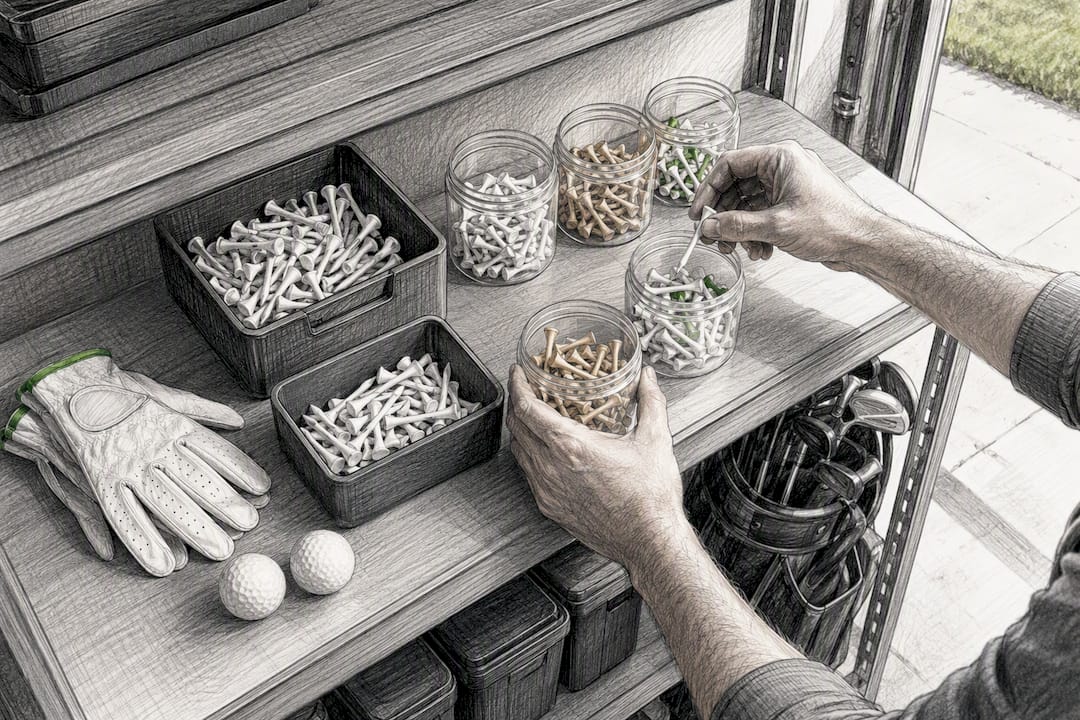
Material choice comes down to what you’re optimizing for. Wooden organizers lean toward a premium look and stable footprint, the kind of piece that doesn’t look out of place if your garage doubles as a workshop. Metal racks, especially powder-coated steel, trade a little visual polish for higher weight capacity and a lower price point, which matters if you’re storing multiple bags, extra shoes, and bins of tees and balls on the same unit.
A few organization habits make bulk storage actually useful instead of just tidy:
- Group tees by length in separate small containers, since 2.75 inch and 3.25 inch tees get mixed up fast when tossed in one bin.
- Keep the tee bin physically close to golf balls and towels so refilling your on-course pouch is a single stop, not a scavenger hunt.
- Store wooden tees away from direct sunlight and moisture; UV exposure dries out the wood and makes it snap more easily at impact.
- Use a shallow bin instead of a deep one for tees, so you’re not digging past four inches of loose tees to find one.
- Keep a “grab bag” of 20 to 30 tees pre-sorted near the door so restocking your pouch before a round takes ten seconds, not five minutes.
Locking casters are worth the extra cost if the organizer needs to move around a shared garage, but only if the unit also has a wide stable base. A rolling rack with a narrow footprint tips more easily than one that stays put, which matters once it’s loaded with two bags and a shelf full of accessories.
How to Choose the Right Tee Storage for Your Bag
The right choice depends less on brand and more on how you actually play. Run through this before buying anything.
Start with capacity. A weekend nine-hole player loses far fewer tees than someone playing four rounds a week in windy conditions, so match the holder’s size to how often you actually lose or break tees, not to the biggest capacity on the shelf.
Check the attachment method next. Clips work fine on a stable cart bar but can shake loose on a carry bag jostling with every step. A zippered pouch that clips or slides into an existing pocket avoids that problem entirely.
Water resistance matters more than most golfers assume. A pouch that traps moisture around wooden tees leaves them soft and prone to splitting on impact, which defeats the purpose of storing them carefully in the first place.
Weigh weight and price against how long you expect the piece to last. A leather pouch costs more upfront but typically outlasts a thin nylon equivalent by several seasons, so the price gap narrows once you account for how often you’d replace the cheaper option.
Watch for these red flags when you’re shopping in person:
- A clip that flexes or gaps under light pressure, since that’s the first thing to fail on a bumpy cart ride.
- Seams that pool water instead of draining, a common issue on cheap fabric pouches left out in morning dew.
- Zippers with plastic teeth that already stick before the pouch has seen a single round.
- No secondary compartment, forcing tees to rattle loose against ball markers and scuff each other.
If tees keep vanishing mid-round, the fix is usually placement, not the pouch itself. Move it to a pocket you check automatically, like the one holding your scorecard, and you’ll notice the loss stop almost immediately.
Pro Tip: Before buying, squeeze the pouch shut and shake it upside down. If a tee falls out in five seconds of shaking, it’ll fall out on the course too.
Buyer checklist in one paragraph: Pick a holder sized to your actual round-to-round tee usage, confirm the attachment method matches your bag type (cart bar clip versus carry-bag pocket pouch), check the material for water resistance if you play in wet climates, and test the zipper or clip for a firm, resistant close before you commit to buying it.
Placement, Pre-Loading, and Maintenance Tips From Gary
Storage only works if it’s placed where your hand goes without thinking. On a cart bag, that’s the accessory pocket nearest the seat. On a carry bag, it’s the hip-level side pocket, the same spot you’d reach for a scorecard.
Pre-loading matters more than golfers give it credit for. A practice session rarely needs more than eight to ten tees, since you’re pulling the same one repeatedly off the mat. A full round is a different story, plan for closer to 20 once you account for breaks, bent tees, and the occasional lost one in the rough.
Consistent placement, the same pocket or clip every time, builds the kind of muscle memory that lets you reach for a tee without breaking your pre-shot rhythm. That small habit does more for pace of play than most gear upgrades.
Magnetic systems push this further by removing the fumbling step entirely. A magnetic pouch snaps shut with one motion and stays fixed to a metal bag frame instead of swinging loose, the same principle behind magnetic towel systems that return to the same spot every time.
Maintenance is simple but easy to skip. Wipe pouches down after wet rounds, let damp wooden tees air dry before storing them in bulk, and keep the bulk stash off a garage floor where humidity and dust collect fastest.
— Gary
My Golf Tee Kit: What I Actually Carry
I keep three separate setups, sized for how long I’m playing and how much backup I actually need.
- 9 holes: 8 to 10 tees in a small clip-on caddy, one divot tool, done.
- Full round: 18 to 20 tees split between a hip pouch and a backup stash in the cart bag, plus a spare glove.
- Range session: 8 tees in a mint tin, since I’m reusing the same few off the mat.
Organized tees mean one less thing pulling focus before a shot, which is the entire point.
How Aiming Fluid Golf Solves Your Golf Tee Storage Problem
Every scenario covered above points to the same conclusion: the right storage depends on matching the container to how you actually play. Some premium utility pouches handle the pocket-size, grab-and-go role covered in the portable options section, sized to carry tees alongside ball markers and a divot tool without the rattling or spilling that comes with a flimsy bag. Precision tee packs offer a consistent, properly sized supply to load into whichever pouch or clip caddy you land on, so you’re never mixing warped tees with fresh ones. And for golfers organizing beyond tees, magnetic towel and landing pad systems solve the same “where does this live on my bag” question for towels and gear, using a snap-shut design instead of a zipper or clip.

If you’ve been storing tees loose in a pocket or digging through a garage bin before every round, start with the accessory picks built for cart, carry, and practice bags, then browse the precision tee collection to pair your new pouch with tees sized for your bag setup. Both pages list full specs so you can order the exact combination your routine needs.
Sources
- “Al-Tees” - Altoids Golf Tee Holder – Free STL | 3DSEARCH
- DIY Mason Jar golf projects — ShunGolf
- Heritage golf organizer — StoreYourBoard


