


TL;DR:
- Proper accessory placement in a three-zone system optimizes organization by placing high-frequency items in front pockets for quick access. Consistently restocking and adjusting placement over several rounds ensures an efficient, clutter-free bag tailored to your playing style. Modular pouches and personalized routines help maintain order, reducing search time and enhancing focus during play.
Golf course accessory placement is the practice of assigning every item in your bag to a specific, logical position based on how often you reach for it during a round. Proper accessory placement reduces the need to break stance or lose focus searching for items, which directly improves pace of play and mental confidence. Most golfers treat their bag as a general storage container. The players who score consistently treat it as a precision tool. The difference between those two approaches is a system, and this guide gives you one.
1. Golf course accessory placement tips start with the three-zone system
The most effective framework for organizing your golf bag is the three-zone model: Play Zone, Repair Zone, and Comfort Zone. A three-zone bag system significantly reduces time spent searching for accessories during play by separating gear into distinct categories based on frequency of use. Each zone maps to a specific pocket or area of your bag, so your hand goes to the right place every time without conscious thought.
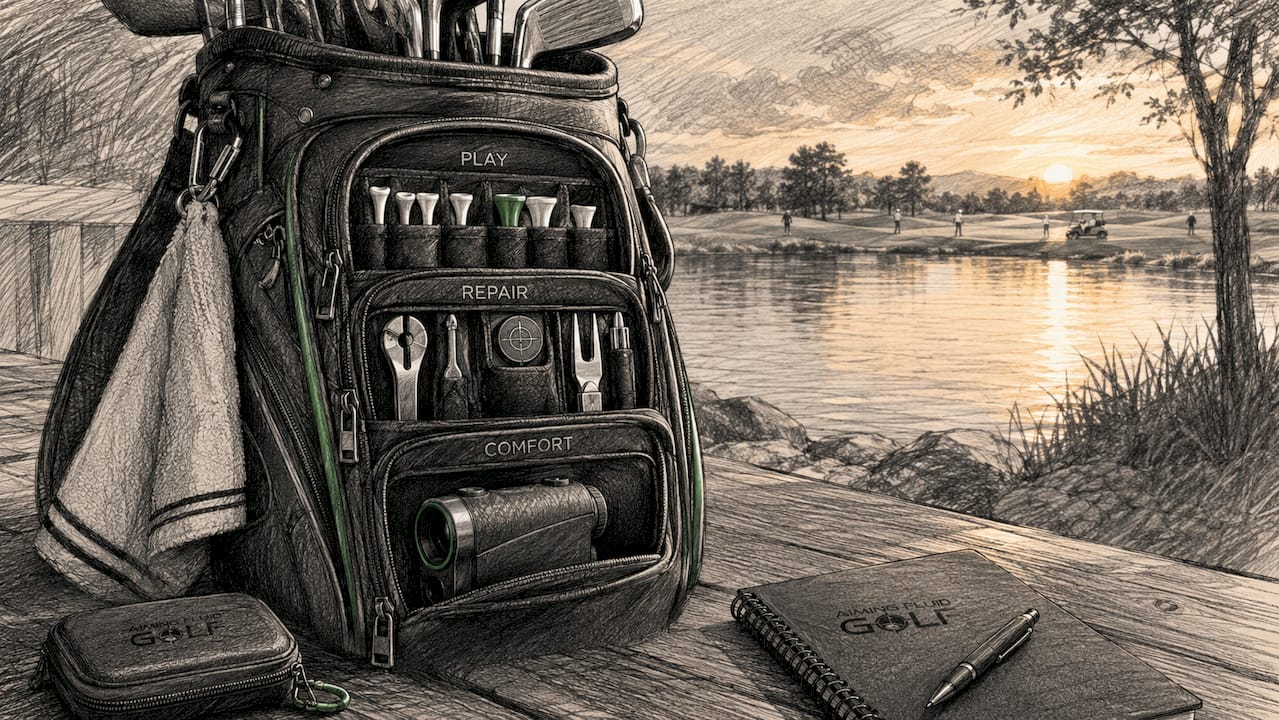
Play Zone items are those you reach for on nearly every hole: tees, ball markers, a pitch mark repair tool, and your rangefinder. These belong in the front pocket or the top-access pocket of your bag, whichever is closest to your dominant hand. Repair Zone items, such as your divot tool, spare glove, and groove cleaner, get used a few times per round and belong in a secondary pocket that requires one extra second to open. Comfort Zone items, including snacks, a rain jacket, sunscreen, and a water bottle, go in the largest or lowest pocket since you access them between holes rather than during a shot sequence.
Pro Tip: Label your pockets with a small piece of tape during your first few rounds using the system. Once muscle memory takes over after three or four rounds, remove the tape. The physical label accelerates the habit formation process.
2. How to arrange clubs for maximum accessory coordination
Club placement and accessory placement are not independent decisions. They interact directly, because the position of your clubs determines which pockets are physically accessible at any given moment during a round.
Effective club placement arranges woods and the driver at the top or back of the bag, mid-irons in center divider slots, and wedges plus the putter in the front-facing slots for fast access. This layout protects club heads and keeps the bag balanced on a cart or stand. The practical consequence for accessory placement is that your front pockets, which face you when the bag is racked, should hold your highest-frequency items.
| Club Category | Bag Position | Adjacent Pocket Use |
|---|---|---|
| Driver and woods | Top/back slots | Rangefinder, GPS device |
| Long irons (3-5) | Upper-center slots | Spare gloves |
| Mid-irons (6-8) | Center slots | Tees, ball markers |
| Wedges and putter | Front/lower slots | Divot tool, pitch fork |
Pro Tip: If you carry a stand bag, the pockets that face outward when the bag is standing are your highest-priority real estate. Assign your Play Zone items exclusively to those pockets.
3. Preventing pocket explosion with modular pouches
“Pocket explosion” is what happens when tees, ball markers, a coin, a broken pencil, and three old scorecards all occupy the same pocket. A dedicated zip pouch for Play Zone items prevents this problem entirely by creating a contained unit that you can pull out, use, and return without dumping the pocket’s contents on the fairway.
The practical approach is to use one small pouch for consumables (tees and ball markers) and one for tools (divot tool, pitch mark repair fork, groove cleaner). Aimingfluidgolf’s leather utility pouch clips directly to the bag exterior, which means your small accessories are accessible without opening any pocket at all. That single design decision eliminates the most common source of mid-round frustration for recreational golfers.
Modular pouches also make restocking faster. After a round, you refill the pouch rather than sorting through a pocket. The system resets in under two minutes.
4. Placing frequently used items for zero-second reach access
Arranging external bag storage by frequency places your rangefinder, ball markers, and tees within reach without breaking your pre-shot stance or routine. Zero-second reach access means your hand finds the item before your brain has to consciously direct it. That level of automaticity only happens when placement is consistent round after round.
The rangefinder belongs in a dedicated side pocket or a clip-on holster attached to the bag strap. Ball markers and tees belong in the same front pocket every single round, never migrating to a different location. Your glove, when not in use, goes in the same secondary pocket every time. Consistency of placement is more important than which specific pocket you choose. Pick a system and commit to it.
Golfers who use cart bags have an advantage here: cart bags typically offer more total pocket volume and dedicated accessory compartments. Walking bag users need to be more deliberate because stand bags and carry bags have fewer pockets and less total space.
5. How to minimize clutter and maintain organization over time
Clutter in a golf bag accumulates gradually. A sleeve of balls here, an extra glove there, a few dozen tees that never get used. The result is a bag that feels like a junk drawer and slows you down at the worst moments.
The rule for ball quantity is direct: carry only enough balls for the round plus a few extras, and restock after each round rather than letting supply build up. Overloading balls and tees creates inefficient bag management and genuine confusion when you reach into a pocket expecting one item and find six.
Follow this restocking sequence after every round:
- Remove all items from every pocket and place them on a flat surface.
- Discard broken tees, empty packaging, and any item you did not use during the round.
- Restock tees to your standard quantity (typically 10 to 15 for most golfers).
- Return ball markers, divot tools, and gloves to their designated pockets.
- Restock balls to your target number for the next round.
- Zip every pocket before storing the bag.
This six-step sequence takes less than five minutes and prevents the gradual accumulation that turns an organized bag into a disorganized one over a season.
6. Choosing the right bag type for your placement strategy
The bag you carry determines the placement options available to you. Choosing a bag that matches your play style directly impacts accessory placement efficiency and overall organization. A cart bag with 14 or more pockets gives you the space to fully implement a three-zone system with dedicated pouches for every category. A Sunday carry bag with four pockets forces radical prioritization.
Walking golfers who carry their bag need to consider weight distribution. Heavier items, including water bottles and rain gear, belong at the bottom of the bag to keep the center of gravity low. Lighter, frequently accessed items belong at the top and in front pockets. Cart golfers do not face the same weight constraint, but they do need to consider which side of the bag faces outward on the cart, since that determines which pockets are accessible without repositioning the bag.
Travel golfers face a third set of constraints. When flying with clubs, accessories must be consolidated into fewer, more protected pockets. A stand bag with tour-level pocket design addresses all three scenarios by providing dedicated compartments that work whether you are walking, riding, or traveling.
7. Limiting accessories to what actually improves your round
Most golfers accumulate gear that adds complexity without adding value. The principle of limiting accessories to one identity item, one comfort item, and one pace-of-play item creates a manageable bundle that actually enhances play rather than complicating it.
An identity item is something personal that reflects your game, such as a signature ball marker or a custom tee color. A comfort item is something that physically improves your experience, such as a quality towel or a specific glove brand. A pace-of-play item is something that speeds up your decision-making or shot execution, such as a rangefinder or a GPS device. Everything beyond these three categories deserves scrutiny before it earns a spot in your bag.
The golf club personalization trend extends naturally to accessories. Golfers who personalize their gear tend to care more about its placement and maintenance, which reinforces organizational habits over time.
8. Personalizing your placement system based on playing style
No two golfers reach for items in exactly the same sequence. Fine-tuning accessory placement over two or three rounds based on actual play experience locks in an optimal personal system that reflects your specific habits and preferences.
The personalization process works as follows:
- After round one with a new system, note which items you reached for in the wrong pocket.
- After round two, move those items to the pocket your hand naturally went to first.
- After round three, the system should feel automatic. Make only minor adjustments from that point forward.
Towel placement is one of the most personal decisions in bag organization. Some golfers prefer the towel clipped to the bag strap for instant access. Others prefer it hanging from the bag handle. Aimingfluidgolf’s magnetic towel system solves this entirely by allowing the towel to attach and detach from a magnetic landing pad on the bag, meaning placement becomes a non-decision. The towel is always where you left it.
Walking golfers and cart golfers also need different placement strategies for the same items. A rangefinder clipped to a cart bag strap is accessible from the seat. The same rangefinder on a carry bag needs to be in a front pocket that opens without removing the bag from your shoulder.
Key takeaways
Strategic accessory placement requires a consistent zone-based system, frequency-driven pocket assignment, and a post-round restocking routine to maintain organization across every round.
| Point | Details |
|---|---|
| Use the three-zone system | Assign every item to a Play, Repair, or Comfort zone before your first round. |
| Prioritize front pockets | Place tees, ball markers, and your rangefinder in the pocket your hand reaches first. |
| Use modular pouches | A dedicated zip pouch for small items prevents pocket explosion and speeds up restocking. |
| Restock after every round | A six-step post-round reset keeps accumulation from turning your bag into a junk drawer. |
| Personalize over three rounds | Adjust placement based on where your hand naturally goes, then commit to the final system. |
What I’ve learned from watching golfers fight their own bags
I have watched a lot of golfers lose a full minute searching for a tee on the tee box. Not because they forgot to bring tees. Because the tees were in a different pocket than the round before, buried under a rain glove and three scorecards from 2024. The bag was full. The golfer was unprepared.
The most common mistake I see is treating bag organization as a one-time task rather than a maintained system. Golfers spend twenty minutes organizing their bag before the season starts, then let it drift back into chaos by the third round. The post-round reset is not optional. It is the mechanism that keeps the system functional.
The second mistake is over-accessorizing. More gear does not mean better preparation. It means more decisions, more searching, and more weight. The golfers I have seen play the most confidently carry the least. Their bags are light, their pockets are clean, and their hands find what they need without looking down.
Personalizing your placement system is not vanity. It is precision. When your towel is always in the same place, your marker is always in the same pocket, and your tees are always in the same pouch, you stop thinking about your gear and start thinking about your shot. That mental shift is worth more than any single accessory you could add to your bag.
— Gary
Gear that makes placement easier from the start
Aimingfluidgolf designs accessories specifically to solve the placement problems described in this guide. The magnetic towel and landing pad system eliminates towel placement decisions entirely. The leather utility pouch keeps Play Zone consumables contained and clip-accessible without opening a pocket. The DON’T SUCK™ golf tees are precision-engineered for consistent tee height, which matters when tees are the item you reach for most. For a full selection of accessories organized by cart, carry, and practice use, see the expert picks guide from Aimingfluidgolf.
FAQ
What are the best golf course accessory placement tips for beginners?
Start with the three-zone system: assign tees, ball markers, and your rangefinder to a front pocket (Play Zone), divot tools to a secondary pocket (Repair Zone), and snacks or rain gear to the main compartment (Comfort Zone). Consistency of placement matters more than which specific pocket you choose.
How do I stop my golf bag pockets from getting cluttered?
Use a dedicated zip pouch for small Play Zone items like tees and ball markers, and run a six-step post-round restock routine to remove broken or unused items after every round. Strategic pocket assignment combined with modular accessories reduces clutter and limits mid-round disruptions.
Should I organize my golf bag differently for walking vs. cart golf?
Walking golfers should place heavier items at the bottom for weight distribution and keep frequently used accessories in front pockets accessible without removing the bag. Cart golfers should prioritize the outward-facing side of the bag for their highest-frequency items.
How many accessories should I carry in my golf bag?
Limit your accessory bundle to one identity item, one comfort item, and one pace-of-play item beyond your core tools. Carrying only what you actually use during a round reduces weight, eliminates confusion, and keeps your bag organized across the full season.
How often should I reorganize my golf bag?
Run a full restock and reset after every round, not once per season. A five-minute post-round routine prevents the gradual accumulation that turns a clean bag into a disorganized one, and it keeps your placement system reliable from the first hole of every round.
Recommended
- How quick-access golf tools streamline your game – Aiming Fluid Golf
- Master golf tee placement workflow for consistent drives – Aiming Fluid Golf
- Top Beginner Golf Mistakes That Kill Your Score (And How to Fix Them) – Aiming Fluid Golf
- 9 Simple Golf Tips to Instantly Improve Your Game (Rick Shiels Breakdo – Aiming Fluid Golf


