


Under Rule 14 of the Rules of Golf, you must mark the spot with a ball-marker or your club before lifting a ball that has to be replaced. The marker itself must be an artificial object; coins, tees, and manufactured markers qualify, but leaves, divot sand, and other natural items do not. Get the sequence wrong and you’re looking at a one-stroke penalty in stroke play or loss of hole in match play.
TL;DR:
- Markers must be artificial objects such as coins or tees; natural items like leaves or sand are not permitted and can incur penalties.
- The sequence of placing the marker behind the ball, aligning it, lifting the ball, and then replacing it in the exact spot is crucial to avoid penalties, with specific techniques for accuracy.
- Moving a marker or lifting a ball before proper marking results in one or two-stroke penalties, but accidental displacements due to wind or animals are penalty-free if properly corrected.
- Using a proper, compliant marker design and quickly preparing it with accessories like magnetic landing pads accelerates pace and reduces the risk of rule violations.
- Consistently practicing the marking sequence and establishing a quick routine ensures compliance and minimizes penalties in both casual and competitive play.
Table of Contents
- What Does Rule 14 Say About Marking, Lifting, and Replacing?
- What Counts as a Legal Ball Marker?
- How Do You Mark, Lift, and Replace Your Ball Correctly?
- How Do You Move a Marker and Put It Back in the Exact Spot?
- What Penalties Apply to Marking Mistakes?
- What Etiquette Speeds Up Marking on the Green?
- What Marker Choices Help You Stay Compliant and Fast?
- What Do You Do When Your Ball Is on Someone Else’s Line?
- How Do You Mark a Ball That’s Embedded or Sitting in an Unusual Lie?
- What Happens If a Ball or Marker Goes Missing After You Mark It?
- Are Marking Rules Different for Casual Rounds Versus Competitions?
- Why Getting the Sequence Right Matters More Than Memorizing the Rule
- Keep Your Marker Ready with Aiming Fluid Golf
- Where to Read the Official Rules Yourself
- Sources
- FAQ
What Does Rule 14 Say About Marking, Lifting, and Replacing?
Rule 14 governs almost everything that happens between a ball landing on the green and the next stroke. Marking is required any time you lift a ball that must go back to its original spot, which covers nearly every putt read, ball clean, or interference check on the green. It is not required if you’re simply hitting the ball where it lies without lifting it.
You mark the spot by placing a ball-marker directly behind the ball or by setting the head of a club, usually a putter, next to it. Either method satisfies the rule, but a marker is less likely to shift if you bump it walking around the green.
Once marked, you may lift the ball to clean it, check for damage, or clear it from another player’s line. Any player, not just the ball’s owner, may lift and replace a ball once it’s properly marked, though it’s standard etiquette for the owner to handle it. The ball must be replaced on its original spot, not simply dropped nearby, and the USGA’s Rule 14 spells out the penalty structure for skipping any part of that sequence.
What Counts as a Legal Ball Marker?
A coin, a golf tee, or a purpose-built marker all satisfy the rule because they’re artificial objects. A leaf, a twig, or a pinch of sand does not count, and marking with one carries a one-stroke penalty in stroke play or loss of hole in match play, according to USGA’s official rules FAQ.
Size matters more than most golfers realize. USGA guidance to manufacturers sets specific thresholds: a marker exceeding certain small dimensional limits in height, width, or having extended printed lines or appendages can be classified as an alignment device rather than a simple marker. Our breakdown of USGA ball marker size rules covers those dimensions in detail.
That classification matters because using an alignment device to orient your ball toward the hole breaches Rule 4.3a, which prohibits equipment that artificially reduces the skill required to play. The USGA’s 2022 rules clarifications give a direct example: placing a marker to show a line, then lining up the ball’s own marking against it, is a violation even if the marker itself is legal.
How Do You Mark, Lift, and Replace Your Ball Correctly?
The mechanics are simple once you’ve done them a few times, but the order matters more than most golfers assume.
- Place the marker directly behind the ball, touching or nearly touching it. Marking to the side or slightly in front is acceptable if another player’s line runs through the spot behind your ball.
- Align the marker using the flat edge of your putter head against the ball before sliding the marker into place. This keeps the mark precise without guesswork.
- Lift the ball once the marker is set, never before.
- Clean and check the ball if needed. On the green, you’re always entitled to clean a lifted ball.
- Replace the ball between the marker and the hole, touching the marker’s edge.
- Remove the marker before you take your stroke. Leaving it in place and putting anyway triggers a two-stroke penalty under Rule 14.
Pro Tip: Lift the marker straight up rather than sliding it off the surface. A sliding motion is the single most common way golfers accidentally nudge their ball out of position right before replacing it.
How Do You Move a Marker and Put It Back in the Exact Spot?
Another player can ask you to move your marker if it sits on their line to the hole. You’re required to comply, and the process for moving and restoring it is one of the most useful skills on the green.
- Pick a fixed reference point away from your ball, something like a sprinkler head, a distinctive blade of grass, or the edge of the cup.
- Use putter-head lengths from that reference to move your marker one, two, or however many clubhead widths the other player requests.
- Mentally note the exact number of lengths and the direction moved.
- After the other player putts, reverse the same count and direction to return your marker to its original spot.
This technique, outlined in Golf, works because a fixed external reference doesn’t move even when your original mark does. Guessing from memory alone is how markers end up an inch or two off after a group putts out.
What Penalties Apply to Marking Mistakes?
Most marking penalties trace back to the same handful of sequence errors. Lifting a ball before marking it costs one stroke in stroke play or the hole in match play. Playing from a wrong spot, meaning you replaced the ball somewhere other than its original position, carries the general penalty: two strokes in stroke play, loss of hole in match play. Making a stroke while your marker is still on the ground next to the ball also draws a two-stroke penalty.
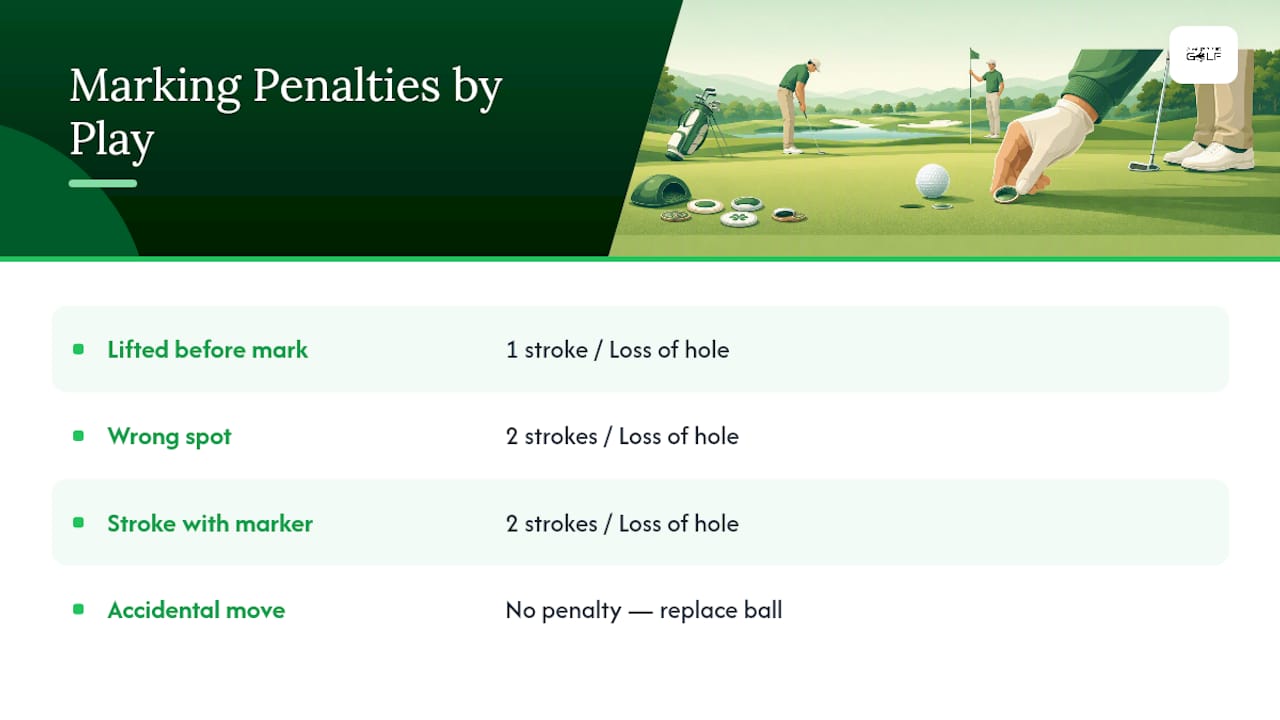
There’s good news, too: if your ball or marker gets accidentally moved, by wind, an animal, or another player’s foot, there’s no penalty at all. You simply replace it on the original spot, estimating the location if you’re not certain, according to Golf.com. The rule punishes careless procedure, not bad luck.
What Etiquette Speeds Up Marking on the Green?
Mark proactively the moment you reach the green, even when your ball isn’t technically in anyone’s way yet. It’s not always required, but it removes a step later and keeps the group moving, a point Golf.com’s instruction team makes repeatedly in their coverage of green procedure.
Walk around, not through, another player’s line when you approach your ball, and avoid setting your bag or feet near anyone’s putting path. A low-profile marker that doesn’t draw the eye, paired with a quick, practiced mark-and-lift motion, shaves real seconds off every hole. Our guide on why you should always use a golf ball marker covers more of these habits.
What Marker Choices Help You Stay Compliant and Fast?
Marker design has more to do with the rules than most golfers think. A low-profile metal marker sits flatter, resists wind, and avoids the height threshold that can tip a design into alignment-device territory. Pairing one with a magnetic landing pad keeps it clipped to your towel or glove instead of buried in a pocket, so you’re not fumbling when it’s your turn.
Skip markers with long printed reference lines or clip-on appendages. They look precise, but those features are exactly what USGA’s manufacturer notice flags as potential alignment aids. A simple round marker you can grab, place, and pocket in one motion beats a gadget every time. Our piece on penalty-free golf accessories breaks down what separates a compliant design from a risky one.
What Do You Do When Your Ball Is on Someone Else’s Line?
If your ball sits between another player’s ball and the hole, mark it. This is the single most common reason to lift on the green even when you’d rather leave your ball alone, and it’s considered standard courtesy rather than a strict requirement in every case, though most groups treat it as mandatory.
The process doesn’t change from a normal mark. Place your marker behind the ball, lift, and step well clear of the other player’s putting line while you wait. Where it gets more nuanced is when multiple balls sit close together near the hole. In that situation, mark and lift in the order that clears the most lines with the fewest moves, typically starting with whoever’s ball is closest to the direct path between another player’s ball and the cup.
If a moving ball happens to strike your ball-marker, there’s no penalty, and the marker’s position doesn’t need to be touched unless it was knocked out of place, in which case you replace it using the fixed-reference method described earlier. A ball that strikes another player’s ball-marker on the green is treated the same way: no penalty for either player, marker restored if it moved.
Communicate clearly before you mark. A quick “I’ll mark, I’m on your line” avoids confusion, especially in group settings where three or four balls might be scattered around the same section of green. Golfers new to competitive rounds often hesitate here, worried about slowing things down, but a fast, confident mark is quicker than a hesitant one.
How Do You Mark a Ball That’s Embedded or Sitting in an Unusual Lie?
A ball plugged into soft turf on the green is rare but not unheard of after heavy rain or aggressive irrigation. The marking procedure doesn’t change: you still mark before lifting. What changes is the care needed to lift the ball cleanly without disturbing the surrounding surface more than necessary.
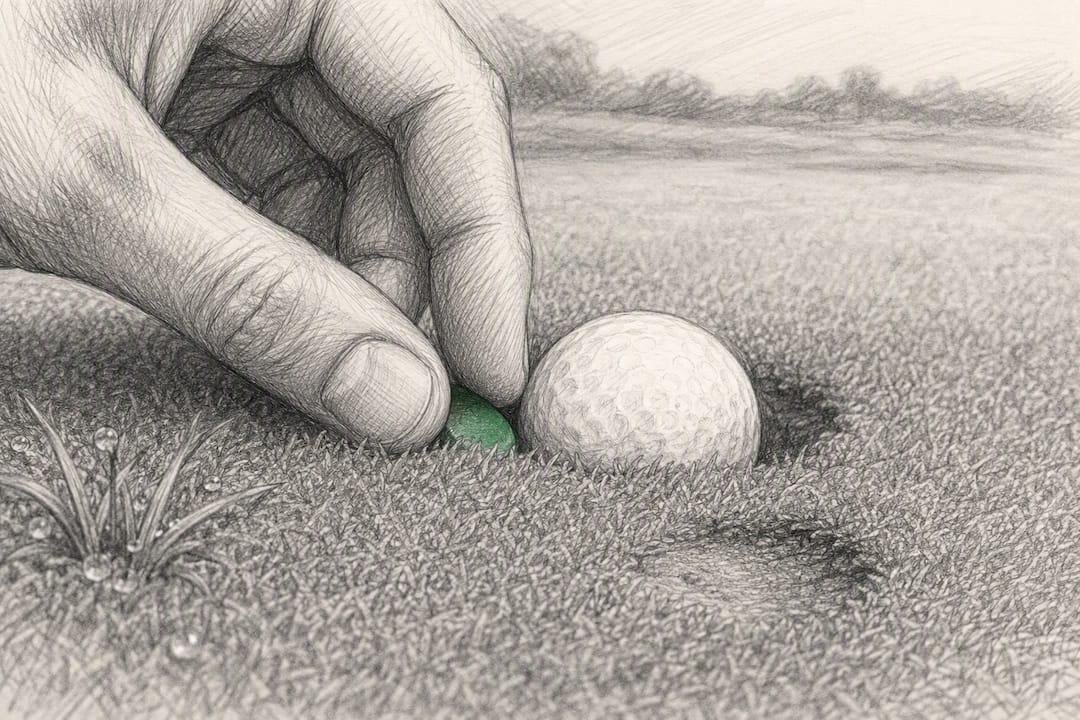
If the green surface itself is damaged, embedded, or holding water near your ball, you may be entitled to relief under a different rule entirely, separate from the marking procedure. Marking correctly still matters here because you need an accurate reference point to know where to replace the ball if relief isn’t available or isn’t taken.
Unusual lies close to the hole edge, in a footprint, or against the flagstick base call for extra attention to marker placement. Set your marker where it won’t get stepped on by other players finishing the hole, and consider marking to the side rather than directly behind the ball if the space behind it is compromised or uneven. The rule allows marking behind, to the side, or in front, so use the option that keeps your marker safest from foot traffic and easiest to see when you return to replace the ball.
If part of the green surface flakes or crumbles as you lift the ball, that’s a course-condition issue, not a rules violation on your part. Replace the ball as close to its original position as the surface allows, and if the exact spot is now damaged beyond recognition, estimate the nearest reasonable point.
What Happens If a Ball or Marker Goes Missing After You Mark It?
A ball-marker occasionally disappears, kicked by another player, picked up by mistake, or simply lost in longer fringe grass around the green. If this happens, you’re required to replace your ball as close as possible to its original spot, using your best judgment and any reference points you noted, such as a nearby ball mark, sprinkler head, or blade pattern.
There’s no penalty for a marker going missing through no fault of your own. The rule doesn’t punish circumstances outside your control. What it does require is a good-faith estimate placed as accurately as reasonably possible, which is exactly why picking a mental reference point the moment you mark is worth the extra two seconds.
A lost ball itself, as opposed to a lost marker, is a different situation entirely and falls under separate lost-ball provisions rather than marking rules. If your ball somehow vanishes after being marked and lifted, which would be an unusual scenario since you’re holding it in hand, treat it as you would any other lost-ball ruling and consult your group or a rules official if the round is competitive.
Keeping a spare marker in your pocket or bag solves most of this before it becomes a problem. It’s a small habit, but it removes the scramble of searching your bag mid-round while your group waits.
Are Marking Rules Different for Casual Rounds Versus Competitions?
The written rule doesn’t change between a Saturday foursome and a club championship. Rule 14’s marking, lifting, and replacing requirements apply identically whether you’re playing for pride or for a trophy.
What changes is enforcement and how strictly groups apply the details. In casual rounds, most golfers relax about marking every single putt, especially tap-ins, and few playing partners would call a penalty over a technical marking slip. In stroke play competitions and any USGA-sanctioned event, the letter of the rule applies, and marking with the wrong object or leaving your marker in place during a stroke can genuinely cost you strokes on your scorecard.
The safest approach is to build the same habit regardless of the stakes. Mark every time you lift, use a proper artificial marker, and remove it before every stroke, even in a friendly weekend round. That consistency means you’re never caught off guard when a round unexpectedly turns competitive, whether it’s a member-guest event or a qualifier you didn’t plan to take seriously until the back nine got interesting.
Why Getting the Sequence Right Matters More Than Memorizing the Rule
The rule itself isn’t complicated. What trips golfers up is inconsistency, marking carefully on some holes and rushing on others. Building one repeatable sequence, mark, lift, clean, replace, remove, turns a rules question into muscle memory. Practice it until it’s automatic, and penalties stop being something you have to think about.
— Gary
Keep Your Marker Ready with Aiming Fluid Golf
A marker that’s easy to reach is a marker you’ll actually use correctly, every time, without rushing the sequence. Aiming Fluid Golf’s magnetic towels pair with a landing pad system that keeps a low-profile marker clipped and visible instead of buried at the bottom of a pocket.

Because the design stays flat and compact, it avoids the height and dimension thresholds that can turn a marker into a problem alignment device, so you’re not second-guessing your equipment on top of your procedure. Between holes, that quick-access setup means less fumbling, fewer dropped markers, and a faster group overall. Browse the magnetic towel and landing pad collection and find a system that keeps your marker exactly where you need it, right when it’s your turn to mark.
Where to Read the Official Rules Yourself
For the primary rule text, go straight to USGA’s Rule 14, the R&A’s Rule 14, and Golf.com’s practical marking guide for hands-on technique.
Sources
- Rule 14 - Procedures for Ball: Marking, Lifting and Cleaning; Replacing on Spot; Dropping in Relief Area; Playing from Wrong Place
- Golf
FAQ
What Ball Markers Are Illegal in Golf?
Any marker classified as an alignment device is illegal to use for orienting your ball, meaning one that exceeds specific small size limits in height, width, or has extended printed lines or appendages. Natural objects like leaves or twigs are also not permitted as markers.
Can You Ask a Player to Mark Their Ball Off the Green?
Marking is specifically a green procedure under Rule 14, so you can’t require someone to mark off the green, though a player may choose to lift for identification in some situations elsewhere on the course under separate provisions.
What Happens If a Putt Hits a Ball Marker?
There’s no penalty if a moving ball strikes a ball-marker on the green, for either player involved. The marker only needs to be repositioned if it was actually displaced.
What Happens If You Accidentally Move Your Ball Marker?
No penalty applies. You simply replace it on the original spot, estimating the location as closely as possible if you’re not certain exactly where it sat.


