


Folding divot tools win for most golfers because they combine pocket safety, full repair capability, and a retracting fork that will not stab you reaching for a tee. Fixed metal tools still earn their place when you need maximum rigidity on hard, compacted greens and want zero moving parts to fail. The real tradeoff is mechanism versus simplicity, and stainless steel construction, a magnetic ball marker, and brands with similar features show how that tradeoff gets solved in practice.
TL;DR:
- Folding divot tools are more likely to be used regularly because they are pocket-safe, compact, and include convenient features like magnetic markers.
- Fixed metal tools offer superior durability over time due to their simple construction and fewer failure points, especially on hard greens.
- For most golfers, a tool with prong lengths between 1.6 and 1.9 inches made of stainless steel and with a wobble-free lock provides the best balance of effectiveness and longevity.
- The repair technique’s success depends more on proper inward pressure and turf handling than on whether the tool is folding or fixed.
- Choosing a lightweight, foldable tool dramatically increases carry rate, which improves overall green repair efforts for casual and serious players alike.
Table of Contents
- Folding vs Fixed Divot Tool: Quick Pros and Cons
- Repair Effectiveness, Durability, Portability, and Ergonomics Compared
- Materials and Construction: What Actually Determines Longevity
- How to Repair a Ball Mark Correctly
- How to Choose the Right Divot Tool for Your Game
- An Author’s Note on Design Priorities
- The Three Divot Tool Types, Explained
- What Most Golfers Get Backwards About Divot Tools
- Get the Aiming Fluid Golf 5-in-1 Divot Tool
- Sources
- FAQ
Folding vs Fixed Divot Tool: Quick Pros and Cons
The fastest way to sort this out is to line up what each design does well before getting into the mechanics behind it. Neither design is objectively broken. Each one just solves a different problem.
Folding (switchblade) divot tools tend to win on:
- Pocket safety, since the prongs retract into the handle instead of riding around exposed near your keys and phone.
- Carry rate. A tool that does not poke you is a tool you actually keep in your bag, which is the single biggest factor in whether marks get repaired at all.
- Built-in extras, especially a magnetic ball marker seated right on the handle, so you are not patting down four pockets on the green.
- Compact size that fits a pants pocket or a small pouch without printing through the fabric.
Fixed two-prong tools tend to win on:
- Zero moving parts. There is no spring, no lock, and nothing that can seize up after a wet round.
- Predictable strength, since a solid metal body does not flex under pressure the way a hinge assembly can.
- Lower failure risk over years of use, which is why some greenkeeping staff still prefer them.
- Simpler ergonomics for golfers who just want to grab, jab, and go without thinking about a button.
Single-prong tools are worth a mention too. Some course staff and traditionalists prefer them because a single tine feels more precise for spot repairs, though most recreational golfers get better leverage from a two-prong design, according to Golfing For All.
Repair Effectiveness, Durability, Portability, and Ergonomics Compared
A useful divot tool comparison has to separate two questions that get conflated constantly: which tool repairs a ball mark better, and which tool actually gets used. The answers are not the same, and that gap is where most buying decisions go wrong.
Repair effectiveness
Both folding and fixed designs can execute a correct repair when the prongs are metal and the technique is right. What actually determines repair quality is prong geometry, not the hinge. A tine that is too short skims the surface without lifting compacted soil; a tine that is too thin bends before it does anything useful. Aiming Fluid Golf’s technique guide confirms the mechanics matter more than the format: the inward-pushing motion is what heals the turf, and metal construction is recommended specifically because it holds up against firm, dry soil where plastic prongs flex and skip.
Durability and failure modes
This is where the two designs genuinely diverge. A fixed tool has one failure mode worth worrying about: the prongs bending or snapping under abuse. That is rare with stainless steel and essentially a non-issue with proper use.
A folding tool has more going on mechanically. The spring, the pivot pin, and the locking mechanism all introduce potential wear points that a solid tool never has to deal with. That does not make foldables unreliable. It means construction quality matters more. Reviewers who pro-test divot tools specifically evaluate push-button locks across repeated open and close cycles, because a mechanism that wobbles or fails to lock after a season of pocket lint and course grit is the single most common complaint about switchblade designs. A sealed spring and a pin joint (rather than a cheap rivet) are the difference between a tool that lasts five years and one that gets tossed after five rounds.
Portability and pocket safety
This is the category where folding tools have a real, measurable edge. A fixed two-prong tool with exposed tines is a small hazard in a pocket that also holds a phone, a scorecard pencil, and a set of keys. Retractable designs solve that by folding the fork flush into the handle, which is exactly why Golf Digest highlights switchblade tools for pocket and finger safety while noting that fixed metal tools can feel bulky and uncomfortable to carry all 18 holes.
That safety margin connects to something more important than comfort. Whether a golfer repairs a mark at all comes down almost entirely to whether they are carrying a tool in the first place. A tool sitting in a golf bag pocket back at the cart is doing nothing for the green you are standing on right now.
Ergonomics and leverage
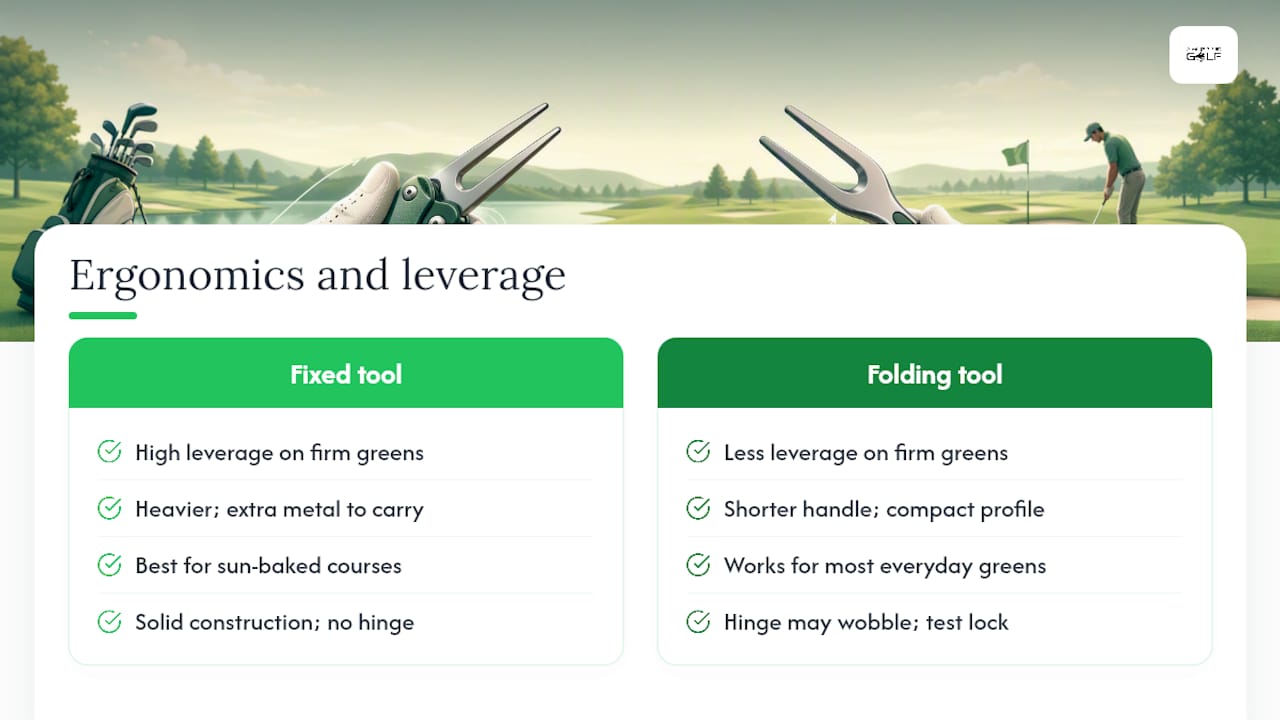
Handle shape and weight distribution affect how much force you can apply without straining your fingers. A heavier fixed tool with a wide, contoured grip gives you more leverage on very firm, sun-baked greens where the soil has almost no give. That extra heft is an advantage in that specific scenario and a minor annoyance in every other one, since you are carrying more metal than you need most rounds.
Folding tools generally use a shorter handle to keep the folded profile compact, which works fine for the vast majority of greens but can feel less commanding on tournament-hard surfaces in August. This is the closest thing to a genuine limitation of the folding format, and it is why some serious competitors still keep a fixed backup in their bag for firm-course events.
Pro Tip: Test the lock before you buy, not after. Open and close a folding tool ten times in the store or right after unboxing. If you feel any wobble at full extension, that mechanism will only get looser with course dirt working into the hinge.
Extra features: magnetic markers and groove cleaners
Modern folding tools often build in a magnetic ball marker and sometimes a small groove cleaner on the same body. A magnetic marker retained in the handle means you are never digging through your pocket at the exact moment your group is waiting on you to mark up. That convenience is real, and it is one reason folding multi-tools have become the default recommendation in most modern buying guides.
The tradeoff is added weight and one more thing that can fail. A magnet that is glued rather than press-fit can pop loose over time, and a groove cleaner bristle pack that is too shallow does not clean much of anything. None of these features are dealbreakers, but they are worth checking before you assume “5-in-1” automatically means better.
| Dimension | Folding tools | Fixed tools |
|---|---|---|
| Repair effectiveness | Equal when metal and used correctly | Equal when metal and used correctly |
| Durability | Depends on lock/spring quality | Fewer failure points overall |
| Portability & pocket safety | Strong advantage | Weaker, exposed prongs |
| Ergonomics on firm greens | Adequate for most rounds | Advantage on very hard soil |
| Extra features | Magnetic marker, groove cleaner common | Rare, tool stays single-purpose |
Materials and Construction: What Actually Determines Longevity
Material choice matters more than format when you are trying to predict how long a tool will last. Stainless steel prongs are the baseline you should expect regardless of whether the body folds or not; plastic tines bend on contact with dry, compacted soil and eventually snap. Aluminum alloy is the common choice for the handle body itself because it balances weight against strength, keeping the tool light enough for an all-day carry without feeling flimsy. Titanium shows up on premium tools where shaving a few more grams justifies a higher price, though for most rounds the practical difference versus a well-made aluminum body is small.
Beyond the raw materials, a few construction details separate a tool that lasts from one that does not:
- Joint type. A pinned or riveted pivot with a sealed spring resists grit and moisture better than an exposed, unsealed hinge that collects sand and dirt over a season.
- Finish. Plated stainless can chip and expose bare metal underneath, which invites rust; solid stainless resists corrosion all the way through, not just on the surface.
- Edge finishing. Prongs and the fork edges should be smooth enough that they do not snag on pocket fabric when you draw the tool out mid-round.
- Lock feel. A quality folding mechanism clicks into place with no wobble at full extension; a cheap one has visible play the moment you push against it.
When you are checking product photos or listings before buying, look for a few concrete signals. Prong length in the 1.6 to 1.9 inch range gives enough leverage for most green conditions without extending so far that it snags in a pocket. Listings that specifically call out stainless steel or aluminum alloy, rather than a vague “metal,” are usually more trustworthy. Customer photos showing months of visible wear tell you more than a manufacturer’s studio shot ever will, and any mention of corrosion resistance or a rust-resistant finish is worth taking as a positive signal rather than marketing filler.
How to Repair a Ball Mark Correctly
Tool choice matters less than most golfers assume. What actually determines whether a repair heals cleanly is technique, and the same four-step motion applies whether you are holding a folding switchblade or a solid fixed tool.
- Insert the prongs at the edge of the mark, angled slightly, just outside the depressed area rather than in the dead center of it.
- Push gently toward the center from two or three different points around the perimeter, working the surrounding turf back inward rather than lifting the compacted soil straight up.
- Smooth the top with the flat face of the tool (or the back of a putter head) to level the surface once the edges have closed in.
- Tamp lightly if needed, applying just enough pressure to settle the grass without recompacting the soil underneath.
The reason inward pressing works and twisting does not comes down to what happens to the grass roots. Aiming Fluid Golf’s repair guide makes the mechanical case clearly: pushing the surrounding, undamaged turf back toward the center preserves the root structure that is still alive at the edges of the mark. Twisting or digging tears those roots and widens the wound instead of closing it, which is exactly why a mark repaired the wrong way often looks worse a week later than one left completely alone.
On very firm or compacted greens, a sturdier metal tool with a bit more handle weight genuinely helps, since you need more consistent pressure to work the soil without the prongs skating across the surface. In a pinch, a tee can substitute for a proper tool for basic ball mark repair, which is part of why the USGA has never treated tool ownership as mandatory. That said, a tee’s short, thin shaft cannot generate the same controlled leverage as a purpose-built fork, so it is a fallback, not a preference.
Pro Tip: Repair your own mark first, then glance around for one or two nearby that got missed. It adds fifteen seconds and it is the single easiest way to leave a green in better shape than you found it.
How to Choose the Right Divot Tool for Your Game
Start with one question: will you actually carry this tool every single round? If the honest answer is no, pick the folding format, because pocket safety and low weight are what turn “I own a divot tool” into “I use my divot tool.” If you mostly play firm, fast, summer-baked courses, weight that answer against a preference for metal fixed tools or a heavy-duty foldable with a longer, sturdier fork.
A few concrete thresholds are worth holding onto when you are comparing options side by side:
- Prong length between 1.6 and 1.9 inches. Long enough for real leverage, short enough to avoid snagging.
- Stainless steel prongs, not plastic. Plastic is a durability compromise you will notice within a season.
- A locking mechanism with no wobble at full extension, if you are choosing a folding design.
- Magnetic marker retention that feels snug rather than loose, if the tool includes one.
- Explicit corrosion resistance, especially if you play courses with heavy morning dew or coastal humidity.
Three quick scenarios cover most golfers:
The casual walker who plays a few rounds a month and values convenience above all else should default to a lightweight foldable. Pocket safety and low weight matter more than raw leverage for someone playing mostly average conditions.
The serious competitor playing firm, tournament-condition courses should lean toward a solid metal fixed tool, or a heavy-duty foldable with a proven, tested lock and a longer fork built for leverage on hard turf.
Greenkeeping staff or course volunteers repairing dozens of marks a shift need a solid fixed tool with long, durable prongs. Mechanism wear from hundreds of daily cycles is not worth risking when repair volume is that high.
An Author’s Note on Design Priorities
Divot tool design at focused golf accessory brands starts from a simple observation: the best repair technique in the world does not matter if the tool is sitting in a junk drawer at home instead of your pocket. That thinking shapes material and mechanism decisions on competitive folding tools.
Durable metal prongs are non-negotiable, because a bent or dulled tine defeats the purpose of carrying a tool at all. The locking mechanism often undergoes repeated open and close testing during development, since a wobbly lock is the fastest way to lose user trust in a folding design. Integrated magnetic markers address the common annoyance of misplacing a ball marker mid-round.
Well-designed folding tools are built against a checklist: pocket safety, real leverage, metal durability, and a marker you will not lose. That checklist is a good standard for any divot tool, folding or fixed.
The Three Divot Tool Types, Explained
Nearly every divot tool on the market falls into one of three families, and understanding the differences helps explain why the folding versus fixed debate exists in the first place.
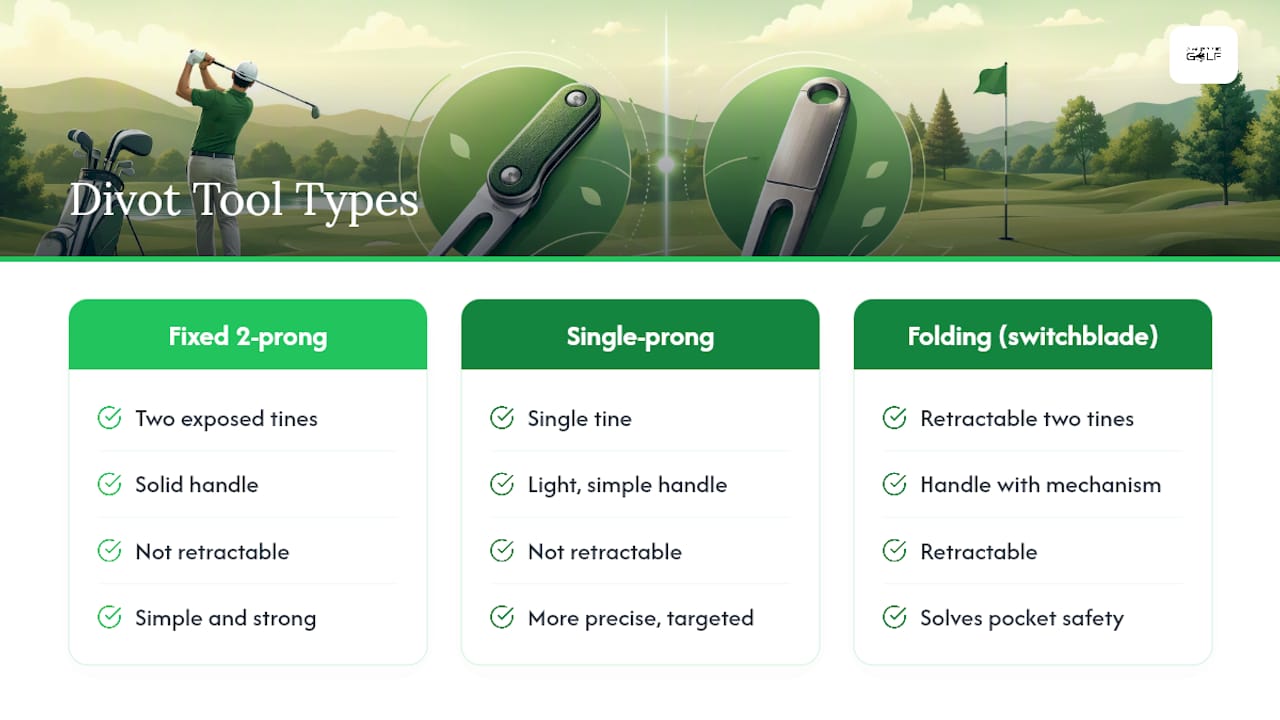
Fixed two-prong tools are the traditional design: a solid handle with two exposed metal tines permanently extended. They are simple, strong, and have been the standard for decades, which is why so many golfers still default to them without a second thought.
Single-prong tools use one tine instead of two, favored by some players and course staff for what they consider more precise, targeted repairs. They tend to be lighter and simpler than two-prong designs, though most casual golfers find a two-prong fork easier to use effectively.
Folding or switchblade tools retract the fork into the handle with a button or slide mechanism, similar in concept to a folding pocket knife. This is the newest of the three formats and the fastest growing, largely because it directly solves the pocket safety problem that has always plagued fixed designs. Most switchblade tools also use the retracted body as a mounting point for extras like a magnetic marker, which is harder to integrate cleanly into a simple fixed fork.
What Most Golfers Get Backwards About Divot Tools
Most advice on this topic focuses on repair mechanics: prong angle, pushing versus twisting, tine length. That advice is correct, but it answers the wrong question. The real bottleneck is not repair quality. It is carry rate.
A golfer with a mediocre tool in their pocket every round repairs more marks than a golfer with a perfect tool sitting in a bag back at the clubhouse. That is the entire case for folding designs over fixed ones for the average player, and it is a case built on behavior, not engineering. Pros who use divot tools like a genuine part of their routine treat the habit, not the hardware, as the variable that matters.
Where conventional advice falls short is treating fixed and folding as competing on repair quality. They are not. They compete on whether you will still be carrying the tool by your third round of the season. Prioritize the design you will actually keep on you, then worry about prong length.
— Gary
Get the Aiming Fluid Golf 5-in-1 Divot Tool
A solid divot tool checklist includes a folding switchblade fork for pocket safety, stainless steel prongs for durability, an aluminum alloy body that balances weight and strength, an integrated magnetic marker for convenience on the green, and a locking mechanism designed to deploy securely without wobble.

The Aiming Fluid 5-in-1 divot tool was built against exactly that checklist. It folds down to pocket size, deploys with a secure lock, and carries a magnetic marker on the handle so your pocket setup stays simple instead of cluttered with loose accessories. If you are outfitting the rest of your bag at the same time, the full Aiming Fluid Golf accessories lineup covers everything from magnetic towels to precision tees with the same organization-first thinking.
Expect a compact, palm-sized package on delivery, light enough that it disappears in a pocket until you actually need it. Check the foldable divot tool collection to compare finishes and pick the one that fits your bag.
Sources
- Best divot repair tools for golf | Golf Digest
- 5 Best Golf Divot Tools: Pro‑Tested For Perfect Greens | GolferHive
- Divot repair tool | Golfing For All glossary
FAQ
Do golfers actually use divot tools?
Many do not, and carry rate rather than repair skill is the biggest factor determining whether marks get fixed at all. A tool that is comfortable and safe to carry, like a folding design, gets used far more consistently than one left in a bag pocket.
Why do pro golfers not always replace their own divots?
On fairways, some tour players rely on course staff or maintenance crews to handle full divot repair rather than doing it themselves mid-round, especially under tournament time pressure. Ball marks on the green are a different matter entirely and nearly every player repairs those personally.
Why doesn’t Tiger Woods take divots on some shots?
Divot size and depth vary by swing type, ball position, and turf conditions rather than being optional. A shallower or steeper strike pattern can produce a smaller divot on certain shots, but it is a swing mechanics outcome, not a deliberate choice to avoid repairing turf.
Is a folding or fixed divot tool better for firm greens?
Fixed metal tools or heavier-duty foldables tend to perform better on very firm, compacted greens because they offer more consistent leverage. Standard lightweight foldables still work fine on most course conditions.
What should I check before buying a divot tool?
Look for stainless steel prongs between roughly 1.6 and 1.9 inches, a wobble-free locking mechanism if it folds, and explicit corrosion resistance in the product description. The Aiming Fluid 5-in-1 covers each of those points in a single foldable design.


