


TL;DR:
- Purpose-built rain accessories enable golfers to play more confidently in wet conditions by preventing gear failures and organizational failures. Selecting waterproof bags with welded seams, easy-access pockets, and high-quality rain apparel ensures long-lasting protection and comfort during rainy rounds. Using magnetic towels and organized utility pouches streamlines gear retrieval, minimizing disruptions when the weather turns wet.
Wet weather does not have to ruin a round. The real problem is not the rain itself but the cascade of failures it triggers: soaked grips, wet towels that spread moisture instead of removing it, and bags that leave your valuables sitting in puddles. Golfers who invest in purpose-built rain accessories consistently play more confidently and efficiently than those relying on standard gear improvised for bad weather. This article breaks down the selection criteria that matter most, compares the strongest options available, and identifies the accessories that deliver the greatest impact when conditions turn wet.
Table of Contents
- How to choose the best golf accessories for rain
- Waterproof bags and rain covers: Protecting your gear
- Rain-ready apparel: Jackets, gloves, and outerwear
- Underrated accessories for rainy golf: Magnetic towels, utility pouches, and more
- What most golfers overlook: Making rainy rounds easier with smart accessories
- Upgrade your rainy round essentials with Aiming Fluid Golf
- Frequently asked questions
Key Takeaways
| Point | Details |
|---|---|
| Premium waterproof bags | Welded seams and multi-pocket designs provide maximum protection for your golf gear. |
| Rain-specific gloves | Special wet-weather gloves enhance your grip and performance during rainy rounds. |
| Quick access organization | Multiple zip access points and magnetic towels keep valuables and gear accessible and dry. |
| Rain jackets with swing freedom | High-quality jackets deliver both waterproofing and full movement for year-round comfort. |
| Smart accessory selection | Prioritize gear that combines protection and easy access to streamline rainy rounds. |
How to choose the best golf accessories for rain
Having set the challenge, let’s break down what truly matters when selecting accessories for rainy golf. Not every waterproof label is created equal, and the details separate functional gear from gear that fails within the first nine holes.
Here are the most critical criteria to evaluate before purchasing:
-
Waterproofing technology. The two primary construction methods are taped seams and welded seams. Welded seams fuse materials together thermally, leaving no needle holes through which water can penetrate. Taped seams apply a barrier layer over stitching, which works well when new but degrades over time with washing and compression. For bags and covers, rain hood quality and taped or welded seams are critical factors, with premium construction enabling full rounds without wet gear while inferior options soak through quickly.
-
Ease of access under wet conditions. When your hands are wet and gloves are slippery, fumbling with small zippers or deep pockets creates frustration and slows your pace of play. Look for oversized zip pulls, magnetic closures, and pockets positioned for single-hand access. Reviewing rain and cold golf gear built specifically for adverse conditions reveals how many manufacturers now prioritize operational ease in wet environments.
-
Wet-specific grip enhancements. Standard leather gloves lose traction when wet, sometimes dramatically so. Wet-specific gloves use synthetic microfiber materials engineered to grip harder as moisture increases. Buying in pairs is standard practice because you will rotate them to maintain consistent grip pressure throughout the round.
-
Durability and breathability. Fully waterproof materials that trap heat and moisture internally create discomfort that leads to poor decision-making on the course. Breathable membranes like Gore-Tex and similar constructions allow vapor to escape while blocking external water entry. Durability under repeated flexion is equally important, as a rain jacket that loses its durable water repellent (DWR) finish after two seasons is not a sound investment. Smart organization also extends gear life, and organizing your golf bag properly reduces unnecessary wear on wet-weather items.
Pro Tip: When evaluating rain gear, run a seam test before your first round. Pour water directly onto the seams of your bag or jacket. If water beads and rolls off cleanly, the construction meets standard. If it absorbs or seeps, return it before conditions matter.
Waterproof bags and rain covers: Protecting your gear
After considering selection criteria, let’s look at solutions for keeping your gear dry and organized. The bag is the foundation of your entire rain system. A failure here means every other piece of gear you carry becomes compromised.
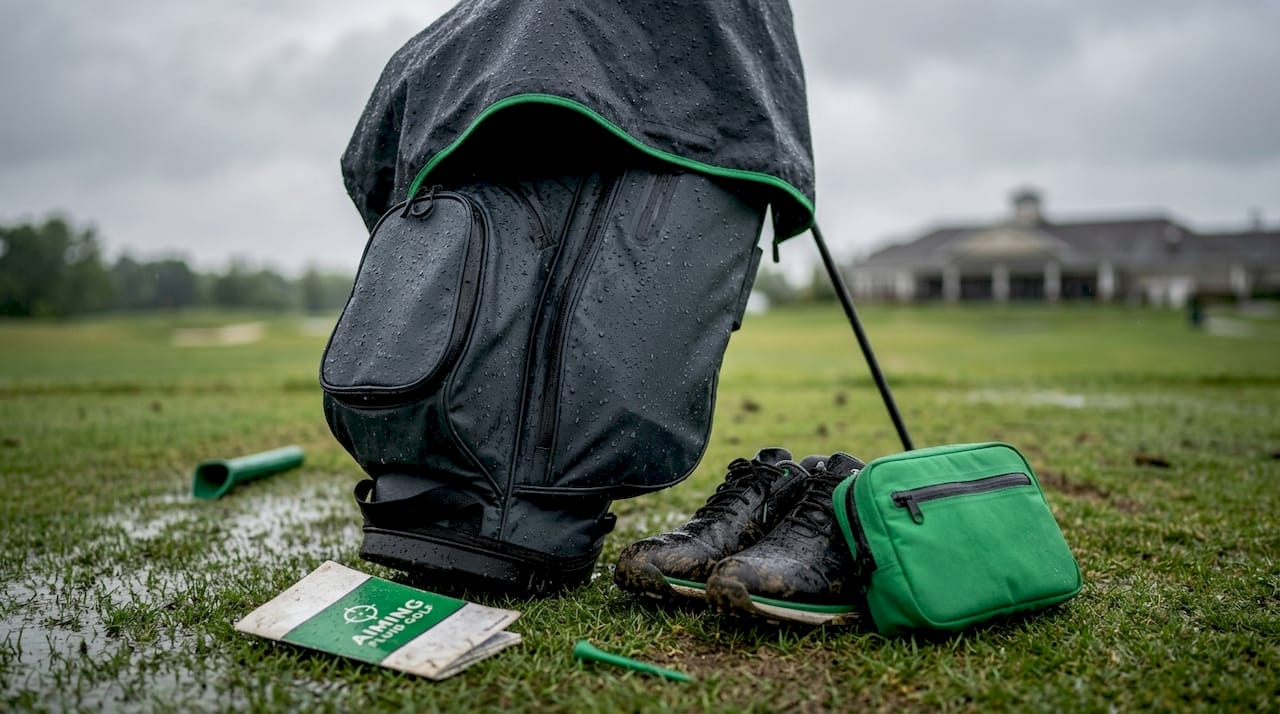
Waterproof golf bags and rain covers protect gear organization effectively when built with premium welded-seam construction, setting a clear benchmark for zero water penetration during extended wet rounds. The difference between a quality waterproof bag and a standard bag with a clip-on cover becomes obvious by the 12th hole.
Key features to prioritize when selecting a bag:
- Welded vs. stitched construction. Welded seam bags cost more upfront but maintain their waterproof integrity far longer. Stitched bags, even with taped seams, show degradation after repeated exposure.
- Rain hood access design. A full-length rain hood that unzips from the top gives you access to all clubs without removing the cover. Look for designs with separate section openings.
- Organizational pocket count and placement. Bags with waterproof pockets positioned on the outer panels allow quick retrieval without opening the main compartment.
- IPX ratings. IPX4 and above indicates resistance to water splashing from multiple directions. IPX7 means the bag can withstand immersion, which is overkill for most golfers but indicates high manufacturing standards.
Properly preparing your bag before a round is just as important as choosing the right one. A thorough approach to preparing your golf bag for rain involves pre-positioning gear, applying DWR spray to fabric pockets, and confirming all zippers are functioning before leaving the car.
| Feature | Welded seam bag | Stitched bag + rain cover | Budget bag + cover |
|---|---|---|---|
| Water penetration resistance | Excellent | Good initially | Variable |
| Seam durability over time | High | Moderate | Low |
| Quick zip access points | 4 to 8 typically | 2 to 4 typically | 1 to 2 |
| Organizational pocket count | 8 to 14 | 4 to 8 | 2 to 5 |
| Weight | Moderate to heavy | Lighter | Lightest |
| Long-term value | Highest | Middle | Lowest |
One important consideration for organization: bags with many pockets are ideal when dry, but tight pockets in fully waterproof bags can become harder to access when full during wet rounds. A bag with fewer, wider pockets often outperforms in actual rainy-round use. Planning your golf bag essentials with pocket accessibility in mind saves significant frustration on course.
Rain-ready apparel: Jackets, gloves, and outerwear
Once your bag is prepared, it’s time to focus on apparel that keeps you comfortable and lets you perform. Gear that restricts movement or soaks through by the back nine undermines every other preparation you make.
Rain jackets require specific evaluation criteria beyond simple waterproofing:
- Swing freedom. Articulated sleeves and stretch panels in the shoulders and underarms allow full rotation without binding. A jacket that restricts your backswing will cost more strokes than the rain itself.
- Breathable membranes. Look for taped seam construction combined with breathable membranes rated above 10,000g/m2 per 24 hours for moisture vapor transmission. Below that threshold, you will feel clammy by mid-round.
- DWR coating longevity. The outer fabric’s DWR finish determines how long water beads on the surface rather than saturating the shell. Quality DWR applied to premium rain jackets supports long-term waterproofing and swing freedom, consistently outperforming in both breathability and durability evaluations over multiple seasons.
- Packability. A jacket that compresses into a small pocket stays with you throughout a round. Bulky jackets left in the cart bag are useless when a storm rolls in during hole 14.
Wet-specific gloves are among the most impactful and underutilized accessories in a golfer’s rain kit. Regular leather gloves lose up to 40% of their grip coefficient when wet, which translates directly to reduced club control and inconsistent shots. Rain gloves worn in pairs provide maximum wet grip, with premium wet-specific models maintaining or enhancing traction empirically across multiple rounds where standard gloves fail. Rotation between two pairs during a round keeps grip performance consistent.
For additional outerwear considerations, including UV protection outerwear options that also manage light rain, multi-function layers provide year-round value beyond dedicated rain gear.
Pro Tip: Pack three pairs of wet gloves in a dry pouch rather than two. Rotating through three pairs across 18 holes means each pair has time to partially dry before being reused, maintaining peak grip performance throughout the round. Pair this with a performance golf polo made from moisture-wicking fabric under your rain layer to prevent the uncomfortable compression of wet cotton against your skin.
A well-assembled weather-resistant golf gear system accounts for both external protection and internal moisture management. Neither layer alone is sufficient.
Underrated accessories for rainy golf: Magnetic towels, utility pouches, and more
Beyond the big-ticket items, smaller accessories can make a major impact on rainy rounds. These are the tools that separate a prepared golfer from one who spends half the round searching for dry surfaces and dry storage.
Magnetic towels represent a genuine functional upgrade over traditional hook or loop towels. The core advantage is retrieval speed. In rain, you need to wipe a grip, face, or ball and return the towel to your bag without breaking stride. Understanding golf towel placement reveals how much time and focus golfers waste with poorly positioned towels during a round.
Key advantages of magnetic towels in wet conditions:
- Instant one-hand attachment and removal. Magnetic mounting eliminates fumbling with clips or loops when your hands are wet.
- Secure positioning. A strong magnetic connection keeps the towel in place on the cart or bag frame even in wind and rain.
- Quick-dry microfiber construction. High-quality microfiber removes moisture from club faces and grips rather than redistributing it.
- Reduces cross-contamination. A towel that stays clean and positioned means you are not wiping a grip with a muddy or waterlogged surface.
The role of keeping golf gear dry extends beyond the towel itself. Hooks, magnetic attachments, and organized placement systems collectively ensure that every dry-off tool is ready when you need it.
Utility pouches serve a specific but important function during rainy rounds: protecting electronics, scorecards, range finders, and personal items from moisture damage. A waterproof-zip pouch mounted inside an accessible bag pocket means your rangefinder stays dry without needing a separate case.
| Accessory type | Rain performance | Dry performance | Access speed | Replacement frequency |
|---|---|---|---|---|
| Standard cotton towel | Poor (retains moisture) | Adequate | Moderate | High |
| Microfiber hook towel | Good | Good | Moderate | Moderate |
| Magnetic microfiber towel | Excellent | Excellent | Fast | Low |
| Standard glove | Poor when wet | Good | Fast | Moderate |
| Wet-specific glove pair | Excellent | Adequate | Fast | Moderate |
| Zip utility pouch | Excellent for valuables | Good | Moderate | Very low |
| Budget rain cover | Variable | N/A | Slow | High |
The pattern in the table above reflects a consistent principle: accessories engineered for wet-specific performance deliver superior results in their intended conditions and competitive or equivalent results under normal conditions. There is no meaningful trade-off in choosing premium wet-weather accessories over standard ones.
What most golfers overlook: Making rainy rounds easier with smart accessories
Here is a perspective that most rain-gear guides avoid: the majority of golfers focus almost entirely on apparel when preparing for wet weather, but the biggest performance losses in rainy rounds come from organizational failures, not warmth or waterproofing failures.
Think about what actually disrupts your round when it rains. It is not usually that your jacket leaks. It is that your towel is wet before you reach the third hole, your spare gloves are buried under a rain hood you cannot open quickly, and your rangefinder is sitting in a damp pocket. These are system failures, not equipment failures. The apparel is doing its job, but the supporting accessories are not.
Golfers who approach their bag as a functional system, rather than a collection of individual tools, consistently perform better in wet conditions. This mirrors what separates scratch golfer techniques from high-handicap habits: it is rarely about one piece of gear but about how all pieces work together under pressure.
The three most common organizational mistakes in rainy rounds are predictable:
- Forgetting to pre-position spare gloves in an accessible outer pocket before the round starts.
- Using a standard towel without a secure attachment system, leading to lost or contaminated towels within the first few holes.
- Carrying valuable electronics loose in main compartments rather than in sealed utility pouches.
The fix for all three is not expensive. It requires selecting accessories with wet-round operation in mind rather than selecting for dry conditions and hoping they perform when it rains.
Pro Tip: Invest in gear that combines protection with easy access simultaneously. A waterproof pouch that requires four steps to open defeats its own purpose. A magnetic towel system that holds firmly but releases with one motion is worth twice the price of a cheaper option that fails under operational pressure.
Upgrade your rainy round essentials with Aiming Fluid Golf
The accessories reviewed in this article all address specific failure points in rainy-round play. Aiming Fluid Golf builds products that target the exact gaps most golfers encounter: slow towel access, disorganized pouches, and gear that works in the parking lot but fails on the course.

Our magnetic golf towels are engineered for one-hand attachment and release, keeping your drying surface clean, accessible, and secure in all weather. Our premium utility pouches provide waterproof storage for the valuables that standard bags leave exposed. For golfers looking to build a complete wet-round system, our best golf accessories expert picks page walks through curated recommendations by category. You can also review our top divot tool guide to cover every accessory category a serious golfer needs in wet conditions.
Frequently asked questions
What makes a golf bag truly waterproof?
A truly waterproof golf bag relies on welded seams and IPX-rated materials combined with multiple zip access points that keep water out while maintaining fast, organized retrieval of your gear. Standard stitched bags, even with taped seams, cannot match the long-term water resistance of welded construction.
Do rain gloves work better than regular golf gloves in the wet?
Yes. Premium wet-specific gloves maintain or improve traction as moisture increases, while regular leather gloves lose grip significantly in wet conditions. Wearing them in pairs and rotating throughout the round delivers the most consistent performance.
Are premium rain jackets worth the investment for golf?
Premium rain jackets like the Zero Restriction Z2000 outperform in breathability and long-term durability, providing full swing mobility and sustained waterproofing over multiple seasons. For golfers who play frequently in wet conditions, the cost per round quickly justifies the higher initial price.
How do utility pouches help during rainy rounds?
Utility pouches with waterproof zippers create a sealed environment for electronics, scorecards, and personal items that standard bag pockets cannot provide. They prevent damage that accumulates gradually through repeated exposure, protecting gear that costs significantly more than the pouch itself.
What’s the best strategy for retrieving towels and gloves quickly during a rainstorm?
Use a magnetic towel system mounted to your bag frame for one-motion access, and store spare gloves in a dedicated outer pocket marked before your round starts. Pre-positioning your most-needed wet-round accessories eliminates the search time that disrupts focus and pace of play.
Recommended
- Rain-Ready Golf: How to Prepare Your Golf Bag for Wet Weather – Aiming Fluid Golf
- How Weather-Resistant Golf Gear Elevates Your Game – Aiming Fluid Golf
- Winter Golf Survival Guide: Gear & Tips for Rain & Cold – Aiming Fluid Golf
- Keeping Your Golf Gear Close and Dry: The Role of Golf Towel Hooks – Aiming Fluid Golf


