


TL;DR:
- Ergonomic golf accessories focus on reducing fatigue, improving organization, and supporting consistent performance.
- Upgrades like zero-taper grips and dual-strap bags provide significant comfort and efficiency benefits.
- Small ergonomic improvements often outperform expensive club technology in enhancing overall golf performance.
Every serious amateur golfer has felt it: fumbling for a towel mid-round, shoulders aching after 14 holes, or burning 30 seconds hunting for a rangefinder buried in a cluttered bag. These moments add up. They drain focus, eat into your energy reserves, and cost real strokes. Modern ergonomic golf design is engineered specifically to eliminate those friction points. This guide breaks down the key criteria for evaluating ergonomic golf accessories, examines the best categories available, and delivers a clear comparison framework to help you choose upgrades that actually move the needle on performance.
Table of Contents
- The key criteria for evaluating ergonomic golf accessories
- Ergonomic golf grips: The foundation for comfort and control
- Ergonomic golf bag innovations for efficient on-course organization
- Quick-access and magnetic golf accessories for seamless play
- Side-by-side comparison: Which ergonomic golf accessories deliver the biggest gains?
- A new approach: Why minor ergonomic tweaks outclass expensive upgrades
- Maximize your golf performance: Top ergonomic accessories to try now
- Frequently asked questions
Key Takeaways
| Point | Details |
|---|---|
| Prioritize ergonomic upgrades | Single-hand access, magnetic closures, and padded straps immediately improve efficiency and energy. |
| Zero-taper grips for stability | Switching to zero-taper grips balances hand pressure and increases swing consistency with brief adaptation. |
| Bags with smarter compartments | Golf bags with well-placed pockets and dual straps reduce search time and fatigue over a full round. |
| Quick-access accessories speed play | Magnetic towels and utility pouches help keep you organized without breaking concentration during a round. |
The key criteria for evaluating ergonomic golf accessories
Once you know what you want to achieve, let’s break down the main ergonomic factors that matter when choosing accessories that genuinely improve performance.
Most golfers evaluate gear by brand recognition or price. Serious amateurs should evaluate it by biomechanical efficiency: how well a piece of equipment reduces unnecessary movement, minimizes physical strain, and supports consistent performance over 18 holes.
Three factors matter most:
- Weight distribution: Accessories that concentrate load unevenly force compensatory posture changes that build fatigue. Balanced load design keeps your body in a neutral position longer.
- Single-hand access: Any accessory requiring two hands to operate interrupts your routine, slows pace of play, and adds a minor but cumulative cognitive cost. One-hand access mechanisms eliminate these micro-interruptions.
- Adjustable fit: Bodies and swings differ. Accessories with adjustable components, whether strap length, grip thickness, or attachment angle, allow you to tune the fit to your exact mechanics.
Overlooked features like magnetic closures and easy-reach compartments also play a measurable role. Dual padded straps and load-distributing harnesses reduce fatigue over 18 holes, meaning the structural design of your gear directly affects how much energy you have left on the back nine.
Pro Tip: Prioritize accessories that can be operated with one hand during play. If you need to stop, set down your club, and use both hands to retrieve something, that accessory is costing you time and focus every single round.
Ergonomic golf grips: The foundation for comfort and control
With your criteria in mind, start with the most hands-on accessory: your grips. No accessory makes more direct physical contact with a golfer during a round, and grip design has seen some of the most significant ergonomic advances in recent years.
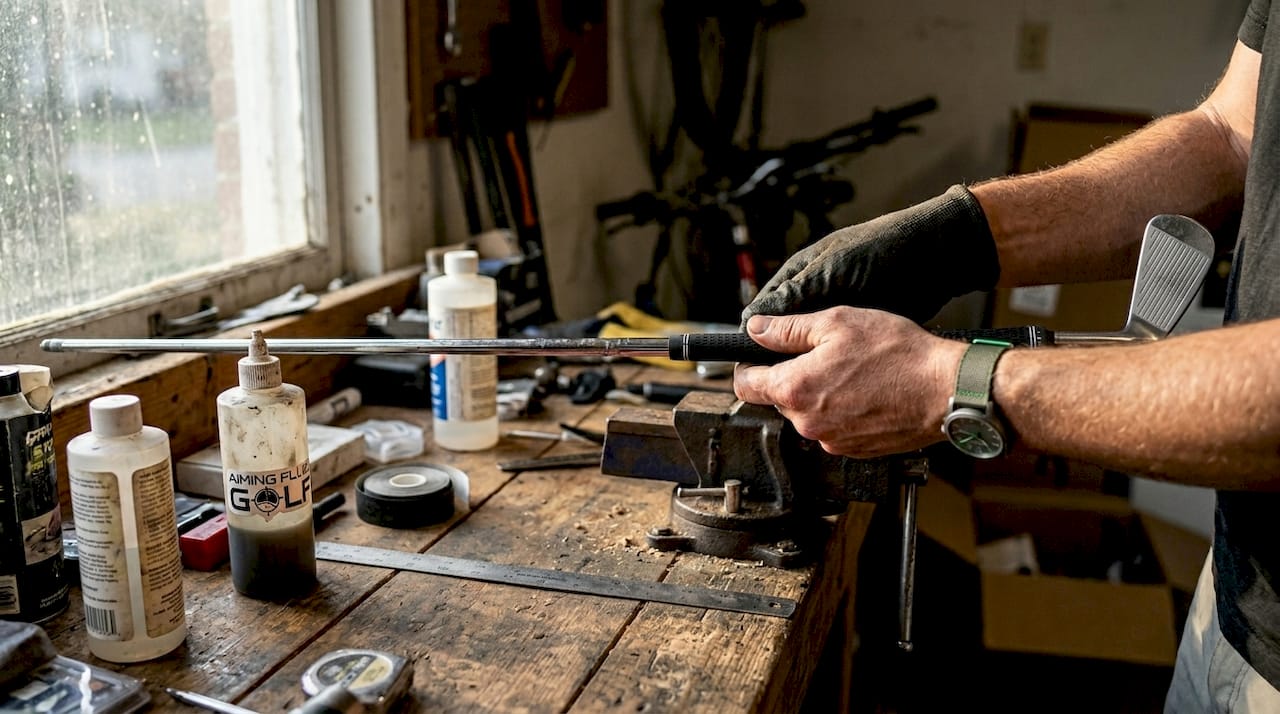
Zero-taper grips are the most talked-about innovation. Traditional grips taper from a thicker top to a narrower bottom, which can create uneven pressure between the top and bottom hand. Zero-taper designs maintain a consistent diameter throughout the grip length, eliminating that pressure differential.
Key benefits for serious amateurs:
- Reduced grip tension: Consistent diameter means neither hand is squeezing harder to compensate for taper.
- More consistent swing path: Balanced pressure translates to a more repeatable face position at impact.
- Less forearm fatigue: Lower tension across 70-plus swings per round adds up to meaningful energy savings.
- Improved face awareness: Players report a better tactile sense of club face angle when grip pressure is equalized.
“Zero-taper golf grips reduce uneven hand pressure and improve face awareness after two weeks of use.”
Most players need one to two weeks of adaptation before the benefits fully register. For players with established grip habits, traditional grips may still be preferable on full-swing clubs while zero-taper is adopted on the putter first. Testing on the green before committing to a full regrip is the practical approach.
Ergonomic golf bag innovations for efficient on-course organization
After grip comfort, your golf bag’s ergonomics play a huge role in energy and focus over 18 holes. A bag that fits poorly or buries essential gear can quietly sabotage even a well-prepared round.
Dual padded straps are the single most impactful structural feature. By distributing the bag’s weight across both shoulders and the lower back, dual-strap systems prevent the unilateral muscle fatigue that comes from single-strap carry bags. Your core and back stay more balanced, meaning your posture, and your swing mechanics, hold up better as the round progresses.
The most valuable bag innovations, ranked by practical impact:
- Magnetic rangefinder pocket: Instant single-hand access before every shot, no zipper to fight with.
- Dedicated ball pockets: Separate compartments for game balls and range balls prevent the search penalty.
- Smart club dividers: Full-length dividers protect shafts and make club selection faster.
- Integrated cooler sleeve: Hydration access without a separate bag or detour to the cart.
- Hip pad and sternum strap: Fine-tune load distribution for your exact torso length and carry style.
Premium ergonomic golf bags offer 15 storage zones and features like magnetic rangefinder and ball pockets for faster access, a design standard that serious amateurs should treat as a baseline, not a luxury.
Pro Tip: Adjust your bag straps at the start of each round, not just when you buy the bag. Temperature, clothing layers, and fatigue all affect ideal strap length, and a five-second adjustment protects your back for all 18 holes. Pairing this habit with a guide on organizing your golf bag systematically can double the efficiency gains.
Quick-access and magnetic golf accessories for seamless play
Beyond bags, a new wave of magnetic and one-handed accessories is making a real impact for serious amateurs. These tools address a specific problem: the constant micro-interruptions caused by traditional clip, zipper, and velcro systems.
Magnets and grab-and-go designs reduce fumbles and keep your attention on the shot at hand, not on gear retrieval. This category covers more ground than most golfers realize:
- Magnetic golf towels: Attach directly to the bag frame with a strong-pull magnet. Grab with one hand, wipe, return. No threading through bag loops or re-clipping a carabiner.
- Utility pouches with magnetic closures: Keep tees, ball markers, and divot tools organized and accessible without a zipper search.
- Magnetic rangefinder holders: Mount to cart rails or bag frames for instant grab-and-go access before every approach.
- Magnetic divot tools: Attach to the bag or belt clip and remove with one motion.
| Feature | Magnetic accessories | Traditional accessories |
|---|---|---|
| Access time | Under 2 seconds | 5-15 seconds |
| Hand operation | Single-hand | Usually two-hand |
| Lost-item risk | Low (secured by magnet) | Moderate (clips, zippers fail) |
| Setup time per round | Minimal | Moderate |
One-hand access mechanisms and balanced load can cut wasted gear handling time by as much as 20-30% per hole, a figure that translates to real time savings and reduced mental load across a full round. For players focused on faster gear access, the magnetic category is where the most immediate gains are available without changing your swing or fitness routine.
When choosing, factor in your course style. Cart players benefit most from magnetic rangefinder holders and utility pouches. Walkers see the biggest return from magnetic towels and lightweight bag attachments. Budget is rarely a major barrier: most magnetic accessories cost less than a single sleeve of premium balls.
Side-by-side comparison: Which ergonomic golf accessories deliver the biggest gains?
To help you choose confidently, see this head-to-head look at the best-in-class ergonomic accessory upgrades.
| Accessory type | Fatigue reduction | Organization score | Best for |
|---|---|---|---|
| Zero-taper grips | High | Low | Swing consistency, grip pressure control |
| Ergonomic dual-strap bag | Very high | High | Walkers, long rounds |
| Magnetic towel | Low | High | All players, pace of play |
| Magnetic utility pouch | Low | Very high | Cart and carry players |
| Magnetic rangefinder holder | Low | High | All players, approach shots |
Minimized fatigue through ergonomics correlates with better late-round consistency and organization, even without direct score benchmarks. The practical implication: the cumulative benefit of several ergonomic upgrades working together outperforms a single expensive equipment change.
Recommendations by player type:
- Walker: Dual-strap ergonomic bag plus magnetic towel. Address carry fatigue first.
- Cart player: Magnetic utility pouch plus magnetic rangefinder holder. Optimize access speed.
- Budget-focused: Start with magnetic towel and zero-taper putter grip. High impact, low cost.
- Gear minimalist: Magnetic divot tool and one utility pouch covers the essentials without overloading.
When balancing cost, weight, and ergonomics, prioritize the category where you feel the most friction today. The goal of efficient accessory design is to remove the barriers between your intention and your execution on the course.
A new approach: Why minor ergonomic tweaks outclass expensive upgrades
Seeing the comparison, here is the hard-earned view from inside the game. Most serious amateurs chase new clubs when their scores plateau. A new driver, updated irons, a heavier putter. The logic feels sound: better equipment should produce better results. But the data and practical experience tell a different story.
Biomechanical design improvements yield measurable comfort gains, translating into consistency for serious amateurs. The most persistent late-round errors rarely trace back to club technology. They trace back to fatigue, distraction, and time wasted managing gear instead of managing the course.
“The most persistent late-round errors usually trace to fatigue and organization, not club tech.”
A $40 magnetic towel or a $25 zero-taper putter grip addresses the actual failure point far more directly than a $500 club upgrade. When you customize your accessories systematically, you remove the compounding friction that erodes performance over the final six holes of a round.
Pro Tip: Test one ergonomic upgrade at a time and give it three to four rounds before evaluating. Stacking multiple changes at once makes it impossible to isolate which improvement is producing results.
Maximize your golf performance: Top ergonomic accessories to try now
Ready to level up your organization and ease on the course? Here are resources and accessories that deliver proven ergonomic benefits for serious amateurs at every budget level.

Aiming Fluid Golf builds accessories specifically engineered for the friction points this article covers: magnetic attachment systems, precision-designed utility pouches, and performance towels built for one-handed access. Start with ergonomic magnetic towels to eliminate the most common on-course interruption immediately. For a broader view of category-leading gear, the expert golf accessory picks guide covers options across every player type. If you want the full framework before buying, the top golf accessory guide breaks down every major category with performance benchmarks and practical recommendations.
Frequently asked questions
What are the most important ergonomic features in a golf bag?
The biggest benefits come from dual padded straps, magnetic closures for single-hand access, and multiple organized compartments that reduce fatigue and save search time across a full round.
How do zero-taper grips help amateur golfers?
Zero-taper grips promote balanced pressure across both hands, reduce grip tension throughout the swing, and improve face awareness and stroke consistency for players who struggle with uneven grip pressure.
Why are magnetic golf accessories recommended?
Magnetic accessories enable instant single-hand gear retrieval, reducing lost time on every hole and keeping your attention on course management rather than equipment fumbling.
Do ergonomic accessories directly lower golf scores?
While direct score benchmarks are limited, ergonomic accessories consistently reduce fatigue and maintain focus, which supports better decision-making and swing consistency during the final holes of a round when performance typically drops.


