


A well-built equipment tracking workflow for golfers is a deliberate, structured approach to organizing, monitoring, and maintaining every piece of gear in your bag. It prevents loss, speeds up access during play, and keeps your equipment performing at the level your game demands. Without it, your bag feels like a junk drawer: clubs misplaced at the green, towels buried at the bottom, tees scattered everywhere.
The core benefits of a systematic gear management approach include:
- Loss prevention: Club trackers that attach inside grip ends alert your phone the moment a club separates from your bag, typically before you reach the next hole.
- Faster access: Magnetic towel and landing pad systems allow one-handed retrieval and return, cutting the time you spend searching between shots.
- Condition awareness: Regular assessments catch loft and lie drift before it forces compensatory swing changes.
- Inventory control: Tracking usage history lets you schedule replacements proactively, not reactively.
Aimingfluidgolf builds accessories specifically for this kind of workflow: magnetic towels, landing pads, precision tees, and utility pouches designed to keep gear accessible, clean, and ready on every hole.
Table of Contents
- How to build an equipment tracking workflow that actually works
- Premium accessories that make your workflow function on the course
- How to keep your golf equipment workflow performing over time
- Why thoughtful accessory design determines workflow success
- Aimingfluidgolf gives you the physical foundation your workflow needs
- Key Takeaways
How to build an equipment tracking workflow that actually works
Setting up a reliable golf gear tracking system takes one focused session and a consistent routine after each round. Here is the sequence that holds up over time.

Step 1: Categorize by frequency and condition. Sort your gear into three tiers: items used every hole (towel, tees, ball marker, divot tool), items used most rounds (rangefinder, glove, extra balls), and items used occasionally (rain gear, extra grips, training aids). Assign each tier a fixed location in your bag.
Step 2: Assign magnetic accessories to high-frequency items. Your towel and divot tool should never require a search. Magnetic systems attach these items to the exterior of your bag so they snap back in place after every use. This eliminates the “bottom of the bag” syndrome where essential tools disappear until the worst possible moment.
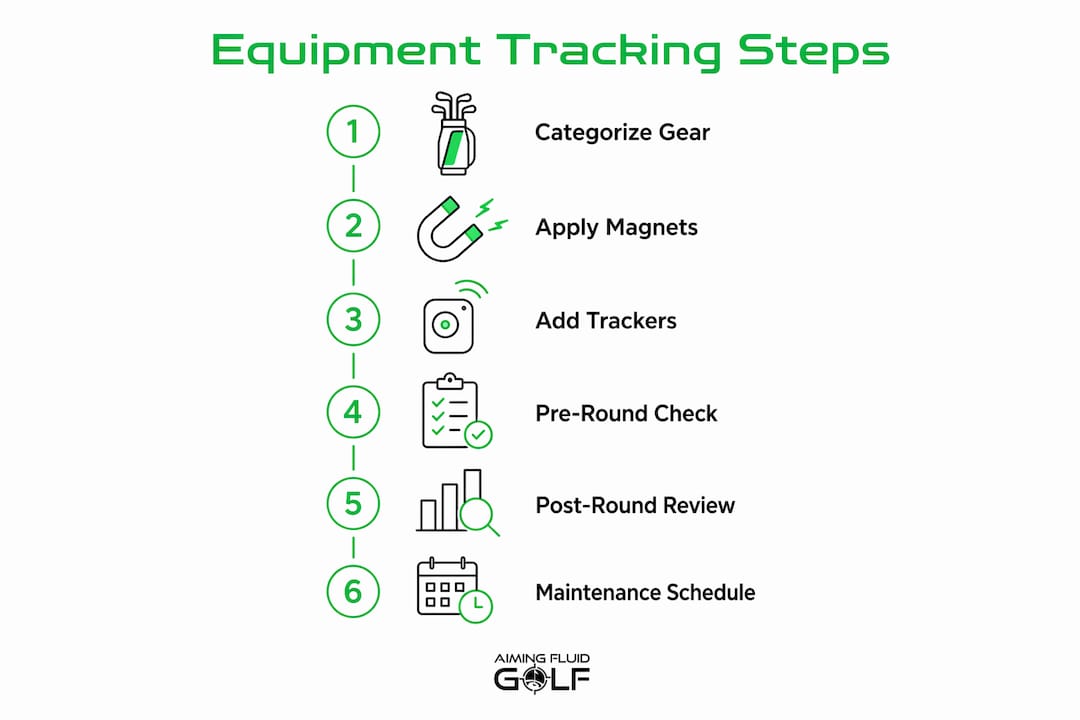
Step 3: Integrate a purpose-built club tracker. Generic bag trackers tell you where your bag is. A grip-end tracker like ClubWatch tells you the second a specific club is not in it, with a real alarm rather than a passive locator. The device fits inside the standard grip end without affecting your swing feel.
Step 4: Build a pre-round check routine. Before every round, confirm your full club count, check tee and ball marker supply, inspect your towel and landing pad magnets, and verify your rangefinder battery. Five minutes at the car prevents a 45-minute scramble on the course.
Step 5: Run a post-round review. After each round, wipe down clubs, note any gear that showed wear, and update your inventory log. A simple notes app works fine for this. The goal is a living asset record that tracks each item’s condition and last service date.
Step 6: Schedule maintenance and replacements. Grips typically need replacing every 40–60 rounds. Wedge grooves wear faster for players who practice frequently. Tracking usage by round count gives you a concrete trigger for replacement rather than waiting until performance degrades.
Pro Tip: Prioritize the accessories you touch on every single hole. If your towel takes more than two seconds to access and return, it is costing you focus and pace. Fix that before adding any other layer to your workflow.
Premium accessories that make your workflow function on the course
The right physical accessories are what convert a workflow plan into a real on-course system. These are the categories that matter most.
1. Magnetic golf towels
A magnetic golf towel attaches directly to your bag with a strong magnet, stays put during your swing, and releases with one hand when you need it. Compared to carabiner-style towels, the magnetic connection is faster and requires no grip adjustment. Aimingfluidgolf’s magnetic towels include a dedicated wash pocket so you always have a clean surface for your clubface.
2. Magnetic landing pads
A landing pad gives your towel a fixed return point on the bag exterior. Without one, even a magnetic towel can end up draped awkwardly or dropped. Aimingfluidgolf’s landing pad system pairs directly with their magnetic towels, creating a consistent snap-back location that works whether you are walking or riding.
3. Precision golf tees
Tees are the most frequently lost item in any bag. Keeping a dedicated tee pouch in a fixed outer pocket, stocked with a consistent tee style, removes one more variable from your pre-shot routine. Aimingfluidgolf’s DON’T SUCK tees are designed for consistent height and durability, reducing mid-round restocking.
4. Multipurpose divot tools
A 5-in-1 divot tool that includes a ball marker, groove cleaner, and club rest reduces the number of separate items you carry. Fewer items means fewer things to misplace and fewer pockets to check.
5. Utility pouches
A structured utility pouch mounted to your bag keeps small items (ball markers, tees, a spare glove) in one retrievable location. The key design requirement is external access: if you have to open a zipper and dig, the pouch is not doing its job.
“The best golf accessories are the ones that are used the most and not left in the bottom of your golf bag to only be rediscovered years later.” — Today’s Golfer
Pro Tip: When evaluating any accessory for your workflow, ask one question: can I access and return this item in under three seconds without looking? If the answer is no, the design is working against you.
How to keep your golf equipment workflow performing over time
A workflow degrades without maintenance. These practices keep it functional across seasons.
- Assess club fit annually. Incorrectly fitted clubs force technique adaptations that mask the real problem. A professional fitter checks loft, lie, shaft flex, and grip size against your current swing mechanics, not the swing you had when you bought the clubs.
- Check loft and lie after any swing change. Even a moderate adjustment to your swing path or attack angle can make previously fitted clubs work against you. Periodic loft and lie checks prevent inconsistent strikes from becoming a permanent technique problem.
- Update your inventory log after every equipment change. When you add a club, replace a grip, or retire a wedge, update your record the same day. Stale inventory data is worse than no data because it creates false confidence.
- Inspect magnetic connections monthly. Magnet strength can degrade if accessories are dropped repeatedly or exposed to heat. A quick pull-force check confirms your towel and landing pad are still holding at full strength.
- Replace consumables on a schedule, not on feel. Grips that feel fine often measure well below optimal tackiness. Tracking round counts gives you an objective replacement trigger.
Consistent workflow upkeep means you arrive at every round knowing your gear is ready. That confidence removes a category of mental distraction that affects more shots than most golfers realize.
Why thoughtful accessory design determines workflow success
Most golfers who struggle with gear organization are not undisciplined. They are using accessories that were not designed for workflow integration. A towel with no fixed return point, a divot tool that lives loose in a pocket, tees scattered across three compartments: these are design failures, not personal failures.
Industry analysts note that over-complicated gear kits with rarely used accessories create clutter that undermines focus, while lean kits with assigned locations for each item improve comfort and concentration. The solution is not more gear. It is purposeful gear.
Professional club fitters make the same point about equipment fit: chasing new gear to solve performance problems almost always misses the actual cause, which is usually a fit issue with existing clubs. The same logic applies to accessories. Adding a fifth bag organizer does not fix a workflow problem caused by a poorly designed towel attachment.
Aimingfluidgolf’s design philosophy addresses this directly. Every product in their line solves a specific on-course friction point: the magnetic towel and landing pad system eliminates towel retrieval time, the precision tees reduce pre-shot fumbling, and the multipurpose divot tool cuts the number of items you carry. The result is a golf convenience workflow built around subtraction, not addition.
Aimingfluidgolf gives you the physical foundation your workflow needs
Most workflow guides stop at the system level and leave you to find the accessories yourself. Aimingfluidgolf builds the physical layer: the magnetic towels, landing pads, precision tees, divot tools, and utility pouches that make the workflow function on the course, not just on paper.

The magnetic towel and landing pad combination is the fastest way to fix the single biggest access problem in most golfers’ bags. Every product is engineered for one-handed use, durable materials, and a fixed return point so your gear is always where you expect it. Browse the full expert accessory picks at Aimingfluidgolf and build your workflow from the ground up.
Key Takeaways
A reliable equipment tracking workflow for golfers depends on categorizing gear by frequency, using magnetic accessories for instant access, integrating digital club trackers, and maintaining equipment through scheduled assessments.
| Point | Details |
|---|---|
| Categorize before you organize | Sort gear into three tiers by use frequency and assign each a fixed bag location. |
| Magnetic systems eliminate search time | Magnetic towels and landing pads provide one-handed access and a consistent return point on every hole. |
| Digital trackers prevent club loss | Grip-end club trackers alarm your phone the moment a club separates from your bag. |
| Fit checks protect your workflow | Annual professional fitting prevents incorrectly fitted clubs from forcing compensatory swing changes. |
| Aimingfluidgolf | Magnetic towels, landing pads, precision tees, and divot tools form the physical foundation of an on-course gear management system. |
Recommended
- Golf Bag Systems | Stop Losing Gear & Play Faster | Aiming Fluid Golf
- Master the golf convenience workflow for faster play – Aiming Fluid Golf
- Improve golf equipment workflow for faster play and focus – Aiming Fluid Golf
- Golf Bag Essentials Checklist 2026: The Ultimate Gear Guide – Aiming Fluid Golf


