


A ball mark, also called a pitch mark, is a dent your ball punches into a green on landing. Fix it immediately by pushing the turf inward, not lifting it. A divot is the chunk of turf your club rips out of a fairway or tee. Replace that turf or fill the scar with a sand mix. If you skip either repair, you leave the next player a bad bounce or a bent putt.
TL;DR:
- Repair ball marks by pushing the turf inward from the edge, avoiding lifting or digging, to promote faster healing and prevent damage to roots.
- Fix intact divots by replacing them in the hole with firm pressure, but fill shattered divots with sand and seed to prevent erosion and slow recovery.
- Use a two-prong repair tool designed for greens on ball marks, and avoid using it for fairway divots, which require filling or turf replacement instead.
- Do not assume relief for fairway divots, as under the Rules of Golf they must be played as they lie unless a local rule states otherwise.
- Proper tools and techniques, like sturdy, shape-retentive repair tools, make correct repairs easier and help keep courses in better condition.
Table of Contents
- Divot vs Ball Mark: What Each Term Actually Means
- How Do You Repair a Ball Mark Correctly?
- How Should You Fix a Fairway Divot?
- Why Is a “Divot Tool” Actually for Ball Marks?
- What Do the Rules of Golf Say About Repairs?
- What Repair Mistakes Actually Hurt the Course?
- Why Better Tools Make Correct Repairs Easier
- A Note on Stewardship From Gary
- Gear That Makes Correct Repairs Automatic
- Sources
- FAQ
Divot vs Ball Mark: What Each Term Actually Means
The two terms describe different injuries to different parts of the course, caused by different objects hitting the ground. Mixing them up is understandable, since both leave a visible scar in turf, but the mechanics and the fix are not interchangeable.
A divot is the strip of turf and soil your clubhead displaces during a downward swing, typically on a fairway or a tee box. You’ll see the divot hole (the bare patch left behind) and, ideally, the divot itself lying a few feet ahead, still attached to a slab of dirt. Divots happen almost exclusively where you’re swinging a club through the ground: fairways, tee boxes, and the rough after an aggressive iron shot.
A ball mark, or pitch mark, is something else entirely. It’s a small crater formed when your ball lands on a green with enough speed and spin to compress the grass and soil beneath it. No club touches the ground here. The damage comes from the golf ball itself, usually on an approach shot that lands soft and steep. You’ll find ball marks almost exclusively on putting greens, occasionally on closely mown collars or fringe areas where a chip shot lands hard.
Regional naming adds another layer of confusion. In the United States, golfers almost universally say “ball mark.” In the United Kingdom and much of the rest of the golfing world, the same crater is called a “pitch mark.” Both terms describe the identical injury. The confusion compounds when golfers then talk about a “divot on the green,” which technically doesn’t exist, since nothing is removed on a green, only compressed.
Here’s a quick reference for keeping the two straight:
- Divot: turf removed by a club, found on fairways, tees, and rough
- Ball mark / pitch mark: turf compressed by a landing ball, found on greens and closely mown surfaces
- Repair direction: divots get filled or replaced; ball marks get pushed inward, never lifted
- Naming: “pitch mark” and “ball mark” are the same thing; “divot” never applies to green damage
Understanding this distinction matters for more than vocabulary. The repair method for one will actively damage the other if you apply it in the wrong place, which is exactly what the next section covers.
How Do You Repair a Ball Mark Correctly?
A ball mark is a compression injury. The turf isn’t gone, it’s been pressed down and outward, with the surface layer often torn or folded at the edges. That distinction drives the entire repair technique, because the goal is to close the wound, not excavate it.
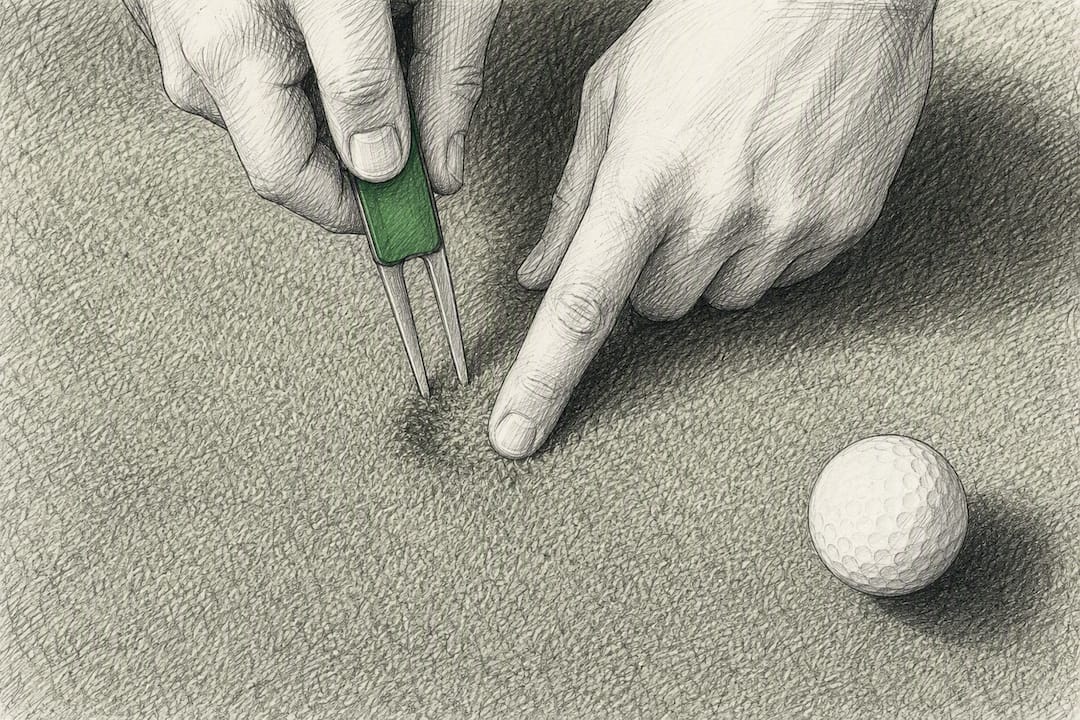
Compare that to a divot, where turf has actually been removed and needs to be replaced or filled. Treating a ball mark like a divot (trying to lift or lever the center back into place) tears roots that are still partially connected and creates a bare spot that takes far longer to heal. The USGA Green Section explains this biological difference directly: ball marks need closure from the edges inward, while divots need replaced turf so roots can re-establish soil contact.
Here’s the correct technique, step by step:
- Locate the raised edge. A fresh ball mark usually has turf pushed up on one side, opposite the direction the ball was traveling. That raised lip is where you start.
- Insert your repair tool at the edge, not the center. Push the prongs into the turf just outside the crater, angled slightly toward the middle.
- Twist gently and pull the surrounding turf inward. Work around the perimeter, drawing grass from all sides toward the center of the depression, rather than digging into the middle itself.
- Tamp the surface flat with your putter head. Once the turf is pulled together, a light, level press seats it back into the soil without leaving a mound.
- Check the surface with your palm or putter face. It should feel smooth and flush with the surrounding green, not raised, not sunken.
The most common mistake is inserting the tool straight down into the center and levering upward, like you’re popping a cork. That motion tears the root system directly beneath the mark and leaves a bare patch that takes noticeably longer to fill in. PGA Play’s turf guidance is blunt about this: the correct motion pushes turf inward from the edges, and lifting from below is the single most damaging habit golfers repeat without realizing it.
The second mistake is leaving a small mound after repair, usually from overcompensating by pulling in too much turf. A mound catches sunlight unevenly, dries out faster than the surrounding grass, and can still deflect a rolling ball, defeating the entire purpose of the repair.
The payoff for getting this right is almost immediate. A properly repaired ball mark can recover in a day or two, while one left untouched or repaired poorly can take days or weeks to heal, staying visible and affecting the roll of every putt that crosses it in the meantime.
Pro Tip: Repair your own ball mark before you even mark your ball for putting. It takes ten seconds, and doing it early means you won’t forget once your focus shifts to the read on your putt.
For golfers who want a visual walkthrough of this exact motion, Aiming Fluid Golf’s step-by-step repair guide breaks down the same technique with photos of proper tool angle and pressure.
How Should You Fix a Fairway Divot?
Fairway divots split into two categories, and which one you’re looking at determines your repair method. Get this wrong and you either waste a perfectly good piece of turf or make a mess trying to force a shattered clump back into a hole it won’t sit flush in.
Intact divots hold together as a single piece, roughly the shape and size of your clubhead, with soil still clinging to the roots. If your divot flew out in one piece, the fix is straightforward: pick it up, place it back in the hole grass-side up, and press it down firmly with your foot or club. Firm contact matters here, since the goal is re-establishing soil contact so the roots can reconnect and keep growing.
Shattered divots break apart into loose fragments, usually because the turf was dry, thin, or already stressed from heat or foot traffic. Trying to reassemble a shattered divot is a losing effort. Instead, most courses provide a sand-and-seed mix in a bottle mounted on carts or at tee boxes specifically for this scenario. Fill the scar level with the surrounding fairway, using enough mix to cover the exposed soil without mounding it above grade.
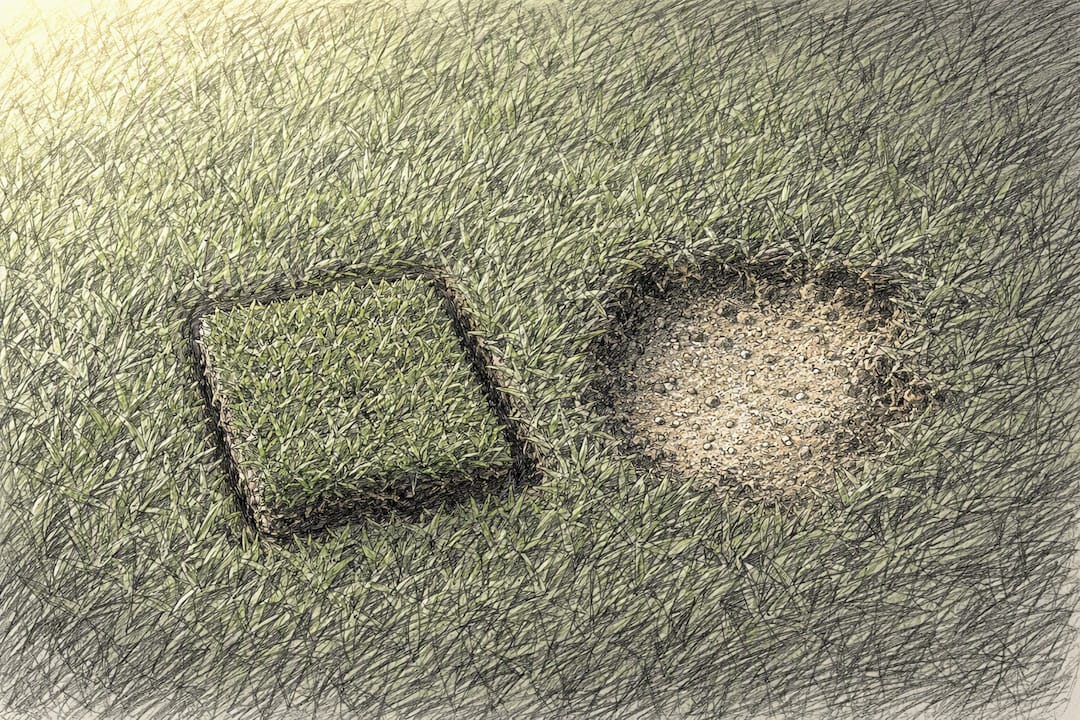
Course policy varies more than most golfers realize. Some clubs actively prefer sand-fill over turf replacement even for intact divots, since replaced turf that doesn’t root properly can actually die and leave a worse scar than a filled one. Others expect players to always replace intact turf and reserve sand mix strictly for shattered pieces. When you’re unsure, replacing an intact piece and pressing it firmly is generally the safer default, since it speeds re-rooting compared with overfilling with sand.
A few quick rules for handling what’s in front of you:
- If the divot came out in one piece with roots and soil attached, replace it and press firmly.
- If the turf is fragmented, dry, or crumbly, use the course’s sand mix instead of forcing pieces back together.
- If no sand bottle is available and the divot is shattered, at minimum push loose fragments back into the hole so it doesn’t stay open.
- When a course has posted signage or scorecard notes about its preferred method, follow that over general habit.
The urgency matters more than golfers tend to assume. A properly repaired ball mark can recover in a day or two, while an unrepaired one can take days or weeks, and fairway turf follows a similar pattern. An unfilled divot exposes bare soil to weed seed, sun scorch, and erosion from foot and cart traffic, all of which slow recovery well beyond what a thirty-second fix would have cost you.
Why Is a “Divot Tool” Actually for Ball Marks?
Here’s a naming quirk that trips up even experienced golfers: the two-pronged forked tool you clip to your belt or golf bag, universally sold and labeled as a “divot tool,” has almost nothing to do with fairway divots. Its actual job is repairing ball marks on greens.
The confusion traces back decades, when golfers started calling any turf damage a “divot” regardless of where it occurred. Manufacturers picked up the popular term for marketing, and the name stuck even though the tool’s prongs are sized and shaped specifically for pulling compressed green turf inward, not for handling the much larger, heavier chunks of fairway sod. Multiple equipment guides confirm the tool sold under this name is intended purely for green repair, and using the correct term, “pitch mark repair tool” or “ball mark repair tool,” would save a lot of confusion if it ever caught on widely.
Understanding which tool does what saves you from carrying the wrong gear or, worse, using the wrong technique in the wrong place:
- Two-prong repair tool: designed for ball marks on greens; insert at the edge and pull turf inward, never on fairway divots.
- Sand-and-seed bottle: designed for shattered fairway divots; fill the scar level with the surrounding turf.
- Tee: occasionally useful in a pinch for ball mark repair if you have nothing else, though a dedicated tool works far better and won’t tear roots as easily.
For a round where you’re actually equipped to fix whatever you create, pack three things: a two-prong repair tool, a spare ball marker so you’re not fumbling for a coin, and either a small sand bottle or a clear sense of your course’s divot policy. Aiming Fluid Golf’s foldable divot tool collection covers the first item with a design built for exactly this repair motion, and knowing the difference between what you’re carrying and what it’s actually for is half the etiquette battle.
What Do the Rules of Golf Say About Repairs?
The Rules of Golf draw a sharp line between what you’re allowed to fix on the green and what you generally have to accept in the fairway, and that distinction backs up everything covered so far about repair technique and urgency.
Rule 13.1c(2) explicitly permits players to repair ball marks, spike damage, and other forms of damage on the putting green, including doing so before or after your putt. The USGA’s rule interpretations make clear this repair right exists specifically because green damage affects the roll of the ball for every player who follows, and the rulebook treats that as worth protecting.
Fairway divots get no such protection. If your ball comes to rest in a divot hole (someone else’s unrepaired scar, or even your own from a previous shot), you generally have to play it as it lies. There’s no free relief written into the standard Rules of Golf for a ball sitting in a divot, unless your specific course has adopted a local rule granting relief from divot holes on the fairway, which some clubs do during winter conditions or major tournaments. Always check the scorecard or ask the pro shop before assuming relief applies.
A short checklist covers the etiquette side of all this:
- Repair every ball mark you can find near your line, including ones you didn’t create.
- Replace or fill every divot before walking off the tee or fairway.
- Rake bunkers smooth after your shot, entering and exiting from the low side.
- Never assume relief from a divot hole unless your course has posted a local rule granting it.
What Repair Mistakes Actually Hurt the Course?
Most turf damage that lingers on a course isn’t from the original ball mark or divot. It’s from a bad repair job that made things worse.
The single most damaging habit is levering the center of a ball mark upward instead of pulling the edges inward. That motion severs roots that were still viable and turns a shallow compression injury into an actual bare patch, which is functionally a self-inflicted divot on a green that was never designed to have one. Turf-care guidance is consistent on this point: a mark treated correctly can look nearly normal within a day or two, while the same mark treated with an upward lever can leave a visible scar for weeks.
Ignoring divots entirely, or overfilling them with sand well above the surrounding grade, causes a slower but equally real problem. Bare soil left exposed invites weed seed and dries out faster than surrounding turf, and a sand mound sitting above grade creates an uneven surface that stays visible long after grass would have filled in naturally.
A few habits separate golfers who leave a course better than they found it from golfers who don’t:
- Fix your own mark or divot first, then look for two or three more nearby that others missed.
- Tamp every repaired ball mark flat with your putter face rather than leaving it slightly raised.
- Press replaced fairway turf down firmly with your foot, not just a light tap.
- Match your tool to the injury: pull edges inward on greens, fill or replace on fairways.
Pro Tip: Make a habit of fixing three marks per green, not just your own. It costs you fifteen extra seconds and it’s the single easiest way to leave a course in better shape than you found it, especially during peak season when greens take a beating.
Why Better Tools Make Correct Repairs Easier
The most common repair mistakes aren’t really etiquette failures. They’re tool failures. A flimsy, single-prong tool or a bent freebie from a pro shop counter encourages exactly the lever-and-lift motion that tears roots, simply because it’s the only motion the tool physically allows.
Some products are engineered around the actual repair motion turf experts recommend, not the motion that happens to be easiest to manufacture cheaply. A well-designed two-prong tool with properly spaced, sturdy tines makes the correct inward-pull technique the natural motion, rather than something you have to consciously fight your equipment to do.
The Foldable Metal Divot Tool reflects this thinking directly. Built from metal rather than the flexible plastic common on giveaway tools, it holds its shape under repeated use and folds compactly enough to clip onto a bag without catching on pockets or towels, which matters more than it sounds like once you’ve fished around for a tool with wet hands on the back nine.
Design choices like this connect to a broader pattern worth understanding if you’ve ever wondered why some greens seem to heal faster than others after a busy weekend. Aiming Fluid Golf’s guide on why most divot tools damage greens breaks down exactly which common tool designs encourage the lever-and-lift mistake, and its companion 4-step repair technique guide walks through the correct motion in more depth than a single article section allows.
A Note on Stewardship From Gary
Golf courses survive on thousands of small decisions made by players who will never meet each other. Every ball mark you repair, or don’t, changes the surface for someone teeing off an hour after you leave. I find that framing changes behavior faster than any etiquette lecture. Carrying the right tool removes the last excuse, since a fumbled repair attempt with a bad tool is often just as damaging as skipping the repair entirely. Make the fix immediately, before you mark your ball or walk to your next shot, and the habit sticks without you thinking about it. Small, consistent stewardship is what keeps a course playable for everyone behind you.
— Gary
Gear That Makes Correct Repairs Automatic
Reading the correct technique is one thing. Doing it consistently, round after round, comes down to whether the tool in your pocket makes that motion easy or fights you every time. Some designs focus on building tools that make the right repair the natural one instead of the awkward one.

Start with the Foldable golf divot tools, built from metal for a firmer, more controlled edge-pull than flexible plastic allows, and compact enough to fold flat in a pocket. Pair it with the Premium Magnetic Metal Golf Ball Marker, so you’re never scrambling for a coin right when you need to mark your ball before repairing a mark near your line. For pace of play between shots, the Magnetic Landing Pad keeps your towel and small gear anchored and instantly accessible, cutting down the fumbling that slows groups down on busy weekends. None of these replace good habits, but they remove the friction that makes good habits harder to keep. Browse the full divot tool collection and pick the one that clips onto your bag without a second thought.
Sources
- Back to the basics of course care & etiquette — USGA Green Section
- How to correctly repair your pitch marks and divots — PGA Play
- When to use a divot tool — TellMeMoreGolf
FAQ
Do Any Pros Not Take Divots?
Yes. Some elite ball strikers, most famously players known for a shallow, sweeping swing path, take shallow or minimal divots compared to peers with steeper attack angles. It comes down to swing mechanics and attack angle, not a different set of rules or turf.
Why Doesn’t Tiger Woods Take Divots on Certain Shots?
Tiger Woods, like many tour players, varies his divot size based on the shot and lie, taking deeper divots on aggressive iron shots and shallower ones on shots requiring more control. Swing plane and ball position both affect how much turf a club displaces, so divot depth is more a signature of technique than a fixed rule.
Does Scottie Scheffler Mark His Ball Every Time?
Tour players mark their ball on the green whenever it’s in another player’s line or when they need to clean it, which is standard practice for nearly every professional. Marking the ball is separate from repairing a ball mark, though pros typically repair their own pitch marks immediately after marking, following the same technique described earlier in this article.
Do You Get Relief if Your Ball Is in a Divot?
Generally, no. Under the standard Rules of Golf, a ball resting in a fairway divot hole must be played as it lies, since divot scars in the fairway are considered part of the course’s general condition. Some courses adopt a local rule granting relief from divot holes, so check your scorecard or ask the pro shop before assuming it applies.
What’s the Real Difference Between a Divot and a Ball Mark?
A divot is turf physically removed by a club, found on fairways and tees, and repaired by replacing the turf or filling with sand. A ball mark, or pitch mark, is turf compressed by a landing ball on a green, repaired by pushing the edges inward rather than lifting the center.


