


Tee your driver so the ball’s middle sits at the top edge of the clubface, or roughly half the ball shows above the crown. That single reference point, taken from instructors who study driver setup, gives you a repeatable baseline for center-face contact. The USGA’s rules for teeing the ball leave the exact height up to you, so consistency, not a magic number, is what actually lowers your scores.
TL;DR:
- Using a reference point where half the ball sits above the crown ensures consistent center-face contact for optimal driver performance.
- Standardized methods like the ball-as-guide trick or marked tees help maintain the same tee height across multiple shots and rounds.
- Raising the tee encourages higher launch and more carry, but can widen miss patterns if not matched to the individual’s swing attack angle.
- Running a short test with multiple tee heights on a launch monitor or impact tape reveals the best height based on strike consistency and distance.
- A stable, repeatable tee height prevents common mishits like pops or low pulls caused by overly high or low setups.
Table of Contents
- What is the correct tee height for a driver?
- How do you measure the same tee height every time?
- How does tee height affect distance and accuracy?
- How do you find your personal optimal tee height?
- Why do bad tee heights cause bad drives?
- Gary’s workflow for repeatable tee height
- Lock in your tee height with precision tees
- Sources
What is the correct tee height for a driver?
Center-face contact wins rounds, not a specific measurement in inches. That’s why the half-ball guideline has stuck around for decades: it gives you a visual checkpoint you can verify in two seconds, standing over the ball, without pulling out a ruler.
Here’s how the common reference points stack up:
- Half-ball rule: the horizontal midpoint of the ball lines up with the top edge of your driver’s face. This is the most common instructor starting point and a good default for most modern drivers with 460cc heads.
- One-third rule: less of the ball sits above the crown. Better suited to players with a steep, downward angle of attack who want to avoid excess spin.
- Two-thirds rule: more of the ball rides above the crown. This favors golfers with a shallow or upward angle of attack chasing extra carry.
If you prefer numbers over visuals, many players find a small range of tee length above the turf, depending on the tee brand and how far it’s pushed into the ground. Take that range as a rough starting point, not a rule. Two tees from different manufacturers can have different peg lengths, so a ball-above-crown check will always be more reliable than the ruler in your pocket. The real goal is picking one reference and using it every single time you tee up.
How do you measure the same tee height every time?
Guessing at tee height on every hole is where consistency dies. Golfers who play their best rounds tend to use a physical checkpoint instead of eyeballing it, and a few of these methods take less time than pulling a club from your bag.
- Use the ball-as-guide trick. Set a second ball on the ground right next to your tee before you push it in. Push the tee down until its top lines up with the top of that ground ball, then place your driver’s ball on top. This method, popularized by LPGA player Emily Kristine Pedersen, gives you a fixed visual reference instead of a guess.
- Standardize the finger-crease method. Lay the tee flat against your index finger and note which knuckle crease the top of the peg reaches. Once you find the crease that matches your ideal height, that’s your new physical yardstick. It works in bad light and doesn’t require setting anything on the ground.
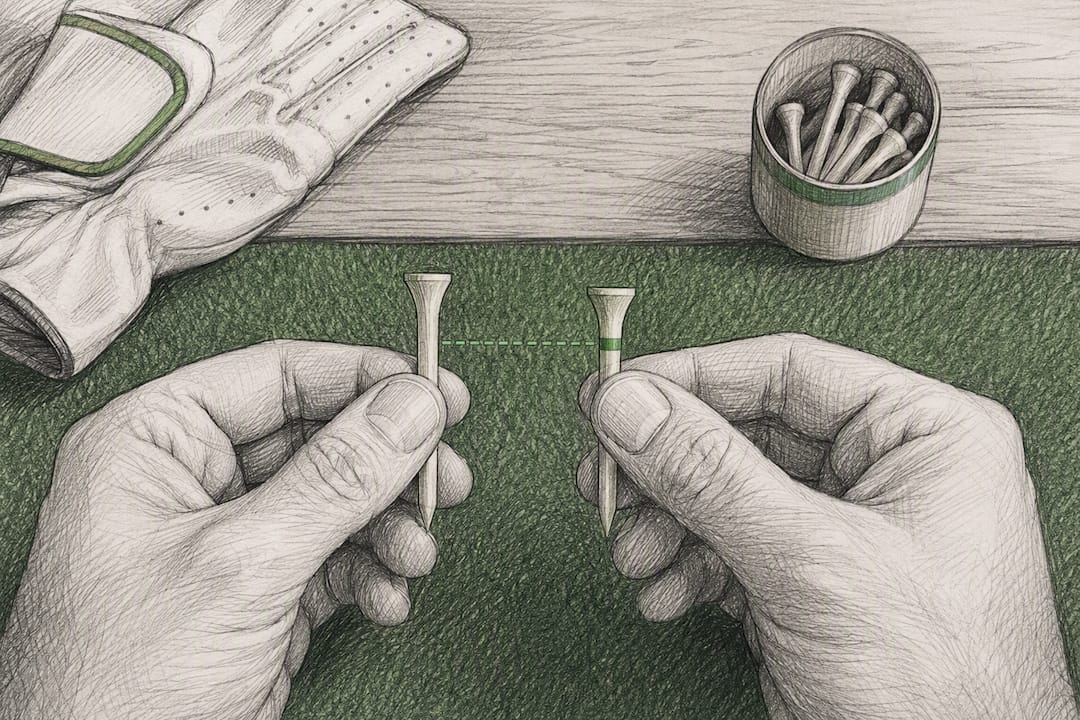
- Switch to marked or precision tees. Tees with a printed line or a stepped collar remove the guesswork entirely. Push the tee in until the mark meets the turf, and you’re set without checking the ball at all.
Keep one tee style in the same pocket of your bag every round, so you’re not hunting for the right peg while your group waits. A single motion, pull, insert to the mark, place ball, should take less time than re-tying a shoe.
Pro Tip: Carry a spare tee already snapped or marked to your reference height in your glove or front pocket. On the tee box, you check it against a fresh peg in three seconds instead of relying on memory.
How does tee height affect distance and accuracy?
Tee height changes the geometry of impact, and that changes ball flight in predictable ways. A higher tee encourages an upward angle of attack at impact, which tends to raise launch angle and reduce backspin. That combination can add carry distance for a lot of golfers, but it also tends to widen your miss pattern if your swing path isn’t built for hitting up on the ball.
A lower tee does close to the opposite: it promotes a steeper, more downward strike, which usually means more backspin, a lower launch, and tighter dispersion. You trade some carry for control.
- Raise the tee when you have a helping wind, a wide-open fairway, or a hole where extra roll matters more than accuracy.
- Lower the tee into the wind, on tight driving holes, or any time your last few rounds have shown a wider miss than usual.
- Keep your swing the same. The tactical adjustment lives in the setup, not in trying to manufacture a different swing on the fly.
Golf Digest’s coverage of the “high tee, low tee” approach used by touring professionals notes that they keep one stock swing and change tee height by hole to shift launch conditions instead of overhauling their mechanics under pressure.
Your baseline stays the half-ball rule. The tactical moves above are deviations, not replacements for it.
How do you find your personal optimal tee height?
The fastest way to stop guessing is to run a short, structured test instead of trusting feel. Instructors consistently point to the range or a launch monitor as the place to settle this question once, rather than relitigating it every round.
- Pick three heights. Use your current baseline, one notch higher, and one notch lower.
- Hit 8 to 10 shots at each height. Fewer than that and one bad swing skews your read.
- Record where you strike the face on every shot. Impact tape or a strip of foot spray on the clubface shows you exactly where contact happened.
- Log launch angle, spin rate, and smash factor if you have access to a monitor. These numbers confirm what your eyes are already telling you.
- Rank the three heights by center-face frequency first. Carry distance and smash factor are the tiebreakers, not the primary metric.
No launch monitor? No problem. Impact tape plus a phone video from behind the ball will show you strike location clearly enough to make the call. What you’re hunting for isn’t the highest number on a screen, it’s the height that puts the most swings dead center on the face, because that consistency of strike location matters more than chasing one perfect measurement.
Once you’ve got a winner, lock it into your pre-shot routine the same day you find it. Write the crease reference or tee mark on a notecard in your bag if you have to. The test only pays off if the answer becomes automatic on the first tee, not something you have to rediscover mid round.
Pro Tip: Run this test with the same ball model you play in competition. Softer or firmer covers can change how contact feels off a low tee, which throws off your read if you switch balls between test and round.
Why do bad tee heights cause bad drives?
A tee that’s too high often produces a pop-up or a weak slice off the top of the face, especially if your swing path is already flat or steep to begin with. A tee that’s too low tends to produce heavy contact, low pulls, or a driver that feels like it’s digging into the turf on the way through.
- Too high + steep angle of attack: expect thin contact above the sweet spot and a shot that dies short.
- Too low + shallow angle of attack: expect contact near the bottom groove and a low, spinny shot that comes up short.
- Inconsistent height round to round: expect inconsistent miss patterns that look like a swing flaw but are actually a setup flaw.
If a round starts going sideways, check the tee before you touch your swing. A quick fix, moving one notch up or down and rechecking against your reference point, solves more bad drives than a full mechanical overhaul does. Run through a short mental checklist before every tee shot: reference height, ball position relative to the face, and one look down the target line.
Gary’s workflow for repeatable tee height
I think most golfers overcomplicate this. Tee height doesn’t need daily reinvention. It needs one decision, made once, using an actual test, and then protected by a routine simple enough to survive a bad day.
My workflow is three steps: find the reference point that produces the most center-face strikes, physically mark that height so you’re not relying on memory, and keep the same tee in the same pocket so setup takes seconds. Precision in tee design matters here because a tee with an inconsistent peg length undoes all the work you put into finding your number. That’s also why pace of play and consistency are connected. A golfer fumbling for the right tee holds up the group behind them.
If you want the deeper mechanics behind why height changes ball flight, our driver distance guide breaks down the physics further, and our step-by-step setup guide walks through the on-course routine in more detail than we can cover here.
— Gary
Lock in your tee height with precision tees
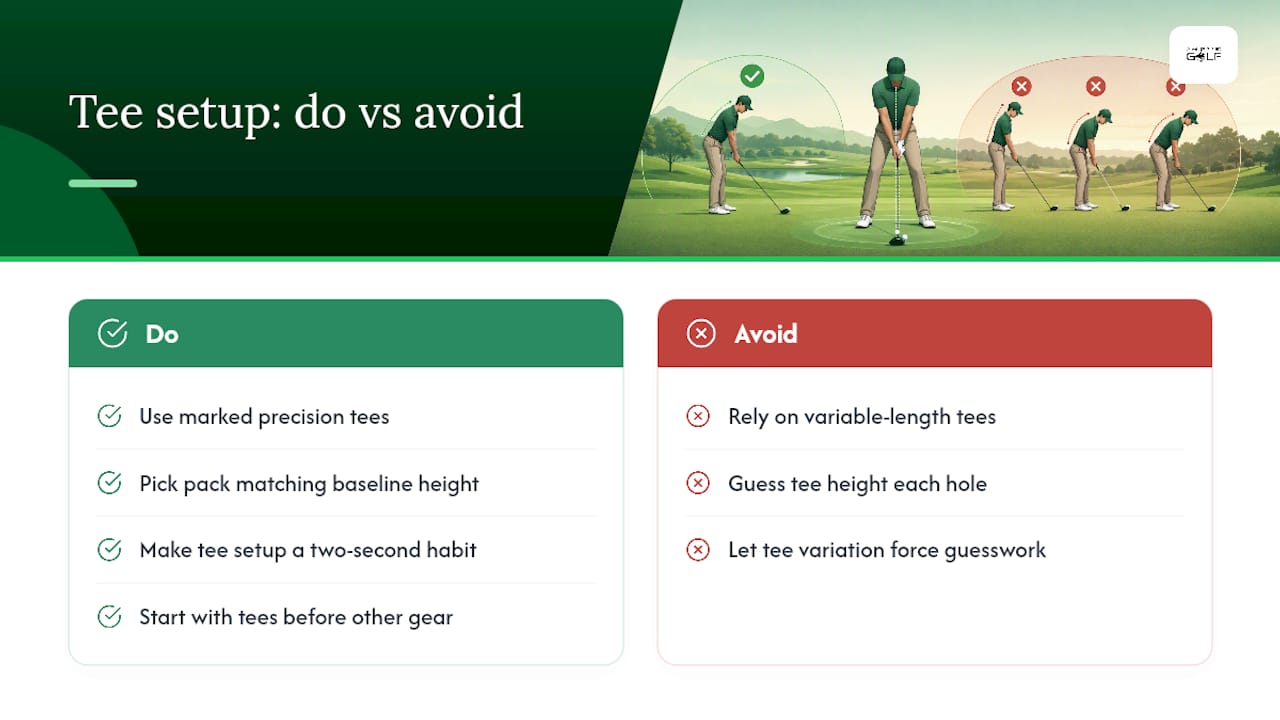
A marked or precision tee turns everything above into a two-second habit instead of a guessing game every single hole. Aiming Fluid’s precision tees use consistent geometry and clear height references so the setup you tested for and found works becomes the setup you actually repeat under pressure.

That matters because the entire point of everything covered here, the half-ball rule, the ball-as-guide trick, the range test, only pays off if you can reproduce it on command. A tee that varies in length from peg to peg forces you back into guesswork exactly where you don’t want it. The DON’T SUCK™ Golf Tees give you that fixed reference in a durable design built for a full bag of rounds, not a handful.
If you’re already rethinking what’s in your bag, our best golf accessories picks cover the other small gear upgrades that speed up your pre-shot routine. Start with the tees. Check the Golf Tees collection, pick the pack that matches your baseline height, and take the guesswork out of your next round.
Sources
This article draws on instructional analysis from Golf.com’s tee height experiment, Golf Digest’s coverage of tour tee-height tactics, and USGA rules guidance on teeing the ball. For hands-on setup help, see Aiming Fluid’s tee placement workflow and precision tee benefits guide.
- Golf


