


Most golfers assume great golf design is about length or difficulty. That’s a misconception. Thoughtful golf design prioritizes strategic depth, natural integration, and playability over raw challenge. The best courses force you to think, not just hit harder. This guide explores the core principles of thoughtful golf design, contrasting philosophies like minimalism and maximalism, and how these concepts apply to golf accessories that enhance organization and efficiency. You’ll discover how understanding design principles can improve your play, sharpen your course management, and help you choose gear that supports smarter golf.
Table of Contents
- Understanding The Principles Of Thoughtful Golf Design
- Contrasting Design Philosophies: Minimalism Versus Maximalism
- Classic Strategic Templates And Their Role In Thoughtful Design
- Applying Thoughtful Golf Design Principles To Golf Accessories For Better Organization And Efficiency
- Discover Thoughtfully Designed Golf Accessories At Aiming Fluid Golf
- Frequently Asked Questions
Key takeaways
| Point | Details |
|---|---|
| Strategic depth over difficulty | Thoughtful design emphasizes mental challenge and shot options rather than pure length or hazard density. |
| Natural integration matters | Courses built with minimal earth moving respect terrain and create sustainable, playable layouts. |
| Design philosophies vary | Minimalist approaches preserve natural features while maximalist designs reshape land for creative challenge. |
| Classic templates guide strategy | Template holes like Redan and Eden embed timeless strategic principles across diverse courses. |
| Principles apply to accessories | Thoughtful design extends to golf gear, improving organization, efficiency, and on-course performance. |
Understanding the principles of thoughtful golf design
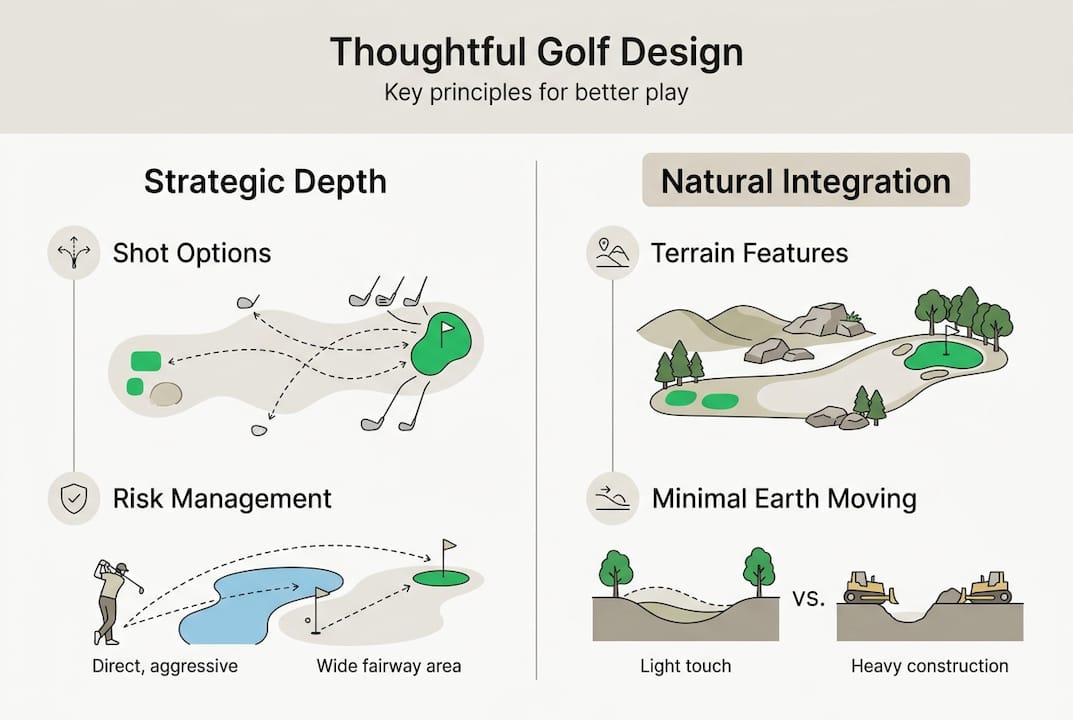
Thoughtful golf design primarily refers to golf course architecture that emphasizes strategic depth, natural integration, playability, and mental challenge over mere length or difficulty. It’s about creating layouts that reward smart decisions, not just powerful swings. Great courses offer multiple routes to the hole, each with distinct risk and reward profiles. This forces you to assess your skills, the conditions, and the situation before committing to a shot.
Strategic options are central to thoughtful design. A well-designed hole presents choices: play safe to the fat part of the fairway or challenge a hazard for a better angle into the green. These decisions create mental engagement. You’re not just executing shots but solving problems. Wide fairways with angled hazards, contoured greens that reject poorly planned approaches, and varied hole lengths all contribute to this dynamic.
Natural terrain features play a huge role. Thoughtful architects minimize earth moving, using existing slopes, vegetation, and landforms to shape play. This approach is sustainable, cost effective, and creates courses that feel organic rather than manufactured. When a course works with the land, it flows naturally and presents challenges that feel fair, not arbitrary.
Mental challenge is the hallmark of great design. Courses should create indecision, forcing you to weigh options and commit with confidence. This is different from physical difficulty. A narrow fairway lined with trees is physically hard but mentally simple: hit it straight or pay. A wide fairway with strategic bunkering is physically easier but mentally complex: which angle gives you the best approach? That’s the difference.
Typical features of thoughtful design include:
- Wide fairways that encourage strategic positioning rather than precision off the tee
- Angled hazards that reward bold play and punish conservative shots from poor angles
- Contoured greens with subtle breaks that demand careful reading and precise approach shots
- Template holes that borrow classic strategic principles for consistent challenge
- Minimal rough and natural vegetation that frame holes without creating arbitrary penalties
Pro Tip: When playing a thoughtfully designed course, spend time on the tee visualizing your ideal landing zone. The best courses reward planning over power, so map out your strategy before you swing.
Understanding these principles helps you appreciate great courses and make smarter decisions on the course. It also informs how you think about golf accessories. Just as great courses prioritize function and efficiency, great gear should enhance your organization and performance without unnecessary complexity. Integrated golf system examples show how thoughtful design principles apply beyond course architecture.
Contrasting design philosophies: minimalism versus maximalism
Golf course design isn’t one size fits all. Two dominant philosophies shape how architects approach their work: minimalism and maximalism. Minimalism prioritizes restraint and sustainability, contrasting maximalist earth shaping, and experts debate intervention degrees based on site quality. Understanding these approaches helps you recognize what makes a course feel natural or dramatic.
Minimalism emphasizes working with the land as it exists. Architects like Bill Coore, Ben Crenshaw, and Tom Doak champion this philosophy. They move minimal dirt, preserve natural contours, and let the terrain dictate routing and strategy. The result is courses that feel timeless and sustainable. Minimalist designs often feature wide playing corridors, natural hazards, and greens that follow existing landforms. They’re less expensive to build and maintain, and they age gracefully because they respect the environment.

Maximalism takes a different approach. Architects like Tom Fazio reshape land to create dramatic features and visual interest. This philosophy involves significant earth moving, sculpted bunkers, water features, and bold contouring. Maximalist courses can be stunning, with eye-catching aesthetics and memorable holes. They’re often built on bland or featureless sites where creativity is necessary to generate challenge and character. The trade off is higher construction and maintenance costs, plus greater environmental impact.
Contrasting views: Minimalism versus maximalism; site dictates intervention, with restraint on great land and creativity on bland terrain. If you’re working with a naturally rolling, tree-lined property, minimalism makes sense. If you’re stuck with flat farmland, maximalism might be the only way to create interesting golf.
Here’s a comparison of the two philosophies:
| Philosophy | Key Features | Pros | Cons |
|---|---|---|---|
| Minimalism | Low earth moving, natural hazards, wide corridors, sustainable maintenance | Lower cost, timeless feel, environmental respect, strategic simplicity | May lack visual drama, limited on featureless sites |
| Maximalism | Heavy shaping, sculpted bunkers, water features, bold aesthetics | Stunning visuals, creative challenge, works on bland land | Higher cost, maintenance intensive, environmental impact |
Both philosophies can produce great golf when applied thoughtfully. The key is matching the approach to the site. A minimalist design on world class dunes is breathtaking. A maximalist design on a cornfield can be equally compelling if executed well. The worst outcomes happen when architects force a philosophy onto an unsuitable site.
Pro Tip: When evaluating a course, ask yourself whether the design feels natural or manufactured. Great minimalist courses make you forget an architect was involved. Great maximalist courses make you appreciate the architect’s vision. Both are valid if the result is strategic, playable, and enjoyable.
This philosophical debate extends beyond courses. When choosing golf accessories, consider whether you prefer minimalist simplicity or feature-rich designs. A minimalist golf design review shows how less can be more when functionality is prioritized over flash.
Classic strategic templates and their role in thoughtful design
Classic golf hole templates are foundational elements in thoughtful course design. Template holes like Redan or Eden borrow classic strategic principles for consistent challenge across terrains. These templates, developed by early golf architects like C.B. Macdonald and Seth Raynor, embed timeless strategic concepts into courses worldwide. Understanding them helps you recognize great design and anticipate challenges on unfamiliar courses.
Template holes are essentially blueprints for strategic golf. Each template presents a specific challenge that tests decision making, shot shaping, and course management. The Redan, for example, is a par 3 with a diagonal green that slopes away from the player. The ideal play is a low running shot that uses the slope to feed the ball toward the hole. Aggressive players can fly the ball directly at the pin, but they risk missing the green entirely. It’s a perfect example of risk versus reward.
The Eden is another classic template, typically a long par 4 with a fairway that runs parallel to a hazard. The green is angled and often features a deep bunker short left. Players must decide whether to challenge the hazard for a better angle or play safe and accept a tougher approach. The Biarritz is a long par 3 with a deep swale bisecting the green, demanding precise distance control. The Alps is a blind par 4 where you must trust your line and commit to the shot without seeing the landing area.
These templates work because they create mental challenge. You’re forced to weigh options, assess conditions, and execute with precision. They also provide variety. A course with multiple templates offers diverse strategic tests, keeping play interesting and engaging. Modern architects often integrate templates into their designs, adapting them to fit local terrain and conditions.
Common classic templates and their strategic characteristics include:
- Redan: Diagonal green sloping away, rewards low running approach, penalizes aggressive misses
- Eden: Parallel hazard, angled green, forces angle versus safety decision
- Biarritz: Long par 3 with deep swale, demands precise distance control and club selection
- Alps: Blind tee shot, requires trust and commitment, tests course knowledge
- Road Hole: Long par 4 with narrow green and hazard behind, punishes aggressive play
- Short: Drivable par 4 with severe consequences for missing the green, ultimate risk reward hole
Templates maintain design consistency across diverse terrain. Whether you’re playing a links course in Scotland or a parkland layout in the U.S., a well-executed Redan presents the same strategic challenge. This universality is why templates remain relevant more than a century after their creation.
Understanding templates also improves your play. When you recognize a template hole, you can anticipate the strategic challenge and plan accordingly. If you spot a Redan, you know the green slopes away, so you aim for the front and let the ball release. If you see an Eden, you know the angle matters, so you choose your tee shot line carefully.
Templates aren’t just for courses. The concept of proven designs that solve specific problems applies to golf accessories too. Just as a Redan solves the challenge of creating strategic interest on a par 3, a well-designed magnetic towel system solves the challenge of keeping your towel accessible without fumbling through your bag. Game tracking sensors and strokes gained analytics help you identify where templates and strategic design impact your scoring, giving you data-driven insights into course management.
Applying thoughtful golf design principles to golf accessories for better organization and efficiency
Thoughtful design principles extend beyond courses to golf accessories. Just as great courses prioritize strategy, playability, and efficiency, great gear should enhance organization and performance without adding complexity. The same mindset that creates strategic golf holes can inform how you choose accessories that support smarter play.
Consider the magnetic towel and landing pad system. Traditional towels clip to your bag, forcing you to dig through pockets or fumble with carabiners mid-round. A magnetic system solves this problem with simple, elegant design. The towel attaches instantly to a magnetic landing pad on your bag, cart, or pushcart. You grab it, use it, and return it without thinking. This mirrors how thoughtful course design removes friction from play, letting you focus on strategy rather than logistics.
Utility pouches and accessory organizers reflect similar principles. Course design edge cases: Reverse camber fairways or wind and firmness force real-time adjustments; expert nuance favors mental indecision over power. Just as great courses demand quick decisions, effective accessories keep your gear organized so you can adapt to changing conditions without delay. A well-designed pouch with dedicated compartments for tees, ball markers, and divot tools ensures you’re never searching for essentials when you need them.
Precision golf tees are another example. Thoughtful design here means consistent height, durability, and ease of use. Cheap tees break, wobble, or force you to guess at height. Premium tees eliminate these issues, giving you one less variable to manage. This is the accessory equivalent of a well-maintained course: it removes distractions so you can focus on execution.
Features in well-designed golf accessories include:
- Strong magnets that hold securely without adding bulk or weight to your setup
- Secure wash pockets or compartments that keep dirty items separated from clean gear
- Ergonomic arrangement that places frequently used items within easy reach
- Durable materials that withstand weather, wear, and repeated use without degrading
- Minimal design that prioritizes function over unnecessary features or embellishments
Pro Tip: When choosing golf accessories, apply the same criteria you’d use to evaluate a golf course. Does it solve a real problem? Does it enhance your experience without adding complexity? Does it prioritize function over flash? If the answer is yes, it’s probably designed thoughtfully.
Thoughtful accessories also complement your course strategy. If you’re playing a course with firm, fast conditions, having a clean towel readily available matters. If you’re navigating a layout with severe greens, a reliable divot tool helps you maintain the course and respect the design. These small details add up, improving your efficiency and letting you focus on the mental challenge of the game.
Smart design golf accessories reflect the same principles that define great golf courses: they solve problems elegantly, enhance performance, and remove friction from the experience. By understanding thoughtful design, you can make better choices about the gear you carry and how it supports your play.
Discover thoughtfully designed golf accessories at Aiming Fluid Golf
If you value strategic thinking and efficient organization on the course, Aiming Fluid Golf offers accessories designed with the same thoughtful principles that define great golf course architecture. Our products solve real problems, enhance performance, and keep you focused on the game.

Our magnetic golf towels feature strong magnets and secure wash pockets, giving you instant access without fumbling through your bag. Our golf tees collection delivers consistency and durability, eliminating one more variable from your setup. The best golf divot tool guide showcases our multipurpose divot tool, designed to maintain course condition and improve your play. Every product reflects our commitment to smart design, premium materials, and practical functionality. Explore our full range and experience how thoughtfully designed accessories can elevate your game.
Frequently asked questions
What is thoughtful golf design?
Thoughtful golf design emphasizes strategic depth, natural integration, and mental challenge over raw difficulty or length. It creates courses that reward smart decisions, offer multiple playing options, and respect the natural terrain. Great design forces you to think, plan, and execute with precision, making golf a mental game as much as a physical one.
How do minimalist and maximalist design approaches differ?
Minimalist design works with existing terrain, moving minimal dirt and preserving natural features for sustainable, timeless layouts. Maximalist design reshapes land extensively, creating dramatic features and bold aesthetics through heavy earth moving. Both can produce excellent golf when matched to the site, with minimalism favoring naturally interesting land and maximalism suited to bland or featureless terrain.
How do classic hole templates contribute to thoughtful design?
Classic templates like Redan, Eden, and Biarritz embed proven strategic principles into courses, creating consistent mental challenges across diverse terrains. They force decision making, test shot shaping, and reward course management. Templates provide variety and timeless appeal, ensuring courses remain engaging and relevant decades after construction.
What should I look for in golf accessories that align with thoughtful design principles?
Choose accessories that solve real problems, prioritize function over flash, and enhance organization without adding complexity. Look for strong magnets, secure compartments, durable materials, and ergonomic design. The best accessories, like magnetic towels or precision tees, remove friction from your routine and let you focus on strategy and execution.
How does understanding thoughtful golf design improve my play and enjoyment?
Recognizing design principles helps you anticipate challenges, plan smarter strategies, and appreciate the nuances of great courses. You’ll make better decisions on the tee, approach greens with more confidence, and enjoy the mental challenge that defines strategic golf. This understanding also guides your gear choices, ensuring your accessories support efficient, focused play.
Recommended
- Smart design in golf accessories for efficient play in 2026 – Aiming Fluid Golf
- Integrated golf system examples for better play in 2026 – Aiming Fluid Golf
- Stix Golf 9-Club Set Review: Premium Performance, Minimalist Design – Aiming Fluid Golf
- Best Golf Gifts 2026 – Aiming Fluid Golf Accessories & Funny Gifts


