


TL;DR:
- On-course preparedness combines physical warm-up, mental organization, and strategic planning to ensure consistent golf performance. Proper preparation preserves mental energy by eliminating logistical distractions, allowing players to focus on shot execution. Effective routines include arriving early, organizing gear, studying course conditions, and completing targeted warm-up and practice sequences.
On-course preparedness is defined as the intentional combination of physical readiness, mental organization, and strategic planning that golfers execute before and during a round to perform consistently under real course conditions. This is the standard the best players in the world treat as non-negotiable, and it goes well beyond showing up with a full bag. The brain consumes roughly 20% of the body’s total energy during high-focus activities like golf. That figure explains why a four-hour round without proper preparation leaves you making poor decisions on the back nine. Experts at Zen Golf and Aimingfluidgolf both point to pre-round warm-up timing of 30–40 minutes before tee time as the baseline standard for effective course readiness.
What is on-course preparedness and why does it matter?
On-course preparedness is the process of arriving at the course with your equipment organized, your body warmed up, your nutrition planned, and your course strategy already mapped. The term “course readiness assessment” captures the same idea in more structured language. Both phrases describe the same core discipline: removing variables before the round starts so you can focus entirely on execution.

Preparedness protects cognitive resources by eliminating logistical distractions that drain mental energy. When your bag feels like a junk drawer, your brain spends energy searching for tees, towels, and ball markers instead of reading the green. That wasted attention compounds across 18 holes.
The practical result is that unprepared golfers make more impulsive decisions. They rush club selection, skip pre-shot routines, and lose focus after bad shots. Prepared golfers have already answered the logistical questions before the first tee, so every unit of mental energy goes toward the shot in front of them.
Why is on-course preparedness critical for consistent performance?
Mental fatigue is the hidden opponent in every round. A golf round lasting four or more hours places sustained cognitive demands on the player, requiring concentration, spatial reasoning, and emotional regulation across dozens of shots. Without preparation, those demands arrive on top of logistical stress.
“Preparedness acts as the quiet work of protecting attention, allowing golfers to focus on performance rather than logistics. When the environment is organized, the mind is free to compete.” Course Readiness: What It Is, Why It Matters, and How to Get It Right
Elite performance starts with understanding the course environment rather than obsessing over swing mechanics. Tour-level players study wind direction, pin positions, and firmness of fairways before they hit a single ball. That environmental awareness shapes every club decision during the round.
Sleep quality directly affects the cognitive function and decision-making that golf demands. A golfer who arrives sleep-deprived has already compromised their ability to read greens and manage risk, regardless of how well they hit balls on the range. Preparedness is a 24-hour discipline, not a 30-minute warm-up.
The golfer who manages these variables consistently shoots more predictable scores. Consistency is not a talent. It is a product of repeatable preparation.
What practical steps make up effective on-course preparation routines?
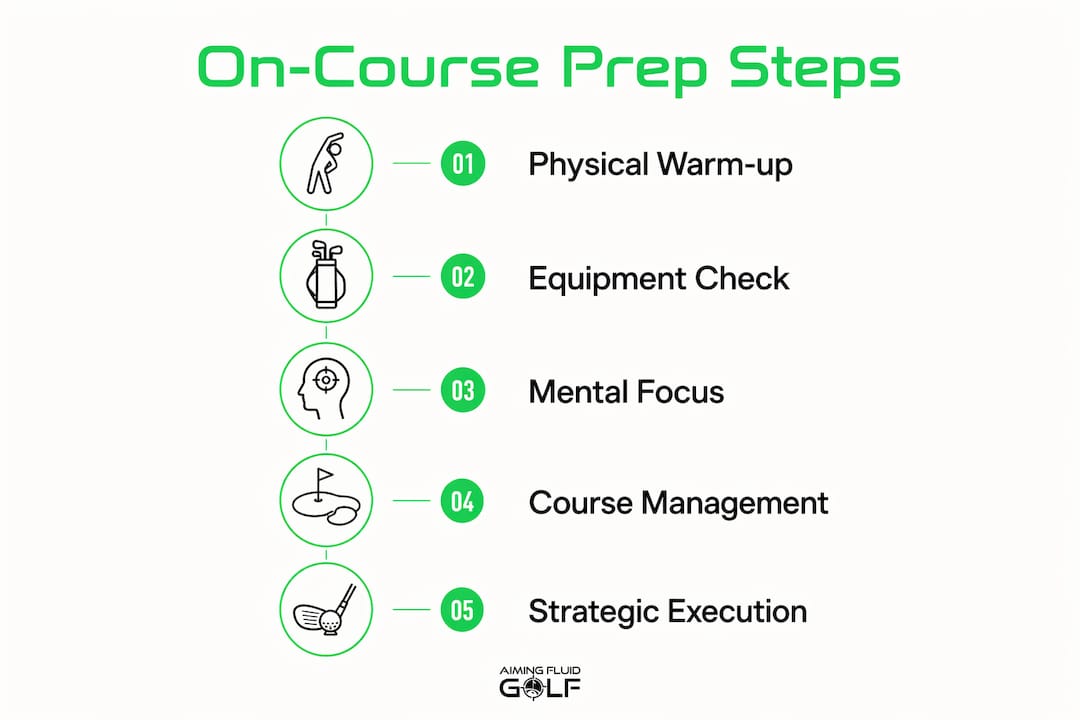
Effective course preparation follows a defined sequence. Nine essential preparation steps cover the full range from the night before to the moment you address the first ball. Each step removes one more variable from the round.
Core pre-round preparation steps:
- Course preview: Study the scorecard, yardage book, or a GPS app the night before. Identify the three or four holes that will define your round.
- Equipment check: Confirm ball count, tee supply, divot tool, ball markers, and towel are all accessible without digging through your bag.
- Nutrition and hydration packing: Pack water, electrolytes, and calorie-dense snacks like nuts or energy bars before you leave home. Hunger and dehydration accelerate mental fatigue.
- Dynamic stretching: Spend 10 minutes on hip rotations, shoulder circles, and trunk rotations before touching a club. Cold muscles produce inconsistent contact.
- Swing rhythm calibration: Hit half-wedge shots first to establish tempo. Build up to full swings only after rhythm is established.
- Putting green session: Roll 10–15 putts from varying distances to calibrate green speed. This is the highest-return warm-up activity for scoring.
- Strategy commitment: Decide your tee shot targets and bail-out zones for the first five holes before you leave the practice area.
Pro Tip: Arrive 30–40 minutes before your tee time and work backward. Spend the first 10 minutes on the putting green, the next 15 on the range, and the final 10 reviewing your strategy for the opening holes. This sequence builds confidence in the right order.
Equipment organization is where most amateur golfers lose ground without realizing it. Aimingfluidgolf designs products specifically to solve this problem. A magnetic towel system keeps your towel attached to the bag and instantly accessible, so you never break your pre-shot routine searching for it. A leather utility pouch keeps tees, markers, and a divot tool in one clipped location. These are not luxury items. They are preparation tools that protect your attention during the round.
For a full breakdown of warm-up sequencing, the golf warmup routines guide from Aimingfluidgolf covers each step with timing and purpose.
How does strategic course management enhance on-course preparedness?
Course management is the analytical layer of on-course preparedness. It separates golfers who play reactively from those who play with a plan. The discipline requires two distinct mental modes: a planning phase and an execution phase. Mixing them produces hesitation and poor contact.
Course management must be completed before addressing the ball. The analytical mind should switch off at setup, replaced by a committed, intuitive swing. Doubt at address is the direct result of incomplete pre-shot analysis.
| Pre-shot planning phase | In-shot execution mindset |
|---|---|
| Assess wind direction and speed | Commit fully to the chosen target |
| Identify landing zone and bail-out area | Trust the club selection already made |
| Select club based on carry distance and risk | Focus on tempo and contact point only |
| Account for slope, lie, and pin position | Visualize the shot shape, then swing |
| Confirm yardage with GPS or yardage book | Eliminate all analytical thoughts |
Pro Tip: Before you pull a club, complete your full analysis from behind the ball. Walk into your setup only when the decision is final. If doubt appears after you address the ball, step back and restart the process.
Elite golfers build confidence by learning the course environment first, not by chasing swing perfection on the range. A player who knows the course’s dominant wind, the firmness of the greens, and the location of the worst miss on each hole has a structural advantage before the round begins. Yardage books and GPS apps like Hole19 give every golfer access to this kind of pre-round intelligence.
For deeper reading on applying these principles, the Aimingfluidgolf guide on defining golf course readiness covers course management frameworks in practical detail.
What are common challenges golfers face in achieving course readiness?
Most golfers know they should prepare better. The gap between knowing and doing comes from specific, identifiable pitfalls.
Common preparation failures and their fixes:
- Arriving late: Skipping the warm-up forces a cold start. The first three holes become your warm-up, and those shots count. Fix: treat your tee time minus 40 minutes as your actual arrival deadline.
- Inconsistent nutrition: Skipping food after the turn causes blood sugar drops that impair focus on holes 10–14. Fix: pack two snacks and eat one after hole 6 and one after hole 12, regardless of hunger.
- Disorganized gear: Searching for a tee or ball marker mid-round breaks concentration. Fix: use a dedicated utility pouch clipped to your bag so every small item has a fixed location.
- Ignoring course conditions: Playing the same strategy regardless of wind or green firmness is a preparation failure. Fix: spend five minutes on the putting green before your round to read the day’s green speed.
- Skipping visualization: Golfers who step onto the first tee without a mental picture of their opening tee shot are already reacting instead of executing.
Pro Tip: Use mental rehearsal and visualization the night before your round. Walk through the first five holes in your mind, picturing your target lines and expected shot shapes. This reduces impulsive decisions when you face those holes in real time.
Building physical resilience also supports on-course readiness. Resources like the athlete’s guide to competition-level tools from Gripnatic cover the physical conditioning side of performance preparation that translates directly to sustained focus during long rounds.
Key Takeaways
On-course preparedness is the single most controllable factor in golf performance, and it begins the night before the round, not on the first tee.
| Point | Details |
|---|---|
| Define preparedness clearly | On-course preparedness combines physical warm-up, mental readiness, course study, and gear organization before play begins. |
| Protect cognitive energy | The brain uses roughly 20% of body energy during focus-intensive activity; organized preparation preserves that resource for shot execution. |
| Follow a warm-up sequence | Arrive 30–40 minutes early and work through putting, range work, and strategy review in that order. |
| Complete course management before setup | Finish all club selection and risk analysis behind the ball; switch to a committed, intuitive mindset at address. |
| Organize gear to protect attention | Accessible equipment, such as a clipped utility pouch and magnetic towel, removes logistical distractions during the round. |
Preparedness is the edge most golfers leave on the table
Most golfers I observe spend their pre-round time hitting driver on the range and hoping their swing shows up. That approach treats preparation as entertainment rather than performance work. The players who improve consistently do something different. They treat the 40 minutes before tee time as the most important part of their round.
The uncomfortable truth is that swing changes produce marginal gains compared to preparation discipline. A golfer with a repeatable pre-round routine and organized equipment will outscore a technically superior player who arrives rushed and disorganized. I have seen this pattern repeat across every skill level.
Commitment to the pre-round plan is where most golfers fail. They study the course the night before, then abandon the strategy on hole two after a bad drive. Preparation is only valuable if you trust it under pressure. Tracking your scores alongside your preparation quality, specifically whether you arrived early, completed your warm-up, and stuck to your course management plan, reveals the direct connection between process and result. That data is more useful than any swing tip.
The golfers who improve fastest are not the ones who practice the most. They are the ones who prepare the most deliberately.
— Gary
Aimingfluidgolf gear built for on-course organization
Preparation does not end when the round starts. Keeping your equipment organized and accessible throughout 18 holes is a direct extension of your pre-round work.

Aimingfluidgolf designs accessories that solve the specific problems prepared golfers face: towels that attach magnetically so they are always within reach, precision golf tees engineered for consistent tee height, and utility pouches that keep your small essentials in one fixed location. Every product in the expert-picked accessories collection is built to reduce the logistical friction that costs you focus during a round. When your gear works without thought, your attention stays where it belongs.
FAQ
What is on-course preparedness in golf?
On-course preparedness is the combination of physical warm-up, mental readiness, course study, nutrition planning, and equipment organization that golfers complete before and during a round to perform consistently. It is the process of removing logistical variables so all cognitive energy goes toward shot execution.
How long before tee time should I start my warm-up?
Golfers should arrive 30–40 minutes before their tee time to complete a methodical warm-up that prioritizes rhythm and tempo over power. This window allows time for putting green work, range sessions, and strategy review.
Why does mental preparation matter so much in golf?
The brain consumes roughly 20% of the body’s energy during high-focus activities like golf, making mental fatigue a real performance factor across a four-hour round. Preparation reduces the cognitive load of logistics, preserving that energy for decision-making and shot execution.
What is the difference between course management and on-course preparedness?
Course management is one component of on-course preparedness, specifically the analytical process of selecting targets, assessing risk, and choosing clubs. Full preparedness also includes physical warm-up, nutrition, sleep quality, and equipment organization.
How does equipment organization affect golf performance?
Disorganized equipment forces golfers to search for tees, towels, and markers mid-round, breaking concentration and pre-shot routines. Accessible, well-organized gear, such as a clipped utility pouch and a magnetic towel, protects attention and supports a consistent routine across all 18 holes.


