


TL;DR:
- Magnetic attachment uses permanent magnets to connect components without fasteners, enabling tool-free detachment. It relies on strong neodymium magnets and strategic circuit design for reliable, precise, and clean connections across industries. However, magnets alone cannot handle shear or torque loads, making mechanical support essential for structural applications.
Magnetic attachment is defined as a fastening method that uses permanent magnets to secure, align, and connect components without screws, clips, or adhesives, allowing tool-free detachment on demand. The technology relies on neodymium magnets, grades N48 or N52, which deliver exceptional holding force relative to their size. From Apple’s MagSafe system to dental prosthetics to golf accessories from Aimingfluidgolf, magnetic attachment technology appears across industries wherever quick, clean, and repeatable connections matter. Understanding how it works, where it excels, and where it falls short gives you a clear picture of why engineers and product designers keep reaching for magnets.
What is magnetic attachment and how does it work?
Magnetic attachment works through the fundamental physics of magnetic poles. Every magnet has a north pole and a south pole. Opposite poles attract; like poles repel. When two components each carry a magnet oriented so their opposing poles face each other, they pull together with measurable force and hold until a user applies enough pull force to separate them.

The engineering goes deeper than simple attraction. Alternating N/S pole arrangements create a self-centering effect. When one component approaches another, the alternating poles guide it into the correct position automatically. This is why a MagSafe charger snaps into alignment on an iPhone without the user needing to look. The self-centering behavior is a designed outcome, not an accident.
Magnetic circuit design is the discipline that governs how efficiently a magnet’s flux is directed toward the attachment interface. A well-designed magnetic circuit concentrates force at the contact point rather than dispersing it into surrounding air. This is why optimizing the magnetic circuit produces stronger hold than simply stacking more magnets. More magnets add bulk and cost. Better circuit geometry adds performance.
Some magnetic connectors go further by integrating electrical components. Hall-effect sensors and Pogo pins are embedded alongside the magnets to transmit data or power across the magnetic connection. This approach appears in laptop chargers, medical monitoring devices, and wearable technology, where the connector must carry current while remaining easy to detach.
Pro Tip: When evaluating any magnetic attachment product, check whether the magnet grade is listed. N48 and N52 neodymium grades indicate high energy density and reliable hold. Products that omit this detail often use lower-grade ferrite magnets with significantly weaker pull force.
What are the key benefits and limitations of magnetic attachment?
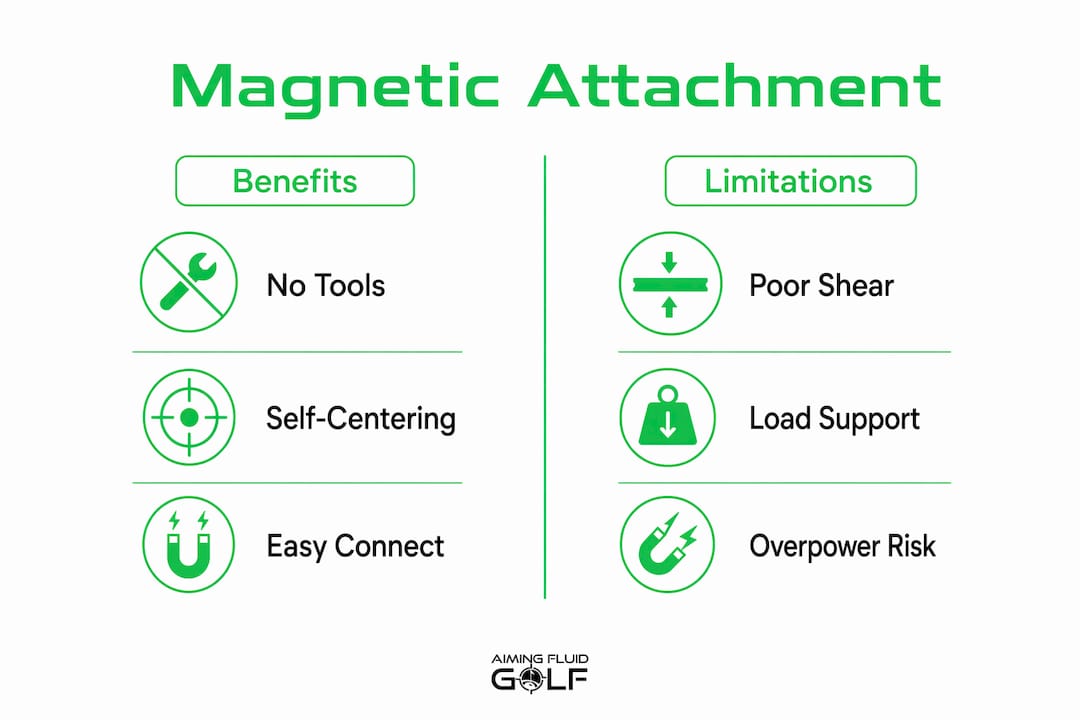
Magnetic attachment delivers a user experience that mechanical fasteners cannot match. The connection is immediate, requires no tools, and leaves no visible hardware on the product surface. Designers use this to create cleaner aesthetics and faster assembly workflows. The benefits are concrete and measurable in real use.
The core advantages break down as follows:
- Speed of attachment. A magnetic connection engages the moment two components come within range. There is no threading, no snapping, and no alignment struggle.
- Self-alignment. Alternating pole arrangements guide components into the correct position automatically, reducing user error.
- Durability. High-quality rare-earth magnets resist corrosion and maintain consistent holding force across thousands of attachment cycles.
- Clean design. No external fasteners means no screw heads, no clips, and no visible wear points on the product surface.
- Reversibility. The connection releases cleanly without tools, which matters in applications where frequent access is required.
Limitations are equally real and worth understanding before specifying magnetic attachment for a project.
Magnets resist pull force well but perform poorly under shear load, torque, or sustained vibration. A magnet that holds 5 lbs in a straight pull may slide or rotate under a fraction of that force applied sideways. Magnetic attachment must be supplemented with mechanical stops, interlocking geometry, or guide pins whenever side load or impact is part of the use case.
Pro Tip: Never rely on magnets alone for structural load-bearing joints. Use the magnet to guide and hold, then add a mechanical feature, such as a lip, groove, or pin, to handle shear and torque. This combination is how MagSafe accessories stay aligned on a phone without sliding off during normal use.
A common misconception is that stronger magnets always solve attachment problems. Overpowered magnets make detachment difficult, attract metal debris, and can interfere with nearby electronics. Matching magnet grade to the actual pull force requirement is a design discipline, not an afterthought.
How is magnetic attachment used across industries and golf accessories?
Magnetic attachment technology appears in a wide range of products. The table below shows how different industries apply the same core mechanism to solve different problems.
| Industry | Application | Key Benefit |
|---|---|---|
| Consumer electronics | Apple MagSafe chargers and accessories | Precise alignment, safe detachment |
| Dental/medical | Denture retention systems | Minimal lateral stress on abutment teeth |
| Industrial manufacturing | Modular tooling and fixture systems | Fast changeover, no fastener wear |
| Golf accessories | Magnetic towels and landing pads | Quick access, no fumbling on course |
| Wearable technology | Smartwatch bands, fitness trackers | Clean design, easy band swapping |
Apple’s MagSafe system is the most widely recognized example of magnetic attachment technology in consumer products. N48 or N52 neodymium magnets arranged in a ring provide both alignment and holding force simultaneously. The circular arrangement means the charger self-centers on the device regardless of the approach angle. This design principle applies directly to any product where repeatable, precise alignment matters.
In dentistry, magnetic attachments secure removable dentures to implant abutments. The magnets provide retentive force with minimal lateral stress on the supporting teeth. This is a load case where pull force is the primary requirement and shear is minimal, which makes magnetic attachment an ideal fit.
Golf accessories represent one of the fastest-growing application areas for magnetic attachment technology. Magnetic golf towels and landing pads use strong neodymium magnets to attach instantly to a golf bag without clips or carabiners. Aimingfluidgolf builds its entire Magna-Anchor system around this principle. A golfer reaches for the towel, uses it, and returns it to the bag in one motion. The magnet handles alignment and retention automatically. That faster towel access adds up across 18 holes and keeps the golfer focused on the shot rather than the gear.
What design strategies make magnetic attachment reliable?
Effective magnetic attachment design follows a set of engineering principles that separate products that work from products that fail after a few months of use.
- Optimize the circuit, not the magnet count. Adding more magnets rarely solves a weak attachment problem. Redesigning the flux path to concentrate force at the interface does. Yoke materials, pole piece geometry, and gap distance all affect circuit efficiency.
- Use tight placement tolerances. Magnet placement tolerances near ±0.1 mm are critical for reliable self-centering. Minor misalignment reduces holding force and can introduce unwanted torque that causes the connection to rotate or slide.
- Add mechanical interlocking for load-bearing joints. Magnets guide and hold. Mechanical features, such as grooves, lips, or guide pins, handle shear and torque. Combining both is the standard approach in any application where the joint faces real-world forces beyond simple pull.
- Select corrosion-resistant materials. Neodymium magnets are susceptible to oxidation if uncoated. Nickel, epoxy, or gold plating protects the magnet surface and maintains consistent force over repeated use cycles.
- Encapsulate magnets in 3D-printed or molded parts. Internal encapsulation prevents magnets from dislodging under vibration or impact. Mechanical interlocking within the part geometry adds a second layer of retention.
Material selection extends beyond the magnet itself. The mating surface material affects how cleanly the connection engages. Ferromagnetic steel backing plates concentrate flux and increase effective pull force without increasing magnet size. This is a standard technique in industrial magnetic fixtures and increasingly common in consumer products.
Key Takeaways
Magnetic attachment is most reliable when neodymium magnets are paired with precise circuit design, tight placement tolerances, and mechanical support for any load beyond straight pull force.
| Point | Details |
|---|---|
| Core mechanism | Permanent magnets attract through opposing poles and self-center via alternating pole arrangements. |
| Best magnet grade | N48 and N52 neodymium grades deliver the strongest hold for their size in compact applications. |
| Primary limitation | Magnets resist pull force well but require mechanical support to handle shear, torque, or vibration. |
| Design priority | Optimizing the magnetic circuit outperforms adding more magnets for improving hold strength. |
| Golf application | Magnetic towels and landing pads use neodymium magnets for instant, tool-free attachment on the course. |
Why magnetic attachment is more than a convenience feature
The products I find most interesting are the ones where magnetic attachment solves a problem that mechanical fasteners created in the first place. Screws strip. Clips break. Carabiners snag. Every mechanical fastener introduces a failure mode that the user eventually encounters at the worst possible moment.
What magnetic attachment gets right is the interaction model. The connection is forgiving. It guides you in, holds what it needs to hold, and releases cleanly when you want it to. That behavior is genuinely difficult to replicate with mechanical hardware, and it is why the technology keeps appearing in new product categories.
The area I watch most closely is sports and fitness gear. Golf is already there. Aimingfluidgolf’s approach of building an entire accessory system around magnetic attachment, rather than treating it as a single product feature, reflects where the technology is heading. Modular gear systems where every component snaps into place and releases on demand are a natural fit for athletes who need their equipment to work without thinking about it.
The caution I would add is this: magnetic attachment is an interface technology, not a structural one. The products that fail are the ones that ask magnets to do structural work. The products that succeed treat magnets as the user-facing layer and build mechanical support behind them. That distinction separates well-engineered magnetic products from ones that feel great in the store and disappoint in the field.
— Gary
Magnetic golf accessories built on this technology
Aimingfluidgolf designs its magnetic golf accessories around the same engineering principles covered in this article. Strong neodymium magnets, precise placement, and mechanical backing combine to create a system that holds reliably through a full round.

The magnetic golf towel collection uses high-grade magnets to attach directly to any golf bag without clips or rings. The magnetic landing pad system gives the towel a dedicated docking point on the bag, so it returns to the same spot every time. If you want to see how magnetic vs. clip-on attachment compares in real use, Aimingfluidgolf has published a direct side-by-side breakdown. The result is a bag that stays organized and a golfer who stays focused.
FAQ
What is magnetic attachment in simple terms?
Magnetic attachment is a fastening method that uses permanent magnets to hold two components together without screws or adhesives. The connection releases instantly when pulled apart with enough force.
What magnets are used in magnetic attachment technology?
Neodymium magnets, typically grades N48 or N52, are the most common choice because they deliver high holding force in a compact size. Higher grades provide stronger hold but are more sensitive to heat.
How does magnetic attachment differ from traditional fasteners?
Traditional fasteners like screws and clips require tools and create wear points over time. Magnetic attachment is tool-free, self-aligning, and leaves no visible hardware on the product surface.
Can magnetic attachment handle heavy loads?
Magnetic attachment handles pull force well but requires mechanical support, such as guide pins or interlocking geometry, to resist shear load, torque, or sustained vibration in demanding applications.
How are magnetic attachments used in golf accessories?
Magnetic golf towels and landing pads use neodymium magnets to attach instantly to a golf bag. The system allows golfers to grab and return their towel in one motion without clips or carabiners.
Recommended
- Magnetic Landing Pad: The Ultimate Docking Station for Any Golf Bag – Aiming Fluid Golf
- The Magna-Anchor™ Ecosystem | The Complete Magnetic Golf Towel System – Aiming Fluid Golf
- Why Magnetic Golf Towels Fail | Real-World Failure Modes (Design Over Function Trap) – Aiming Fluid Golf
- BEST MAGNETIC LANDING PADS — COMPLETE BUYER’S GUIDE (AIMING FLUID GOLF – Aiming Fluid Golf


