


TL;DR:
- Effective golf practice focuses 60% on short game and putting to improve scores faster.
- Structured routines with warm-up, drills, and pressure games build consistency and confidence.
- Using the right accessories and tracking progress enhances focus and measurable improvement.
Most amateur golfers spend hours on the range and walk off the course wondering why their scores haven’t moved. The frustration is real: you’re putting in the time, hitting bucket after bucket, yet the handicap barely shifts. The answer isn’t more practice. It’s smarter practice. Research consistently shows that structured, intentional sessions built around the short game and putting produce faster score improvement than unplanned full-swing repetitions. This guide breaks down a step-by-step practice routine designed specifically for amateur golfers who want measurable results, not just more range time.
Table of Contents
- Why most practice routines fail (and how to avoid it)
- Essentials for effective practice: What you’ll need
- Step-by-step routine: Warming up to technical drills
- Short game and putting: The scoring superpower
- Simulating on-course pressure and tracking improvement
- The truth: Why amateurs see dramatic gains with structure (and consistency)
- Upgrade your game with premium golf accessories
- Frequently asked questions
Key Takeaways
| Point | Details |
|---|---|
| Short game focus | Practice sessions should dedicate at least 60% of time to short game and putting for best score improvement. |
| Use structured phases | Divide practice into warm-up, technical drills, and pressure simulations to maximize results. |
| Prioritize quality | Short, consistent, focused sessions outperform long, unplanned ones every time. |
| Track your progress | Setting and reviewing benchmarks is key to seeing real improvement over weeks and months. |
Why most practice routines fail (and how to avoid it)
The average amateur golfer arrives at the range, grabs a driver, and starts swinging. It feels productive. It rarely is. The core problem is a fundamental mismatch between where golfers practice and where strokes are actually lost.
Short game and putting make up 40-65% of every round you play, yet most amateurs spend the majority of their session hitting full irons and drivers. That’s practicing the minority of the game while ignoring the majority. Understanding yardages that matter on the course reveals just how often shots inside 100 yards determine your final score.
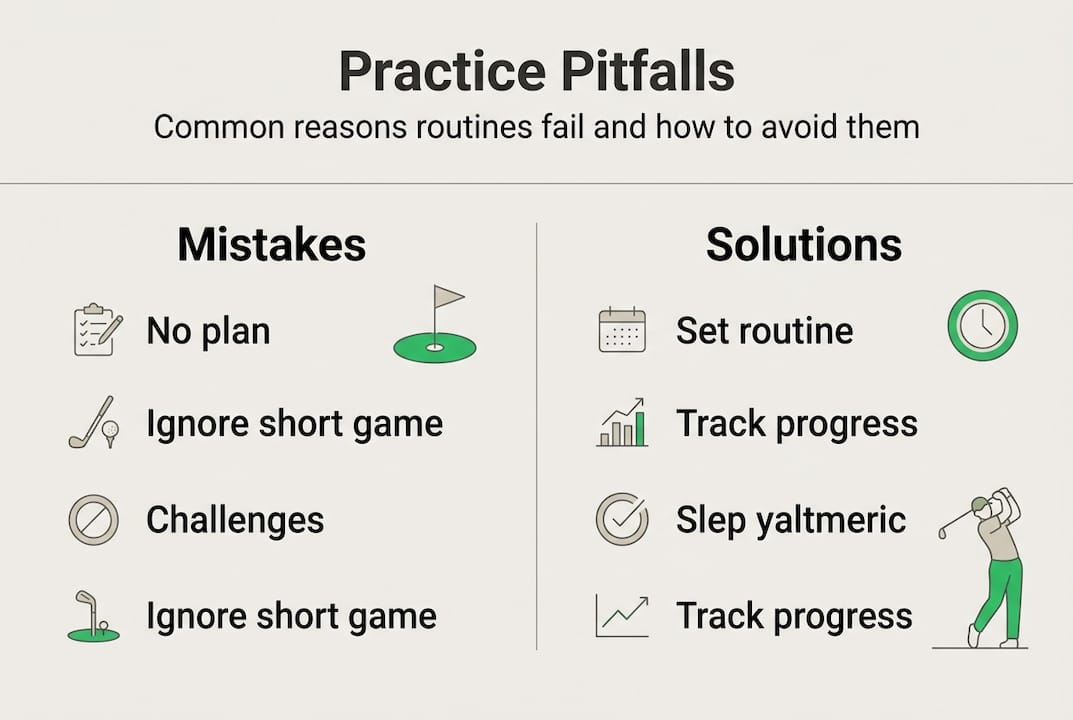
Beyond the time allocation problem, there’s the issue of mindless repetition. Hitting 80 balls without a specific target, feedback mechanism, or drill structure is closer to muscle fatigue than skill development. Practice without a plan creates habits, but not necessarily good ones.
Three core principles separate effective practice from wasted effort:
- Principle 1: Prioritize short game and putting. Allocate at least 60% of your session to shots inside 50 yards and putting. This is where scores are made and broken.
- Principle 2: Use two practice modes. Block practice (repeating one drill to build technique) and random practice (mixing clubs, targets, and lies to simulate real pressure) both serve different purposes. Use block practice to fix mechanics. Use random practice to build on-course confidence.
- Principle 3: Track benchmarks. Without data, you can’t measure progress. Track total putts per round, up-and-down percentage, and greens in regulation every two weeks.
“The golfer who practices with purpose for 30 minutes will outperform the golfer who mindlessly hits balls for two hours. Structure is the multiplier.”
A solid short game prep guide can help you build this structure before you even arrive at the course.
Essentials for effective practice: What you’ll need
Understanding what fails is half the battle. Here’s what you need for practice success.
Tour pros structure sessions with intentional phases and proper accessories to maximize focus. You don’t need their budget, but you do need the right tools. Arriving at the range without the right gear is like showing up to a job site without your tools. You’ll waste time compensating for what’s missing.
Here’s a breakdown of what belongs in every practice kit:
- Wedges (52, 56, 60 degree): Essential for short game work. Most amateurs own them but rarely practice with them intentionally.
- Alignment sticks: Cheap, lightweight, and one of the highest-impact training aids available. Use them for ball position, alignment, and swing path.
- Putting aid or gate drill setup: Two tees placed just wider than your putter face create instant feedback on your stroke path.
- Premium golf towel: Keeping your grips and clubfaces clean during practice directly affects feel and feedback. A magnetic towel stays accessible without interrupting your session flow.
- Utility pouch: Organize tees, ball markers, and divot tools in one place. When your bag feels like a junk drawer, your focus suffers.
| Accessory | Essential | Optional |
|---|---|---|
| Wedge set (3 clubs) | Yes | |
| Alignment sticks | Yes | |
| Putting aid | Yes | |
| Premium golf towel | Yes | |
| Utility pouch | Yes | |
| Launch monitor app | Yes | |
| Swing recording tripod | Yes | |
| Impact tape | Yes |
Review practice routine tools for a broader look at how equipment choices shape session quality. Also check the golf warm-up essentials page for gear that bridges warm-up and practice.
Pro Tip: Pre-load your practice kit in your car trunk at the start of each week. When the bag is already packed and ready, there’s no excuse to skip a session.
Step-by-step routine: Warming up to technical drills
With your essential gear ready, let’s walk through exactly how to structure your first minutes on the range or practice green.
Pros and top amateurs start practice with 5-10 wedge shots at 60-80 yards, phasing into technical drills. This approach primes your neuromuscular system without loading it with full-power swings before it’s ready.
Follow this sequence for any session between 20 and 40 minutes:
- Minutes 0-5: Dynamic mobility. Rotate your torso, swing your arms across your body, and do 10 slow hip circles each direction. Skip static stretching before swinging. It reduces power output temporarily.
- Minutes 5-12: Wedge feel shots. Hit 8-10 wedge shots at 60-80% effort, focusing on contact quality and rhythm. No scorecard. No pressure. Just feel.
- Minutes 12-22: Block practice drills. Pick one or two technical elements to work on. Grip pressure, takeaway path, or weight shift are good starting points. Drill these in isolation using alignment sticks for feedback. Review tee setup for consistency to dial in your setup mechanics.
- Minutes 22-35: Random practice. Mix clubs, distances, and targets. Simulate real shot decisions. This is where technique starts becoming instinct.
- Minutes 35-40: Pre-shot routine repetition. Every shot should include your full pre-shot routine, even in practice. This is how on-course habits are built.
Consult the tour pro warmup checklist for a professional-grade warm-up framework you can adapt to your schedule.
| Session length | Warm-up | Block drills | Random practice | Pre-shot routine |
|---|---|---|---|---|
| 20 minutes | 5 min | 8 min | 5 min | 2 min |
| 30 minutes | 5 min | 10 min | 12 min | 3 min |
| 40 minutes | 7 min | 12 min | 17 min | 4 min |
Pro Tip: If you only have 15 minutes, skip the full-swing block entirely. Go straight to putting or chipping. Short game work in 15 minutes beats 15 minutes of rushed driver swings every time.
Short game and putting: The scoring superpower
Warmed up with purpose, you’re ready for the section that truly separates great rounds from average ones: your short game.
Shots inside 50 yards and putts are where handicaps drop fastest. Benchmarks for amateurs show that making over 85% of putts inside 6 feet, averaging under 32 putts per round, and keeping 40-65% of strokes around the green are the targets that define a competent short game. Most mid-handicappers fall well below these numbers, which means this is the highest-leverage area to practice.
Here are three putting drills that build measurable skill fast:
- The gate drill. Place two tees just wider than your putter head, 6 inches in front of the ball. Every stroke that clips a tee reveals a path problem. Clean passes build confidence.
- The clock drill. Place four balls at 3, 6, 9, and 12 feet around a single hole. Make all four before moving back. This builds pressure tolerance and distance control simultaneously.
- The lag drill. From 30 feet, putt to a tee instead of a hole. Your goal is to stop within 18 inches. This trains distance control, which eliminates three-putts.
For chipping, use these two routines:
- The landing spot drill. Pick a landing spot 2 feet onto the green and practice landing every chip within a club-length of that spot. Focus on the landing, not the hole.
- The up-and-down challenge. Drop five balls in different lies around the green. Count how many times you get up and down in two shots. Track this number weekly.
Check distance benchmarks to understand how your full-swing distances compare, and use the short game practice stats to set realistic weekly targets.
Pro Tip: End every session with a pressure game. Try to make 10 putts in a row from 4 feet. If you miss, reset to zero. This single drill builds more on-course composure than any technique drill.
Simulating on-course pressure and tracking improvement
Now, make every session count by locking your gains in with pressure and tracking.
Randomized, pressure-focused games produce better on-course results than endless block practice. The reason is simple: the brain learns best when it must solve problems under uncertainty. Block practice builds mechanics. Pressure games build performance.
Here are four ways to simulate real game pressure during any session:
- Play a 9-hole scorecard on the range. Assign each bay target a hole. Hit one shot per hole with the club you’d actually use on course. Score it honestly.
- Create a consequence system. If you miss a target three times in a row, add 10 extra short game shots to your session. Stakes, even small ones, activate focus.
- Use a shot clock. Give yourself 30 seconds from the time you step up to the ball to complete your shot. This mirrors real pace-of-play pressure.
- Compete against yourself. Track your best score on a drill and try to beat it every session. Progress against a personal record is highly motivating.
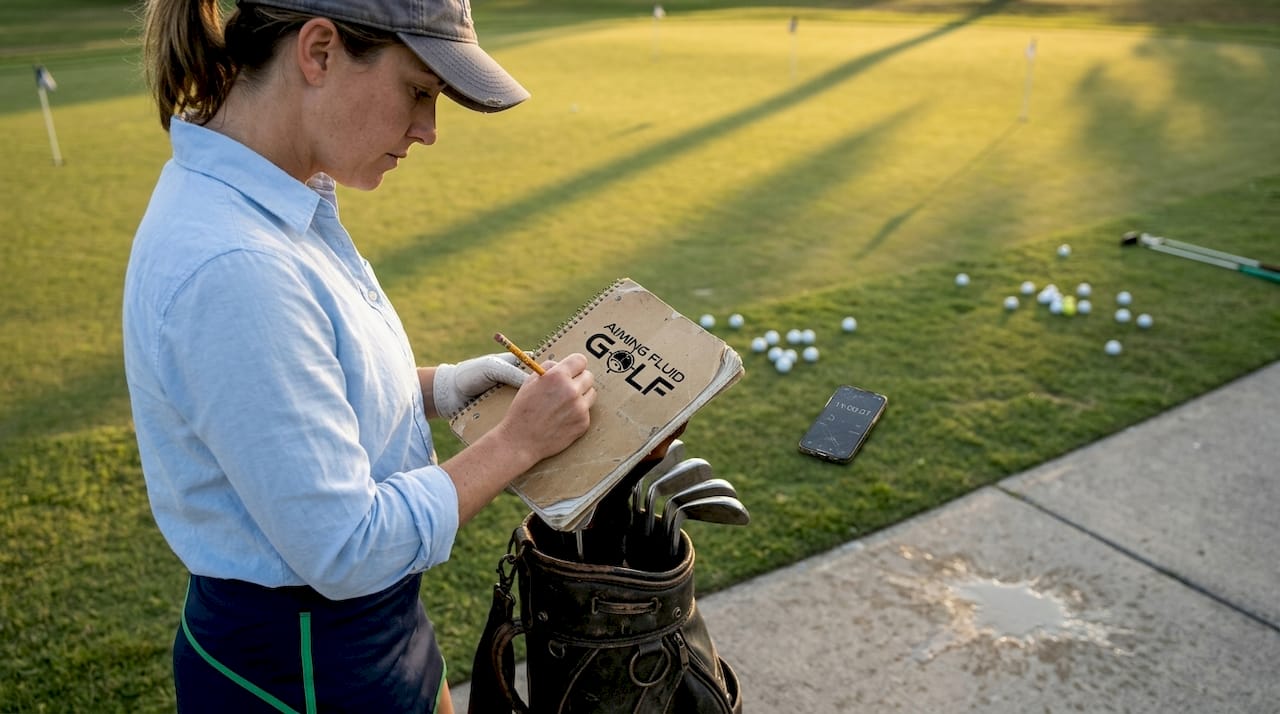
Tracking is equally important. Use a simple notes app or paper log to record total putts per round, up-and-down percentage, and fairways hit. Review these numbers every two weeks. You’ll quickly see which areas are improving and which need more attention. The instant improvement tips and foundational golf basics pages offer additional frameworks for identifying and fixing common patterns.
Review the random practice science behind interleaved training to understand why mixing shot types and targets accelerates skill transfer to the course.
Pro Tip: Review your stats every two weeks and identify one metric that’s lagging. Adjust your next four sessions to address that specific area. One focused adjustment beats five vague ones.
The truth: Why amateurs see dramatic gains with structure (and consistency)
Here’s what most practice articles won’t tell you: the golfers who improve fastest aren’t the ones who practice the most. They’re the ones who show up with a plan every single time.
The myth that more hours equal lower scores is one of the most persistent in amateur golf. You don’t need 15 hours a week. You need focused, measurable sessions where every drill has a purpose and every result gets recorded. Structure creates accountability. Accountability creates consistency. Consistency creates confidence.
The real competitive advantage for amateur golfers isn’t talent or time. It’s repeatability. When you follow the same warm-up sequence, work through the same drill progression, and end with the same pressure game, your nervous system starts to recognize the pattern. That recognition transfers directly to the first tee.
Review your tee setup consistency as part of that repeatable framework. Even small setup details, practiced consistently, compound into lower scores over a season.
Treat your practice like a round. Stick to your routine. Don’t chase quick fixes. The golfer who shows up with a plan three times a week will outperform the golfer who grinds for five unstructured sessions. Every time.
Pro Tip: Write your practice plan the night before. Even a three-line note on your phone creates commitment and eliminates the decision fatigue that leads to mindless range sessions.
Upgrade your game with premium golf accessories
Ready to streamline your practice sessions even more? Here’s how the right accessories help.
A well-organized practice kit removes friction from every session. When your tees, divot tool, and ball markers are in a dedicated utility pouch, you spend less time searching and more time practicing. When your towel is always within reach via a magnetic attachment system, clean grips and clubfaces become automatic, not an afterthought.

Aiming Fluid Golf designs accessories specifically for golfers who take their game seriously. From magnetic towels that attach and detach instantly to the best divot tool built for durability and one-handed use, every product is engineered to reduce on-course friction. Better organization means better focus. Better focus means better scores.
Frequently asked questions
How many times per week should I practice golf for improvement?
Aim for 2-4 focused sessions weekly, mixing range work, short game, and putting. Consistency across multiple shorter sessions outperforms one long, infrequent grind.
What’s the optimal time for a golf practice session?
20-60 minutes of quality work per session produces the most gains. Quality and focus matter far more than session length.
What percentage of practice should be short game and putting?
Allocate at least 60% of practice to short game and putting. 40-65% of all strokes for amateurs come from inside 50 yards and on the green, making this the highest-return area to develop.
How can I practice like a tour pro as an amateur?
Structure sessions in clear phases: warm-up, technical block drills, random target games, and a pressure challenge at the end. Tour pros structure routines with warm-ups, focused drills, and finish with pressure to lock in performance under stress.
Recommended
- 9 Simple Golf Tips to Instantly Improve Your Game (Rick Shiels Breakdo – Aiming Fluid Golf
- Step-by-step golf tee setup guide for consistency – Aiming Fluid Golf
- Golf round preparation guide: boost your game in 2026 – Aiming Fluid Golf
- The 4-Hour Round Manifesto: Gear & Habits for Fast Play – Aiming Fluid Golf


