


TL;DR:
- Most delays in golf come from off-the-ball activities like disorganized gear, late arrivals, and inefficient movement, rather than slow swings.
- Implementing ready golf, proper preparation, and quick-access gear can significantly reduce round times and improve overall pace.
Most golfers assume that slow swings are what cause slow rounds. They are wrong. The pace of play in golf is almost never ruined by the swing itself. It gets eaten up by the two minutes spent hunting for a tee, the delayed walk to the ball, the bag that functions like a junk drawer when you need one club fast. Fix the time between shots, and you fix the round. This article covers the official standards, the real causes of slow play, and the specific strategies, including ready golf and gear habits, that measurably cut your round time without touching your technique.
Table of Contents
- Key takeaways
- Understanding pace of play standards and official rules
- Common causes of slow pace and how to avoid them
- Ready golf and modern pace-of-play strategies
- Practical tools, preparation, and habits for efficient play
- Handling pace disruptors: lost balls, slow groups, and difficult setups
- My take on pace and why it actually changes how you play
- Gear that supports a faster, more organized round
- FAQ
Key takeaways
| Point | Details |
|---|---|
| Know the standard | A four-player round should finish in 4 to 4.5 hours, roughly 14-15 minutes per hole. |
| Delays happen off the ball | Disorganized gear, late arrivals, and inefficient movement cause more delays than slow swings. |
| Ready golf is USGA-endorsed | Playing when safe and ready, even out of traditional order, can save 20 to 30 minutes per round. |
| Preparation compounds over 18 holes | A pre-round checklist and organized bag prevent dozens of small delays that stack up significantly. |
| Gear design affects pace | Quick-access accessories reduce fumbling time and keep you moving between shots. |
Understanding pace of play standards and official rules
The phrase “pace of play” refers to the speed at which a group moves through a round of golf, measured both hole-by-hole and across the full 18. A target 18-hole round for a group of four sits between four and four and a half hours, which translates to roughly 14 to 15 minutes per hole. That benchmark applies at most public and private courses, and it is the standard course marshals use when monitoring groups.
The official framework comes directly from the Rules of Golf. Rule 5.6 requires players to play promptly and to make each stroke within 40 seconds once they are able to play without interference or distraction. That 40-second clock does not start when you arrive at the ball. It starts when it is clearly your turn and conditions are ready. Most recreational golfers significantly exceed that window without realizing it.
Courses manage pace through checkpoint times, which are specific holes where a group’s time is recorded and compared to the posted schedule. If a group is running behind by more than one hole, a marshal will typically intervene. Some courses post their expected pace times on scorecards or at each tee box, giving players a built-in reference.
The professional game is now tracking pace with even more precision. The Korn Ferry Tour publicized speed-of-play stats in 2026, including tournament averages and season totals, making individual pace data visible to players and fans. That level of transparency signals a shift: pace is no longer an informal courtesy. It is a measurable, managed part of the game at every level.
“Pace of play is not just about courtesy to other groups. It is about the integrity of your own round, your concentration, and the experience of everyone sharing the course with you.”
Common causes of slow pace and how to avoid them
Here is where most golfers get it wrong. They focus on what happens during the swing and ignore what happens everywhere else. The primary causes of slow rounds are non-shot activities: arriving late, disorganized gear, searching for scorecards, extended social conversations at the wrong moments, and taking extra time walking between shots.
The most consistent pace killers on any given round include:
- Disorganized bag setup: Spending 20 to 30 seconds finding a club, a tee, or a ball marker on every hole adds up to more than 10 minutes across a full round.
- Inefficient walking paths: Walking to your bag before your group has finished putting, or not planning your next move while others are hitting, wastes time that never feels obvious in the moment.
- Excessive practice swings: Two or three rehearsal swings before every shot adds a full minute per hole for a group of four.
- Lost ball searches without a plan: Unorganized search patterns with multiple players walking in random directions extend searches well beyond what is necessary.
- Late tee time arrivals: Starting even five minutes late means your group is already behind the pace card before a single shot is struck.
Pro Tip: Set up your bag the night before a round. Assign every accessory a permanent location, and you will never waste time searching for a tee or ball marker mid-round.
Every one of these delays feels minor in isolation. But a 30-second extra delay per player on every hole totals more than 90 minutes of cumulative lost time across a four-person group for 18 holes. That is not a slow swing problem. It is a preparation and habits problem. The walking golfer organization guide from Aimingfluidgolf covers specific gear and movement patterns that directly address these delays.

Ready golf and modern pace-of-play strategies
Ready golf is the most practical pace solution available to recreational golfers right now. The USGA and R&A endorse ready golf for stroke play, meaning players are encouraged to play when safe and ready, even if it is not their turn under traditional honor system rules. The key word is “safe.” You never hit when there is any risk of interfering with or endangering another player.
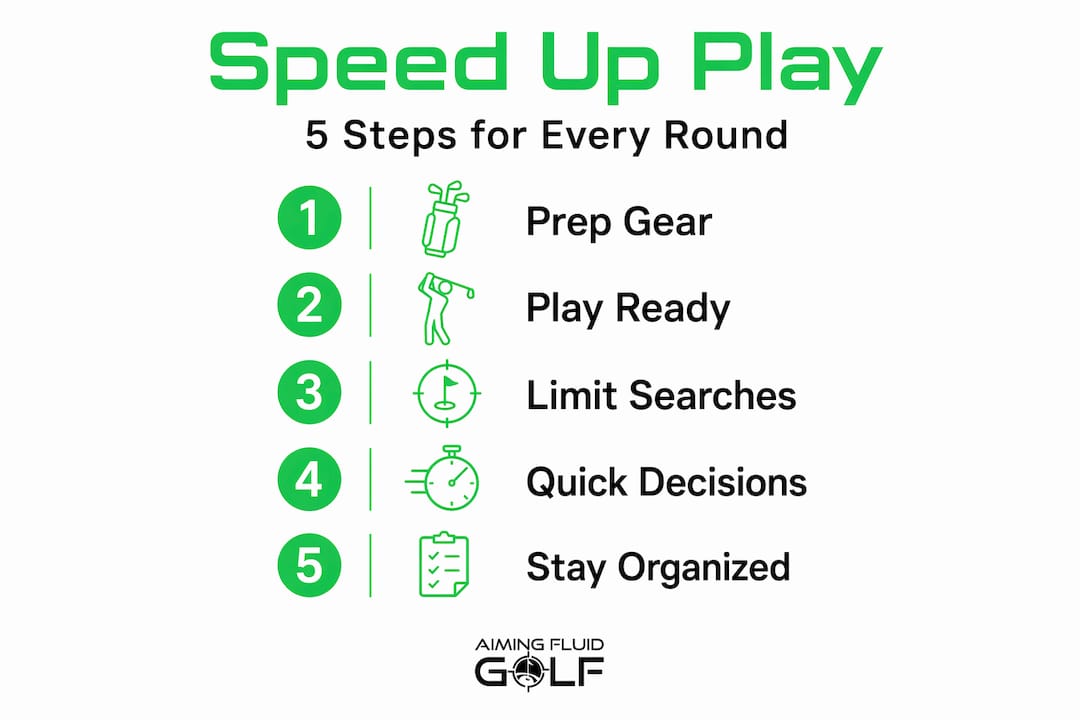
When applied consistently, ready golf can shave 20 to 30 minutes off a typical four-hour round. Here is how to apply it systematically:
- Walk and plan simultaneously. While walking to your ball, assess the lie, wind, and target. By the time you arrive, you should need only a few seconds to confirm your club selection.
- Shorter hitters tee off first. On par-3 holes or on approach shots, players with shorter expected carry distances should play first while longer hitters wait for the green to clear.
- Read putts during others’ turns. Do not wait until the player ahead of you has finished putting to begin reading your own line. That time is available to you now.
- Limit pre-shot routine to 40 seconds. Keeping pre-shot routines under 40 seconds and restricting practice swings to one or two preserves rhythm without compromising shot quality.
- Leave the green promptly. Record scores at the next tee box, not while standing on the green. This alone clears the hole faster for the group behind you.
Pro Tip: Before each round, agree with your group that you will play ready golf. A shared commitment prevents the awkward pause where everyone waits for someone else to hit first.
For golfers who want a deeper look at how these habits fit into a complete efficiency framework, the 4-hour round manifesto from Aimingfluidgolf breaks down gear and behavioral strategies for maintaining that benchmark consistently.
Practical tools, preparation, and habits for efficient play
Preparation before the round prevents delays during it. The golfers who move efficiently through 18 holes typically share the same pre-round habits, and very few of those habits require extra time. They require forethought.
A structured pre-round preparation guide should include:
- Arriving at the course at least 20 minutes before your tee time to organize gear, warm up, and handle logistics before you reach the first tee.
- Confirming your bag has sufficient tees, ball markers, and spare balls so you are not borrowing from playing partners or searching through pockets mid-round.
- Setting your bag up so that frequently used items, tees, divot tools, ball markers, and a towel, are accessible without opening pockets or digging.
The 40-second rule deserves particular attention. Once you can play your shot, you have 40 seconds under Rule 5.6. Most recreational golfers have never timed themselves and would be surprised at how often they exceed it. Counting internally, or using a consistent pre-shot trigger to signal when the clock starts, makes this more manageable.
Here is a practical comparison of two player approaches over a full round:
| Habit | Unorganized player | Organized player |
|---|---|---|
| Finding tee before each hole | 20-30 seconds | Under 5 seconds |
| Locating ball marker on green | 15-20 seconds | Immediate |
| Accessing towel between shots | 20-30 seconds | Immediate (magnetic attach) |
| Clearing the green after putting | 45+ seconds (scoring there) | Under 15 seconds (score at next tee) |
| Total estimated delay per 18 holes | 15-20 minutes extra | Minimal |
Quick-access accessories are not a luxury. They are a functional part of pace management. When your towel clips magnetically to your bag and returns to the same spot every time, that is 15 to 20 seconds per hole recovered across the round.
Handling pace disruptors: lost balls, slow groups, and difficult setups
Even organized golfers encounter situations that threaten to derail a round’s pace. Knowing how to manage these scenarios calmly and efficiently separates players who maintain pace from those who fall behind.
Lost ball situations are among the most common disruptors. The official 3-minute search rule means once three minutes have passed from when you begin searching, the ball is lost under the Rules of Golf. Efficient searching requires the group to spread out immediately and cover the likely area in a coordinated pattern rather than clustering together and moving randomly.
Key strategies for managing pace disruptors:
- Hit a provisional ball. If there is any doubt about where your ball landed, hit a provisional before searching. It takes 30 seconds now and potentially saves five minutes later.
- Let faster groups play through. If your group has fallen behind and there is an open hole ahead, waving a faster group through is standard etiquette and resolves the pressure immediately.
- Adjust strategy based on difficulty. Course difficulty and conditions can push rounds well past five hours even at the professional level. On tight layouts or courses with water on every hole, lay up more often and accept bogey targets to keep the group moving.
- Communicate with your group. If someone in your group consistently searches too long or takes excessive time, a calm conversation before the round sets expectations better than frustration mid-round.
The objective is not to rush anyone’s shot. It is to eliminate every delay that does not serve the shot itself.
My take on pace and why it actually changes how you play
I have watched hundreds of rounds from the perspective of someone focused on how golfers interact with their equipment and their environment. And what I have found is that slow pace is not just a courtesy issue. It actively degrades the quality of golf being played.
When groups fall behind pace, the pressure compounds. Players start rushing the shots that actually matter, having wasted time on everything else. The golfer who spent two minutes chatting near the cart path then rushes a four-foot putt under time pressure. That is an avoidable outcome. The mental rhythm of a round depends on consistent spacing. Too much idle time between shots disrupts focus just as much as rushing does.
Group cooperation is the variable most articles skip over. One player committed to ready golf while three others play traditional honor order does not produce a fast round. Pace is a group behavior, not an individual stat. When I see groups that move well, they have almost always had a quick word at the first tee about expectations, they share the work of keeping things moving, and nobody treats efficiency as an affront to their game.
The golfers who play the fastest are not the ones who rush. They are the ones who are simply always ready. Their bag is organized. Their read is done. Their decision is made before they reach the ball. That kind of preparation creates calm, not urgency. And in my experience, those players also tend to score better, because they arrive at each shot in a focused, decisive state rather than a frantic one.
— Gary
Gear that supports a faster, more organized round

The right accessories do not just improve comfort on the course. They directly reduce the friction that causes delays. Aimingfluidgolf designs products specifically around this principle: if your gear is disorganized, your round will be too.
The best golf accessories in the Aimingfluidgolf lineup are built for quick access and consistent placement. The magnetic towel system, for example, clips and returns to a fixed point on your bag without any searching or stuffing. Precision tees, a 5-in-1 divot tool, and a leather utility pouch each solve a specific organizational gap that would otherwise cost you seconds on every hole. Across 18 holes, those seconds matter. Browse the full collection to find the accessories that match your setup and start shaving time off your round in the most practical way possible.
FAQ
What is pace of play in golf?
Pace of play in golf refers to the speed at which a group of golfers progresses through a round, typically measured against a target time of 4 to 4.5 hours for 18 holes. It is governed by Rule 5.6 of the Rules of Golf, which requires players to play promptly and complete each stroke within 40 seconds.
What causes most slow play on the golf course?
Most slow play results from non-shot delays such as disorganized gear, excessive practice swings, inefficient movement between holes, and late tee time arrivals rather than from the speed of swings themselves.
What is ready golf and is it officially allowed?
Ready golf means playing your shot when it is safe to do so, even if it is not your turn under traditional order. The USGA and R&A officially endorse ready golf for stroke play as a practical way to improve golf course speed and reduce round time.
How long can you search for a lost ball in golf?
Under the current Rules of Golf, players have exactly 3 minutes to search for a lost ball from the moment the search begins. After that, the ball is officially lost, and a penalty stroke applies.
How much time can ready golf save per round?
Consistently applying ready golf principles, including playing when ready, reading putts during others’ turns, and scoring at the next tee, can reduce a typical round’s duration by 20 to 30 minutes without affecting shot quality or safety.


