


TL;DR:
- Regular mid-round club cleaning prevents debris buildup that reduces spin and control during play.
- Efficient routines using minimal tools like a damp towel and groove brush improve performance and maintain pace.
Dirty grooves cost you shots. Not sometimes, but consistently, across every round where mud, grass, and debris pack into the face of your irons and wedges. When grooves are blocked, the ball loses spin and predictability, and your carefully planned approach shot becomes a guessing game. At the same time, fumbling through a bag to find a towel after every shot slows your group and creates friction. The solution is a structured, fast mid-round cleaning routine that fits seamlessly into your pace of play without holding anyone up.
Table of Contents
- Why quick club cleaning matters mid-round
- Essential tools for cleaning clubs during play
- Step-by-step: Fastest mid-round club cleaning routine
- Mistakes to avoid and troubleshooting your routine
- Checking your results and improving over time
- What most golfers get wrong about mid-round club cleaning
- Gear up for efficient club cleaning with Aiming Fluid Golf
- Frequently asked questions
Key Takeaways
| Point | Details |
|---|---|
| Faster rounds | Quick on-course cleaning boosts your pace and eliminates time-consuming deep scrubs later. |
| Better shots | Clean grooves mean more spin and control on every swing. |
| Simple gear works | A towel and brush are usually all you need for mid-round cleaning success. |
| Avoid etiquette issues | Keep club cleaning speedy and your group will never be slowed down. |
Why quick club cleaning matters mid-round
A single swing through a fairway lie can pack grass and soil into the grooves of your iron. By the third or fourth hole, those grooves may be significantly compromised, reducing the spin your club can generate on the ball. Grooves are engineered to channel debris away from the contact zone and grip the ball’s cover at impact. When they are full of debris, that mechanism fails, and the ball launches with less control and more variability.
The performance argument is straightforward, but the pace-of-play argument is equally important. Golfers who neglect cleaning mid-round often spend 10 to 15 minutes at the end of the round scrubbing caked-on mud and dried grass from multiple clubs. As pace of play guidelines note, efficient on-course routines prevent post-round deep cleans and keep the group moving without etiquette conflicts.
Beyond scoring and speed, regular cleaning extends the functional life of your equipment. Dirt and moisture accelerate corrosion on steel club faces, and abrasive grit can wear groove edges over time. The club cleaning benefits on equipment longevity are well-documented and apply directly to mid-round maintenance, not just post-round care.
Here is what consistent mid-round cleaning delivers:
- Predictable spin on approach shots and chips
- Cleaner contact from irons, wedges, and fairway woods
- Preserved groove edges that stay sharp longer
- Faster post-round cleanup because less debris has dried and hardened
- Better group etiquette because your routine is efficient and unobtrusive
Cleaning clubs as you play is not extra work. It is replacing slow, messy post-round labor with brief, productive moments that improve every shot you take for the rest of the round.
With the stakes for pace and performance outlined, let’s look at what you will need for a fast, effective on-course cleaning routine.
Essential tools for cleaning clubs during play
The right tools make the difference between a quick 10-second wipe and a frustrating search through your bag. Mid-round cleaning requires three categories of gear: a cleaning towel, a groove brush, and a storage solution that keeps everything instantly accessible.
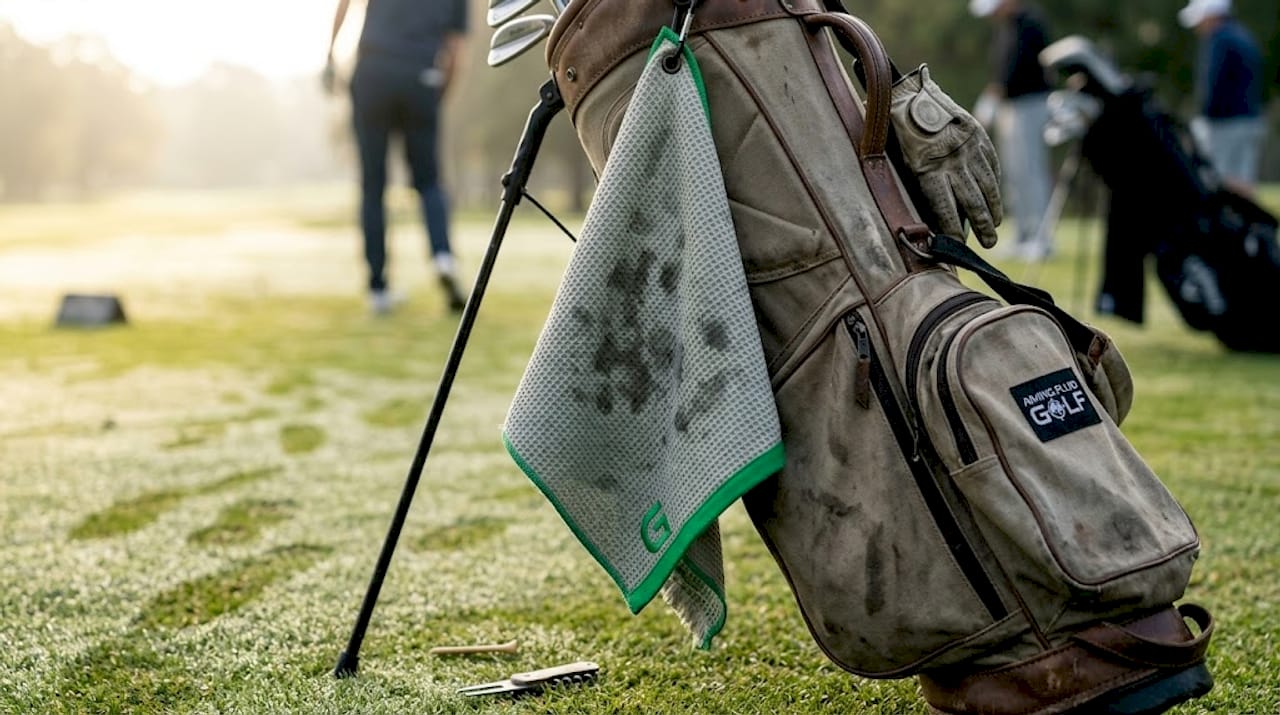
Cleaning towels are the foundation. A small, quick-drying microfiber or waffle-weave towel handles most cleaning tasks when slightly damp. Towels that clip or attach magnetically to your bag are far more practical than ones tucked into a pocket or stuffed in a side pouch. Magnetic attachment systems allow you to grab and return the towel in one motion without breaking stride.
Groove brushes handle what towels cannot. Packed mud or grass in tight grooves requires a stiff-bristled brush with a pointed pick for stubborn debris. The best club cleaning brushes combine a soft face-cleaning brush with a harder groove-specific side, giving you two functions in one compact tool.
Utility pouches serve as the organizational anchor for your cleaning kit. A small, easily clipped pouch mounted to your bag keeps brushes, tees, and backup towels within reach. Without a dedicated storage system, your bag feels like a junk drawer, and you lose time looking for tools instead of using them.
| Tool | Speed of use | Convenience | Typical cost |
|---|---|---|---|
| Magnetic microfiber towel | Very fast (5 sec) | High, clips to bag | $15-$30 |
| Standard hang towel | Moderate (10 sec) | Medium, dangles from bag | $8-$20 |
| Dual-head groove brush | Fast (10-15 sec) | High when clipped | $10-$25 |
| Single-function pick | Slow (20+ sec) | Low, easy to lose | $5-$12 |
| Utility pouch | Instant access | Very high, organizes all tools | $20-$40 |
Keep this gear clipped to the outside of your bag, not buried inside. Accessibility is the entire point. If retrieving your towel takes more than two seconds, your system needs adjustment.
Pro Tip: Pre-moisten your towel with water at the start of the round and store it in a small zip pocket or pouch. A slightly damp towel removes fresh grass and light mud in a single wipe, cutting your mid-round cleaning time nearly in half compared to using a dry towel.
You can find additional guidance on pro tips for clean clubs that reinforce the value of setup before the round begins. With the right tools ready, it is time to put them into action with an efficient cleaning routine for every hole.
Step-by-step: Fastest mid-round club cleaning routine
The goal is to clean each club in under 30 seconds without stopping play. This is achievable when you integrate cleaning into the natural movement between shots. The key is treating cleaning as part of your post-shot routine, not a separate task.
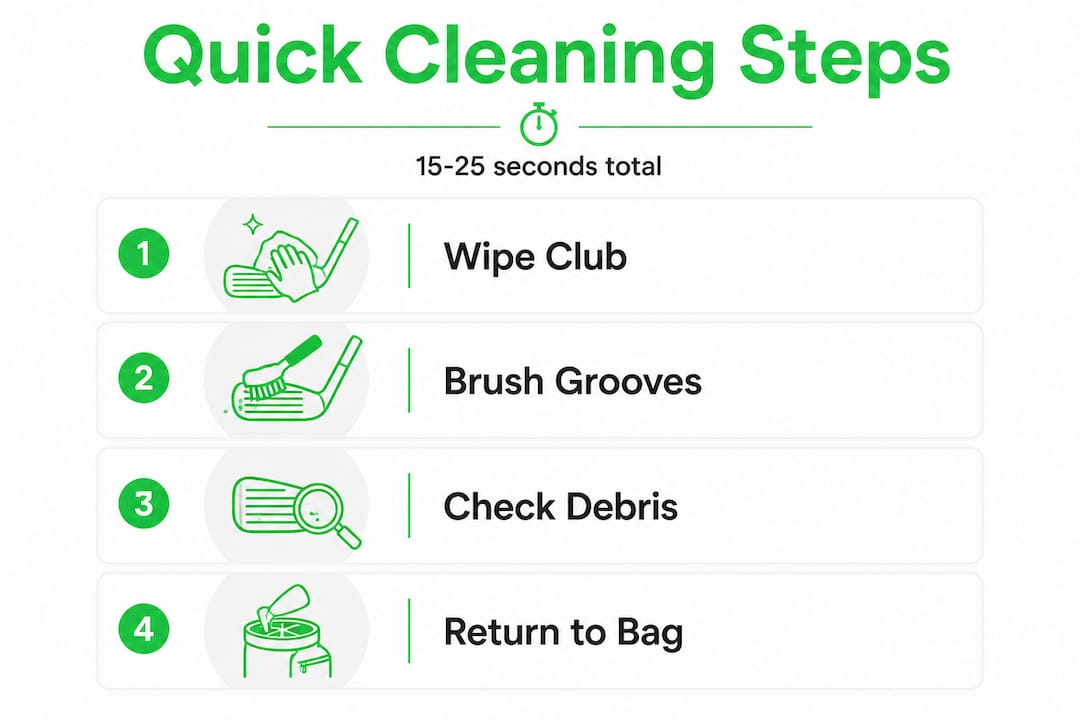
Here is the four-step sequence:
-
Wipe the face immediately after the shot. The moment you pull the club from the ground or complete your follow-through, run the damp side of your towel across the face. Fresh debris wipes off in one or two passes. This takes roughly 5 seconds.
-
Brush the grooves during your walk. As you move toward your ball or cart, use the groove brush to clear any remaining debris from the face. A few strokes across the grooves is sufficient for routine cleaning. Walking and brushing simultaneously keeps your pace intact.
-
Inspect the face before returning the club. Glance at the clubface to confirm grooves are clear and the face is dry. This takes one second. If debris remains, repeat the brush pass. A quick visual check prevents carrying a dirty club into your next shot.
-
Return the club and reattach your towel. Slide the club back into your bag and clip or snap your towel back to its magnetic attachment point. The restore club spin process becomes fast and automatic when your equipment is always in the same location.
| Scenario | Time required | Cleaning result |
|---|---|---|
| Quick post-shot wipe only | 5-8 seconds | Good for light debris; grooves partially clear |
| Wipe plus groove brush | 15-25 seconds | Excellent; grooves fully clear, face dry |
| Skipped cleaning, dried mud | 60-90 seconds | Requires soaking and hard scrubbing |
| Full wash station stop | 45-90 seconds | Best result but disrupts pace significantly |
The data above makes the case clearly. Spending 15 to 25 seconds after each shot saves you 60 to 90 seconds of scrubbing when debris dries. Multiply that across 14 clubs and an 18-hole round, and the efficiency gains are significant.
Pro Tip: Make it a habit to clean after every shot where the club contacts the turf. On cleanly struck shots with no visible debris, a quick face wipe still confirms the grooves are clear. For a complete reference on technique, the how to clean golf clubs guide covers face cleaning in detail. Efficient routines applied consistently help your group maintain pace across all 18 holes.
Mastering the quick cleaning process is half the battle. Now, let’s address the common pitfalls and troubleshooting tips to keep your routine sharp.
Mistakes to avoid and troubleshooting your routine
Most golfers who attempt mid-round cleaning run into one of a few predictable problems. Identifying these failure modes in advance allows you to adjust your approach before bad habits form.
Letting debris dry before wiping. This is the most common and costly mistake. Mud and grass that are allowed to dry on a clubface bond more tightly to the metal surface. What takes one wipe immediately after a shot may require 30 seconds of scrubbing five minutes later. Clean immediately, every time.
Setting gear on the green. Placing your towel, brush, or pouch on the putting surface creates two problems: it risks damage to the green, and it wastes time retrieving items. Keep all gear clipped to your bag or your person at all times. This is also a courtesy expectation that most serious golfers observe.
Cleaning multiple clubs at once. Some golfers pull out two or three clubs after a hole and try to clean them simultaneously. This approach is slower than sequential cleaning and divides your attention at a time when your group is moving to the next tee. Clean one club, return it, move on.
Skipping cleanup at the tee box. The tee box offers a natural pause before your round continues. If you missed a cleaning opportunity in the fairway, the tee is your recovery point. Catching missed spots here rather than during the next approach shot keeps your irons in optimal condition without disrupting active play.
Under-equipping your bag. Carrying only one towel that is already soaked through by hole five leaves you without an effective cleaning tool for the back nine. A backup towel stored in a utility pouch solves this problem entirely. A combo brush that includes both a face brush and a groove pick also consolidates your toolkit and reduces what you need to carry.
If your cleaning routine is taking more than 30 seconds per club, the problem is almost always one of two things: debris that has dried before you addressed it, or tools that are not immediately accessible. Fix the system, not the effort.
The complete club cleaning guide addresses more detailed troubleshooting for specific debris types, including sand and clay-heavy soils that require modified approaches. Following efficient on-course protocols keeps your routine respectful of everyone in the group.
Having learned the main routine and the pitfalls to dodge, it is important to consider how to verify your strategy and adjust for next time.
Checking your results and improving over time
The end of a round is the best moment to evaluate whether your mid-round cleaning routine actually worked. This is not about perfectionism. It is about building a system that improves incrementally until cleaning becomes automatic.
Use this three-step reflection process after each round:
-
Assess the condition of your clubs. Pull out your irons and wedges and inspect the grooves. If most of them are clean and dry, your routine is working. If several show caked debris or dried mud, identify which holes you skipped cleaning and why. Was it pace pressure? Missing tools? Forgetting after a strong shot?
-
Adjust one variable at a time. If your towel dried out by hole 10, bring a second towel next round. If your groove brush was too slow because it was buried in your bag, move it to a clip-on pouch. Small, specific adjustments produce measurable improvements without overhauling your entire system.
-
Automate through repetition. The optimizing golf gear process mirrors what professional golfers do instinctively: they reduce decision-making by building systems. After four or five rounds with a consistent cleaning sequence, the routine requires no conscious effort. It simply happens as part of your post-shot movement. Consistent pace-of-play habits form faster when cleaning is already built into your natural stride.
The golfers who improve fastest are not always the ones with the best swings. They are the ones who build reliable systems around their equipment and stick to them. Mid-round club cleaning is one of the most controllable systems in golf, and it pays dividends in both score and group etiquette.
What most golfers get wrong about mid-round club cleaning
Here is the honest observation: most amateur golfers treat club cleaning as optional housekeeping rather than performance maintenance. They wait until after the round, bring cleaning supplies home, spend time they did not plan for, and never connect the dirty grooves on hole 12 to the chip that came up short. The cause-and-effect loop is too far apart to register.
The other extreme is equally common. Some golfers arrive at the course with six cleaning tools, a water bottle attachment, three different towels, and a specialty groove tool that takes 45 seconds to operate. Their intentions are good, but their system slows them and their group down. More tools do not produce better results on the course. One damp towel and one quality groove brush handle 95% of what you encounter during a round.
The real insight from working with golfers and testing equipment in actual playing conditions is this: simplicity is not a compromise. It is the correct design. A system that takes two seconds to use gets used every time. A system that takes 20 seconds gets skipped under pace pressure. The tool that stays on your bag performs better than the superior tool buried in your bag.
There is also an etiquette dimension that most articles overlook. Cleaning clubs while staying ready on-course is not just about your performance. It signals to your playing partners that you are organized, prepared, and respectful of their time. That earns social capital in a round, and it makes the whole experience better for everyone.
The best club cleaners are not obsessive. They are efficient. They have made cleaning invisible by integrating it into movement, and they carry exactly the gear they need. That is the standard to build toward.
Gear up for efficient club cleaning with Aiming Fluid Golf
The routines and systems described in this guide work best when your gear is engineered to support them. Aiming Fluid Golf builds accessories specifically for this kind of on-course efficiency.

Our magnetic golf towels attach and detach instantly, keeping your towel exactly where you expect it after every shot. No searching, no dropping, no delay. Paired with a utility pouch that holds your groove brush and backup supplies, your entire cleaning kit is accessible in under two seconds. The 5-in-1 divot tool rounds out the system by consolidating multiple on-course functions into a single compact tool. Browse the full range of on-course cleaning systems and build a kit that matches the routines covered in this guide.
Frequently asked questions
How often should I clean my clubs during a round?
A quick wipe after every shot where the club contacts the turf keeps grooves clear and takes only 5 to 10 seconds per club. You do not need to clean after every single swing, but any shot involving divot, mud, or rough should be followed by an immediate wipe.
Will cleaning my clubs on the course slow down my group?
Not when done with an efficient, accessible system. As pace of play standards confirm, mid-round cleaning done while walking prevents the time-consuming post-round scrubbing that takes far longer overall.
What’s the fastest way to clean dirty grooves on my irons?
Use a pre-moistened towel for an initial face wipe, then a groove brush for 5 to 10 seconds to clear packed debris. The combination takes under 20 seconds and restores full groove function for your next shot.
Is it bad etiquette to clean my clubs while walking between shots?
No, provided you stay in step with the group and do not delay play. On-course etiquette guidelines support cleaning between shots as long as it is done efficiently and does not disrupt others.
What cleaning tools fit best in my golf bag?
A compact microfiber towel with a clip or magnetic attachment, a dual-head groove brush, and a small utility pouch for backup supplies are all you need. Keep everything on the exterior of your bag for immediate access.
Recommended
- How to Keep Clubs Ready: Pro Tips for Clean, Game-Ready Gear – Aiming Fluid Golf
- How to Clean Golf Clubs Properly — The Complete Guide for Better Conta – Aiming Fluid Golf
- How to Clean Golf Clubs & Balls Like a Pro (Without Losing Spin) – Aiming Fluid Golf
- Best Dual-Head Golf Club Cleaning Brush: Oversized Head & Groove Clean – Aiming Fluid Golf


