


TL;DR:
- Maintaining a well-organized golf bag speeds up gear transitions between holes and improves pace of play. Consistently returning clubs and accessories to designated spots right after each shot keeps the bag tidy and ready for quick access. Proper pre-round packing and adjusting based on walking or cart play further enhance efficiency on the course.
Efficient gear transition between holes is defined as the deliberate process of returning, repositioning, and readying your clubs and accessories before the next hole begins. Golfers who master this process maintain better pace of play, reduce mental friction, and arrive at each tee fully prepared. The core principle is simple: every item in your bag has a designated spot, and returning it there immediately after each shot is the foundation of fast, organized play. Aimingfluidgolf builds its entire product philosophy around this idea, designing accessories that make gear retrieval and return automatic rather than effortful.
How to transition golf gear between holes: the core principles
The most effective approach to gear transition starts with how you arrange clubs inside your bag. Proper club arrangement from longest to shortest, grouped by club type, reduces retrieval time and prevents tangling. That means your driver and woods sit at the top of the bag, your irons run down the middle, and your wedges and putter occupy the bottom slots. This arrangement mirrors the natural sequence of play on most holes, so the club you need next is always closest to hand.
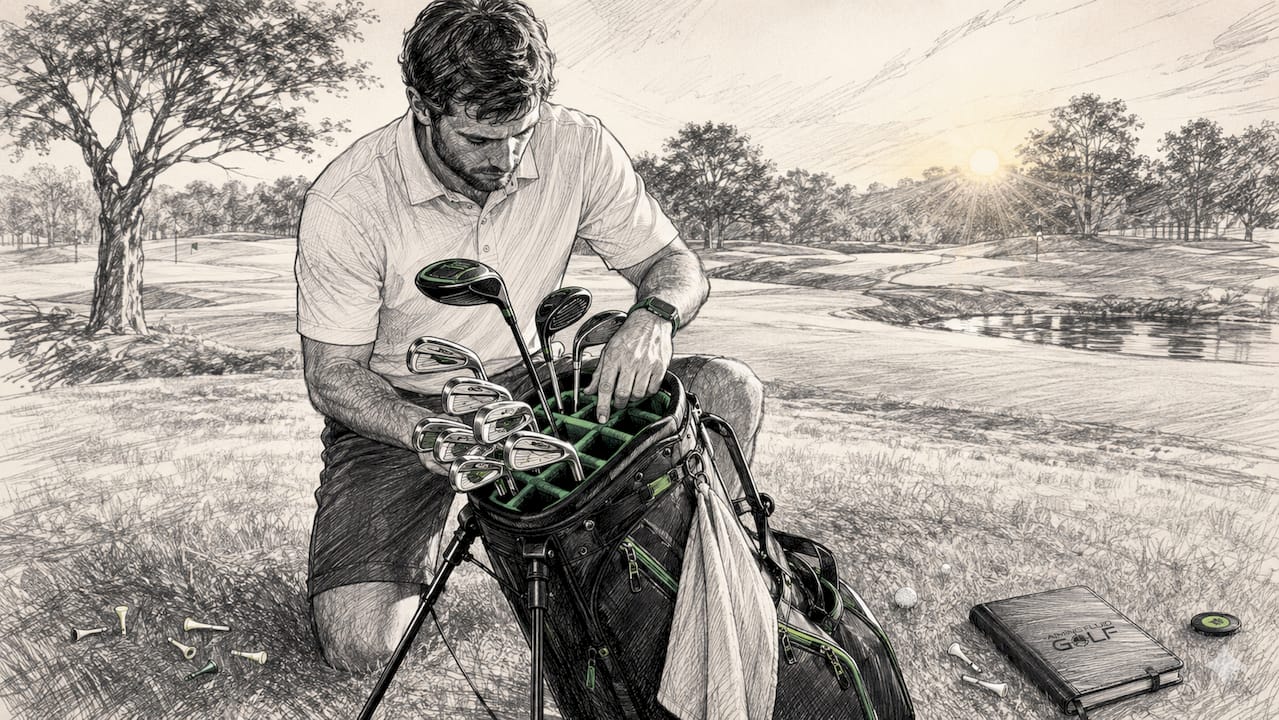
Bag type shapes how you apply this system. A stand bag with a 14-way divider gives every club its own channel. A cart bag typically has wider top dividers and more external pockets, which changes where you store accessories. A tour-style carry bag prioritizes weight reduction, so you group clubs more tightly. Knowing your bag’s layout before the round means you never have to think about where something goes mid-round.
Consistency is the mechanism that makes the system work. Returning clubs to designated slots immediately after every shot eliminates the hunting behavior that slows groups down. Golfers who skip this step find their bag feels like a junk drawer by the fifth hole.
Key organization principles:
- Place woods and driver in the top divider slots, closest to the bag’s back panel
- Group irons together in numerical order, running from long irons to short irons
- Keep wedges and the putter in the bottom slots for fast access near the green
- Store balls, tees, and a divot tool in a single dedicated front pocket
- Use a separate pocket for personal items like a phone, wallet, and keys
Pro Tip: Assign one specific pocket for tees and ball markers only. Never put anything else in that pocket. You will reach for it without looking within three rounds.
How to pack your golf bag for smooth hole-to-hole transitions
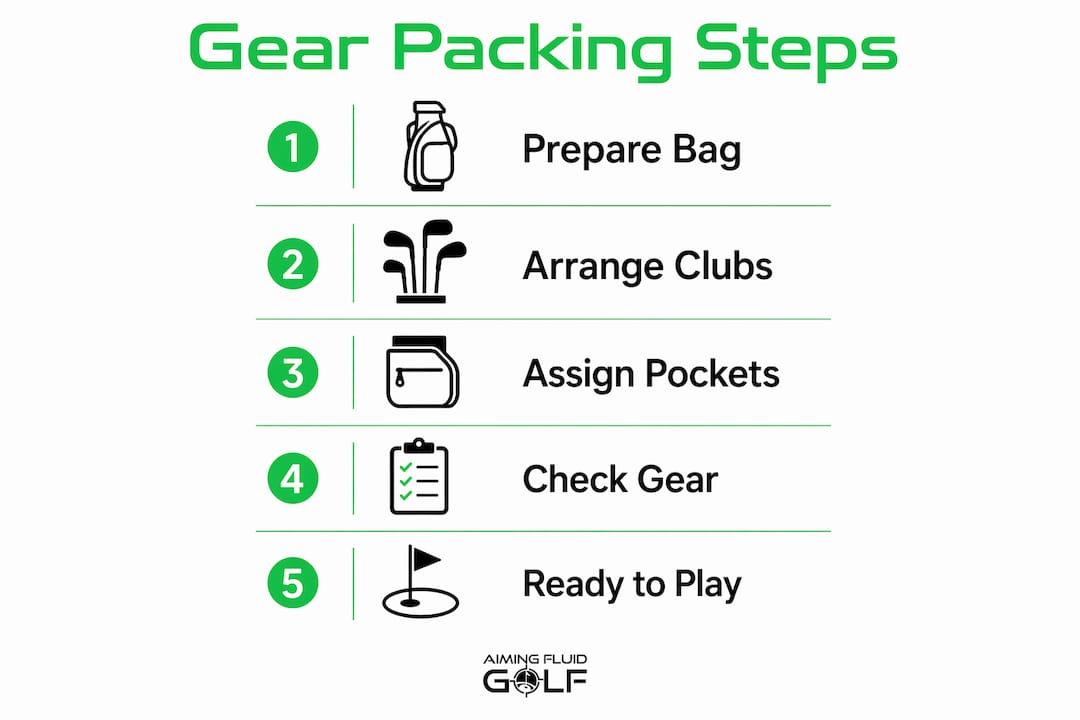
Pre-round preparation is the most underrated part of efficient gear management. Regular bag maintenance on a monthly schedule and after every round keeps clutter from accumulating. A bag that gets tidied only at the start of a season becomes a source of delay, not readiness.
Follow this sequence before every round:
- Empty and inspect. Remove everything from the bag and check each pocket. Discard broken tees, old scorecards, and any item you have not used in two rounds.
- Replenish consumables. Reload your tee pocket with fresh tees, add at least three golf balls per nine holes, and confirm your divot tool and ball marker are in place.
- Arrange clubs by type and length. Set them in order before you zip the bag. Do not leave this to the first tee.
- Balance the load. Placing heavier clubs low and centered improves stability and reduces shoulder strain during walking rounds.
- Check your accessories. Confirm your towel is attached and accessible, your glove is in its pocket, and your rangefinder or GPS device is charged.
| Item | Recommended pocket location |
|---|---|
| Driver and woods | Top divider slots |
| Irons and wedges | Middle and lower divider slots |
| Balls and tees | Front or side accessory pocket |
| Towel and glove | External clip or top side pocket |
| Rangefinder or GPS | Dedicated electronics pocket |
| Personal valuables | Zippered inner pocket |
A well-packed bag at the start of the round removes every decision about gear location during play. That mental clarity compounds across 18 holes.
What habits improve gear transition speed during the round?
On-course behavior determines whether your pre-round preparation actually pays off. The single most effective habit is immediate club return after every shot. Do not carry the club to the next position and then put it away. Return it the moment you finish the stroke.
Magnetic accessory systems change the speed equation for towels and small tools. Magnetic towels and utility pouches reduce time spent retrieving essential gear during play, which directly improves pace. A towel that clips magnetically to your bag returns in one motion. A towel stuffed into a side pocket requires two hands and a few seconds every time. Over 18 holes, those seconds accumulate into minutes.
On-course habits that cut transition time:
- Pull the next club you will need while walking to your ball, not after you arrive
- Use a mental checklist at each green: club returned, ball marked, divot repaired, towel back on bag
- Carry only what the next hole requires. Leave the headcover off your driver if you are teeing off immediately
- Work with your playing partners. If someone else is searching for a club, that is a signal your own system needs tightening
- Keep your bag oriented the same direction at every stop so your muscle memory for pocket locations stays consistent
Pro Tip: Before leaving each green, do a three-second gear check: club in bag, towel clipped, nothing on the ground. Build this into your post-putt routine and it becomes automatic.
What are common mistakes in transitioning golf gear between holes?
Most delays on the course trace back to four repeatable errors. Identifying them by name makes them easier to correct.
- Mixed club placement. Putting a wedge in the iron section, or leaving a fairway wood in the wrong slot, forces you to scan the bag instead of grabbing by feel. The fix is strict slot discipline from the first tee onward.
- Overpacking. Unnecessary items add weight and create clutter that buries the gear you actually need. Audit your bag before each round and remove anything you did not use in the previous two rounds.
- Skipping post-round maintenance. A bag that gets tossed in the trunk without tidying carries its disorder into the next round. Spend three minutes after each round returning clubs to their slots and clearing pockets.
- No designated spot for small accessories. Tees, ball markers, and divot tools that float between pockets create a search problem every time you need them. Assign each item a fixed location and never deviate.
The pattern across all four mistakes is the same: inconsistency. Every delay in gear transition is a consistency failure, not a gear failure. The organization strategies that work for low-handicap golfers are not complicated. They are simply applied without exception.
How does walking versus cart play change your gear transition approach?
The mode of play changes how you orient your bag and which pockets you prioritize. Bag setup differs significantly between walking and cart rounds, and ignoring that difference creates unnecessary friction.
| Factor | Walking round | Cart round |
|---|---|---|
| Bag orientation | Upright on stand legs, clubs accessible from top | Horizontal in cart rack, clubs accessible from side |
| Weight priority | Minimize total weight, balance across shoulders | Weight matters less, prioritize pocket accessibility |
| Club access | Pull from top dividers while bag stands | Pull from side while bag lies flat in rack |
| Towel placement | Clip to bag strap or top ring for walking access | Clip to cart frame or bag side for stationary access |
| Accessory pockets | Front pockets face outward when bag is upright | Side pockets face upward when bag is horizontal |
Walking rounds reward lighter bags and tighter packing. Cart rounds allow more gear but require you to think about which side of the bag faces up in the rack. A bag packed for walking and then placed in a cart without adjustment puts your most-used pockets facing the wrong direction. Adjust your packing sequence based on the mode before you start, not after the first hole.
Key Takeaways
Efficient gear transition between holes depends on consistent club placement, pre-round preparation, and mode-specific bag setup applied without exception every round.
| Point | Details |
|---|---|
| Arrange clubs by type and length | Place woods at the top, irons in the middle, and wedges at the bottom for natural play sequence access. |
| Return clubs immediately after every shot | Immediate return prevents hunting behavior and keeps pace of play steady across all 18 holes. |
| Pack and audit before every round | Remove unused items, replenish consumables, and balance weight before leaving the parking lot. |
| Adapt setup for walking or cart play | Adjust bag orientation and pocket priorities based on whether you are walking or riding. |
| Use magnetic accessories for fast retrieval | Magnetic towel systems and utility pouches cut retrieval time compared to standard pocket storage. |
What I have learned from watching golfers lose time between holes
Most golfers I have observed do not lose time because they play slowly. They lose time because their gear is not ready when they arrive at the ball. The club is in the wrong slot, the tee is in the wrong pocket, or the towel is buried under a rain jacket. The round slows down not from bad shots but from bad systems.
The fix is not buying new gear. It is building a return habit so automatic that you do not think about it. I have found that golfers who practice pace improvement steps off the course, by physically rehearsing their post-shot routine at the range, carry that habit onto the course without effort. Tour professionals take approximately 6 to 8 weeks to fully adjust after changing their equipment setup. That number tells you something important: even elite players need deliberate repetition to make a new system feel natural. Amateurs should expect the same timeline and plan for it.
The golfers I respect most on the course are not the longest hitters. They are the ones who arrive at every tee with their bag organized, their club already in hand, and their mind on the shot rather than the search.
— Gary
Gear built for faster transitions on every hole
Aimingfluidgolf designs accessories specifically for the problems described in this article. The magnetic towel system attaches and detaches in one motion, so your towel is back on the bag before you finish your follow-through. The leather utility pouch gives small accessories a fixed, secure home on your bag so tees, markers, and tools never float between pockets again.

Every product in the Aimingfluidgolf lineup is built around one principle: gear that is easy to return is gear that stays organized. Browse the full magnetic towel collection and the best golf accessories guide to find the tools that match your bag setup and play style.
FAQ
What is the best way to organize clubs for fast transitions?
Arrange clubs from longest to shortest, grouped by type, with woods at the top and wedges at the bottom. This mirrors the natural sequence of play and lets you pull the right club by position rather than by sight.
How do I stop losing time searching for tees and markers?
Assign one dedicated pocket for tees, ball markers, and your divot tool only. Never place anything else in that pocket, and the search problem disappears within a few rounds.
Does bag type affect how I transition gear between holes?
Yes. Stand bags with 14-way dividers give each club a fixed channel, while cart bags require you to account for horizontal orientation in the rack. Adjust your packing approach based on the bag you use.
How long does it take to build a consistent gear transition routine?
Research on tour professionals shows it takes approximately 6 to 8 weeks to fully adjust to a new equipment setup. Amateurs building a new organization routine should expect a similar adjustment period with deliberate practice.
Should I pack my bag differently for walking versus cart rounds?
Yes. Walking rounds require lighter loads and upright bag access, while cart rounds place the bag horizontally, which changes which pockets face up and are easiest to reach. Pack with your mode of play in mind before the round starts.
Recommended
- Optimize your golf gear: the ultimate game rotation guide – Aiming Fluid Golf
- How to Organize Your Golf Bag Like a Pro: The Peter Finch Method – Aiming Fluid Golf
- Efficient Tee Box Routine Guide for Better Golf – Aiming Fluid Golf
- Quick-access golf gear: cut retrieval time by 50% – Aiming Fluid Golf


