


TL;DR:
- Improving golf pace involves following specific time benchmarks, routines, and equipment organization. The USGA sets a 40-second stroke limit and a three-minute ball search cap to monitor pace objectively. Using ready golf, efficient routines, and strategic tee box choices can significantly reduce round times without sacrificing shot quality.
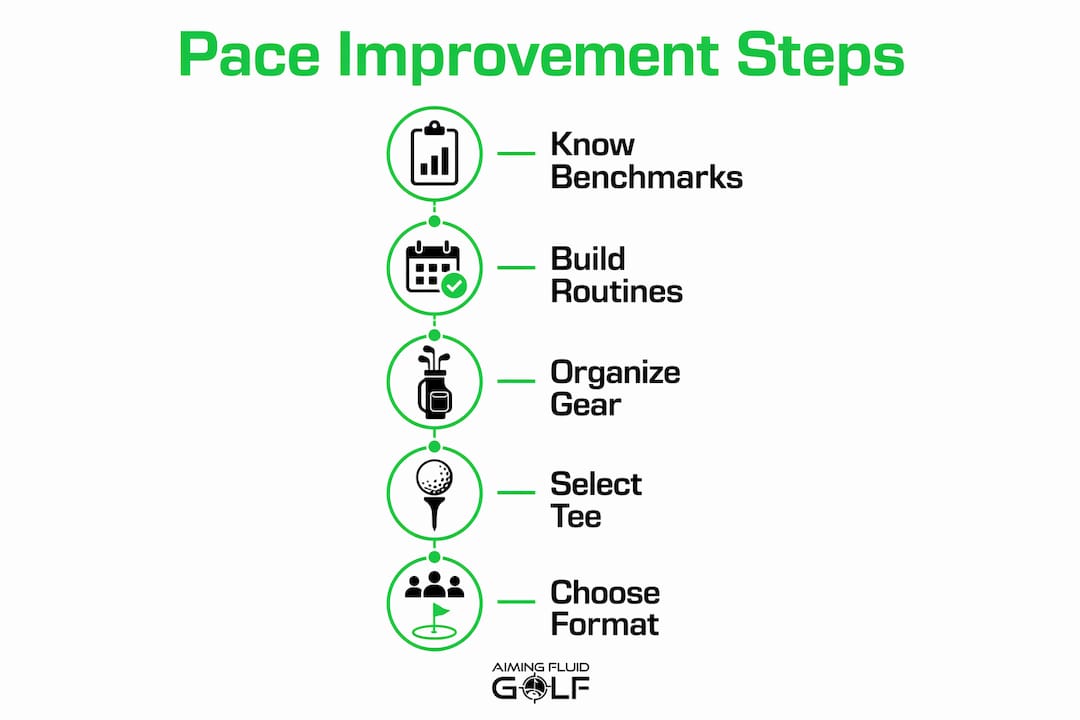
Golf game pace improvement steps are practical actions golfers take to reduce wasted time between shots without sacrificing swing quality or scoring. Pace of play, the industry term for managing round speed, directly affects your score, your group’s enjoyment, and the experience of every golfer behind you on the course. The USGA and golf courses worldwide have established clear timing benchmarks to guide faster play. Applying those benchmarks alongside ready golf principles, efficient routines, and smart equipment choices gives you a measurable framework for cutting time off every round.
What are the key time benchmarks golfers must know?
Two rules define the outer limits of acceptable pace. The USGA major championship policy sets a 40-second stroke limit from the moment it is your turn to play. That 40 seconds covers decision making, setup, and swing execution combined. No single phase gets its own clock.
The second benchmark covers lost balls. Ball search time is capped at 3 minutes, reduced from the prior 5-minute rule. The clock starts the moment you or your caddie begins actively searching, not when you arrive at the general area. That distinction prevents players from walking slowly toward the rough to buy extra time.
These two rules give you a concrete self-monitoring system. If you regularly exceed either benchmark, you are the slow player in your group, regardless of how it feels from inside your routine.
“Pace policies use objective timing caps to help players internalize pace behavior as a measurable skill.” — USGA pace management framework
Key benchmarks at a glance:
- 40 seconds: Maximum time from your turn to swing completion, per USGA major championship standards
- 3 minutes: Maximum ball search time before proceeding under penalty
- 30 seconds: The practical target for a pre-shot routine that keeps rounds moving
- Continuous play: Golfers should move directly to their ball after each shot, not wait at the previous position
Knowing these numbers changes how you experience slow play. Instead of a vague sense that the round is dragging, you have specific thresholds to measure against.
Which routines most effectively speed up your golf game?
Playing faster means removing wasted downtime, not rushing your swing. The distinction matters. Rushed swings produce bad shots and worse scores. Efficient routines produce the same shot quality in less total time.
Top players treat each shot as three distinct phases: decision making while others are hitting, brief setup upon arriving at the ball, and committed execution once over the ball. Separating these phases prevents the common mistake of arriving at your ball with no plan and starting the thinking process from scratch.
- Walk with purpose between shots. Move directly to your ball after each stroke. Avoid stopping to watch others’ full routines unless you are learning something specific.
- Select your club while others hit. By the time it is your turn, you should already know your yardage, wind, and club choice. The 40-second clock should not start with you still deciding between a 7-iron and an 8-iron.
- Limit practice swings to one or fewer. A shot routine under 30 seconds is the standard for efficient play. Two or three practice swings per shot adds several minutes to a round across 18 holes.
- Play ready golf. When it is safe and practical, hit when you are ready rather than waiting for strict honor order. Ready golf is formally endorsed by the USGA for recreational rounds.
- Read putts while walking to the green. Start analyzing line and slope from 20–30 yards out. By the time you reach your ball, your read should be nearly complete.
- Keep marking and tending routines brief. Mark your ball, tend the pin if needed, and putt. Extended green ceremonies are the single largest source of pace loss in recreational golf.
Pro Tip: Build a consistent pre-shot routine that takes the same amount of time on every shot. Consistency is faster than improvisation because your brain stops deliberating and starts executing.
How do equipment choices and course strategies support faster play?

Equipment organization and tee box selection are two underused tools for golf round time reduction. Most golfers focus entirely on swing mechanics when pace problems are often logistical.
Tee box selection
Moving up one set of tees shortens every hole. Shorter holes and formats reduce total walking distance and the number of recovery shots required after errant drives. Fewer recovery shots means fewer searches, fewer penalty strokes, and faster holes. Playing from tees that match your actual driving distance is not a concession. It is a pace management decision.
Format selection
| Format | Pace benefit | Best for |
|---|---|---|
| Shamble | Each player hits tee shot, best ball selected, all play from there | Groups with mixed skill levels |
| Alternate shot | One ball per team, players alternate strokes | Fastest format for two-player teams |
| Best ball | Each player plays own ball, best score counts | Competitive groups wanting full individual play |
| Scramble | All players hit, best shot selected each time | Casual rounds and charity events |
Shamble and alternate shot formats cut round time significantly because they reduce the total number of shots played per hole.
Gear organization
When your bag feels like a junk drawer, you lose 15–30 seconds per hole searching for tees, ball markers, or divot tools. Keeping frequently used items in fixed, accessible locations eliminates that friction. Cart management also matters: drop each player at their ball separately rather than parking the cart between two balls and walking to both. That single habit removes unnecessary waiting from every par 4 and par 5.
Aimingfluidgolf’s magnetic towel and landing pad system addresses this directly. The towel attaches and detaches instantly without digging through the bag, which keeps your hands free and your focus on the next shot.
What pace-killing mistakes should golfers avoid?
Slow play rarely comes from one large delay. It accumulates through a series of small, repeated habits that most golfers do not recognize in themselves.
- Delayed ball searches. The 3-minute search limit exists because extended searches are the most visible pace bottleneck on any course. Start searching immediately, scan likely landing areas first, and accept the penalty if the ball is not found within the time limit.
- Overthinking shots. Taking more than 30 seconds from stepping up to swinging indicates the decision was not made before arriving at the ball. Pre-plan during the walk, not at address.
- Excessive practice swings. One practice swing serves a purpose. Three practice swings are a habit that adds roughly 10–15 minutes to an 18-hole round across a full group.
- Prolonged green reading. Reading a putt from four angles on a recreational course is not a pace strategy. Read while walking up, confirm your line once at the ball, and putt.
- Ignoring group pace. If your group is falling behind the group ahead, the pace problem is yours to solve. Waiting for the group behind to catch up is not a solution.
Pro Tip: Ask a playing partner to time your pre-shot routine on three consecutive holes without telling you in advance. Most golfers are surprised to find their routine runs 45–60 seconds, not the 20–30 seconds they assumed.
The efficient approach to lost ball searches follows a simple protocol: walk directly to the likely landing zone, split the group to cover different areas, and call the ball lost at the 3-minute mark without debate. Prompt, methodical searching is faster than optimistic wandering.
Key takeaways
Pace improvement requires removing wasted time between shots through consistent routines, knowledge of timing rules, and deliberate equipment and format choices.
| Point | Details |
|---|---|
| Know the benchmarks | The USGA sets a 40-second stroke limit and a 3-minute ball search cap. Use both as self-monitoring tools. |
| Pre-plan every shot | Decide your club and shot shape while others are hitting, not after you arrive at your ball. |
| Adopt ready golf | Play when safe and ready rather than waiting for strict honor order to reduce group wait time. |
| Choose the right format | Shamble and alternate shot formats cut round time without reducing competitive enjoyment. |
| Organize your gear | Fixed locations for tees, markers, and divot tools eliminate 15–30 seconds of searching per hole. |
Pace improvement is about rhythm, not speed
The most common misconception I see on recreational courses is that playing faster means swinging faster. It does not. Efficiency between shots is where rounds are won or lost on the clock. Golfers who walk with purpose, pre-plan their shots, and keep routines consistent actually play with better rhythm than those who dawdle and then rush.
The golfers I watch struggle most with pace are not slow because they are deliberate. They are slow because they have no system. They arrive at the ball, look at the target, look at the ball, take two practice swings, step back, look again, and then finally commit. That sequence is not thoughtful. It is indecision dressed up as process.
The fix is not to think less. It is to think earlier. Decide during the walk. Commit at the ball. Execute. That three-phase approach, which top players use instinctively, is something any golfer can build with a few focused rounds of practice. Pair it with the tee box routine habits that set the tone for each hole, and your round time drops without your scores suffering.
One more observation: pace improvement compounds. When you play faster, your group plays faster. When your group plays faster, the group behind you plays faster. One committed player with a consistent routine can shift the entire pace of a four-ball. That is a level of influence most golfers do not realize they have.
— Gary
Gear that supports a faster, more organized round

The right accessories remove friction from every hole. Aimingfluidgolf designs gear specifically for golfers who want to stay organized and move efficiently on course. The best golf accessories for faster play include precision tees that set consistent depth without adjustment, multi-function divot tools that handle ball marking and repair in one motion, and utility pouches that keep valuables and essentials clipped and accessible at all times. Each product is built to reduce the small delays that accumulate across 18 holes. When your gear works without friction, your focus stays on the shot.
FAQ
What is the USGA rule for stroke time?
The USGA major championship policy allows 40 seconds per stroke, covering decision making, setup, and execution. Recreational golfers should use 30 seconds as their personal target.
How long can you search for a lost ball?
The current rule limits ball search time to 3 minutes, reduced from the prior 5-minute allowance. The clock starts when you or your caddie begins actively searching.
What is ready golf?
Ready golf means playing your shot when it is safe and practical to do so, rather than waiting for strict honor order. The USGA formally endorses ready golf for recreational rounds as a primary tool for golf round time reduction.
Does playing faster hurt your score?
Faster play improves scoring for most recreational golfers. Consistent, quick routines build better rhythm and reduce overthinking, both of which lead to more committed, cleaner swings.
Which format speeds up a round the most?
Alternate shot is the fastest format because one ball is played per team. Shamble is the best balance between speed and individual play, making it the most practical choice for groups with mixed skill levels.


