


TL;DR:
- Effective caddie tools organize and support a golfer’s performance by reducing on-course friction and maintaining green health. Building a personalized system targeting specific problem points enhances efficiency, focus, and consistency during play. Prioritizing quality, purpose-driven tools over volume leads to meaningful improvements in game management.
Most golfers step onto the first tee carrying a bag full of clubs and not much else. A caddie, by contrast, arrives with a system: every tool staged, every detail pre-managed, every decision supported before the player even pulls a club. That gap between what a caddie brings and what the average golfer actually carries is larger than most people realize. According to the Final Caddie Handbook 2025, caddie tools cover everything from yardage management and scorekeeping to greens repair and equipment readiness. This guide breaks down every major category of caddie tool, how each one functions, and how to build a setup that gives you genuine on-course efficiency.
Table of Contents
- What are golf caddie tools and why do they matter?
- Essential organization and maintenance tools every golfer should carry
- Modern caddie-like upgrades: Tech tools for distance and efficiency
- Choosing the right tools: Organizer solutions vs. labor-saving upgrades
- Our take: What really separates everyday golfers from tour-level efficiency
- Get the right tools for your game with Aiming Fluid Golf
- Frequently asked questions
Key Takeaways
| Point | Details |
|---|---|
| Caddie tools boost efficiency | Using a smart mix of organizational and tech caddie tools saves time and energy each round. |
| Prioritize essential gear | Focus on must-have items like divot tools, ball markers, proper tees, and a scorecard holder to cover etiquette and performance basics. |
| Upgrade with tech wisely | Decide between rangefinders, GPS, and powered carts by identifying your biggest pain point first. |
| Quality over quantity | Well-chosen premium accessories out-perform a bag overloaded with gear you won’t use. |
What are golf caddie tools and why do they matter?
The term “caddie tools” covers a broader range than most golfers expect. These are not just the bag and the clubs inside it. They are the instruments, systems, and protocols that keep a golfer organized, informed, and focused throughout 18 holes.
Caddie duties commonly include arranging and organizing the bag, preparing tees and ball markers before each shot, cleaning clubs and managing equipment throughout the round, maintaining greens by repairing ball marks, and actively supporting pace of play. Each of those duties maps directly to a physical tool or organizational system.
Here is a quick comparison of what a caddie manages versus a typical self-equipped amateur:
| Task | Caddie setup | Typical amateur setup |
|---|---|---|
| Club and groove cleaning | Dedicated brush and wet towel, staged for every shot | Wet grass or a forgotten rag buried in the bag |
| Distance measurement | Laser rangefinder plus course notes | Sprinkler head yardages or guesswork |
| Greens repair | Quality divot tool, used consistently | No tool, or a broken plastic fork |
| Tee and ball marker access | Pre-staged in a pocket or pouch | Scattered through multiple pockets |
| Scorekeeping | Organized holder clipped to the bag | Folded card getting soggy in a back pocket |
The performance impact is measurable. When a golfer does not have to rummage for a tee, clean a club on their shirt, or estimate yardage, they maintain rhythm and mental focus. Disrupting that rhythm, even briefly, costs strokes by pulling attention away from shot execution and course strategy.
“The golfer who controls their environment before every shot is the golfer who plays their most consistent golf.” This is the caddie’s core function, and it’s entirely replicable with the right tools and setup discipline.
Essential organization and maintenance tools every golfer should carry
With the concept and importance of caddie tools established, here’s how to build your own kit for next-level organization and course respect.
The foundation of any caddie-level setup is a reliable set of physical tools. These are not high-tech. They are purpose-designed, durable, and easy to access. Skipping them is one of the most common ways recreational golfers give back efficiency without realizing it.
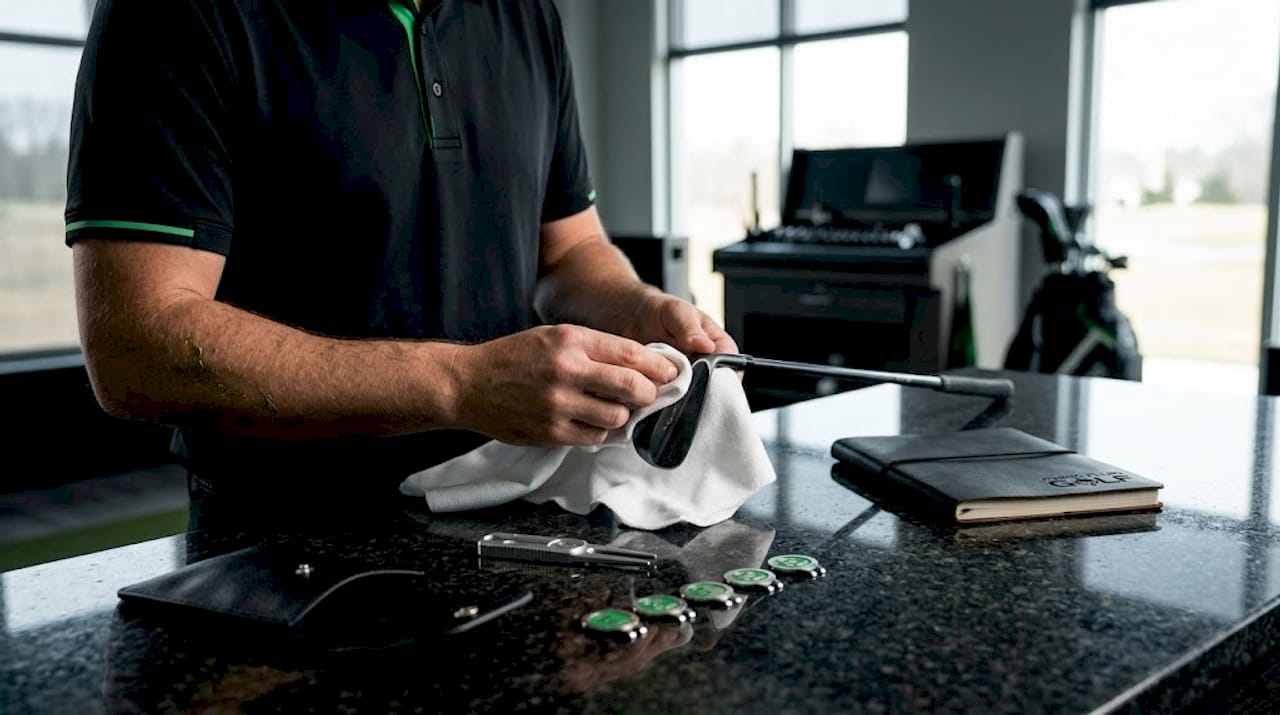
A divot repair tool plus ball marker is the most performance-critical piece of the physical kit. Greens are where strokes are won or lost, and their condition directly affects every putt you and your playing partners face. Carrying a quality two-prong or blade-style divot tool and using it consistently is both a courtesy and a course management habit. You can learn the correct method through divot repair best practices to avoid the common mistake of tearing the green rather than lifting it.
Here are the five caddie tools you need to carry:
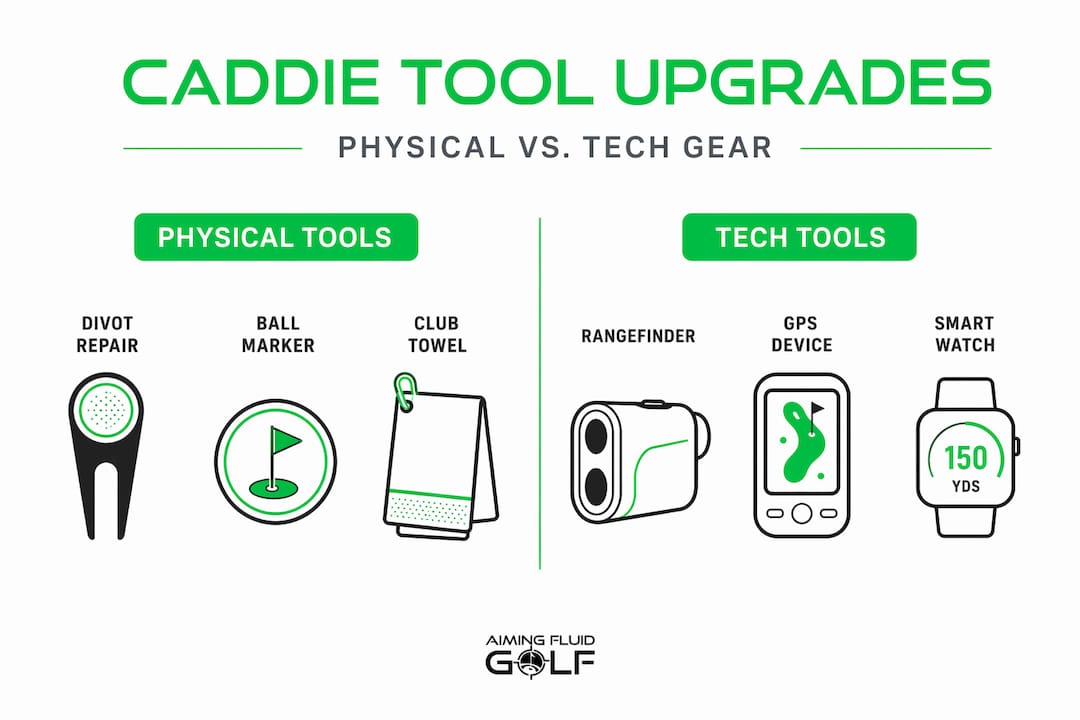
- Divot repair tool - A multi-prong or blade design that lifts and smooths pitch marks without tearing the turf. Always attached to your bag or pouch, not buried inside it.
- Ball marker - Flat, stackable, and ideally magnetic so it attaches directly to your divot tool or hat clip for instant access.
- Club cleaning brush and towel - Grooves must be clean for spin control. A stiff-bristle brush removes dirt from the face after every shot; a damp towel handles the final wipe.
- Precision golf tees - Consistent tee height is a repeatable variable that amateurs overlook. A set of uniform tees stored in a dedicated pouch eliminates on-tee fumbling.
- Scorecard and pen holder - A dedicated holder or clip keeps your card dry, flat, and readable. Scorecard organization eliminates the wasted time and frustration of losing your place mid-round.
Pro Tip: Organize your bag by shot phase, not by club length. Keep your divot tool, ball marker, and tees in the same front pocket so you can access them without breaking stride or delaying the group. A utility pouch clipped to your bag handles all of these in one motion.
One point that surprises many golfers: greens maintenance is mandatory in proper caddie protocol, not optional. Caddie handbooks require all ball marks repaired on greens regardless of who caused them. That standard exists because pitch marks left for more than a few minutes begin to damage the root structure of the putting surface, creating bumps that affect ball roll for days. Following that protocol is how you signal course respect and maintain pace of play simultaneously.
The correct technique matters as much as the tool itself. A 4-step divot repair technique focuses on working the grass edges inward and tamping flat, never pulling up the center of the mark. Many golfers who think they are repairing divots are actually enlarging the damage.
| Essential tool | Key benefit | Etiquette impact |
|---|---|---|
| Divot repair tool | Preserves putting surface quality | Required by caddie protocol |
| Ball marker | Enables legal ball lifting and replacement | Keeps play moving on greens |
| Club cleaning brush | Maintains groove sharpness for spin control | Demonstrates equipment preparation |
| Precision tees | Consistent setup for every tee shot | Reduces time spent on tee boxes |
| Scorecard holder | Clean, stable record-keeping | Supports accurate, fast scorekeeping |
Modern caddie-like upgrades: Tech tools for distance and efficiency
Once your basic toolset is in place, consider these technology-driven options for getting even closer to true caddie-level decision making and efficiency.
Physical tools handle maintenance and organization. Technology tools handle the information layer that a tour caddie provides verbally: precise distances, wind adjustments, and shot history. For self-equipped golfers, that information comes from two primary device categories.
Rangefinders use laser technology to measure exact distances to flagsticks, hazards, and layup targets. Devices like the Shot Scope PRO LX+ deliver 1-yard accuracy at ranges up to 900 yards, with the added capability of bundled GPS yardages and automatic performance tracking in a single unit. That kind of precision removes the single largest variable in club selection.
GPS devices and watches map the entire course from satellite data and display carry distances to the front, center, and back of greens as well as hazard positions. They require no aiming, which makes them faster to operate during the natural flow of a round. For golfers who want curated top rangefinder picks or need to work through the rangefinder vs. GPS decision, both categories have strong arguments depending on course type and personal workflow.
Here is a side-by-side breakdown:
| Feature | Laser rangefinder | GPS device/watch | Manual yardage (sprinklers) |
|---|---|---|---|
| Accuracy | 1 yard or better | 2-3 yards typical | Variable, often 5-10 yards off |
| Speed of use | Requires aiming and locking | Instant readout | Requires walking to marker |
| Hazard data | Flagstick only | Full course mapping | Not available |
| Battery life | 6-8 hours typical | 10-16 hours typical | N/A |
| Skill level | Moderate | Beginner-friendly | Any level |
Modern cart-assist technology addresses a different efficiency problem: physical fatigue. For walking golfers, powered cart-wheel kits automate the pushing and braking mechanics of a manual push cart through remote-control operation and snap-in bracket systems. The result is that walking golfers arrive at their ball with more physical and mental energy available for shot execution rather than cart management.
Key modern upgrades to consider:
- Laser rangefinder with slope: Adds incline and decline compensation, giving you the adjusted carry distance rather than the flat yardage.
- GPS watch: Keeps yardage information on your wrist with no device to carry or point.
- Powered cart-wheel kit: Removes pushing effort from the equation for walking golfers.
- Smartphone stat tracking apps: Record fairways hit, greens in regulation, and putts per round so you understand where strokes are actually being lost.
For golfers researching the full landscape of mapping devices, a best GPS devices breakdown covers handheld, clip-on, and watch formats across multiple budget levels.
Pro Tip: Physical and tech tools are not competing systems; they are complementary layers. Use your rangefinder for precise shot yardage, your GPS watch for quick hazard checks mid-fairway, and your organized pouch for instant access to the physical tools you need between shots. Stack the layers intentionally rather than grabbing whatever is convenient.
Choosing the right tools: Organizer solutions vs. labor-saving upgrades
Deciding which tool to add next means knowing your unique pain point. Here’s how to make sure your investment pays off for your personal game.
Not every golfer has the same friction point. Adding a rangefinder to a bag where the real problem is gear scattered across six pockets does not solve anything. The right tool is the one that targets your specific drag.
The main tool categories each address a distinct problem:
- Organization tools (pouches, holders, magnetic systems): Solve the problem of wasted time rummaging for equipment and the mental frustration that comes with it.
- Maintenance tools (divot tools, brushes, towels): Solve the problem of degraded equipment performance and course damage caused by neglected upkeep.
- Decision-support tools (rangefinders, GPS watches): Solve the problem of distance uncertainty and poor club selection.
- Labor-saving tools (powered cart systems, ergonomic bag designs): Solve the problem of physical fatigue reducing swing quality and focus late in the round.
The best choice depends on your largest drag: rummaging through your bag, walking fatigue, or distance uncertainty. Buying all categories at once usually means none of them are set up correctly, and the workflow benefits never materialize. A full golf GPS device roundup can help narrow the decision for golfers unsure which format suits their playing style.
When to prioritize each category:
- Focus on organization tools if you regularly search your bag between shots, delay your group, or feel mentally scattered on the course.
- Focus on maintenance tools if your wedge spin has declined, your greens play suffers on bumpy surfaces, or you find yourself without tees and markers during a round.
- Focus on decision-support tech if your club selection is inconsistent, you frequently hit short into hazards, or you play unfamiliar courses regularly.
- Focus on labor-saving tools if your back-nine play is consistently weaker than your front nine, or if physical fatigue is reducing your ability to execute late in the round.
Our take: What really separates everyday golfers from tour-level efficiency
Here is the part most caddie-tool articles skip entirely: tour-level efficiency is not about copying a tour bag. It is about identifying the specific moments in your round where friction costs you strokes and fixing those precisely.
The trap most golfers fall into is buying gear based on what looks impressive or what a professional setup includes. That approach rarely transfers because tour setups are built around tour-specific problems: precise yardage windows measured in single yards, course conditions that change by the hour, and a mental load that requires complete external management. Your game has different friction points, and they deserve targeted solutions.
Overbuying gear is a real failure mode. A bag loaded with gadgets, holders, apps, and accessories that do not connect to a clear workflow creates a different version of the same problem: a bag that feels overwhelming rather than organized. The solution is workflow-first purchasing. Define the moment in your round that costs you the most time, focus, or accuracy. Buy the tool that addresses exactly that moment. Use it consistently for several rounds before adding anything else.
Greens maintenance is a good case study. Most golfers know they should repair ball marks. Far fewer understand that the repair method matters as much as the act itself, and that a poor repair technique done with a great tool still damages the green. Solving that problem requires two things: the right tool and the right technique, applied together.
The golfers who gain the most from caddie tools are the ones who treat them as a system rather than a collection of individual accessories. Each tool earns its place by solving a defined problem. When everything has a purpose and a place, you stop thinking about equipment during the round and start thinking about golf.
Get the right tools for your game with Aiming Fluid Golf
Ready to build a caddie-level setup without the guesswork? Aiming Fluid Golf designs every product around the specific on-course efficiency problems covered in this guide.

Start with the expert accessory picks guide to identify which combination of tools fits your bag and playing style. For greens maintenance specifically, the top divot tool guide covers design differences, material quality, and which formats work best for different green conditions. And if towel access is the friction point costing you focus mid-round, the magnetic golf towels system from Aiming Fluid eliminates the search entirely with instant-attach, instant-release magnetic mounting built into your bag setup.
Frequently asked questions
What are the absolute essentials to include in a modern caddie tool kit?
A divot tool, ball marker, tees, scorecard holder, club cleaning towel, and a quick-access pouch cover the core of every effective caddie kit. These tools address maintenance, organization, and scorekeeping without requiring any tech investment.
Do I need both a rangefinder and a GPS device for accurate distances?
Most golfers only need one. Rangefinders and GPS units each cover distance measurement effectively, so the choice comes down to whether you prefer the speed of a GPS watch or the precision of a laser lock-on.
How do powered cart kits actually reduce physical strain on the golf course?
Modern cart-wheel kits automate cart movement and braking through remote-control mechanisms, removing the push force required from the golfer and preserving physical energy for swing execution throughout the round.
Why is greens repair considered mandatory regardless of who makes the ball mark?
Caddie protocols require all ball marks repaired regardless of responsibility because pitch marks left unfixed damage the root structure of the putting surface and create persistent bumps that compromise putting conditions for every player on the course.
Is it better to carry more accessories or focus on quality upgrades?
Targeted quality upgrades consistently outperform volume. The best tool choice is the one that addresses your specific drag, whether that is rummaging, fatigue, or distance guessing, rather than a broad collection of accessories that do not connect to a clear workflow.
Recommended
- Personal gear in golf: cut retrieval time by 50% – Aiming Fluid Golf
- Why robust golf tools matter: improve your game’s efficiency – Aiming Fluid Golf
- Optimize your golf gear: the ultimate game rotation guide – Aiming Fluid Golf
- Blue Tees 6-in-1 Divot Repair Tool: Magnetic Marker & Groove Cleaner – Aiming Fluid Golf


