


TL;DR:
- The golf bag layering method organizes equipment into zones based on use, improving access and reducing fumble. This system enhances speed, focus, and consistency, benefiting players of all skill levels. Regular audits and appropriate accessories support optimal efficiency and ongoing refinement.
Standing over a tricky approach shot, the last thing you want is to dig through a disorganized bag looking for your yardage device or a spare tee. A cluttered bag disrupts rhythm, adds mental friction, and chips away at on-course focus one fumble at a time. The golf bag layering method solves this by organizing your equipment into intentional zones so that every item has a predictable home. This guide covers what the method is, what gear you need, how to execute it step by step, and how to verify that your system is actually working for your game.
Table of Contents
- What is the golf bag layering method?
- What you need: gear and accessories for effective layering
- Step-by-step: how to layer your golf bag for maximum efficiency
- How to check your setup and refine your golf bag layering method
- Why most golfers overcomplicate bag organization—and how simple layering beats fads
- Organize your game with the right accessories
- Frequently asked questions
Key Takeaways
| Point | Details |
|---|---|
| Layering boosts efficiency | Organizing your bag in layers solves common problems like lost gear and wasted time during play. |
| Choose the right gear | Proper bag types, divider systems, and purpose-built accessories are essential for successful layering. |
| Follow a stepwise approach | Layer your bag sequentially from top to bottom and assign every item a designated spot to avoid clutter. |
| Audit your system regularly | Regularly checking and refining your setup ensures your bag stays efficient as your game and preferences evolve. |
What is the golf bag layering method?
With a clear promise of how the layering method eliminates messiness, let’s break down exactly what this system means and why it’s worth your time.
The golf bag layering method is a structured approach to organizing your bag by grouping equipment and accessories into distinct zones or layers based on how and when you use them during a round. Instead of placing items wherever they fit, you assign each club, accessory, and piece of gear to a specific position that reflects its frequency of use and its physical relationship to your body and your game.
Professional guides recommend specific strategies for organizing golf bags, and layering methods build directly on that foundation by adding spatial logic to simple categorization. The Peter Finch method is one well-known example of how a deliberate top-to-bottom club arrangement creates faster club selection, particularly during competitive rounds.
How layering differs from conventional organization:
Traditional bag setup often follows a loose logic: woods at the top, irons in the middle, wedges and putter somewhere near the bottom. Accessories go wherever there is space. This works until you are on the 14th hole with rain coming and you cannot locate your rain glove or your ball marker without pulling items out and restacking them. Conventional setup prioritizes fitting everything in. Layering prioritizes accessing everything instantly.
The layered system treats your bag like a set of golf bag essentials arranged by function and frequency. High-use items live in easy-reach zones. Rarely-used items go to deeper or lower pockets. Nothing shares a zone with an item that serves a completely different function.
Key benefits of the layering method:
- Speed: You reach for a club or accessory and it is exactly where you expect it to be.
- Reduced distraction: No searching means more mental bandwidth for shot planning and course management.
- Less lost gear: Consistent placement means you notice quickly when something is missing.
- Improved pace of play: Faster access to gear keeps you and your group moving efficiently, a factor that applies to everything from golf course essentials to club selection under pressure.
Traditional vs. layered organization: a direct comparison
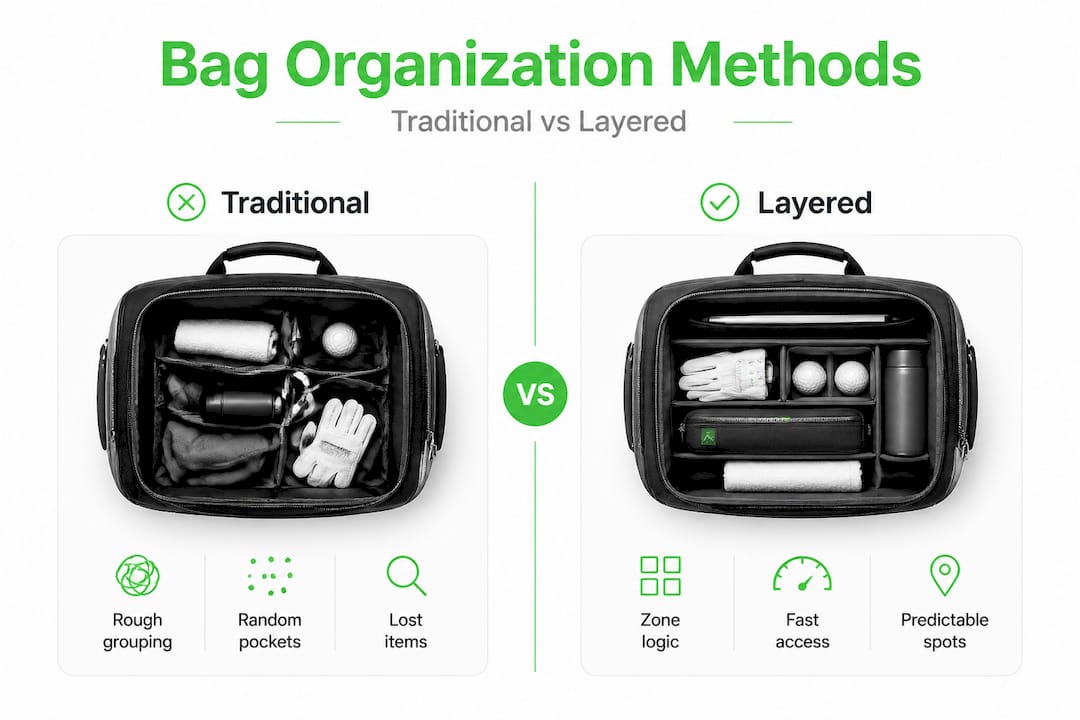
| Factor | Traditional setup | Layered setup |
|---|---|---|
| Club placement logic | Rough top-to-bottom grouping | Zone-based by use frequency |
| Accessory location | Wherever space exists | Assigned pocket by function |
| Search time mid-round | Often 15 to 30 seconds | Near zero |
| Consistency round to round | Variable | Highly repeatable |
| Risk of leaving gear behind | Moderate to high | Low |
| Adaptability (walking vs. cart) | Rarely adjusted | Easily refined per format |
The layering method pays dividends regardless of your skill level. Competitive players benefit from the mental clarity it creates. Walkers benefit because unnecessary weight shifts and fumbling cost energy over 18 holes. Cart users benefit because they can grab exactly what they need when approaching a shot without holding up their playing partners.
What you need: gear and accessories for effective layering
Now that you understand the concept, let’s detail what equipment and accessories you need for layering to reach its full potential.
The method requires more than just intention. Your bag’s physical structure directly determines how well a layered system can function. Different bag types and pockets support various layering systems, which means your starting point matters.
Bag types and their layering compatibility:
- Cart bags: These offer the most pockets, typically seven to nine, and often feature 14-way divider cart bags that give each club its own slot. This structure is ideal for layering because it enforces club separation at the hardware level.
- Stand bags: Fewer pockets and a lighter build. Layering works here but requires more discipline in accessory placement since pocket count is limited.
- Hybrid bags: A balance between portability and storage. They accommodate layering well for golfers who alternate between walking and riding.
Gear and accessory checklist by layer
| Layer/Zone | Items | Recommended accessory type |
|---|---|---|
| Top layer | Woods, hybrid clubs | Full-length dividers |
| Mid layer | Long irons, mid irons | Divider sleeves |
| Lower mid layer | Short irons, wedges | Separated divider slots |
| Bottom layer | Putter | Dedicated putter well |
| Side pocket (top) | Laser rangefinder, glove | Fleece-lined or easy-open pocket |
| Side pocket (mid) | Tees, ball markers, divot tool | Small zip pocket |
| Lower side pocket | Extra balls, rain gear | Large accessible pocket |
| Rear/bottom pocket | Valuables, phone, wallet | Waterproof zip pocket |
| External attachment | Golf towel | Magnetic clip or ring mount |
Pro Tip: Magnetic accessories solve one of layering’s most persistent failure points: the golf towel. Traditional towels stuffed into a pocket disrupt pocket organization and slow access. A towel that attaches magnetically stays outside the pocket system entirely, which preserves every pocket zone for its designated purpose. No fumbling, no repacking.
Essential accessories that reinforce the layering structure include utility pouches for small items like tees, a dedicated divot tool slot or magnetic attachment point, and a valuables pouch that remains completely separate from your on-course tools. Mixing phone, keys, and wallet into the same pocket as your ball supply is a common failure mode that layering specifically prevents.
Step-by-step: how to layer your golf bag for maximum efficiency
With your gear in hand, let’s move through the sequential process that makes layering both easy and reliable.
Modern organization techniques save time and improve focus on course, and the execution steps below translate that principle into a concrete, repeatable system.
Step 1: Empty your bag completely
Remove every item. Shake out debris, old tees, grass clippings, and any items that have accumulated at the bottom. This step is not optional. Layering onto a half-organized bag produces a half-organized result.
Step 2: Categorize everything before loading
Sort your clubs by type: woods and hybrids together, long irons together, short irons and wedges together, putter separate. Do the same for accessories: on-course tools in one group, comfort items (snacks, sunscreen) in another, valuables in a third.
Step 3: Load clubs from top to bottom
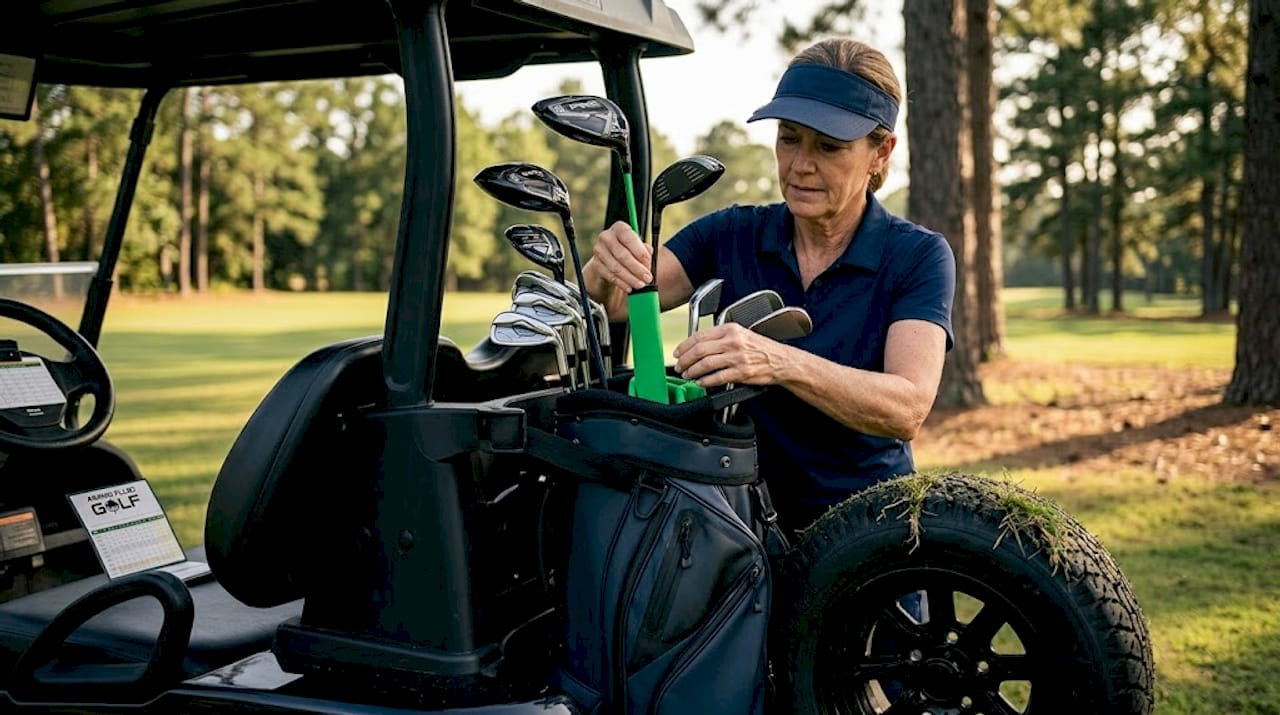
Place woods and hybrids in the top-most divider slots. These are the longest clubs, and top placement protects the shafts from contact with shorter clubs during transport. Load long irons in the mid-zone slots, then short irons and wedges below them. The putter goes in its dedicated well or the designated bottom slot. If your bag supports a low handicap organization guide style layout with each club in its own slot, follow it exactly.
Step 4: Assign accessory pockets by use frequency
The pocket you reach for most often during a round should be the easiest to open one-handed. This is typically where your rangefinder, spare glove, and tees live. Use the fleece-lined or soft-touch pocket for items you cannot afford to scratch.
Step 5: Set up your rain and comfort layer last
Rain gear, extra snacks, and a spare umbrella go into lower pockets or the bag’s base compartment. These items are rarely accessed mid-round but need to be reachable fast when conditions change.
Step 6: Attach your towel externally
A towel jammed into a pocket occupies valuable accessory real estate. Mount it on the bag’s external ring or use a magnetic system to keep it accessible without consuming pocket space.
“If you haven’t touched an item in your last five rounds, consider leaving it out.”
Applying this filter before finalizing your setup is what separates a lean, functional bag from one that gradually reverts to a junk drawer.
Pro Tip: Assign a permanent “home” pocket for your laser rangefinder and never deviate from it. Refer to this faster play workflow resource for additional pocket assignment strategies that reduce search time to near zero.
Troubleshooting common mistakes:
- Overloaded pockets: If a pocket does not close cleanly, it has too much in it. Remove items and redistribute.
- Shared zones with mismatched items: Tees and your phone should never share a pocket. Separate them.
- Neglected bottom buildup: Grass, tee fragments, and broken rubber pieces accumulate fast. Check the base pocket after every round.
How to check your setup and refine your golf bag layering method
After layering your bag, it is important to make sure your system works and continues to match your game.
Signs your setup is functioning correctly:
- You reach for a club and pull the right one without looking.
- Pockets close fully and no items shift noticeably during walking or cart transport.
- You have not searched for a single item mid-round.
- Nothing has fallen out of your bag or been left at a tee box.
Regular organization audits reduce lost gear and improve in-round efficiency, and a systematic pre-round and post-round check is the most reliable way to maintain your layered system over time.
Pre-round and post-round checklist:
- Confirm all clubs are present and in their assigned slots.
- Verify that rangefinder and glove are in their designated pocket.
- Check that the valuables pocket is secured and contains only non-course items.
- Remove any debris or items that crept in during the last round.
- Restock tees, ball markers, and divot repair tools.
Typical frustrations vs. outcomes with layering
| Common frustration | Outcome with layered system |
|---|---|
| Can’t find rangefinder mid-round | Always in the same designated pocket |
| Wrong club pulled in a hurry | Top-to-bottom zone logic prevents misgrabs |
| Towel buried in a pocket | External mount keeps it instantly accessible |
| Valuables mixed with golf gear | Separate sealed pocket eliminates this risk |
| Rain gear hard to reach in weather | Bottom pocket assigned specifically for weather gear |
Adjusting your layers for walking versus cart golf is a practical refinement. Walkers benefit from heavier items (extra balls, rain gear) distributed lower and centered in the bag for weight balance. Refer to the walking golfer organization guide for specific adjustments that address fatigue-related access problems over 18 holes. Cart users can prioritize front-facing pocket access since most bags face outward when loaded onto a cart.
Your towel system organization also plays into this audit process. If you find your towel repeatedly tangled or relocated after each round, that is a signal to switch to an external attachment system rather than treating it as a pocket item.
Pro Tip: Review your layering after every three rounds. Gear needs shift as conditions change or your round format rotates. A brief five-minute reset keeps your system dialed in rather than gradually drifting back to disorganization.
Why most golfers overcomplicate bag organization—and how simple layering beats fads
Here is an honest assessment of something the golf accessory market rarely acknowledges: most bag organization problems do not come from a lack of specialized gear. They come from clutter, inconsistency, and placing too much confidence in gadgets that promise to solve a behavioral problem through hardware alone.
The ultimate game rotation guide makes this point clearly: experienced, low-handicap players typically carry fewer items than beginners, not more. Their bags look minimal because they have done the filtering work. They know exactly what they need for 18 holes and they have assigned it a precise location. There is no bag within the bag, no overflow pocket stuffed with items that “might come in handy.”
Marketing-driven bag add-ons frequently target the organization problem by adding compartmentalization gadgets that sit inside existing pockets. This compounds the issue rather than solving it. You end up with organized chaos: each compartment neatly loaded but the total system still requiring you to remember which sub-compartment holds what.
The layering method works because it is built on spatial memory, not inventory management. When your clubs occupy the same top-to-bottom zones every single round, your hand reaches for the right club before your brain finishes processing the request. That automaticity is what saves time and focus. No app, no color-coded organizer, and no premium insert patch addresses the fundamental requirement: put the same thing in the same place, every time.
“Focus on proven, simple systems — layer your bag and play unfazed by fads.”
The golfers who benefit most from this approach are not the ones with the most sophisticated bags. They are the ones who commit to the system consistently, audit it regularly, and resist the urge to add items because a golf content creator made them look useful. Simple, repeatable layering beats elaborate systems that require sustained mental energy to maintain.
Organize your game with the right accessories
If you’re ready to take your layering system further, the right accessories make the system faster and more durable across rounds.
At Aiming Fluid Golf, the gear is engineered specifically to support systematic bag organization. The magnetic golf towels attach externally to your bag, keeping your towel immediately accessible without occupying a single pocket. The best divot tool options include magnetic attachment designs that clip to a bag ring rather than disappearing into a pocket. Together, these tools reinforce your layered zones rather than disrupting them. Explore the full selection of best golf accessories to find the specific items that align with your bag type and course format.
Frequently asked questions
What is the main advantage of the golf bag layering method?
The layering method saves time and improves focus by ensuring every item is in a predictable location, eliminating mid-round searching entirely.
Can I use the layering method with any golf bag?
Most bags can benefit from layering, but multi-divider or pocket-rich bags provide the most structural support for a systematic zone-based approach.
What accessories are most helpful for layering?
Magnetic towels, valuables pouches, structured divider systems, and magnetic divot tools are the most effective accessories, as towel systems alone can improve bag organization noticeably.
How often should I reorganize my golf bag?
Reviewing your setup every two to three rounds, as recommended in the walking golfer organization guide, keeps the system optimized and prevents gradual drift back to disorganized placement.
Does the layering method really save strokes or is it just about convenience?
Removing the distraction of searching for gear preserves mental focus, and modern organization techniques demonstrate a direct link between bag efficiency and better on-course decision-making.
Recommended
- How to Organize Your Golf Bag Like a Pro: The Peter Finch Method – Aiming Fluid Golf
- Master the golf convenience workflow for faster play – Aiming Fluid Golf
- Golf Bag Essentials Hub: What Every Golfer Should Carry (Beginner to S – Aiming Fluid Golf
- Golf Bag Systems | Stop Losing Gear & Play Faster | Aiming Fluid Golf
- Top 8 UV Protection Clothing for Golfers in Australia 2026


